In this story
A bocadillo is a Spanish sandwich built on a crusty, baguette-style loaf that is cut in half and filled, as a rule, with only one or two ingredients, according to Food Republic. The Spanish Royal Academy’s dictionary derives the word from bocado, a mouthful, which makes the bocadillo literally a small bite. No source fetched for this post gives an inventor or a founding date for the sandwich itself. What the sources do document is a set of fillings, a handful of regional specialties with disputed origins, and one fried-squid version that Madrid treats as its own.
Video: Bocadillo de calamares en la Plaza Mayor de Madrid, un clásico gastronómico | Telemadrid
A small bite, and a speech balloon
The Real Academia Española lists the etymology of bocadillo as a diminutive of bocado. Its first definition describes an open piece of bread, or two slices, with something placed or spread inside, and names sándwich, emparedado, medianoche, bocata and pulga as other words for the same thing. A second definition is a snack that workers and students usually take between breakfast and the midday meal.
The same entry lists senses with no connection to bread: a small portion of food, the bordered space that holds a character’s words in a comic strip, a thin fabric hung between sheer curtains and drapes, and a thigh bruise from a knee strike. The comic-strip meaning shows how far the diminutive has traveled from the table. The UBTERM terminology database of the University of Barcelona pairs bocadillo with the Catalan entrepà and sandvitx and with English sandwich, without ranking the Catalan terms.
Bocadillo against sándwich
The dictionary treats the two words as synonyms. Everyday use in Spain draws a line between them, as Food Republic describes it. A sándwich is made with two slices of sliced bread and tends to be fussier, with fillings such as mayonnaise, lettuce and tomato, olive tapenade or melted cheese, and it is served at sit-down restaurants. The bocadillo is the bar-counter version, cheap, easy to make at home, easy to carry and free of the oils and damp vegetables that make a sandwich messy.
Long split rolls with a single main filling turn up in other countries under city-specific names, a subject covered in the post on hoagie, sub, hero and grinder. The Spanish version differs mainly in how little goes inside.
Jamón, tortilla and tomato
The fillings named by Food Republic read like a short list of Spanish pantry staples. Tortilla española, the omelet of eggs, onion and potatoes, is eaten hot or at room temperature, though the article admits it is harder to manage on the move. Serrano ham with Manchego cheese is a dry pairing that holds together well while traveling. Raw garlic and tomato are rubbed over the inside of the loaf rather than spread as a sauce. Canned or jarred sardines or tuna, sometimes with pickled peppers, round out the list.
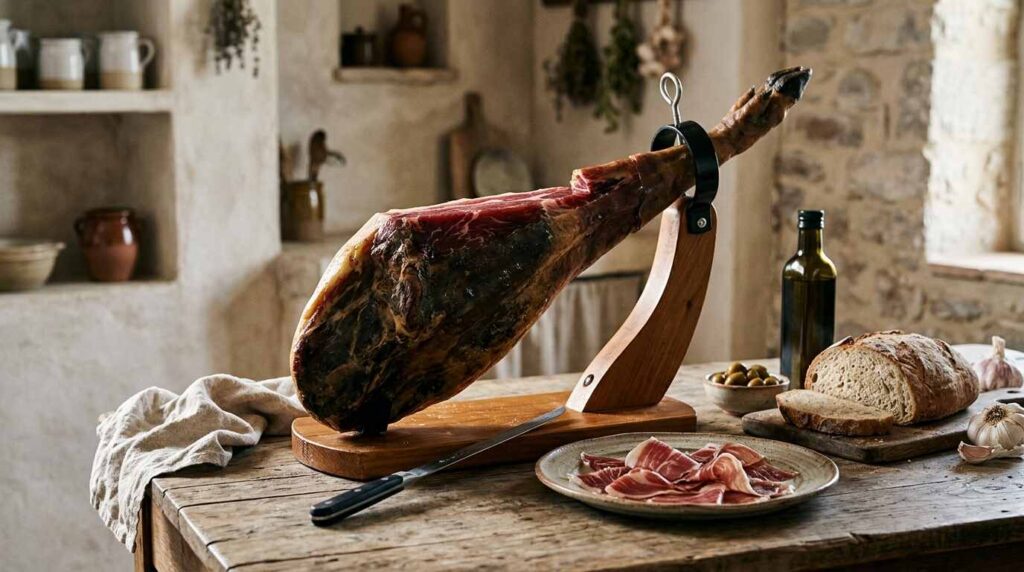
Jamón is the filling most often treated as the standard. InsideHook calls jamón serrano the standard bocadillo, with chorizo, cheese, bacon and tortilla de patatas as other common choices, and reports that bocadillos are sold at bakeries, bars, train stations and rest stops for roughly four to five euros. Chowhound describes a premium route: jamón ibérico from acorn-fed pigs, which it says carries more fat and a nuttier taste than ordinary cured ham, layered on a lightly toasted baguette that has been rubbed with ripe tomato and drizzled with extra virgin olive oil. Pata negra, the black-hoof label, is the most prized version. The same article calls the sandwich an unofficial favorite of Spanish football fans.
The omelet version has its own murky history. Tasting Table says the origins of the tortilla, and so of the sandwich, are murky, that the dish is younger than 500 years because potatoes reached Spain only after the discovery of the New World, and that legends of its birth usually point to Navarra or the Basque Country in the eighteenth and nineteenth centuries. It names Quimet de Horta in Barcelona and Bar Juantxo in San Sebastián as celebrated places for the bocadillo de tortilla.
Pan con tomate and the 1884 reference
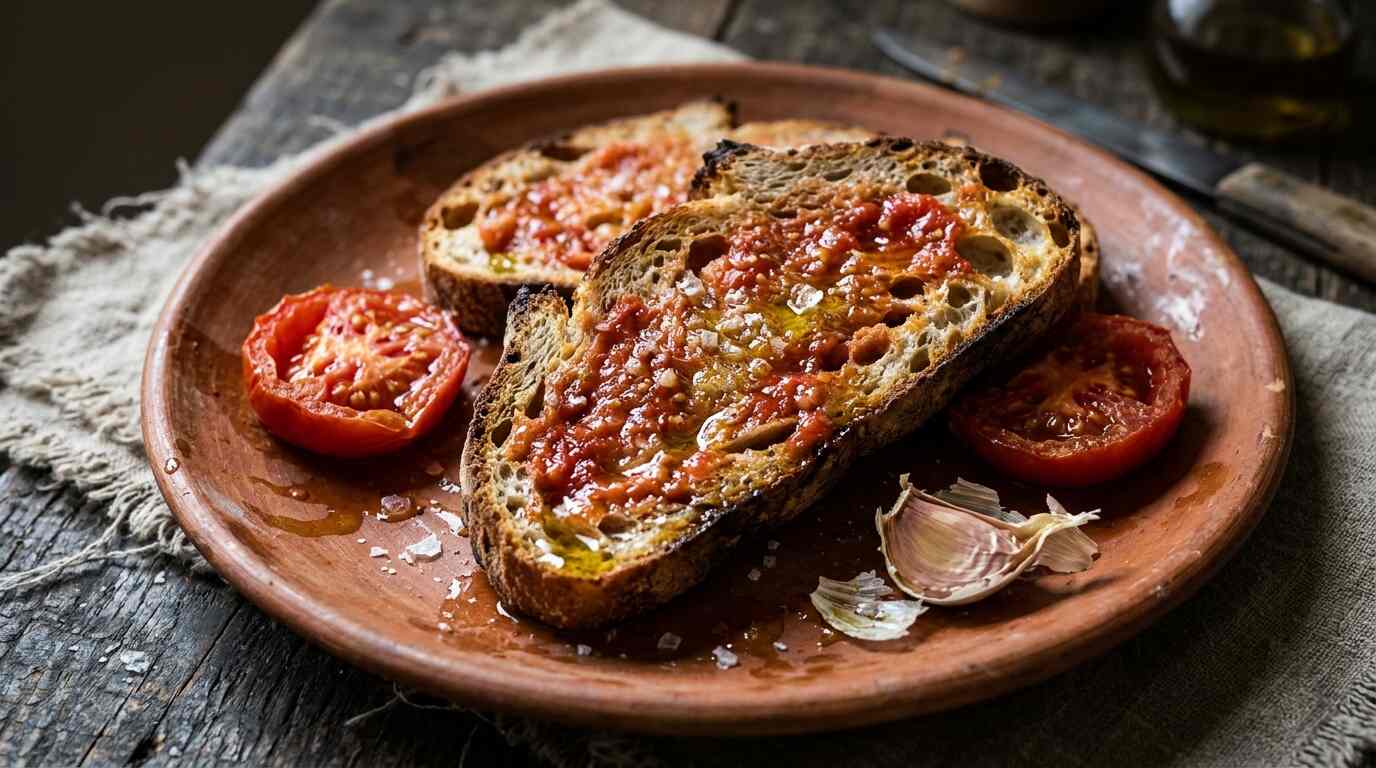
Tomato rubbed on bread is both a bocadillo filling and a dish on its own, and its documented history is thin. Ara, the Catalan newspaper, reports that the earliest cited reference is an 1884 writing by Pompeu Gener, which the paper says is hard to verify in Gener’s own work. The writer Néstor Luján first explained it in a 1984 newspaper article, quoting the line “What we ate one night was bread with oil seasoned with tomato.” The artist Leopoldo Pomés repeated the date in his 1985 book on the subject, and the 1884 claim has largely been accepted on the strength of those two sources. The same article points out that Catalans ate bread with oil and garlic long before tomato joined it.
Pomés laid out an orthodox method. It calls for pan de payés, a rustic country loaf, with tomato spread on both sides to form what he called a “red and substantial varnish”. Salt goes on before the oil, because salt added afterward slides off. Ara also records the disputes: grating the tomato onto the bread counts as a sacrilege for some cooks, as does a brushed-on sauce of crushed tomatoes with skins. City Life Madrid, writing for a Madrid audience, takes the opposite line and offers grated tomato as an alternative method to avoid mess. It says the dish most likely traces back to Catalan farmers who rubbed ripe tomatoes on crusty bread, and it hedges the claim with “likely.”
Mallorca and Ibiza follow a different habit, according to Ara, where tomato is typically sliced and placed between the bread.
Bocadillo de calamares in Madrid
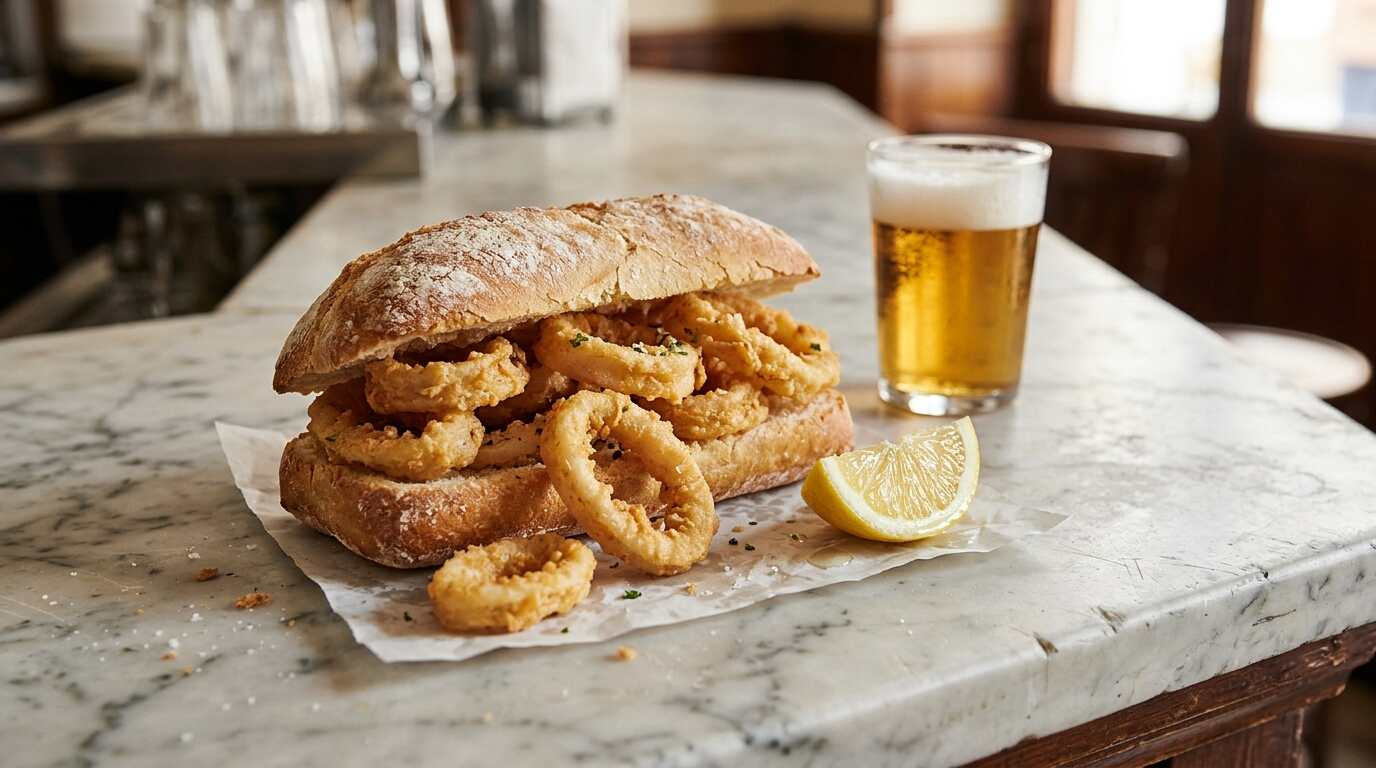
Madrid sits about two hours by high-speed train from the coast, and its best-known sandwich is a heap of fried squid rings in a roll. InsideHook counts the bocadillo de calamares among the few dishes considered native to the city, alongside callos and cocido madrileño. It is a staple of the center, especially around the Plaza Mayor. The sandwich is usually served with lemon and no mayonnaise or tartar sauce, though El Brillante will add condiments on request.
The history offered by sources is part economic and part religious. Hosteltur’s Madrid guide says fish reached the city in the sixteenth century but was not eaten regularly until the eighteenth, and that consumption grew especially from the mid-nineteenth century with the arrival of the railway. It credits Andalusian tavern keepers, skilled at batter frying, with helping to establish the tradition, and notes that squid was valued for its texture and low price. InsideHook quotes Ana Benavente, whose grandfather opened El Brillante, on the Catholic custom of meatless Fridays and holy days, which created demand for fish inland. Frying helped, she says, because “the batter helped to hide it” if the squid had turned.
El Brillante, across from Atocha station, is the sandwich’s best-known address. InsideHook gives its opening as 1952, while Hosteltur says only the 1950s. Alfredo Rodríguez, the founder’s son, uses a half-and-half mix of all-purpose and garbanzo flour and says “Garbanzo flour expels the fat.” Hosteltur reports that on festive days the bar serves more than 2,000 bocadillos. Another Plaza Mayor address, Casa Rúa, claims to sell up to 3,500 in a day, a figure that comes from the owners and is not independently confirmed.
Bread varies by bar. InsideHook says demi-baguettes or hoagie rolls are used, while Hosteltur reports that Los Galayos serves its squid on rustic chapata. Blue Bay Hotels adds that Los Galayos buys squid from Galicia and fries it in mild olive oil.
Regional names and local specialties
Some bocadillos have left the general category and acquired names of their own. In Catalonia, a grilled ham-and-cheese sandwich is called a bikini, a local counterpart of the French croque-monsieur covered in the post on croque monsieur. Xceed, a Barcelona nightlife site, traces the name to 1953 and to Sala Bikini on the Avinguda Diagonal, where the owner imported the French sandwich. Under Franco, the article says, French and English names for Spanish products were forbidden, so customers asked for el bocadillo de la casa, which became “bikini bocadillo” and then “bikini.” The article cites no sources, so the date and the language rule rest on its word alone.
Seville has the serranito, a sandwich of pork loin, serrano ham and a fried green pepper, served with French fries on the side. Fascinating Spain says it is believed to have started in Seville bars around 1970, and that José Luis Cabeza Hernández patented the name about a decade later and opened a restaurant called Serranito. The bread is a viena andaluza or a mollete.
Madrid is traditionally considered the birthplace of the pepito de ternera, a griddled beef steak in a baguette, and two accounts compete to explain the name. Direct al Paladar cites a 1933 text by the historian and cook Teodoro Bardají, in which the son of the founder of the Café de Fornos asked the cook for a hot meat sandwich and customers began ordering one like Pepito’s. A rival story credits a bar called Pepe, whose owner was known as don Pepito, with popularizing the sandwich in the 1950s.
Where tapas end and bocadillos begin
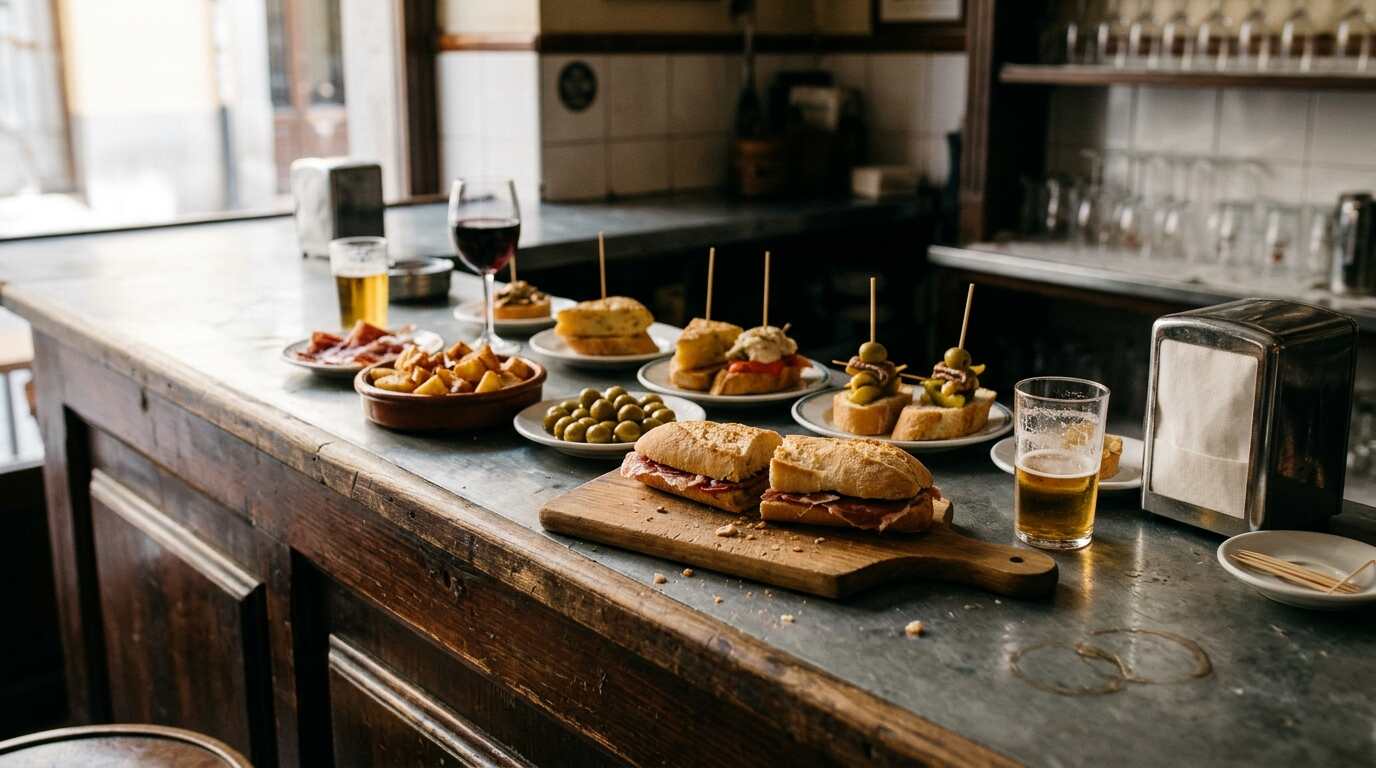
Both are bar food, and the boundary is blurry. SpanishDict defines tapas as small portions of food served with drinks, which can arrive on skewers, on bread, between slices of bread, or on small plates, and gives the word’s origin as tapar, to cover. A popular legend says the first tapa was a cover set over a glass, supposedly to keep flies out, though the guide’s own wording marks that as unconfirmed. Tasting Table describes tapas as “merely smaller servings of regular dishes”, and says pintxos, the Basque form, are held together with a toothpick and were originally built on slices of crusty bread.
The categories overlap in practice. SpanishDict lists the montadito as a tapa sandwiched between two pieces of bread and the tosta as a tapa served on a slice, and it suggests calamares a la romana can be eaten as a mini bocadillo. The sources therefore sort the two by different criteria, a tapa by portion and setting and a bocadillo by its loaf, and none of them draws a firm boundary.
Sources:
- Food Republic, “Why Spain’s Bocadillo Isn’t Just Another Sandwich”: https://www.foodrepublic.com/1759676/what-is-bocadillo-sandwich-explained
- Real Academia Española, Diccionario de la lengua española, “bocadillo”: https://dle.rae.es/bocadillo
- UBTERM, University of Barcelona terminology database: https://www.ub.edu/ubterm/?p=32073
- InsideHook, “The Bocadillo de Calamares Is the Spanish Sandwich That Should Take Over the World”: https://www.insidehook.com/food/bocadillo-de-calamares-spanish-sandwich-recipe
- Chowhound, “This Spanish Sandwich Starts With A Type Of Ham You Won’t Find At Most Delis”: https://www.chowhound.com/2089769/bocadillo-de-jamon-ham-sandwich
- Tasting Table, “Spain’s Bocadillo De Tortilla Is The Ultimate Comfort Sandwich”: https://tastingtable.com/1166314/spains-bocadillo-de-tortilla-is-the-ultimate-comfort-sandwich
- Ara, “X-ray of pa amb tomàquet”: https://en.ara.cat/food/x-ray-of-pa-tomaquet-sacrileges-detractors-and-the-origin-of-this-traditional-catalan-dish_1_5696955.amp.html
- City Life Madrid, “The Spanish Kitchen: Pan con Tomate”: https://www.citylifemadrid.com/the-spanish-kitchen-pan-con-tomate
- Hosteltur, “Madrid responde: bocadillo de calamares”: https://www.hosteltur.com/madrid-responde/es/bocadillo-calamares-madrid
- Blue Bay Hotels, “Madrid’s Calamari Sandwich Route”: https://www.bluebayhotels.com/blog/en/bluebay-gourmet/ruta-del-bocadillo-de-calamares-por-madrid/
- Xceed, “The bikini, a famous ham & cheese sandwich in Catalunya, owes its name to a nightclub”: https://xceed.me/blog/en/the-name-bikini-the-ham-cheese-sandwich-in-catalunya-comes-from-a-nightclub
- Fascinating Spain, serranito: https://fascinatingspain.com/?p=295792
- Direct al Paladar, “Receta de pepito de ternera”: https://www.directoalpaladar.com/recetas-de-carnes-y-aves/receta-pepito-ternera-sencillo-bocadillo-espanol-convertido-todo-clasico
- SpanishDict, “Guide to Spanish Tapas”: https://www.spanishdict.com/guide/guide-to-spanish-tapas
- Tasting Table, “What’s The Difference Between Tapas And Pintxos?”: https://tastingtable.com/1169178/whats-the-difference-between-tapas-and-pintxos
- Telemadrid (YouTube), “Bocadillo de calamares en la Plaza Mayor de Madrid, un clásico gastronómico”: https://www.youtube.com/watch?v=3JnKI3_zECs