In this story
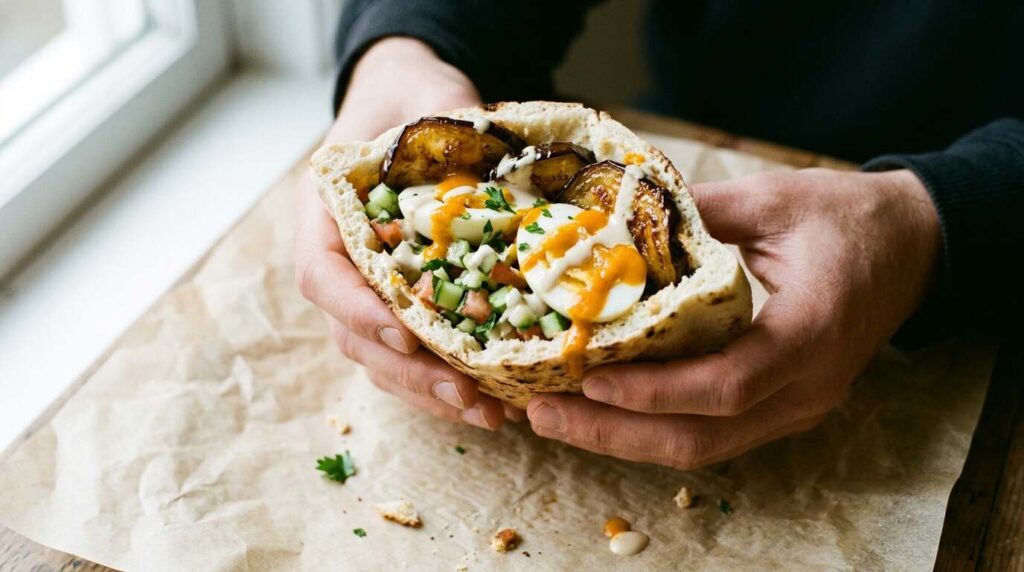
Sabich is a pita sandwich of fried eggplant, hard-boiled egg, salad, tahini and amba, a tangy orange pickled-mango sauce. It descends from the Shabbat morning breakfast of Iraqi Jews, whose components could all be eaten at room temperature, and My Jewish Learning reports that Iraqi immigrants carried that meal to Israel mainly in the 1950s. Nearly everything after that point is argued over: who first sold it in a pita, in which suburb, in what decade, and whether the dish is named for a person, a time of day or a joke.
Video: How to Make Sabich: The Best Eggplant Sandwich Ever | At the Immigrants Table
The Shabbat breakfast behind the sandwich
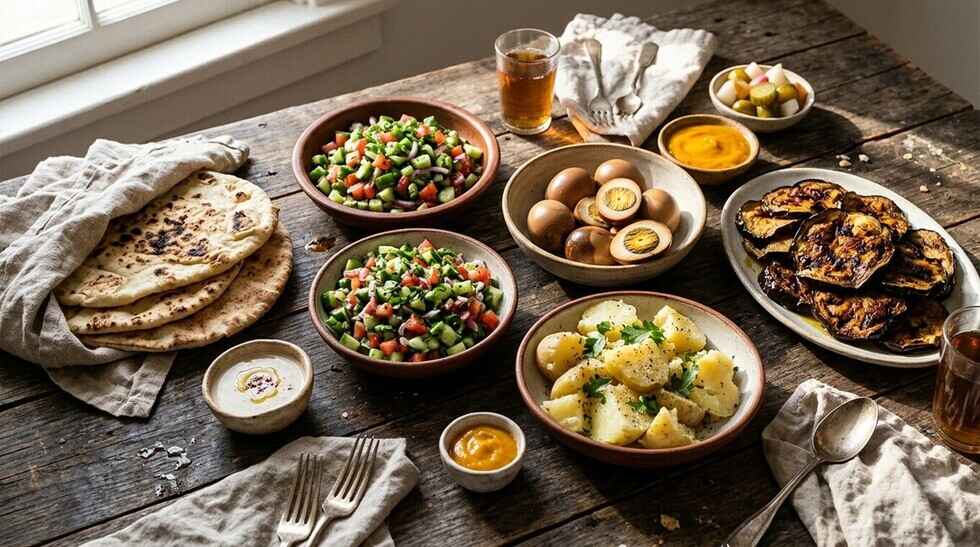
Observant Jews do not cook on Shabbat, so a Saturday meal has to be kept warm from Friday or served at room temperature. My Jewish Learning describes sabich as the classic Shabbat morning breakfast of Iraqi Jews for that second reason, laid out in Iraq as a buffet from which each person chose what to eat. An SBS Food account says the eggplant and potato were prepared on Friday and the eggs cooked slowly overnight, and that families assembled their own plates or sandwiches after returning from synagogue.
The eggs deserve a note. Several sources describe them as brown, slow-cooked eggs rather than the white boiled kind seen in most sandwich shops today. The Forward says the older version used a long-cooked baked brown egg, and a Jewish Journal piece by Noga Gur-Arieh says the traditional eggs are haminados, cooked in a hamin until they darken. Saveur adds that the cold Sabbath meal included long-cooked eggplant, steamed potatoes and hard-boiled eggs.
In Iraq the parts stayed separate. The step of rolling them into a single pita is credited to Israel, and the question of who took it first is where the accounts split.
Sabich Tzvi Halabi and the Ramat Gan kiosk
The best-documented story names a man, not a restaurant. According to the Jewish Independent, Sabich Zvi was born in Baghdad in 1938, made aliyah in the early 1950s and died in 2012. He had worked in an iron molding factory before he bought a small kiosk from an elderly couple at 60 Uziel Street in Ramat Gan, a Tel Aviv suburb, opposite the last stop of the No. 63 bus. Bus drivers and ticket sellers bought bourekas, wafers and drinks there. The drivers asked for something more filling, and he asked his wife, Rina, for the leftover brown Shabbat eggs, which matched the Iraqi family breakfast of eggs, fried eggplant and salads.
A 2026 piece in Ynet gives a fuller timeline, drawn from a Halabi relative and other family members. It dates the kiosk to 1961, on Uziel Street near Bar-Ilan Garden, and says Yaakov Sasson, a close friend, later became his full partner. The pair moved in 1982 to a snack bar at the corner of HaRoeh and Negba Streets, where the business still operates. Ynet says Halabi put the ingredients into one pita where Iraqi custom had put them on a plate, and that he died of ALS in 2012. The Jewish Independent says his widow, Rina, has kept the stand going and comes in each morning to peel eggs or prepare the salad.
The name Tzvi is the Hebrew form that some Iraqi immigrants adopted. The Jewish Food Society says Sabich, a name meaning dawn or first light in the language of Iraqi Jews, was commonly swapped for Tzvi on arrival in Israel. It names the man behind the first stand as Sabich Tzvi Halabi. Spellings of his name vary across sources: Zvi, Tzvi, Sabich Halabi, or Sabich alone.
Dates and rival claims
The Ramat Gan story is not the only one in circulation, and its date shifts depending on who is telling it. Tablet calls Halabi the usual credit for the invention and says he opened what is believed to be the first stand in 1961. The same 2012 article presents Oved Daniel, who serves the sandwich in Givatayim, as the snack’s greatest champion. An older Forward article says that, per legend, the sandwich reached the wider Israeli public in the 1970s when two shops opened in Ramat Gan and Givatayim. The chef Einat Admony recalls two places in the late 1970s, though not as common as sabich is today.
The Jewish Food Society takes a later date still. It says the dish’s rise as an Israeli icon is traced to the 1980s, citing a Haaretz article that was not fetched for this post. That sits uneasily with a 1961 kiosk. One possible reconciliation, which no fetched source states outright, is that the sandwich existed locally for years before it became a national phenomenon. Ynet reports that sabich stands spread across the country in the early 1990s, which fits a slow rise.
My Jewish Learning mentions the rivalry directly. It says the popular tale has a man called Tzvi, nicknamed Sabich, as the first street seller in Ramat Gan, and that the tale probably served to back his claim against his rival Oved from neighboring Givatayim. The article also doubts that Sabich was a common nickname for Tzvi and finds it more plausible that he was given the nickname because of the food, a reading that the Jewish Food Society’s account of Sabich as a given name does not support.
What the name means
Three explanations compete, and sources disagree on which should win.
The first is that the dish is named for Halabi. Tablet notes that others believe the name honors Halabi, and Ynet takes the same position. It says customers asked the couple for “Sabich,” and onlookers assumed that was the name of the food. The same piece rejects the other two theories. A Halabi relative told the paper that the family lost the right to profit from the name, and the article’s headline gives the relative’s complaint as ‘People don’t believe my story’. Ynet reports that the family registered “sabich” as a trademark in the 1980s and paid fees for years, and that no one sued.
The second is Arabic. My Jewish Learning calls the derivation from the Arabic word for morning the most believable, and says it is the most widely cited explanation among food scholars including Gil Marks and Janna Gur, but concludes that the true origin of the name will likely stay uncertain.
The third is an acronym. The Forward and Saveur both report a popular reading of the letters as the Hebrew words for salad, egg and eggplant. Saveur calls it plausible because Modern Hebrew uses acronyms often, but unproven. Tablet reports that Oved Daniel offers a version in which the last word is “more eggplant,” and says it may be a joke. The Forward, in a 2018 article, notes that the children’s-book account of Halabi contradicts the acronym explanation.
Amba and the rest of the sandwich
Most sabich sandwiches share a core of fried eggplant, sliced egg, tahini and amba, in a pita or sometimes a laffa. Saveur lists hummus, pickles and Israeli salad as usual additions, and SBS notes that boiled or fried potato chunks are common. Optional heat comes from zhug, a Yemeni hot sauce, per SBS, or harissa, per My Jewish Learning, which also notes that some cooks add bulgarit, a Bulgarian cow’s milk cheese similar to feta.
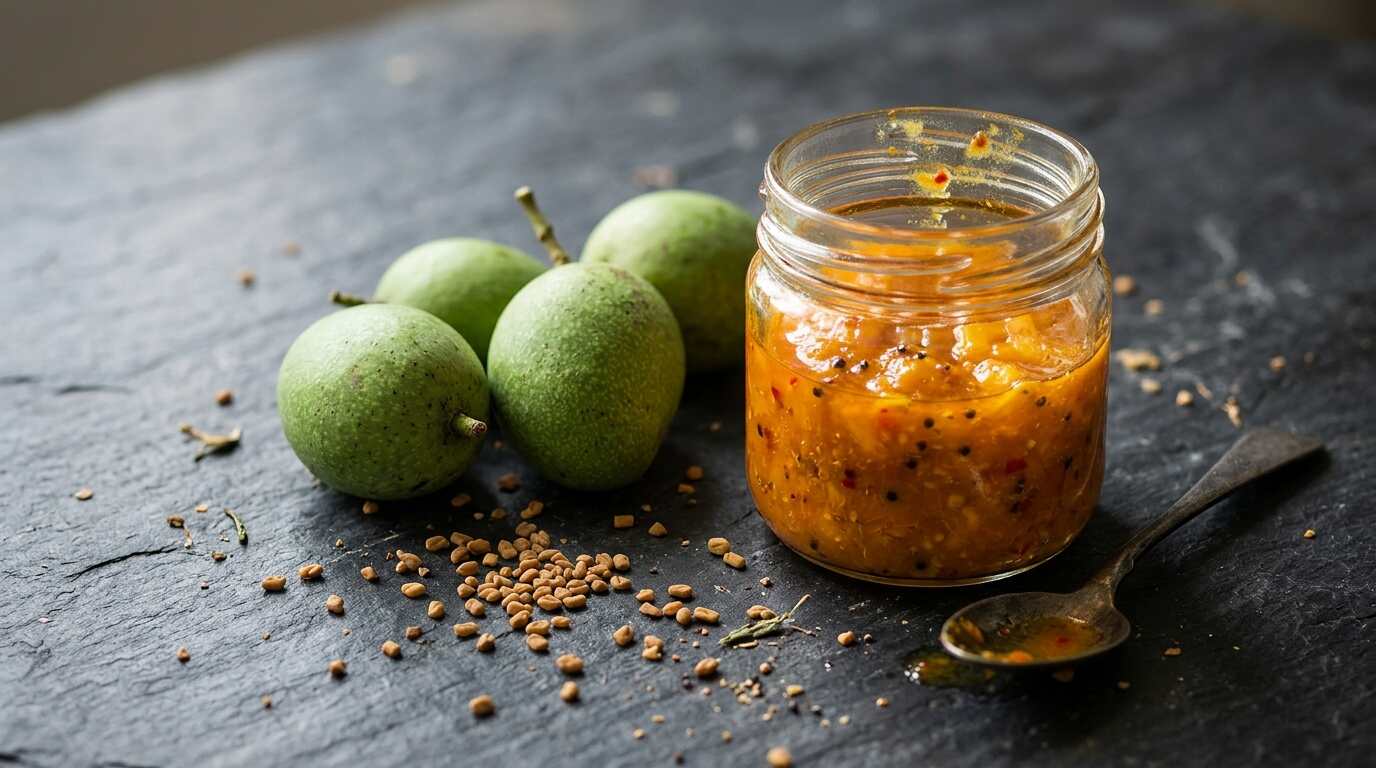
Amba, the orange sauce, has its own history. Another My Jewish Learning article reports a legend that the Sassoon family, wealthy Iraqi Jews living in Bombay, invented it in the late nineteenth century, modeling it on Indian mango chutneys and sending barrels of vinegar-soaked mangoes to Iraq, where the fruit was unknown. The word comes from the Marathi word for mango. Amba uses unripe green mangoes, which makes it tangier than the sweeter Indian versions, and its flavor comes from fenugreek, vinegar, turmeric and mango. Saveur tells a similar story at lower resolution: Iraqi Jewish traders had close ties with India, and mango chutney was imported to Iraq, where locals added fenugreek, mustard and chili.
The two accounts are not identical. The Sassoon barrels are presented as legend, and Saveur names no inventor. Both agree that amba reached Israel with Iraqi immigrants and that it balances the richness of oil-fried eggplant and egg. A chef quoted by SBS, Shuki Rosenboim, says that “nothing can compete” with amba, fried eggplant and tahini together.
The eggplant itself is usually sliced about a centimeter thick, salted for ten minutes, pressed dry and shallow-fried until golden, per SBS. Layering matters as much as the frying. Itay Aricha, who opened a sabich shop on Jerusalem’s Agrippas Street in 2014, says in the Forward’s 2018 article that frying eggplant and baking pita are easy, and proper layering separates good sabich from poor.
Iraqi dish or Israeli invention
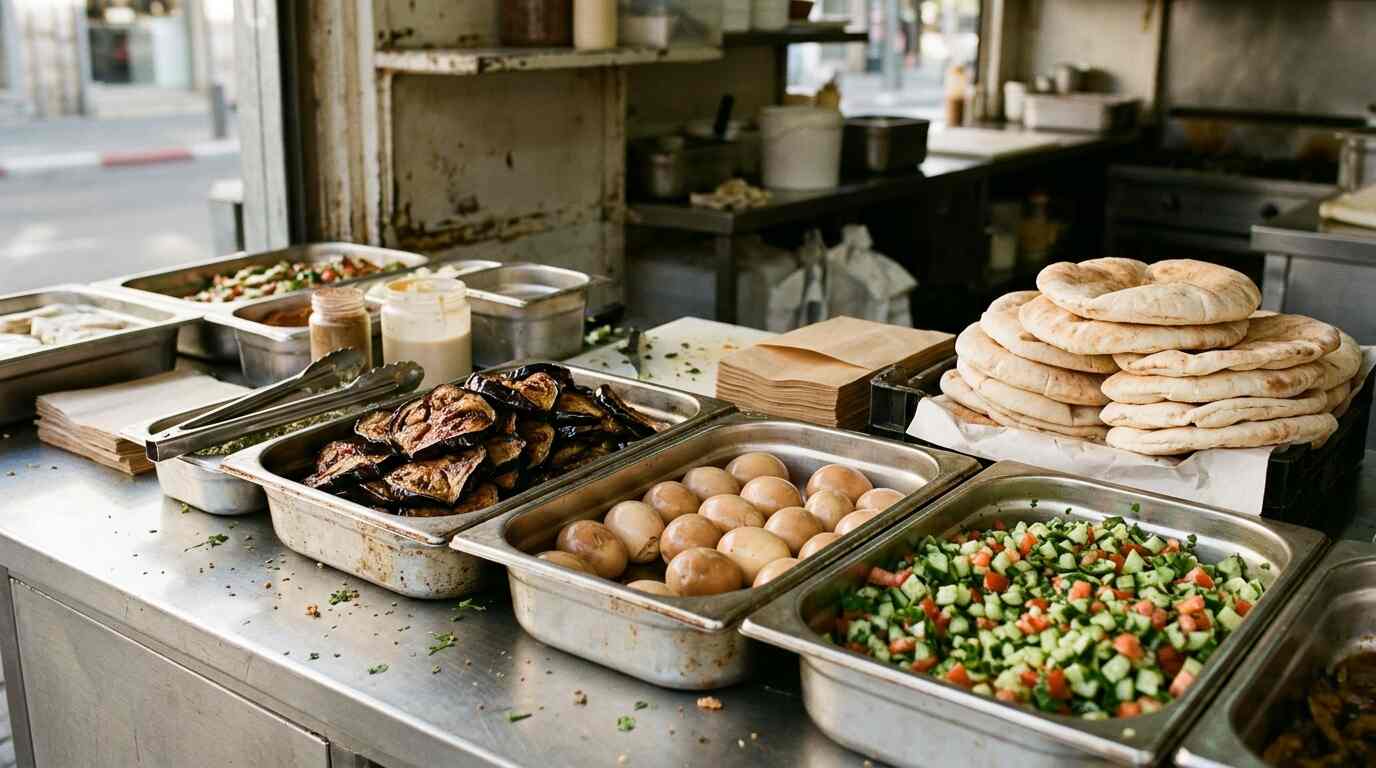
Whether sabich is an Iraqi dish at all is a live question. Udi Goldschmidt, chairman of the Israeli Association for Culinary Culture, says in the Forward’s 2018 article that the Iraqi origins of the proto-sabich are unclear and that it appears to have grown up in Israel. He points out that eggplant is in season year-round in Israel and that eggs were cheap during the state’s early food rationing. Tablet takes a similar view, calling the sandwich a local Israeli invention, unlike hummus and falafel, which it describes as Arabic dishes that Israelis adopted and exported, and describing the pita-wrapped version as entirely Israeli.
Others emphasize the debt to Iraq. Saveur describes an Iraqi-Israeli hybrid, notes that Israeli fluffy pita replaced the traditional Iraqi flatbread, and says European-style cucumber pickles and hummus were added in Israel. The Forward’s 2018 article also places sabich in the broader argument over who owns Middle Eastern food, in which Israelis and Palestinians each claim dishes such as falafel and hummus, though it presents sabich as largely outside that quarrel.
The dish has since been reworked in both directions. Chef Michael Solomonov, in a book quoted by My Jewish Learning, calls it “the world in a pita”. The cafe Aroma serves it on sliced bread. Adom, a restaurant at Jerusalem’s First Station, serves a deconstructed version with roasted eggplant, whole chickpeas in place of hummus, amba as an aioli and a poached egg. In the United States, Admony’s Taim and Solomonov’s Dizengoff offer their own. Admony said in the Forward’s older article that every falafel place in Israel now sells sabich as well, and that some small places sell nothing else.
Sources:
- My Jewish Learning (The Nosher), “One of Israel’s Most Popular Street Foods Has a Fascinating Jewish History”: https://www.myjewishlearning.com/the-nosher/one-of-israels-most-popular-street-foods-has-a-fascinating-jewish-history/
- My Jewish Learning (The Nosher), “Meet Amba, the Funkiest Jewish Condiment”: https://www.myjewishlearning.com/the-nosher/meet-amba-the-funkiest-jewish-condiment/
- SBS Food, “Sabich is an addictive Iraqi-Jewish breakfast sandwich”: https://www.sbs.com.au/food/article/2020/09/03/sabich-addictive-iraqi-jewish-breakfast-sandwich
- The Forward, “Sandwiches of Israel: The Divine Sabich”: https://forward.com/food/132074/sandwiches-of-israel-the-divine-sabich/
- The Forward, “No ‘Cultural Genocide’ Here: An Israeli Sandwich Stays Out Of Hummus Wars”: https://forward.com/food/393320/no-cultural-genocide-here-an-israeli-sandwich-stays-out-of-hummus-wars/
- Jewish Journal, Noga Gur-Arieh on sabich: https://jewishjournal.com/blogs/israelife/164129/
- Saveur, “Hybrid Power: The Iraqi-Israeli Sabich”: https://www.saveur.com/article/Travels/Israel-Sabich-Sandwich/
- Jewish Food Society, “When your father shares a name with a national dish”: https://jewishfoodsociety.org/stories/when-your-father-shares-a-name-with-a-national-dish
- The Jewish Independent, “Sabich Zvi: The man who gave birth to an Israeli street food icon”: https://thejewishindependent.com.au/sabich-zvi-man-gave-birth-israeli-street-food-icon
- Ynetnews, “‘People don’t believe my story’: How Israel’s beloved sabich was born”: https://www.ynetnews.com/food/article/b1slrd7mfl
- Tablet, “Egging on Sabich in Israeli Cuisine”: https://www.tabletmag.com/sections/news/articles/egging-on-sabich-in-israeli-cuisine
- At the Immigrants Table (YouTube), “How to Make Sabich: The Best Eggplant Sandwich Ever”: https://www.youtube.com/watch?v=KKtSI_ceM3U