In this story
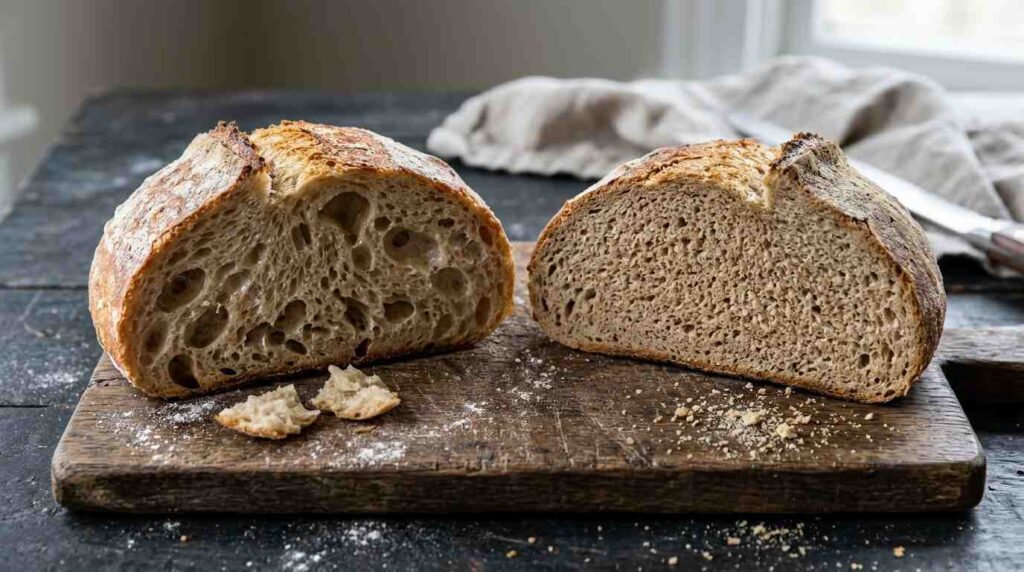
Bread goes stale mainly because its starch re-forms crystals as the loaf cools and ages, not simply because it dries out. The hardening starts while the loaf is still cooling, and a loaf sealed in plastic firms up even though it loses little water. A 2014 review in Comprehensive Reviews in Food Science and Food Safety, Bread Staling: Updating the View, opens by calling staling “cause of significant product waste in the world” and confirms “the central role of amylopectin retrogradation and water redistribution,” while admitting the phenomenon “has not been fully elucidated so far.”
Video: How To Bring Stale Chips And Bread Back From The Dead | Reactions (American Chemical Society)
Crystals, not just dryness
Baking swells the starch granules in dough with water and breaks up their ordered structure. In a short explainer, Don Mercer of the University of Guelph’s food science department says that as bread cools, the swollen, amorphous starch molecules gradually realign into an organized crystalline structure, a process called retrogradation. BBC Science Focus puts the contrast in one line: recrystallization, not drying, is what makes bread go hard, and it happens even in humid conditions.
Two sugar-chain molecules make up wheat starch, amylose and amylopectin. Cosmos magazine says the interlocking structure of amylopectin traps water after baking and slowly loosens, which firms the loaf. Science ABC’s account gives both molecules a part, saying the amylose and amylopectin chains slowly realign and re-form crystals. The research literature divides the work unevenly. The 2014 review names amylopectin as central, and it notes mixed evidence on amylose: waxy wheat flours, which lack amylose, slowed the first phase of retrogradation in some studies, softened bread on day one without slowing later staling in another, and showed no significant difference in a third.
Where the water goes
If dryness were the whole cause, sealing the loaf would stop staling. It does not, and the explanations for the water involved differ by source.
James BeMiller, an emeritus professor of food science at Purdue, told Scientific American that starch crystals need water to form and take it from the gluten, which changes the bread’s network and makes it rigid at room temperature and below. BBC Science Focus describes the water as moving out of the starch as it cools. Science ABC says the water is not lost at all, becoming bound in the new crystals and migrating from the crumb toward the crust.
The full text of the 2014 review lists three main causes: changes in the starch, starch-gluten interactions and redistribution of moisture. It cites one study using differential scanning calorimetry that found freezable water falling and unfreezable water rising as bread aged, which the authors linked to water moving from crumb to crust. The review also notes that the mechanism “has not been well established,” and one cited team suggested hardening may involve more than starch crystallization or water loss.
A moisture-loss figure sits in a 2021 storage study in the journal Foods. Alpers and colleagues measured pan wheat bread and mixed-type sourdough under four conditions, and moisture loss ranged from 10.3 percent in a paper bag to 3.5 percent in a plastic bag for the wheat loaf at room temperature. Firmness rose in every condition, including the one with the least drying.
Why the refrigerator is the wrong place
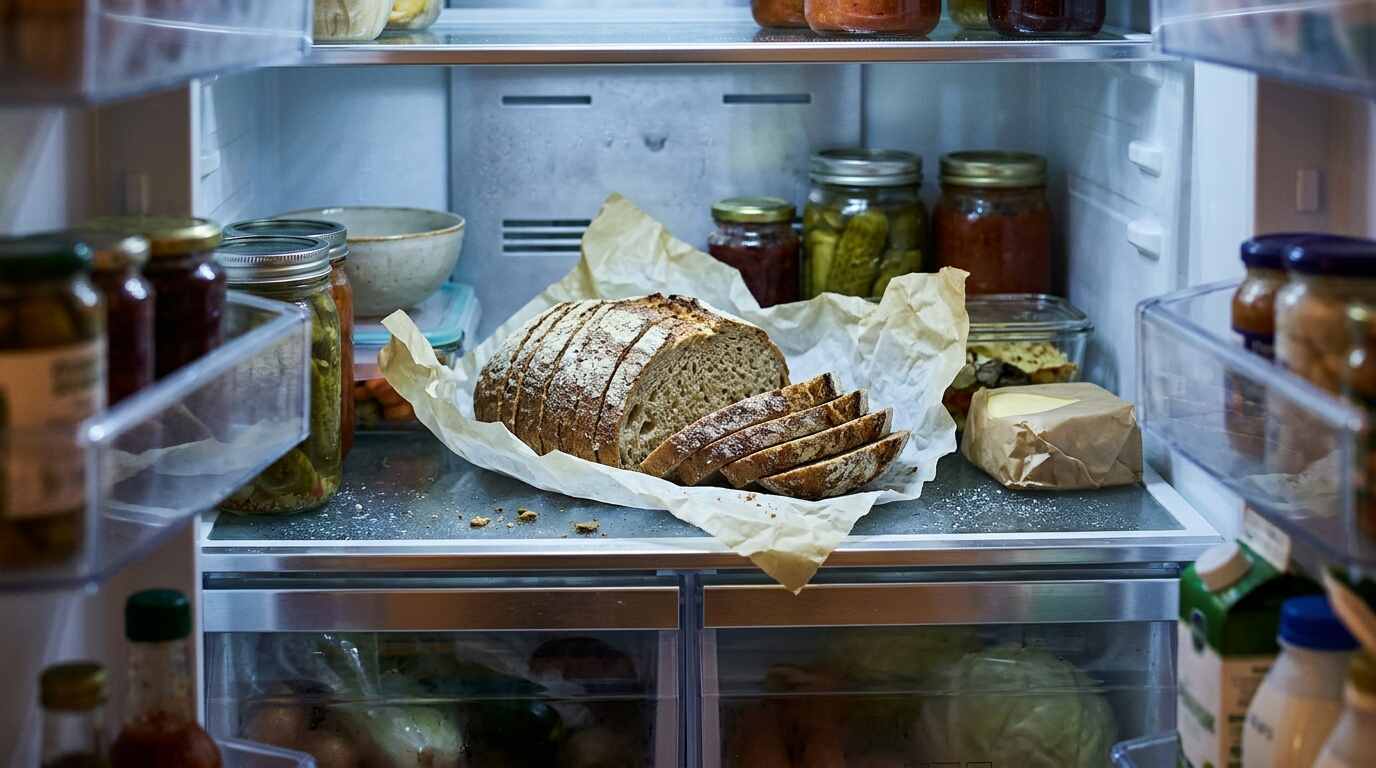
The common advice to keep bread out of the refrigerator has a physical basis. Mercer’s Guelph piece says refrigeration at about 4 °C speeds staling because cold lets starch re-form crystals faster, so refrigerated bread stales sooner than bread left at room temperature. BBC Science Focus agrees that recrystallization is quicker at cooler temperatures, apart from below freezing. Science ABC says retrogradation peaks between 0 °C and 8 °C.
The full review states the relationship as a negative one between storage temperature and staling rate, citing a study that compared 12.5 and 31.5 °C over four days. A Chowhound article on bread storage reports that a 2021 study, which its author does not name, found sourdough in a plastic bag in the fridge went stale 68 percent more than the same bread bagged on the counter, and wheat bread 34 percent more. The Alpers paper is likely the study meant, though Chowhound does not say so, and the figures in the paper’s own table are less tidy than that.
In that table, wheat bread kept in a plastic bag at 8.2 °C firmed at 0.41 newtons per day against 0.29 for the same bag at room temperature, a clear increase. Sourdough went from 0.92 to 1.38 newtons per day, again higher in the cold. On the normalized scale the cold bag also came out higher for both breads, 0.37 against 0.26 for wheat and 0.36 against 0.24 for sourdough. The 8.2 °C condition lost little moisture, 3.1 percent for the wheat loaf, so the faster firming did not come from drying. The test used a cold room temperature of 8.2 °C in a plastic bag, close to refrigeration but not a refrigerator, and cold storage did not help in any of the four comparisons.
Not every source pins the same temperature range. The Chowhound piece cites a report that bread-concentration starch undergoes retrogradation anywhere between 23 °F and 140 °F, which means staling proceeds at room temperature too, only more slowly. At room temperature, the same article says, bread still goes stale within a few days.
Cooling method matters before the loaf is ever stored. The review cites a study in which vacuum-cooling a loaf increased moisture loss, crumb hardness and the heat needed to melt the amylopectin crystals, compared with conventional cooling. Many firming studies, the authors add, fit the hardening curve with the Avrami equation, a model of how crystals grow over time. That model describes the pace of hardening and does not explain it.
Storage at room temperature
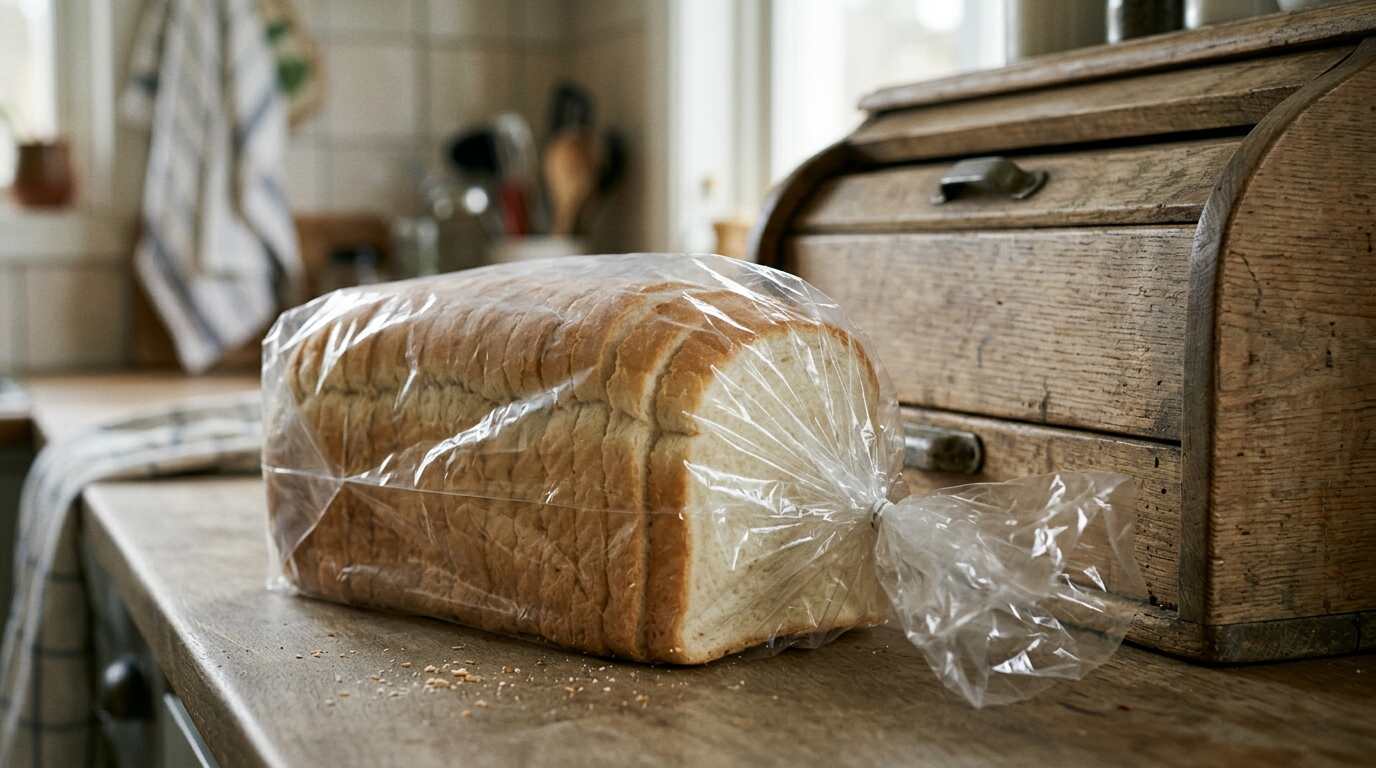
Within the Alpers study, the plastic bag and the bread box gave the slowest firming for pan wheat bread. The normalized rates were 0.26 and 0.24 newtons per day, against 0.46 for a perforated paper bag. Sourdough behaved differently in absolute terms: it firmed faster than the wheat bread under every condition, at 0.92 newtons per day in a plastic bag and 1.27 to 1.30 in a bread box or paper bag.
Crust adds a complication that none of the physics sources settle. Chowhound’s storage article says plastic bags suit soft breads, while crusty breads do better in a bread box, which keeps the crust crunchy even though the loaf stales a little faster. That is a trade between crumb and crust, and the sources describe it as a preference, not a measurement.
Freezing
Cold below freezing behaves differently from refrigeration. Mercer writes that freezing at about -20 °C or lower is sufficient to “almost halt” recrystallization, and that thawed bread is not as soft as fresh bread but is better than bread kept in the refrigerator. Science ABC puts the halting point at about -8 °C. The 2014 review adds a caution from a study at -18 °C: water movement was very limited and water activity stayed nearly constant for 23 days, but recrystallization slowed without stopping.
The Eat Your Books blog reports that Serious Eats writer Dan Gritzer tested storage temperatures and wrapping, and that freezing slows staling considerably. The Serious Eats article itself was not fetched, so the details of those tests are not reproduced here. Chowhound’s storage article recommends freezing a loaf before it goes stale if it will not be finished in a week, then toasting slices straight from the freezer or letting the whole loaf come to room temperature.

Reheating and the limits of a cure
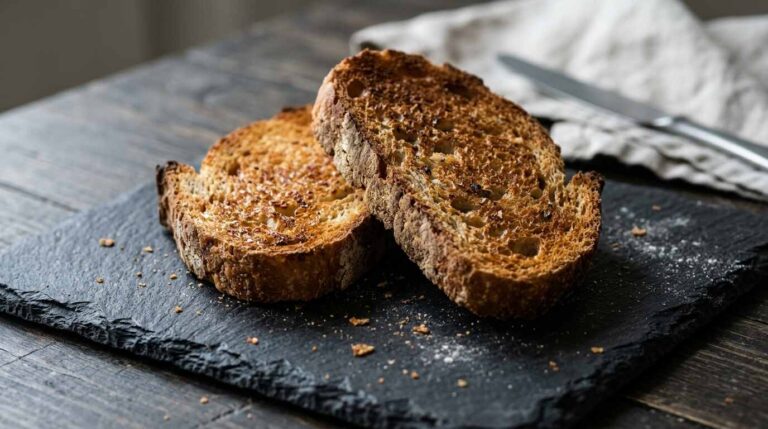
The American Chemical Society’s Reactions team made a short video on the chemistry of staling, including the part starches play and ways to revive bread. Because the crystals are not permanent, heat can undo them for a while. Mercer says toasting or warming stale bread in an oven adds energy that loosens the crystals and softens the bread until it cools again. The same article places starch gelatinization at roughly 60 to 65 °C. Cosmos magazine gives a practical figure of reheating stale bread in an oven at 60 °C, and BeMiller’s quote in Scientific American agrees that stale bread can be freshened by warming it, as in toasting. The Eat Your Books summary of the Serious Eats tests adds that well-wrapped stale bread revived in the oven comes back “much closer to its original glory.”
Science ABC gives another method, wrapping the bread in a damp towel and microwaving it on high for about 10 seconds with close attention to avoid overcooking or fire. That advice comes from a single source and was not tested against the others.
The refresh is temporary, because the crystals form again on cooling. The industrial answer is chemical. The 2014 review catalogs ingredients that delay staling: a maltogenic alpha-amylase that trims the outer branches of amylopectin so the leftover chains are too short to crystallize, xylanase cocktails that delayed staling for up to 10 days at 4 °C in one study, and saturated monoglycerides that lowered crumb firmness in another. Those results come from lab and bakery studies, and the review itself calls the mechanism incompletely understood.
Sources:
- “Bread Staling: Updating the View,” Comprehensive Reviews in Food Science and Food Safety, 2014 (abstract record): https://iris.uniss.it/handle/11388/60525
- “Bread Staling: Updating the View” (full text, CORE): https://core.ac.uk/download/80858684.pdf
- Don Mercer, University of Guelph, “The Complexities of Bread Staling”: https://iufost.org/iufostold/wp-content/uploads/2017/04/66-The-Complexities-of-Bread-Staling.pdf
- BBC Science Focus, “Why does bread go stale?”: https://www.sciencefocus.com/science/why-does-bread-go-stale/
- Scientific American, “Why does food get stale over time?”: https://www.scientificamerican.com/article/experts-why-does-food-get-stale
- Cosmos Magazine, “How to rejuvenate stale bread and crunchless crisps”: https://cosmosmagazine.com/science/chemistry/how-to-rejuvenate-stale-bread-and-crunchless-crisps
- Science ABC, “Why chips soften but bread hardens”: https://www.scienceabc.com/eyeopeners/why-chips-soften-but-bread-hardens-staling-moisture-starch-unstale.html
- Alpers et al., “Impact of Storing Condition on Staling and Microbial Spoilage Behavior of Bread and Their Contribution to Prevent Food Waste,” Foods, 2021: https://www2.mdpi.com/2304-8158/10/1/76
- Chowhound, “Why The Fridge Should Be Your Last Choice For Storing Bread”: https://www.chowhound.com/1572579/never-store-bread-in-refrigerator
- Eat Your Books, “Why refrigerators are bad for bread”: https://www.eatyourbooks.com/blog/2023/02/28/why-refrigerators-are-bad-for-bread
- American Chemical Society via EurekAlert!, release on the Reactions staleness video: https://www.eurekalert.org/news-releases/881403
- Reactions (YouTube), “How To Bring Stale Chips And Bread Back From The Dead”: https://www.youtube.com/watch?v=W_n1uWBqjs8