
In this story
Katz’s Delicatessen sits on the corner of East Houston and Ludlow Streets on Manhattan’s Lower East Side, and its official website greets visitors with the line “A New York institution since 1888.” The deli is known for house-cured, hand-carved pastrami and corned beef, a ticket-and-counter system that has outlasted most of its neighbors, and a scene in a 1989 film that still draws diners to one particular table. Its founding date has been debated by historians, and the debate is part of the story.
Video: How Katz’s Deli Serves 70,000 Pounds Of Meat A Week | Full Service | Insider Food
From Iceland Brothers to Katz’s
Katz’s own history, published on its catering site, begins in 1888, when the Iceland brothers opened a small deli called Iceland Brothers on Ludlow Street. Willy Katz arrived in 1903 and the store became Iceland & Katz. In 1910 his cousin Benny joined, bought out the Icelands, and the business took the name Katz’s Delicatessen. Harry Tarowsky, an immigrant from the same hometown, became a partner in April 1917.
The deli later crossed the street to its present address. The Tenement Museum’s account says the move came because of subway construction, and that the lot once held barrels of meat and pickles before a storefront went up between 1946 and 1949. The Tenement Museum describes Iceland Brothers as a small kosher deli. Tasting Table notes that Katz’s is not kosher today, which is why meat and cheese can share a sandwich.
What the record says about 1888
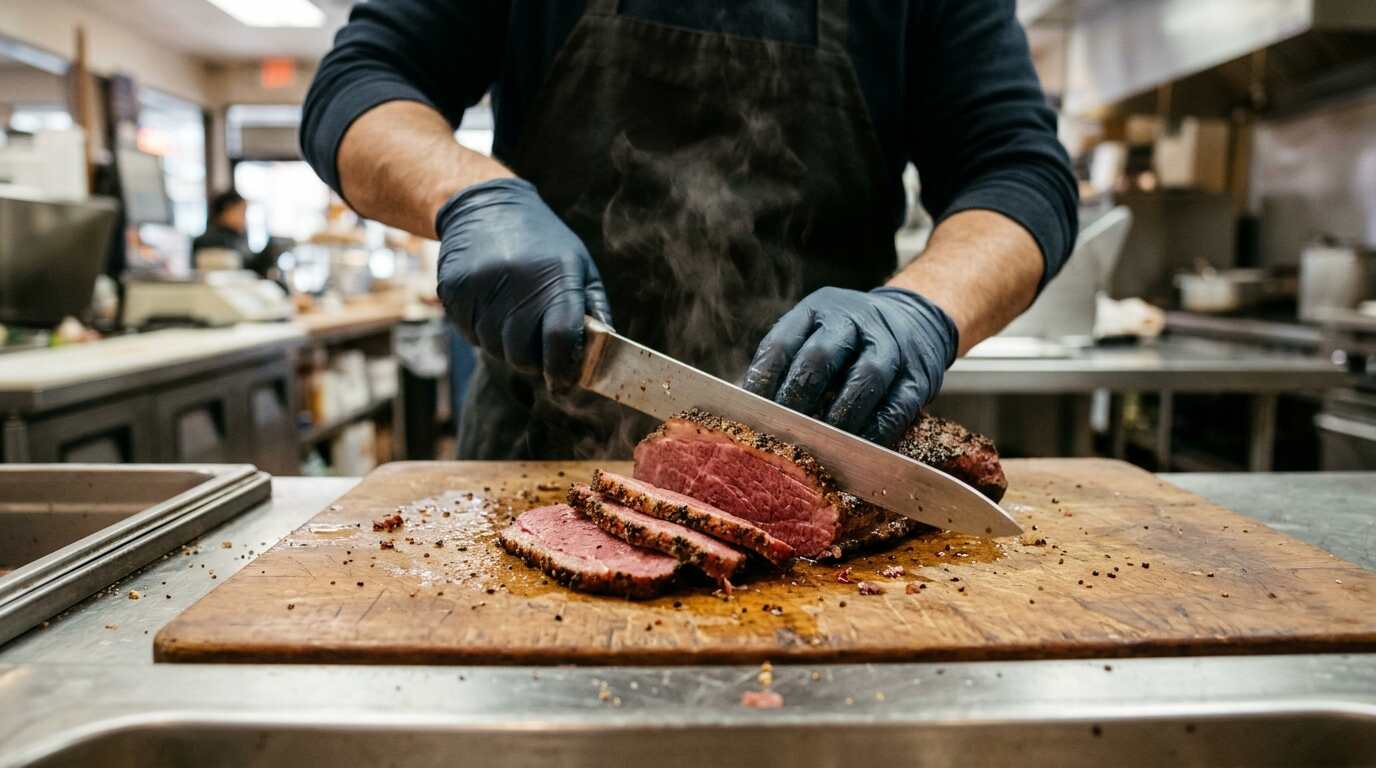
Historians who checked the early city records arrive at a later date. Henry Sapoznik, writing from census returns and directories, finds that Hyman and Morris Iceland arrived in the United States around 1900. He reports that a 1903 Sanborn fire map shows a Chinese laundry, not a deli, at 210 East Houston Street, and that a 1915 directory lists “Eisland and Katz” at 207 East Houston Street. In his reading, the first documented “since” date on the business is 1900, in a 1943 telephone directory ad. The 1888 figure first appears in print, he says, in Craig Claiborne’s April 25, 1961 review, after 1950s signs that read “since 1898.”
Robert F. Moss reaches a similar place by a different path. His essay on how old Katz’s is finds the Icelands arriving around 1902 and a 1911 directory entry for “Iceland Hyman delicatessen” at 207 East Houston, across Ludlow Street from the present building. He concludes that the deli was most likely founded around 1911, and adds that even on that count Katz’s is more than a century old.
The Daily Meal, surveying American delis, could not locate the founders in the 1888-89 New York directory and quotes Dickinson College’s Ted Merwin: “We may never know which Jewish delicatessen was the first to open in New York.” The deli’s own materials keep 1888, and the sources do not settle which date is right. Every account agrees on the street, the families and the unbroken run of the business.
The Daily Meal’s survey places the deli in a wider field. It names Sprague’s Delicatessen in St. Louis, whose 1884 newspaper ad predates Katz’s claimed founding and which closed in 1891, and Fossati’s Delicatessen in Victoria, Texas, which opened in 1882 and which the survey identifies as the oldest deli still operating in America. Tasting Table’s profile, by contrast, calls Katz’s the oldest deli in New York City and the oldest continuously operating deli in the country.
Those claims rest on different yardsticks: first use of the word “deli,” earliest documented ownership, or the date the business names for itself. What all the sources share is the place: directories from 1911 and 1915 put a delicatessen at 207 East Houston Street, across Ludlow Street from the current building.
A deli in a neighborhood of immigrants
The Lower East Side around Houston Street was largely Yiddish-speaking and Jewish when the deli took shape, and the Tenement Museum describes a tight-knit immigrant community centered on places like Katz’s. Franks and beans were a Friday tradition in the early twentieth century, according to the deli’s history, and Tasting Table says the early deli served neighborhood dinners on Fridays and was a gathering place for the immigrant community.
The museum calls Katz’s a remaining “vestige” of an earlier era in a neighborhood that has changed greatly. Fordham University Press marked the deli’s 125th anniversary in a June 2013 post, saying it had “survived three depressions and two World Wars” and still serves bagels, lox and cream cheese beside the pastrami.
Sapoznik’s research adds a human detail to the early partnership. The man known as William or Willy Katz was born Zev Wolf Katz and, by his account, arrived in the United States in 1905. By 1910 he was living as a boarder in Hyman Iceland’s household and working in the delicatessen. After Katz took over in 1917, Sapoznik writes, the Icelands left the restaurant business: Hyman went into real estate and Morris moved to Saratoga Springs in 1920.
Ownership follows a chain of relatives and partners. The deli’s history says Willy Katz’s son Lenny took over after his father died. In the late 1970s, Benny Katz and Harry Tarowsky died, and their heirs, Artie Maxstein and Izzy Tarowsky, ran the store. The Tenement Museum places the deaths of Lenny Katz and Harry Tarowsky in 1980, with the business passing to Lenny’s son-in-law and Harry’s son, so the sources differ on who died when.
On the store’s hundredth anniversary in 1988, according to the same history, Martin Dell, his son Alan, and son-in-law Fred Austin bought into the partnership. Alan’s son Jake joined in late 2009 and oversees major operations. Tasting Table reports that Jake Dell runs the deli today.
Send a Salami to Your Boy in the Army
During the Second World War the owners had three sons in the armed forces, and the family habit of mailing food to them turned into a slogan: “Send A Salami To Your Boy In The Army.” The Tenement Museum attributes the phrase to the Tarowsky family. Tasting Table says the slogan became well known and cites The New York Times for it.
The motto outlived the war. Fox News, in a profile of the deli, repeats it as the wartime motto, and the deli’s homepage today advertises nationwide shipping.
The pastrami and the counter
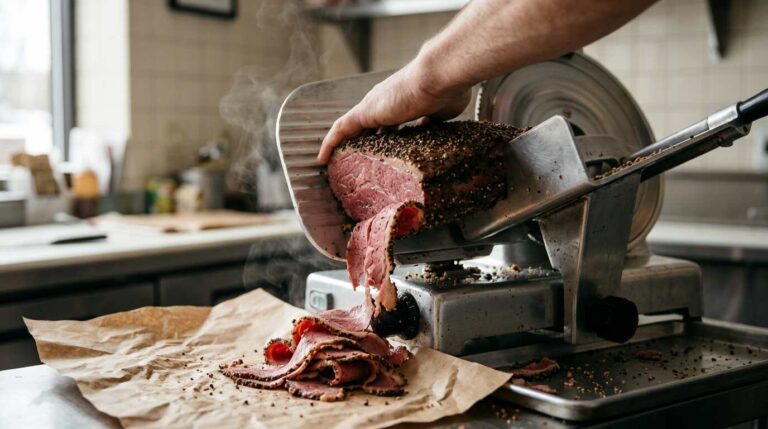
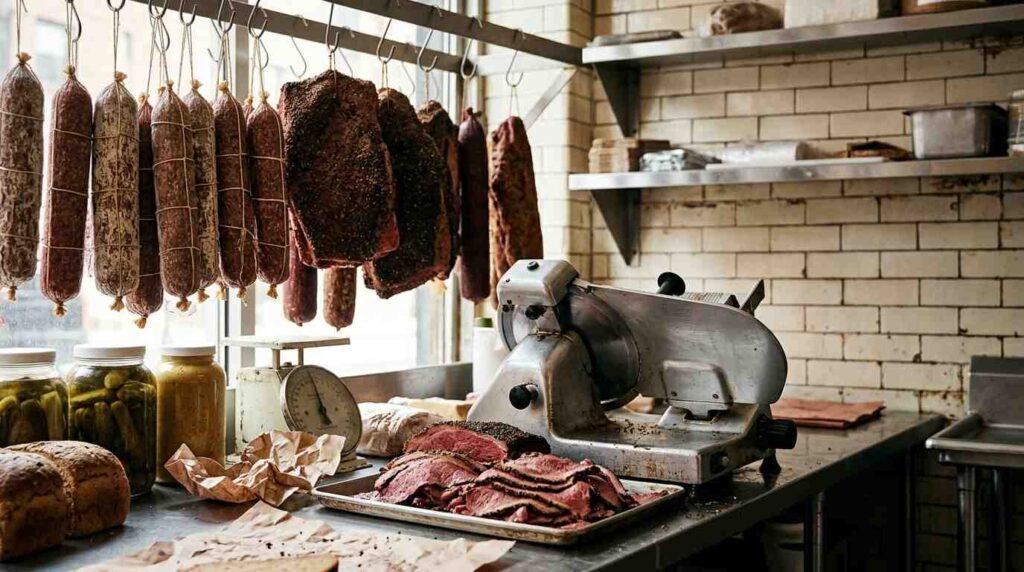
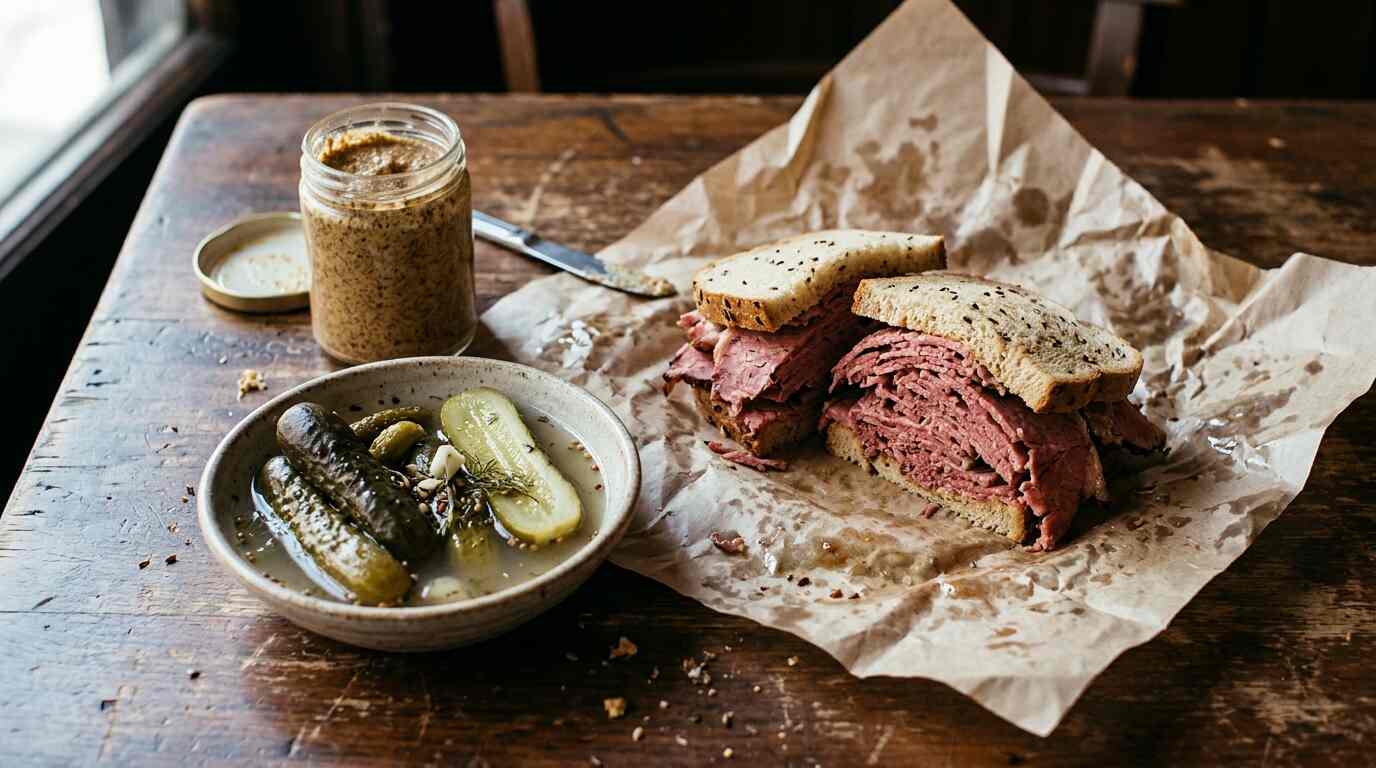
The signature order is pastrami on rye. Katz’s says it selects premium beef and cures its pastrami and corned beef slowly, without injected chemicals, water or other additives. Curing can take up to 30 days, according to the deli, against about 36 hours for pressure-injected commercial versions. The homepage describes the meat as “legendary house-cured, hand-carved pastrami & corned beef,” and the pastrami sandwich was listed there at $28.95 when the page was read for this post.
Volume is a point of pride. Both Tasting Table and the Tenement Museum put the weekly total at about 15,000 pounds of pastrami. Fox News notes that the hand-sliced meat can be ordered lean or juicy. Tasting Table adds that the Reuben has recently become the most popular item on the menu.
Ordering works differently from a standard restaurant. Classic New York History describes it this way: an attendant directs diners to seating or to the counter lines, each diner receives a ticket that is marked as food is ordered and collected when the bill is paid, and separate lines serve the hand-carving cutters, side dishes and drinks. Sandwiches come with full-sour and half-sour pickles. Fox News reports that visitors are told to keep the ticket, since losing it can bring a fee.
The table from When Harry Met Sally
A restaurant scene shot at Katz’s for the 1989 film When Harry Met Sally is the reason Fox News headlines its profile of the deli with “Rob Reiner’s most iconic movie scene.” In it, Meg Ryan’s character acts out faked enjoyment for Billy Crystal’s, and an older diner delivers the closing line, “I’ll have what she’s having.” Fox News identifies that diner as Estelle Reiner, mother of the director Rob Reiner. A sign hangs above the table reading “Where Harry Met Sally … hope you have what she had! Enjoy.”
Owner Jake Dell told Fox News that the scene still prompts “a lot of reminiscing.” Classic New York History adds that scenes were also filmed at Katz’s for Across the Universe, Enchanted and Donnie Brasco. Tasting Table lists visits by Adam Richman of Man v. Food, Sarah Jessica Parker and Matthew Broderick, along with an appearance in a Law & Order episode and in Super Bowl commercials.
The Katz’s history page also says that actors and comedians from the Yiddish theater district were regular customers in earlier decades, and their photographs line the walls. The Tenement Museum places that theater traffic in the 1930s and 1940s.
Location and ordering
The deli stands at 205 East Houston Street, at the corner of Ludlow Street, New York, NY 10002. The official site lists a phone number of (212) 254-2246 and offers nationwide shipping, Manhattan delivery, catering, group reservations, private events and gift cards. Classic New York History puts the deli a short walk from the Second Avenue station and the Delancey Street-Essex Street subway complex. Hours were not available from the pages fetched for this post, and the official site links to a separate hours and location page.
Sources:
- Katz’s Delicatessen, official website: https://katzsdelicatessen.com/
- Katz’s Delicatessen catering site, “Our Story”: https://catering.katzsdelicatessen.com/our-story
- Tenement Museum, “The King of Pastrami: Looking Back at Katz’s Deli”: https://www.tenement.org/blog/the-king-of-pastrami-looking-back-at-katzs-deli/
- Henry Sapoznik, “Was Katz’s Deli Founded in 1888? Not Quite”: https://www.henrysapoznik.com/post/was-katz-s-deli-founded-in-1888-not-quite
- Robert F. Moss, “How Old is Katz’s Deli?”: https://www.robertfmoss.com/features/how-old-is-katzs-deli
- The Daily Meal, “Why It’s So Hard To Pinpoint The Oldest Deli In America”: https://www.thedailymeal.com/1713790/oldest-deli-in-america-info
- Tasting Table, “The Story Behind The Oldest Deli In The US”: https://www.tastingtable.com/1884176/katzs-deli-nyc-oldest-usa/
- Fox News, “Legendary deli made famous by Rob Reiner’s most iconic movie scene: What to know about Katz’s”: https://www.foxnews.com/food-drink/legendary-deli-made-famous-rob-reiners-most-iconic-movie-scene-what-know-katzs.amp
- Fordham University Press, “Katz’s Celebrates 125 Years”: https://fordhampress.com/blog/katzs-celebrates-125-years.html
- Classic New York History, “Katz’s Delicatessen Review And History”: https://classicnewyorkhistory.com/?p=812
- Insider Food (YouTube), “How Katz’s Deli Serves 70,000 Pounds Of Meat A Week | Full Service”: https://www.youtube.com/watch?v=tcAbgMN3wl8