In this story
A griddle is a flat plate of hot metal; food sits on it and cooks where it touches. A grill is a set of bars over a fire, with open space between them, so food cooks partly by contact and partly from heat rising through the gaps. The two tools are often sold side by side and used for the same foods, but they produce different results, and chefs split over which one makes the better burger.
Video: Grill Grates vs Flat Top – Which Makes The BEST Burger, from the Pitmaster X YouTube channel
Three ways heat reaches food
Conduction, convection and radiation
The difference comes down to how heat moves. Blackstone, the outdoor griddle maker, laid out the physics in an October 2022 explainer by Conner Arvidson. On a grill, conduction, the direct transfer of heat between touching objects, happens only where food meets the metal bars; that contact is the sizzle. The open spaces between the bars, about half an inch apart, let heat reach the food in two other ways: convection, as hot air circulates around it, and radiation, straight from the flame or coals.
Radiant heat depends heavily on distance, which is why food held too close to a fire burns. The explainer calls radiant cooking challenging for most grilling and notes that grills can run above 600°F.
On a griddle, the whole underside of the food touches hot metal at once. Conduction does nearly all the work, and nothing can fall through. A company that sells griddles has an obvious stake in that comparison, and its explainer does not attach numbers to the griddle side.
Crust versus char
Full contact and pooled fat
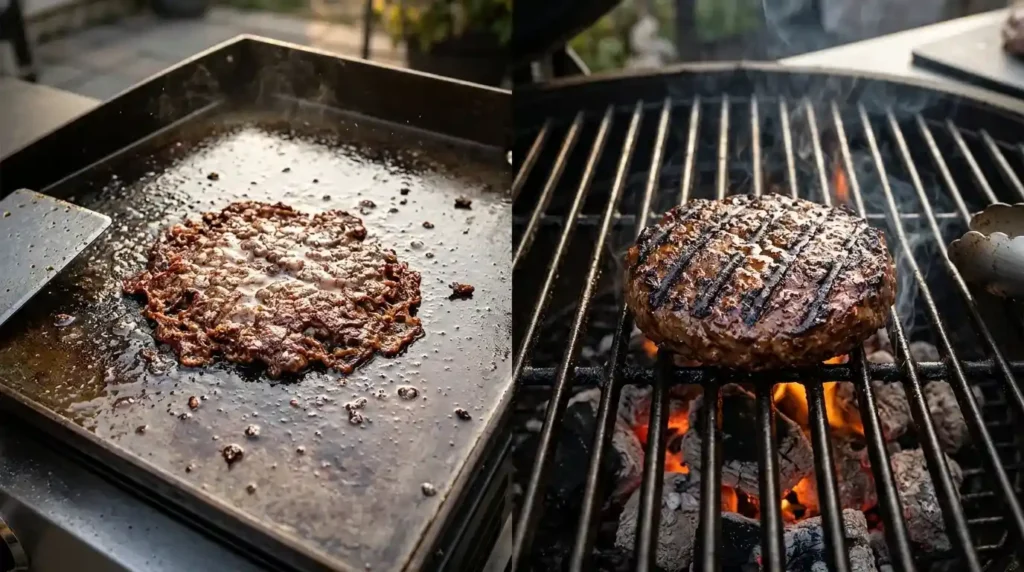
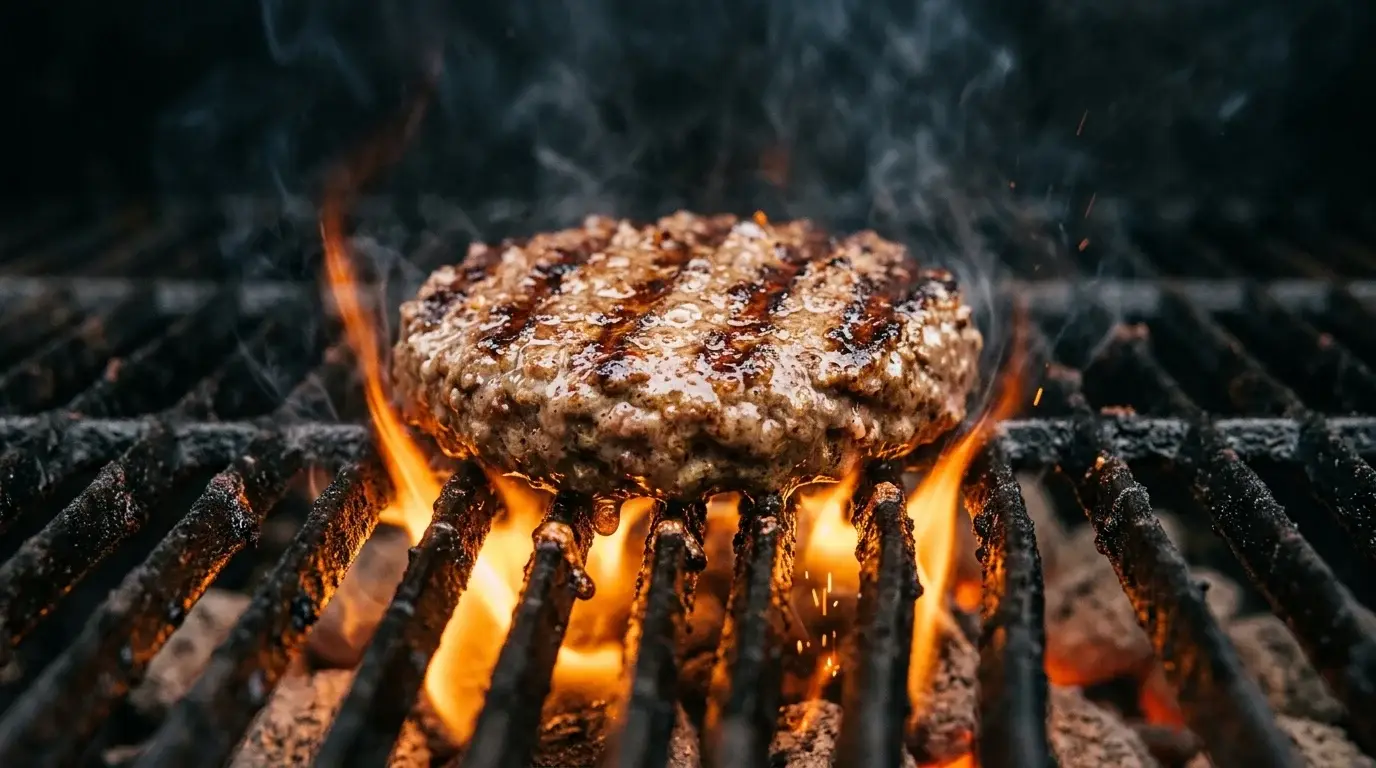
That full-surface contact is the reason griddle cooks give for the crust on a smash burger or a griddled sandwich. The bars of a grill brown the meat in stripes; a flat plate can brown all of it.
The griddle also changes what happens to fat. Food writer and filmmaker George Motz, maker of the 2005 documentary Hamburger America, argued in the New York Times that burgers taste better on a griddle or in cast iron because the beef fat pools in the pan and becomes part of the cooking, as Consumer Reports summarized in August 2014. On a grill, that fat drips through the bars into the fire. Consumer Reports set up its own grill-versus-skillet comparison with blind tasters to test the claim.
The grill’s case is flavor, and as the next section shows, even griddle loyalists concede it.
What chefs choose
Texture or smoke
The split shows up among chefs. In a Bon Appétit video in which the chefs featured in Chef’s Table: Legends answered questions from Reddit users, one asked whether they preferred griddle or grill for burgers. Ben Bowers summarized their answers for Gear Patrol in June 2025. José Andrés went griddle, saying it makes the food crunchier: “I go griddle. All the way.” Thomas Keller also chose the griddle for its texture, while conceding the grill wins on flavor. Jamie Oliver favored the griddle because the fat stays around the food and crisps it. Alice Waters was the holdout for the grill.
The argument, as Gear Patrol framed it, is texture against flavor, and neither side denies the other’s point.

How often to flip
A mathematician weighs in
Grill or griddle, the cook still has to turn the food. The old rule says flip once. In 2022, University of Wisconsin–Madison mathematician Jean-Luc Thiffeault modeled the problem, and the university’s College of Letters & Science reported his result: flipping more than once can cut cooking time by up to 29 percent compared with a single flip, but there is no further gain past three or four flips. The model used simple assumptions, a single fixed temperature under the patty and no accounting for moisture or for cooks who keep lifting the lid.
One pan, both surfaces
The reversible plate
The divide is not always a choice between two machines. A reversible cast-iron plate puts ridges on one side and a flat griddle on the other, sized to span two stovetop burners.
- Lodge Pro-Grid Reversible Grill/Griddle, PFAS-Free, 20 x 10.5 Inches: a cast-iron plate with a ridged grill side and a flat griddle side, sized to span two burners. See it on Amazon (affiliate link)
Video: REVIEW: Lodge Pro Grid Cast Iron Grill/Griddle, from the CookingWithCarolyn YouTube channel
As an Amazon Associate I earn from qualifying purchases. A commission may be earned if you buy through this link, at no extra cost to you.
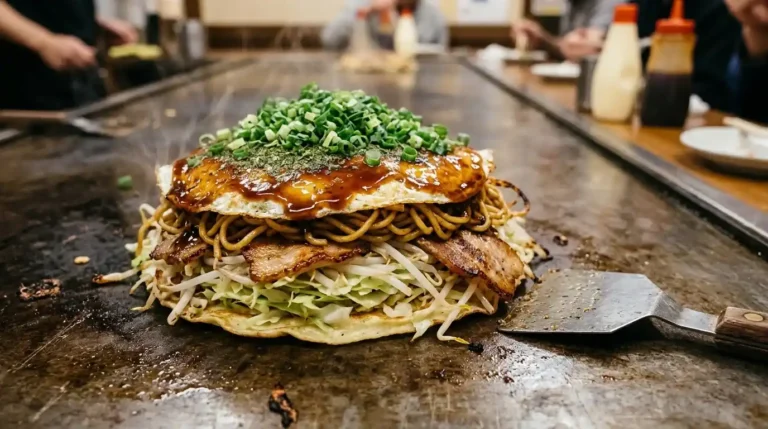
The flat side is the diner tool. GrillCheesy’s guide to seasoning a flat-top griddle covers keeping that surface ready, and the smash burger, diner hash browns, Japanese teppanyaki and okonomiyaki are all griddle foods. The hamburger’s origin story is its own argument.

Frequently asked questions
What is the difference between a griddle and a grill?
A griddle is a flat, solid cooking surface that cooks mainly by contact. A grill has open grates over the heat, so food cooks by contact where it touches the bars and by convection and radiant heat through the gaps.
Is a griddle or grill better for burgers?
It depends on what matters most. Griddles give an all-over crust and keep the fat around the meat; grills give smoke and char. Chefs including José Andrés and Thomas Keller prefer the griddle; Alice Waters prefers the grill.
How many times should a burger be flipped?
A 2022 University of Wisconsin model found multiple flips can cut cooking time by up to 29 percent, with no added benefit beyond three or four flips.
Can a grill pan do the job of a griddle?
A reversible cast-iron plate offers both: a ridged side for grill marks and a flat side for full-contact searing.
Sources
- Conner Arvidson, “Griddles vs Grills,” Blackstone (October 19, 2022): https://blackstoneproducts.com/blogs/why-griddle/griddles-vs-grills
- “How to make the perfect hamburger,” Consumer Reports (August 5, 2014): https://www.consumerreports.org/cro/news/2014/08/how-to-make-the-perfect-hamburger/index.htm
- Ben Bowers, “World-Famous Chefs Were Asked About the Best Way to Cook a Burger. One Tool Dominated,” Gear Patrol (June 18, 2025): https://www.gearpatrol.com/?p=902561
- Aaron R. Conklin, “Flipping out,” University of Wisconsin–Madison College of Letters & Science (August 17, 2022): https://ls.wisc.edu/news/flipping-out