In this story
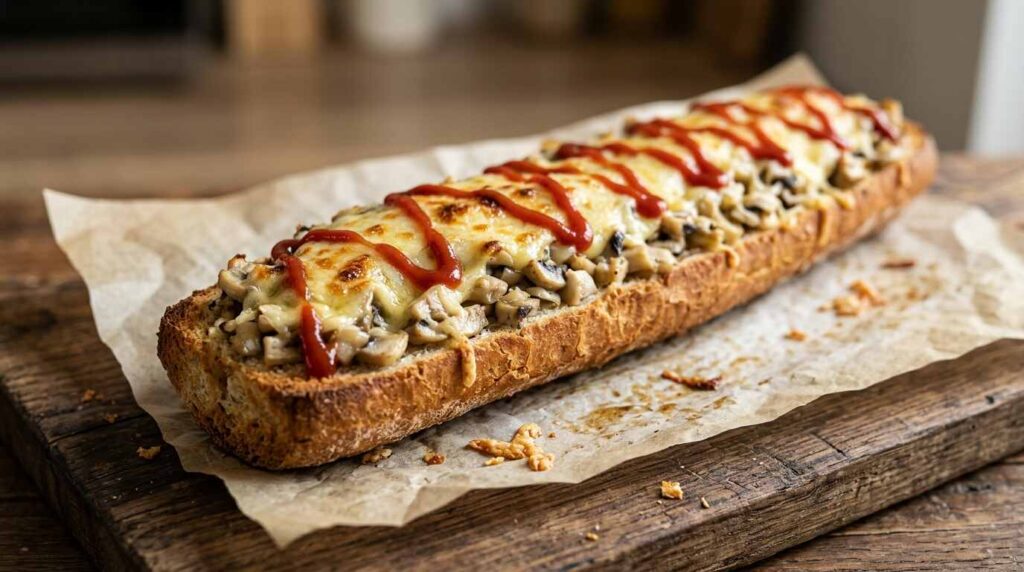
A zapiekanka is a split baguette or half baguette, topped with mushrooms and cheese, baked until the cheese melts and the crust crisps, and finished with ketchup. Writing for Vice, Kamila Rymajdo called it “a cross between a sub and a pizza.” Its history is usually placed in Communist-era Poland of the 1970s, and a good deal of that history, including the most repeated story about where the bread came from, rests on thin documentation.
Video: Street Food in Warsaw, Poland. Cooking and Eating ‘Zapiekanka’, Hot Stuffed Baguette — from the settime2588 YouTube channel
What a Zapiekanka Is
An oven word for a street snack
The name belongs to a broad category. Culture.pl’s Polish food entry explains that it means something roasted or baked, can describe many oven-baked dishes, and usually refers to the warm mushroom-and-cheese sandwich. The word comes from the verb zapiekać, which a 2010 Cafébabel piece glosses as baking in the oven.
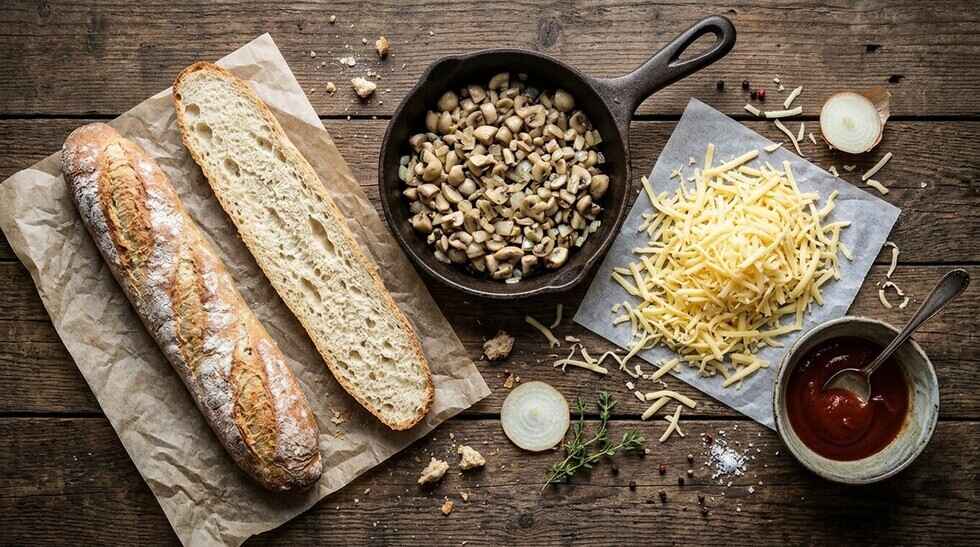
The standard construction is simple. Cafébabel describes a halved baguette spread with butter or olive oil, topped with mushrooms, tomatoes or ham, sprinkled with cheese, baked, and finished with ketchup. The same piece gives a home method of about 180 to 200 degrees Celsius for roughly ten minutes, with ketchup added after the sandwich leaves the oven.
Size varies by city. According to Rymajdo, zapiekanki in Warsaw “have traditionally been long and thin, measuring up to half a metre long,” while in Kraków “wide zapiekanki reigned supreme.” A Kraków guide from CityGlide puts the baguettes at up to 40 centimetres, crisp outside and soft inside.
The Gierek Baguette Story
A party leader, a French licence and an unproven link
The most common origin account runs through Edward Gierek, the First Secretary of the Polish United Workers’ Party. Culture.pl’s article on the toasted baguette says the zapiekanka first appeared in Polish bars in the early 1970s, after Gierek obtained a licence to produce French-style baguettes. The same piece adds that he had spent much of his youth in France and Belgium, where his family worked in mines, and reportedly found the baguette tasty and practical.
Other writers repeat the story with varying confidence. Doug Mack, in a 2022 Snack Stack essay, quotes the Culture.pl account directly. The Sword and the Sandwich places Gierek’s policies at the center of the 1970s Western opening, including Fiat and Coca-Cola’s arrival in 1972, and describes the baguette link as “apocryphally” his doing. Mashed is more careful still, saying no specific name or date marks the dish’s origin and that the 1970s are simply the key decade. The Wikipedia entry, used here only as a pointer to its cited sources, repeats the licence account and attributes it to a 2020 publication.
What the sources agree on is the decade and the bread. A baguette-based, oven-finished snack was circulating in Polish bars by the 1970s, and a French-style loaf is its base. Who first put mushrooms and cheese on it, and in which city, is not documented in any of the pages consulted for this post.
Mushrooms, Shortages and Little Gastronomy
Cheap toppings for a country short on meat
The toppings reflect what was available. Culture.pl says meat was scarce under socialism, so cooks substituted cheaper, more plentiful ingredients, button mushrooms among them. The version it describes uses finely chopped button mushrooms fried with onions, a semi-hard cheese often Tilsit that Poles call “yellow” cheese, and a tomato sauce loosely resembling ketchup. The Sword and the Sandwich adds that mushroom cultivation in Poland took off in the 1950s.
The decade has a name in Polish history writing. The Culture.pl article credits historian Marcin Zaremba with coining “bigos socialism,” a label for a period of relative prosperity, some openness to foreign goods and more freedom to open private businesses. The label compares the system to a filling dish that does not need premium ingredients to satisfy.
Those private businesses are the setting for the zapiekanka. Wikipedia, citing Polish sources, describes small family-owned outlets known as mała gastronomia, or small gastronomy, often stands or trailers turned food trucks, selling the baguette alongside kiełbasa, boiled ham hock and tripe soup, plus hot dogs, hamburgers and French fries. Culture.pl translates the term as “little gastronomy” and says these eateries introduced Poles to fried chicken, pizza and hot dogs.
Mushroom buns may predate the baguette. Culture.pl quotes the current owner of Warsaw’s Murzynek bar in Nowe Miasto, who says mushroom-filled buns were invented there in the late 1960s because hot dog sausages were hard to get and cooks filled buns with scrambled egg or mushroom sauce instead. Mashed reports the same bar reportedly sold hot dog buns with mushroom sauce in the 1960s. Neither page cites a document from the 1960s.
Ketchup and Other Sauces
A finishing line rather than a condiment
Ketchup is part of the sandwich’s identity. Tasting Table says a drizzle of ketchup was part of the original recipe, and Rymajdo describes the sandwich as “finished off with a generous slathering of ketchup.” Cafébabel puts it on after baking, and Wikipedia describes it as the typical garnish, served on hot cheese.
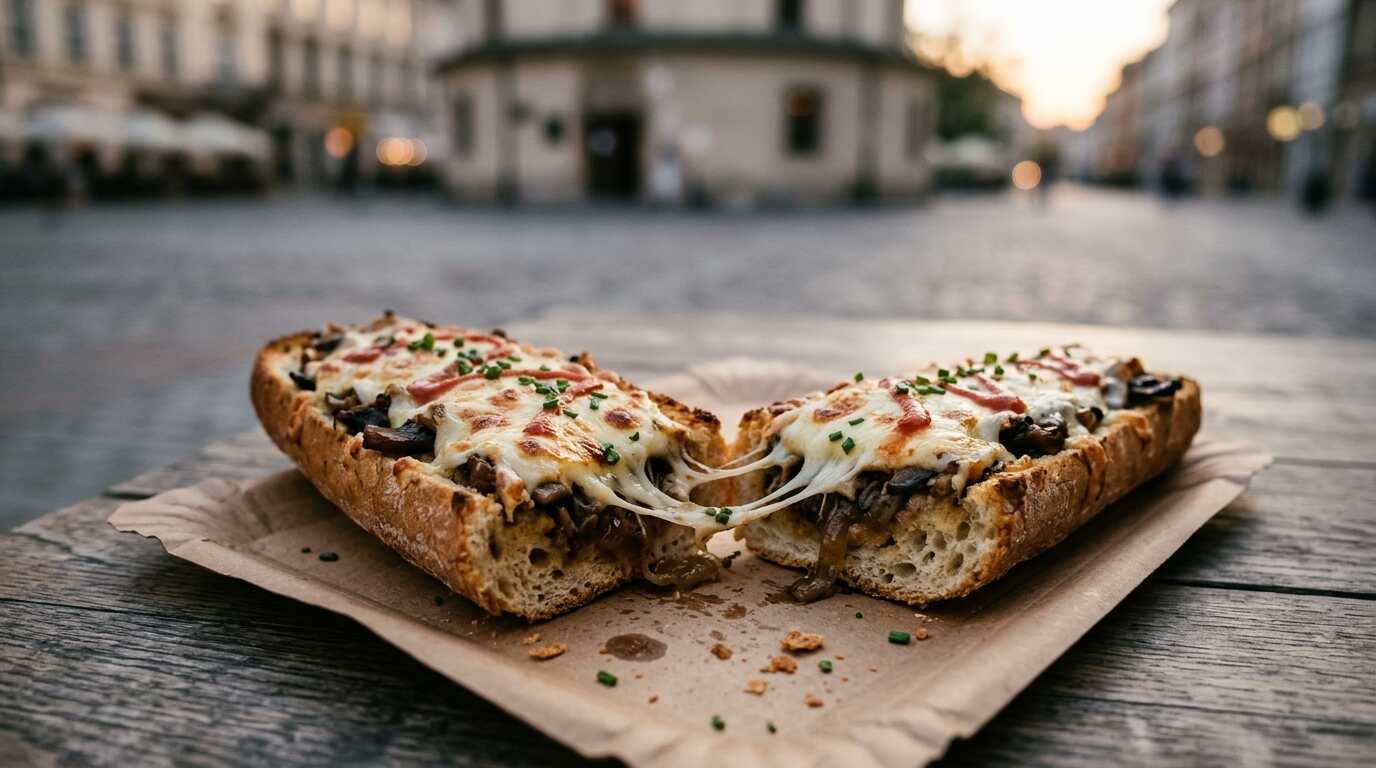
Polish ketchup is not the American product. Mashed recommends a Polish brand, Pudliszki, described as thicker, less sweet and spiced with allspice, garlic and paprika. Rymajdo, visiting the city of Włocławek, writes that it is “known predominantly for its spicy ketchup—the perfect partner to a zapiekanka,” and describes the Włocławski ketchup at a lakeside stand in Kowal as having a tart flavour “miles away from the sweetness of Heinz.”
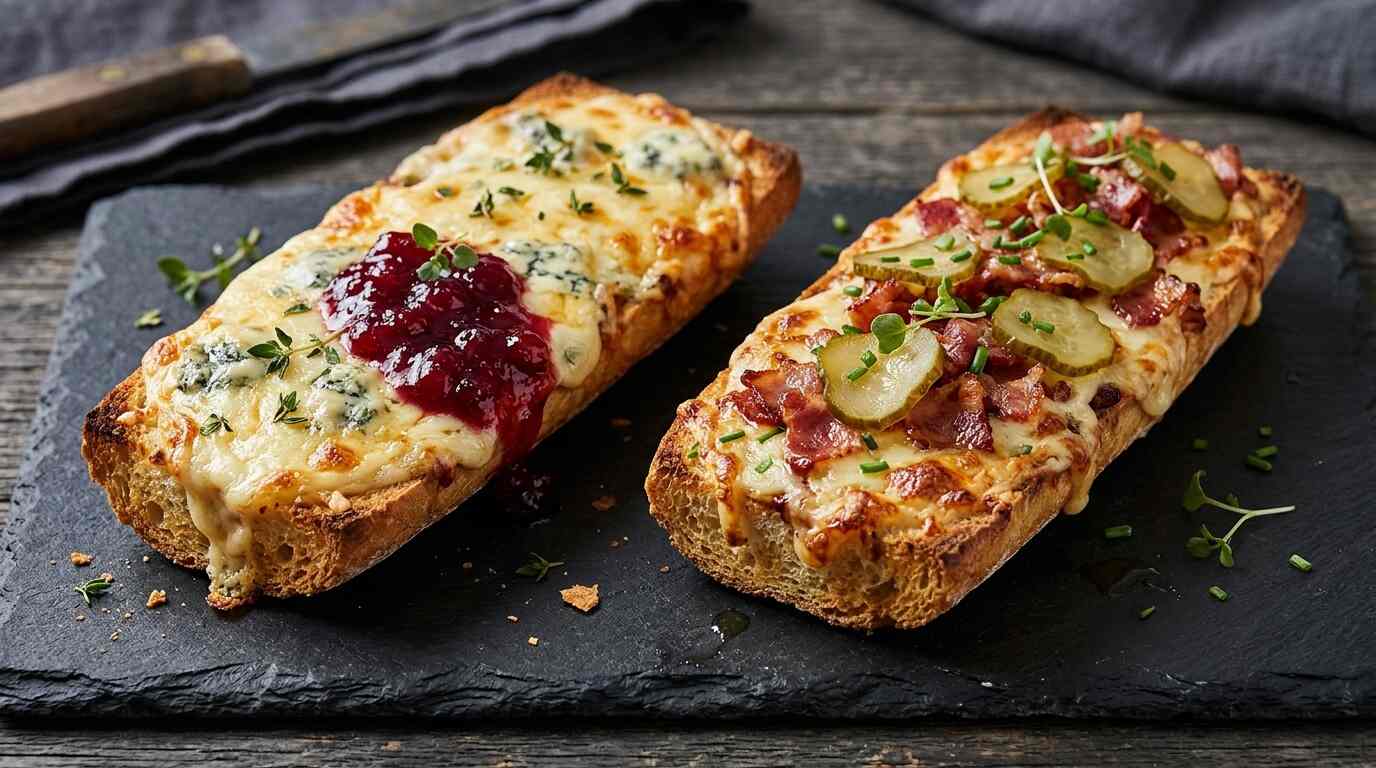
Modern vendors extend the sauce list. A Pale Ale Travel guide to Warsaw shops lists spicy, garlic and ketchup among the sauces, and Rymajdo found a Warsaw shop serving a three-cheese zapiekanka with cranberry jam, “sweet cranberry jam, which replaces the traditional ketchup.”
Plac Nowy and the Okrąglak in Kraków
A rotunda in the old Jewish quarter
Kraków’s Kazimierz district is the dish’s best-known stage. Mashed calls it the main hub, and a 2020 In Your Pocket piece on Plac Nowy calls the zapiekanka there “essentially a baguette pizza” that emerged under Communism as cheap, fast and filling street food.
The square’s central building is the Okrąglak, the rotunda. In Your Pocket reports that the square took its shape by the early nineteenth century, that locals long called it Plac Żydowski, or Jewish Square, because it was the primary marketplace of Kazimierz’s Jewish quarter, and that the rotunda served as a ritual slaughterhouse for poultry until the Nazi occupation. CityGlide says the round building once served as a market hall and now houses many stalls, and that the zapiekanka’s history there “dates back to the communist era,” with no year given.
Cafébabel describes the Okrąglak as a nightly zapiekanka spot, especially in winter, and notes that regulars know which window serves the best one. The piece calls the Kraków version a standout for its bread, browning and generous toppings. Mashed names U Endziora as known for an old-school version, with limited seating and waits that can reach half an hour. CityGlide lists Endzior, Bar Okrąglak and Zapiekanki u Endziora as recommended stalls, with most stalls open from early morning until late at night.
Prices appear in only one dated source. In 2010, Cafébabel put a zapiekanka at roughly one to two euros and never more than two.
Warsaw and Plac Zbawiciela
The long, thin version and a square known for hipsters
Warsaw’s connection runs through early bar sales. The Sword and the Sandwich says the first zapiekanki were sold from bars in Warsaw, as cheese toast topped with a hash of button mushrooms. Culture.pl names several Warsaw spots in its survey of the era’s street food, among them a booth on Rutkowskiego Street (now Chmielna) by the Atlantic cinema, booths near night bus stops on Emilii Plater Street, and a cart near the Wilanów cemetery.
Plac Zbawiciela, or Savior Square, enters the story through a modern shop. Rymajdo’s report places Pałaszowanie, which she describes as a “Scandinavian-looking spot,” on the square, “a roundabout of establishments catering to the bona fide hipster.” The Associated Press’s Monika Scislowska, writing in 2013, notes the square is sometimes called Hipster Square and takes its name from the Church of the Holiest Savior, completed in 1927. None of the pages consulted ties the square to the sandwich’s origin, only to a contemporary zapiekanka shop.
Warsaw’s other well-known address in Rymajdo’s report is Bar Lussi, open around the clock near the Palace of Culture and Science and trading for about 25 years as of her 2017 article. Pałaszowanie’s baguette arrived with the crust cut off, which Rymajdo called “an insult to the whole concept of the zapiekanka.”
Decline, Revival and New Toppings
From a 1988 law to a nostalgia wave
Rymajdo ties the dish’s spread to the 1988 Wilczek Law, which loosened Communist restrictions on private enterprise and led to food trucks selling cheap rotisserie chickens and zapiekanki. Then came competition. Culture.pl says the first McDonald’s opened in Poland in 1992 and became a symbol of fast food replacing the stalls, though zapiekanki declined without disappearing.
Mack points out that a 1993 Detroit Free Press front-page story called zapiekanki “traditional” when the dish was only about twenty years old. Rymajdo reports that ferry operator DFDS added zapiekanki to its menus in 2014, that Tesco sold frozen versions for a while, and that vendors operate in London, Bristol and Kingston-upon-Thames, though she calls the UK scene niche.
Toppings now run well past mushrooms. Cafébabel and Wikipedia name Hawaiian (pineapple and barbecue sauce), Diablo (bacon, pickled cucumber and spicy sauce) and Greek (olives and feta) among the stock varieties. Rymajdo lists a Warsaw three-cheese version with blue cheese, gouda and mozzarella, Łódź’s Zapiekarnia with toppings from smoked cheese to salmon plus a vegan spinach-mushroom-tomato-sweetcorn version, and a Włocławek kiosk offering kebab meat. Mashed adds cranberry sauce with smoked sheep cheese, and Cafébabel adds oscypek. Related entries on this site include the banh mi, another baguette sandwich, the open-faced smørrebrød, the tuna melt and the cheese toastie.
Sources
- Kamila Rymajdo, “In Search of Poland’s Post-Communist Pizza Baguette,” Vice (2017): https://www.vice.com/en/article/in-search-of-polands-post-communist-pizza-baguette/
- Culture.pl, “Poland’s Toasted Baguette: The Zapiekanka”: https://culture.pl/en/article/polands-toasted-baguette-the-zapiekanka
- Culture.pl, “Polish Food 101: Zapiekanka”: https://culture.pl/en/work/polish-food-101-zapiekanka
- Doug Mack, Snack Stack, “A brief history of Polish zapiekanki” (August 2, 2022): https://www.snackstack.net/p/the-snack-from-the-gap-in-the-iron
- Cafébabel, “Zapiekanka: not a Polish kebab” (June 9, 2010): https://cafebabel.com/en/article/zapiekanka-not-a-polish-kebab-5ae005cdf723b35a145df937/
- The Sword and the Sandwich, “Notable Sandwiches #147: Zapiekanka”: https://buttondown.com/theswordandthesandwich/archive/notable-sandwiches-147-zapiekanka/
- Mashed, “Zapiekanka: The Open-Faced Sandwich With Polish Origins”: https://mashed.com/1409035/zapiekanka-open-faced-sandwich-polish-origins
- Tasting Table, “Zapiekanka Is Poland’s Historic Open-Faced Sandwich”: https://www.tastingtable.com/1481318/zapiekanka-poland-open-faced-sandwich
- CityGlide, “Zapiekanki on Plac Nowy – the cult street food in the heart of Kazimierz”: https://escooters.krakow.pl/en/attractions-2/zapiekanki-at-plac-nowy-a-cult-street-food-in-the-heart-of-kazimierz/
- In Your Pocket, “Explore, eat, drink, repeat: Plac Nowy in Kraków’s Kazimierz” (2020): https://blog.inyourpocket.com/poland/2020/02/explore-eat-drink-repeat-plac-nowy-in-krakow-kazimierz/
- Pale Ale Travel, “2 of the Most Righteous Zapiekanki Haunts in Warsaw” (July 15, 2024): https://palealetravel.beehiiv.com/p/zapiekanka-warsaw
- Monika Scislowska, Associated Press, “Savior Square shows how Poland has changed” (September 15, 2013): https://www.hawaiitribune-herald.com/?p=22010
- Wikipedia, “Zapiekanka” (used as a pointer to its cited sources): https://en.wikipedia.org/wiki/Zapiekanka
- YouTube, settime2588, “Street Food in Warsaw, Poland. Cooking and Eating ‘Zapiekanka’, Hot Stuffed Baguette”: https://www.youtube.com/watch?v=0KdpufswFBc