
In this story
Bunny chow is a hollowed-out loaf of white bread filled with curry, a take-out meal that belongs to Durban, South Africa, and to the Indian community that has lived there since the 1860s, according to WNYC. The name has nothing to do with rabbits, a point that The Christian Science Monitor and nearly every other account of the dish make early. What the sources do not agree on is who first put curry inside a loaf, in which decade, and why.
Video: The History of ‘Bunny Chow’ — from The Better India YouTube channel
What a Bunny Chow Is
A quarter loaf, a scooped-out centre, and a curry that soaks the walls
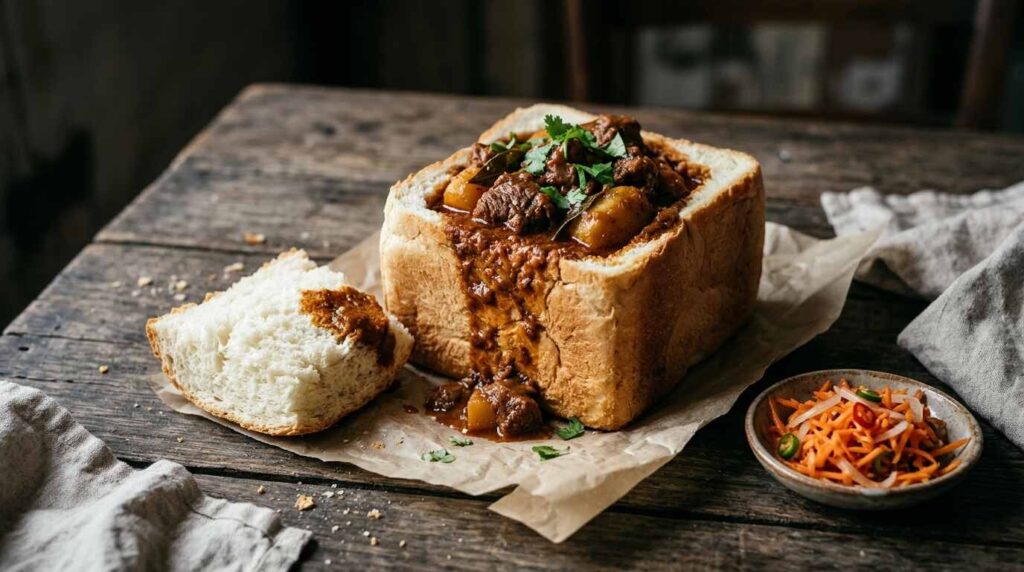
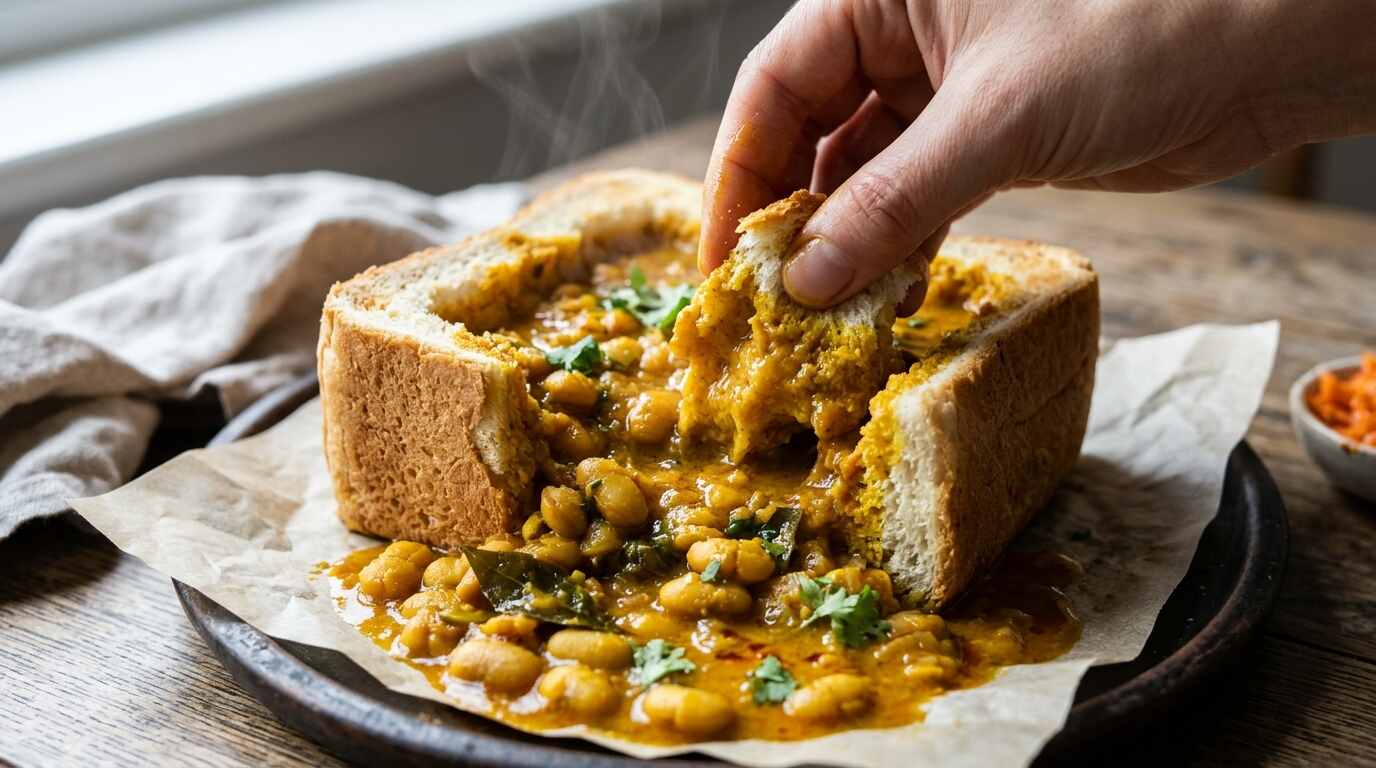
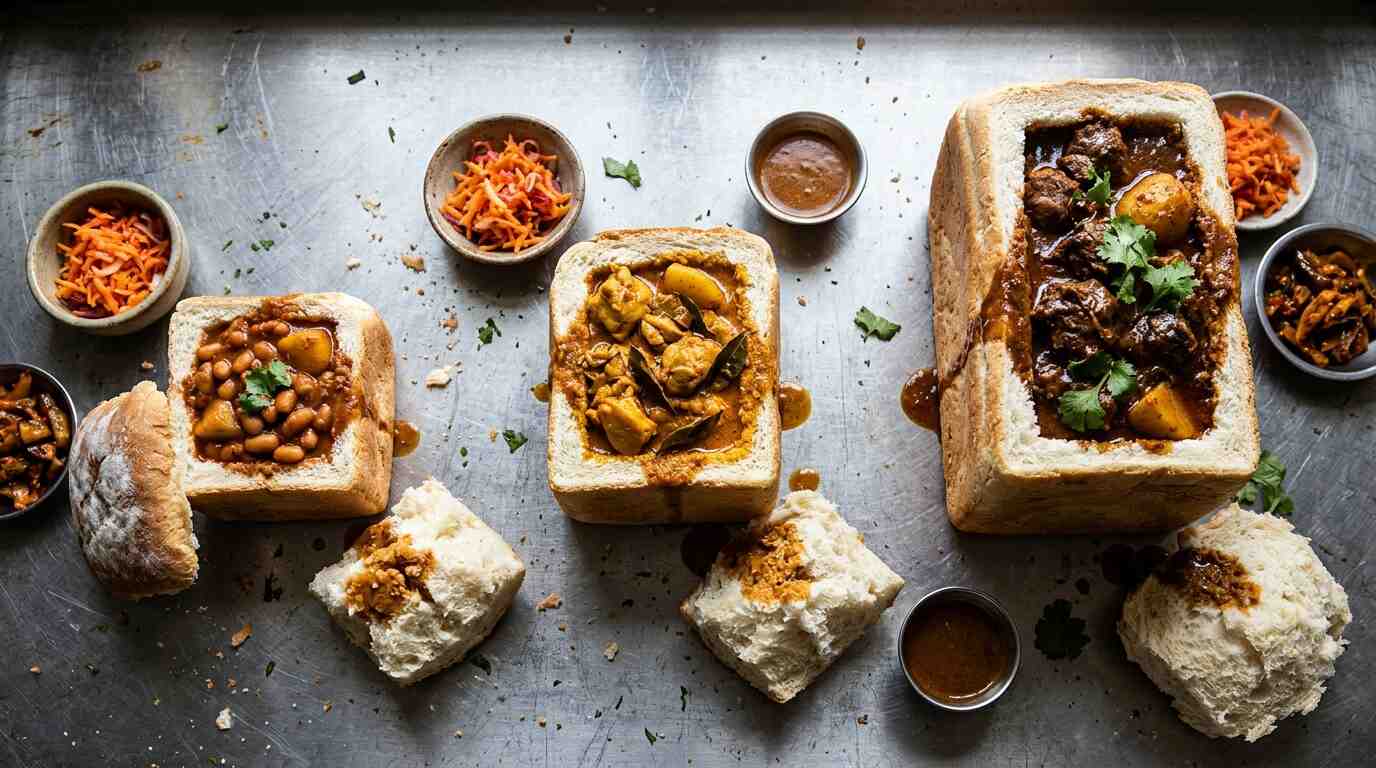
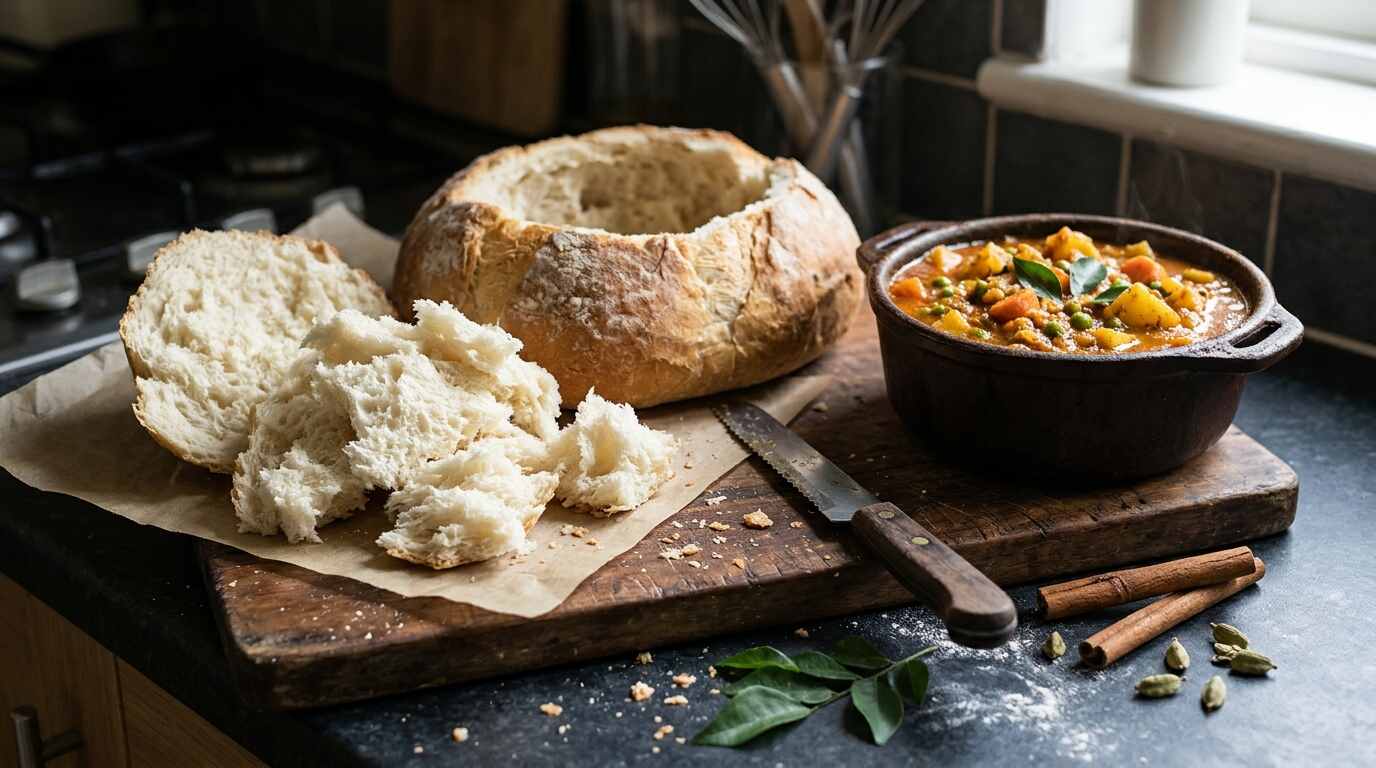
The structure is simple. A loaf of soft white bread is cut, the crumb is removed from the middle, and the cavity is filled with curry. According to Wikipedia, used here as a pointer to its listed references because most of the primary accounts sit behind other publications, the removed piece is set back on top as a lid, and the soaking of curry gravy into the bread walls is a defining feature. The same entry says the original size was a quarter loaf, with halves and full loaves ordered by those who want more. The scooped-out interior has its own name: AFAR reports that the soft centre is called the “virgin,” and that it is dipped into the curry and eaten too.
Fillings run wide. Fodor’s lists bean curry as the traditional filling, with mutton common and beef and chicken also used. The Wikipedia entry adds dhal, chips with curry gravy, and trotters with beans to the list. At Patel’s Vegetarian Refreshment Room on Dr Yusuf Dadoo Street in central Durban, a Time Out review found moong dhal, sugar beans, mixed vegetables and gram dhal among the fillings.
A side of sambals usually comes with it. The Better India describes sambals as a salad of grated carrot, chilli and onion, and says the dish is traditionally eaten without a knife or fork. The Christian Science Monitor calls eating with the hands “the first rule of bunny chow.”
Ordering follows its own shorthand. Wikipedia notes that locals ask for a “quarter mutton,” or pick filling and size. Snackstack adds that locals usually say “a bunny.”
Where the Name Comes From
“Bunny” is usually traced to the bania, a merchant caste, and “chow” is slang for food
The most widely repeated explanation for the word is a corruption of “bania.” AFAR describes the bania as a merchant caste, and says shopkeepers and restaurant owners on Grey Street, the centre of Durban’s Indian community, were known as banias. WNYC quotes Dilip Soni, a Durban jewelry maker, on how the word travelled: “From the ‘bania man shop’ came the ‘bunny man shop,’ and from bunny man shop came the bunny chow.” “Chow” is South African English slang for food and for the act of eating, per Wikipedia.
The writer Minal Hajratwala, whose family connection to the dish comes up below, is cited by AFAR as saying that nobody can say with certainty where the name came from. The same Wikipedia entry records a second, less favoured idea from her 2009 book Leaving India: that “bunny” may be a mishearing of “bun” and “achar,” the Indian pickle, which the entry calls unlikely.
Some tellings attach the word to a single person. The Better India, Fodor’s and the Culture Trip all repeat versions in which the owner or manager of a particular restaurant, a bania, gave his name to the food, so that “bania’s chow” became “bunny chow.” Fodor’s gives the manager’s name as “Bhanya.” The caste-word theory and the person-named theory therefore overlap: both rest on the same word, and differ on whether it described a whole class of shopkeepers or one man’s shop.
The Kapitan’s Claim
A Durban restaurant that opened in 1912 and a family memory of the first beans bunny
The restaurant most often named is G.C. Kapitan’s. The South China Morning Post reports that the most common story credits G.C. Kapitan’s Vegetarian Eating House, opened in 1912 by Ganda Chagan Kapitan, and that the family is said to belong to the Bania caste. AFAR gives the restaurant’s years of operation as 1912 to 1992, and says it reportedly created the first vegetarian “beans bunny.”
The family angle is documented in a first-person source. The Indian Memory Project page, contributed by Hajratwala, describes G.C. Kapitan as her great-great-uncle and says he is credited with inventing the fava-bean version of the dish. The page presents this as a family account and gives no date for the invention. Hajratwala is also the source of a line AFAR quotes about the competition for credit: “Anyone who came near an Indian restaurant in the second half of the century thinks he invented bunny chow.”
The Better India dates the Kapitan’s version to the 1940s and gives the motive as segregation: apartheid laws barred Black customers from eating in restaurants, so take-out was their only option. Fodor’s tells a similar story, saying that Black people were barred from Kapitan’s in the city centre and that the manager began selling takeout on the pavement because roti often fell apart. The Better India adds that Kapitan’s opened branches in other South African cities. AFAR and The Better India both add that a young Nelson Mandela was reportedly a regular at the Johannesburg offshoot, a detail given with the word “reportedly” in each.
The Patel’s Claim
A rival restaurant a few blocks away says its founder came first, and says why
Patel’s Vegetarian Refreshment Room disputes the Kapitan’s account. The Better India reports that Patel’s, on Yusuf Dadoo (formerly Grey) Street, claims to have created the original vegetarian bunny chow, with its founder, named there as Rambhar Morar Patel, making it to retain Black customers. A snack-history post on Snackstack relays what the current owner told Scroll.in: that the first owner, there spelled Rambhai Morar Patel, served curry and bread in a bowl outside to Black customers who could not eat inside with white customers, and that when the bowls kept disappearing he hollowed out the loaf to hold the curry. Snackstack gives the early 1900s as the date Patel’s assigns to the invention. The two sources spell the founder’s first name differently, and neither spelling is confirmed here.
Time Out’s review dates the business to 1911, with Ranchod Rama Patel taking over in 1932, and records a 2016 interview in which longtime owner Manilal Patel described an early proprietor serving curry in hollowed bread to Black customers excluded from eating inside. The review also states plainly that the dish’s inventor is disputed and that no single inventor is universally recognised, with Patel’s among the earliest establishments associated with it.
The shop remains a working kitchen. The Christian Science Monitor, reporting from Durban in 2019, counted about 800 bunnies sold a day at Patel’s, in a standard bowl about four thick slices of bread deep for 15 rand, roughly one US dollar then. Ritesh Patel, third generation at the shop, told the paper: “A bunny chow is to Durban what a pizza is to New York.”
Workers, Caddies and Leftovers
Several older stories give the loaf a job before it had a restaurant
A separate cluster of accounts skips the restaurants and starts with who needed to carry a meal. The oldest-sounding of these concerns the sugar cane. The Wikipedia entry lists a theory, sourced to a 2014 BBC Food piece by Warwicker, that migrant workers on KwaZulu-Natal plantations, with short breaks, hollowed out bread and filled it with curry. The Christian Science Monitor frames the dish as “undoubtedly” created by Durban’s Indian community, most of whom arrived as indentured labourers brought by the British to work sugar-cane plantations and railroads. A University of Southern California folklore interview records a South African student giving the same version: workers carried curry to the cane fields and lacked an easy way to carry it.
The caddie story is more specific. The Culture Trip says Indian caddies at the Royal Durban Golf Course could not leave work long enough to walk to Grey Street, so friends bought curry for them and, with no take-out containers, used hollowed-out bread. The Better India repeats the golf course theory, and the SCMP gives a variant in which Kapitan’s invented the dish for such workers, with roti rejected because curry leaked through it. Wikipedia attributes a different caddie detail to the 2013 reference work Street Food Around the World by Kraig and Taylor Sen: that Indian caddies could not carry knives in public, so a hand-held dish was developed.
Leftovers are a third origin. WNYC reports that Soni heard beggars came at the end of the day for leftover food, and that cooks, with no time to make sandwiches, hollowed out bread and filled it with curry. Billy Mowbray, whose father opened the Victory Lounge in Durban in 1948, confirmed that account to the reporter. In this telling the bread is a gift of surplus, not a work lunch.
Two smaller claims turn up without named sources. The Culture Trip reports “rumours” of a chef at the Queen’s Tavern as inventor and gives no source. The Wikipedia entry carries a roti-substitute story credited to the website Quarterbunny: the white loaf replaced roti, which fell apart as take-out food.
When the Dish Appeared
Patel’s dates it to the early 1900s, while scholars lean on the years after World War II
The accounts do not fit a single timeline. Indians arrived in large numbers from the 1860s, first as indentured sugar-cane workers around Durban and then as “passenger Indians” paying their own way, according to WNYC. Snackstack puts the first indentured labourers arriving by ship in November 1860, with merchants following in a second wave in the late 1800s, and apartheid codified in 1948.
Against that backdrop, Patel’s assigns the invention to the early 1900s, while most other versions place the dish around the 1940s. AFAR, The Better India, Fodor’s and the SCMP all use the 1940s or late 1940s. The WNYC report quotes linguist Rajend Mesthrie of the University of Cape Town, who with other scholars suggests the dish was most likely created after World War II, many years after Indians first arrived. Snackstack itself points out that the early-1900s date it records for Patel’s does not sit easily with its own statement that bunny most likely began in the early apartheid years.
Literature has pulled the other way. WNYC notes that Imraan Coovadia’s novel The Wedding shows a nineteenth-century couple living on bunny chow after landing in Durban. Coovadia told the reporter he knew nothing about the dish’s real history, in the words WNYC quotes: “I had no idea of the history of it.”
The Wikipedia entry adds one geographic wrinkle: a claim that bunny chow was sold in Gwelo, Rhodesia (now Zimbabwe), during World War II and is still sold in Kadoma, formerly Gatooma. Among the pages consulted, only that entry carries the claim, so it is recorded here as a claim, not an established date. The Culture Trip reaches the same place: “We’ll never know the full truth.”
Relatives Across South Africa and India
Quarter loaves, kotas and a Gatsby: the same bread-as-container idea elsewhere
The Christian Science Monitor places two other South African loaf meals in the same era. In Johannesburg there is the kota, built from cheese, bologna, french fries and fried eggs in a hollowed quarter loaf. In Cape Town there is the Gatsby, a riff on the British chip butty with fries, meat, cheese and chutneys; Grill Cheesy has separate write-ups of the Gatsby sandwich and the chip butty. Mesthrie, per WNYC, links “kota” to the word “quarter,” tying it to the way bunny chow is ordered by size. Wikipedia lists sphatlho as another South African dish that evolved from the bunny chow, and gives skhambane and shibobo as other regional names.
Southlands Sun, a South African local paper, reported in 2019 that no bunny chow can be found anywhere in India, a claim The Better India’s headline echoes with its title “An Indian Dish Difficult to Find in India.” The same Better India piece lists a handful of Indian restaurants in Mumbai and the Delhi region now serving it.
Durban itself treats the dish as a competitive craft. Wikipedia records an annual Bunny Chow Barometer in September on the south bank of the Umgeni River, near Blue Lagoon, and Snackstack says the event has ten finalists chosen from dozens of applicants across meat, vegetarian and other categories. Africanews reported in 2018 that bunny chow has also appeared in restaurants in the United Kingdom, the United States and Australia.
Another sandwich built around bread and liquid is the French dip, and the usual failure of bread under moisture is covered in Grill Cheesy’s piece on why sandwiches get soggy. In a bunny chow, the soaking is the point.
Sources
- AFAR, “How Bunny Chow Became South Africa’s National Street Food”: https://www.afar.com/magazine/how-bunny-chow-became-south-africas-national-street-food
- The Christian Science Monitor, “Bunny chow: South African history in a loaf of bread”: https://proof.csmonitor.com/World/Africa/2019/0618/Bunny-chow-South-African-history-in-a-loaf-of-bread
- WNYC, “Bunny Chow: South Africa’s Sweet-Sounding Dish Has A Not-So-Sweet Past”: https://wnyc.org/story/bunny-chow-south-africas-sweet-sounding-dish-has-a-not-so-sweet-past/
- Culture Trip, “The Mystery of Durban’s Signature Dish Bunny Chow”: https://theculturetrip.com/africa/south-africa/articles/a-brief-history-of-the-bunny-chow
- The Better India, “The Story of Durban’s Bunny Chow, An Indian Dish Difficult to Find in India!”: https://thebetterindia.com/120787/bunny-chow-unique-indian-dish-durban-south-africa
- Time Out Durban, Patel’s Vegetarian Refreshment Room: https://www.timeout.com/durban/restaurants/patels-vegetarian-refreshment-room
- Fodor’s, “Bunny Chow: A Durban Specialty”: https://fodors.fodors.com/world/africa-and-middle-east/south-africa/durban/experiences/bunny-chow-a-durban-specialty-267415750
- South China Morning Post, “Eatery uses its loaf to curry hurry”: https://www.scmp.com/article/1001128/eatery-uses-its-loaf-curry-hurry
- Indian Memory Project, G.C. Kapitan entry: https://indianmemoryproject.com/?p=475
- Snackstack, “A brief history of bunny chow”: https://snackstack.net/2021/05/26/the-snack-that-involves-no-actual-rabbits/
- USC Digital Folklore Archives, “Bunny Chow”: https://folklore.usc.edu/?p=64614
- Southlands Sun, “VIDEO: Where did bunny chows originate from?”: https://citizen.co.za/southlands-sun/news-headlines/2019/09/07/video-bunny-chows-originate
- Africanews, “S.Africa’s bunny chow fuses cultures and flavors”: https://www.africanews.com/amp/2018/10/04/safrica-s-bunny-chow-fuses-cultures-and-flavors/
- Wikipedia, “Bunny chow” (used as a pointer to its listed references): https://en.wikipedia.org/wiki/Bunny_chow
- YouTube, The Better India, “The History of ‘Bunny Chow'”: https://www.youtube.com/watch?v=Ponb41J8x1w