In this story
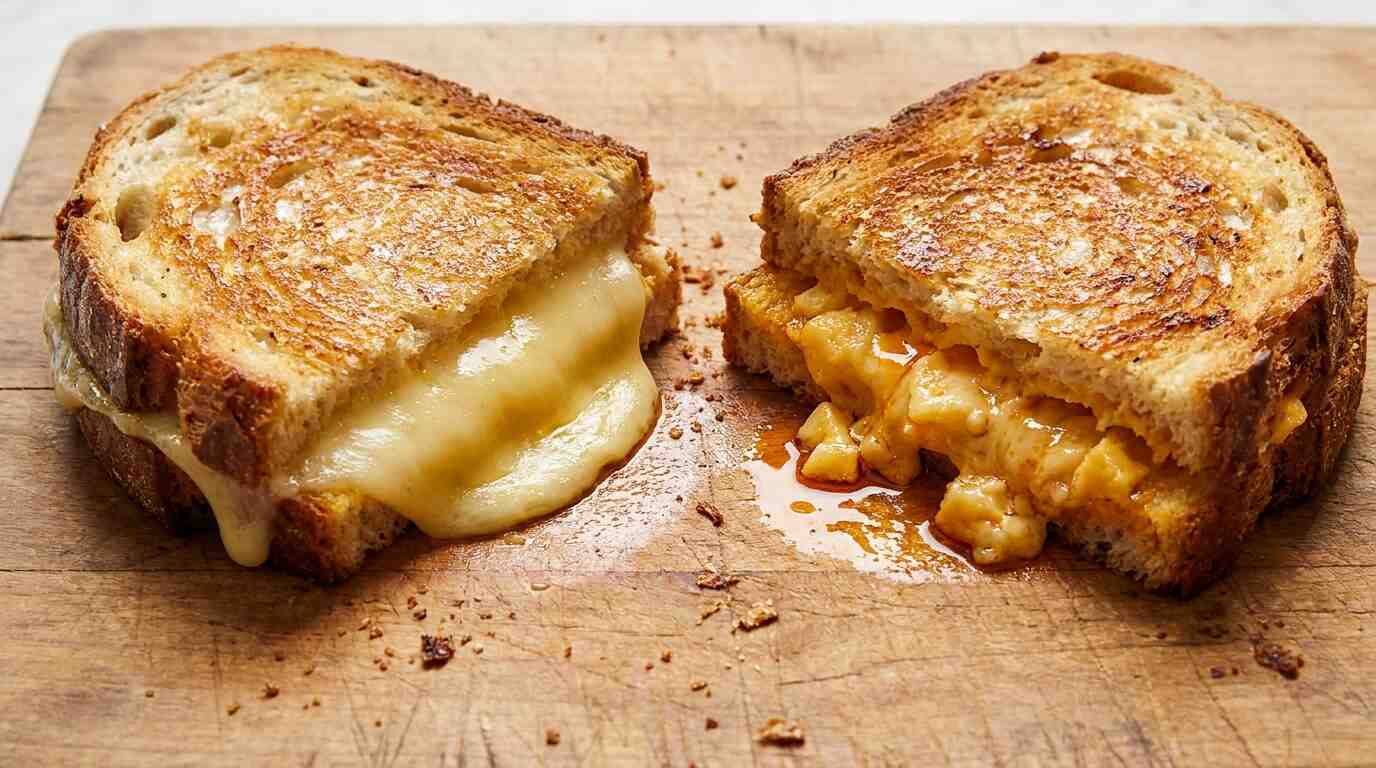
A young cheddar melts into a grilled cheese and stays together as one glossy layer. A cheddar aged two years, sliced from the same kind of block, tends to clump, leak orange fat, or simply sit there and crack. The difference has less to do with heat than with what happened to the cheese’s protein while it sat in a cave or a cooler.
Video: Why young cheese melts better than aged cheese, from the America's Test Kitchen YouTube channel
A test with three cheddars
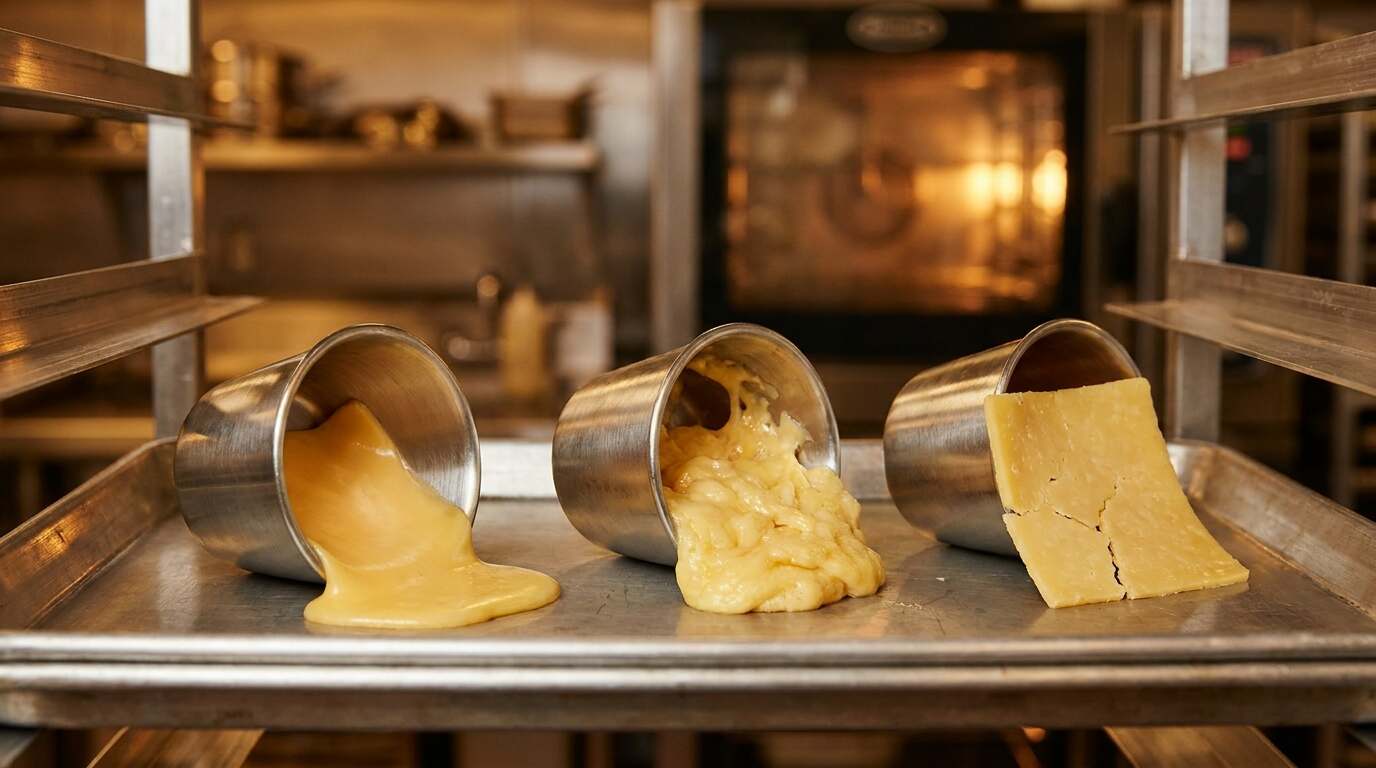
The clearest evidence comes from a kitchen, not a lab. Cook’s Illustrated set out to explain why its testers kept getting better grilled cheese from younger cheeses, and it controlled for the obvious answer first. Aged cheese has lost water, and dry cheese clumps. So the test kitchen bought Cabot cheddars aged three, 16 and 24 months, all sealed against evaporation during aging, and melted slices of each over inverted metal cups preheated in a 175-degree oven.
The three-month cheddar flowed evenly down the sides of its cup. The 16-month cheddar clumped as it slid. The 24-month cheddar broke into two large pieces and never melted at all.
Moisture was not the whole story
Because the water loss was held in check, the result pointed somewhere else. Cook’s Illustrated concluded that moisture plays a part, but the state of the cheese’s casein network matters most.
What casein does in a block of cheese
Casein is the main protein in milk and the frame of almost every cheese. Scientific American, in a piece by Meghan Bartels, describes cheesemaking as turning casein into a network held together by weak bonds and studded with water and fat. Melting, in this picture, is that network loosening enough to move without coming apart.
Calcium holds the network together. The Cheese Science Toolkit, created by the late food scientist Pat Polowsky, calls calcium “the glue that cross-links protein (casein)” and gives cheese its structure. Fat and water sit in the gaps and soften it, the way water softens a sponge.
Heat works on the parts in order. Prateek Sharma of Utah State University told Scientific American that fat starts to melt near room temperature and seeps out, which is why cheese left on the counter turns greasy. Around the temperature of hot tap water the casein loses water and softens, and melting is complete by about 160°F.
The calcium and acid balance
Too many cross-links and the cheese won’t flow. Too few and it turns runny. Sharma described a good melt to Scientific American as needing a middle level of calcium phosphate bonds in the casein.
Acid is what moves that level. The Cheese Science Toolkit explains that acid produced by starter cultures dissolves calcium, loosening the casein network. A cheese at a high pH keeps its calcium and melts poorly. As the pH falls, calcium dissolves and melting improves. Near pH 4.6, the point where casein clumps hardest, the cheese goes firm and won’t melt, as with feta.
Numbers for cheddar
The Center for Dairy Research at the University of Wisconsin puts cheddar’s pH at about 5.1, and its moisture at about 38 percent, against roughly 87 percent in the milk it started as. Those two figures, acid and water, are set when the cheese is made. Aging works on what is left.
Aging snips the protein
As cheese ages, enzymes cut the casein. Cook’s Illustrated calls the process proteolysis: bonds between casein molecules are snipped, the tight clusters of a fresh cheese unwind, and they bind to other casein molecules to form a matrix. The Cheese Science Toolkit lists who does the cutting, including rennet, starter bacteria, surface molds and other lactic acid bacteria that move in during ripening.
Early in aging, that unwinding helps. A 2007 Utah State University thesis by Taylor Rasmussen, Texture Profile Analysis and Melting in Relation to Proteolysis, aged cheddars for up to 12 months and found that melting rose as the amount of intact alpha-s1 casein fell. In plain terms, as more of the main casein was cut, the cheese melted further.
Where the explanations split
The sources agree on the first year. They describe the long-aged end differently.
Cook’s Illustrated: the network tightens
The test kitchen’s explanation is that later in aging the proteins bond more tightly into a stronger network. That network needs more heat to melt and stays less flexible once it does, which leaves separated fat and clumps, as with its 16- and 24-month samples.
Scientific American: the network falls apart
John Lucey of the University of Wisconsin–Madison gave Scientific American a different mechanism. Enzymes and microbes cut casein molecules during aging, which makes cheese melt more easily but stretch less, and at the extreme it can turn soupy rather than gooey. On the acid side, Lucey said that too much acid dissolves so many bonds that charged parts of the casein attract each other directly, and the cheese can no longer stretch.
Both accounts end in the same place for a sandwich: a long-aged cheese doesn’t hold together as one smooth, stretchy layer. Cook’s Illustrated describes clumps and broken pieces; Lucey describes less stretch and, eventually, a loose and soupy melt. Water loss adds to the problem in real cheese that isn’t sealed. Scientific American notes that Parmesan’s low moisture makes it a poor melter.
What cooks do about it
Cook’s Illustrated’s own conclusion for grilled cheese was to pick younger cheese. Its testers found younger cheeses almost always performed better than aged ones on a sandwich.
GrillCheesy’s guide to the best cheese for grilled cheese covers which cheeses melt well, and the post on why cheese melts and turns greasy covers the fat that leaks out of an overheated slice.
Adding back what aging took
The other route is an additive. GrillCheesy’s post on sodium citrate covers the emulsifying salt that turns hard-to-melt cheese into a smooth sauce, and the American cheese post covers the processed slice built on the same idea.
Stretch is a separate question, governed by the same calcium and acid balance. GrillCheesy’s post on why mozzarella stretches covers that end of the scale.

From the test
The cheese and the additive mentioned above, for anyone repeating the comparison at home.
- Cabot Bar Extra Sharp Cheddar, 8 oz: an aged Vermont cheddar from Cabot, the creamery whose cheddars Cook’s Illustrated used in its melting test. See it on Amazon (affiliate link)
- Anthony’s Sodium Citrate Powder, 1.5 lb, Non GMO, Food Grade, Emulsifier: food-grade sodium citrate, the emulsifying salt used to melt hard cheese into a smooth sauce. See it on Amazon (affiliate link)
As an Amazon Associate I earn from qualifying purchases. A commission may be earned if you buy through this link, at no extra cost to you.
Frequently asked questions
Why doesn’t aged cheddar melt like young cheddar?
Aging changes the casein network. Cook’s Illustrated found that 16- and 24-month cheddars clumped or broke apart even when moisture was controlled, while a three-month cheddar flowed smoothly.
Does aging help or hurt melting?
Both, depending on how long. A Utah State study found melting improved over 12 months as casein broke down; Cook’s Illustrated’s older cheddars melted poorly.
What makes a cheese refuse to melt completely?
Too much calcium holding the casein together, or too much acid. The Cheese Science Toolkit names feta, near pH 4.6, as a cheese that firms up instead of melting.
What cheese melts best on a grilled cheese?
Cook’s Illustrated’s testers found younger cheeses almost always beat aged ones on the sandwich.
Sources
- Cook’s Illustrated, “Why Young Cheese Melts Better than Aged Cheese”: https://www.cooksillustrated.com/how_tos/6679-why-young-cheese-melts-better-than-aged-cheese
- Meghan Bartels, “The Science of Melting Cheese,” Scientific American: https://www.scientificamerican.com/article/why-cheeses-such-as-mozzarella-and-cheddar-melt-differently-than-ricotta/
- Pat Polowsky, “Texture Basics,” Cheese Science Toolkit: https://www.cheesescience.org/cheesetexturebasics.html
- Center for Dairy Research, University of Wisconsin–Madison, “Controlling Acidity and Moisture”: https://cdr.wisc.edu/controlling-acidity-moisture
- Taylor Rasmussen, “Texture Profile Analysis and Melting in Relation to Proteolysis as Influenced by Aging Temperature and Cultures in Cheddar Cheese,” Utah State University (2007): https://digitalcommons.usu.edu/etd/5543