In this story
A strip of bacon goes into the pan flat and comes out looking like a ribbon on a gift box. The curl isn’t a defect in the bacon. It is what happens when one slice holds two very different tissues side by side, fat and muscle, and heat shrinks them at different speeds. For a BLT the curl matters more than it seems, because a wavy strip cooks unevenly, crisps in some places and stays flabby in others, and won’t lie flat on bread.
Video: How To Cook Bacon Without It Curling, from the Mr. Cast Iron YouTube channel
Two tissues in one slice
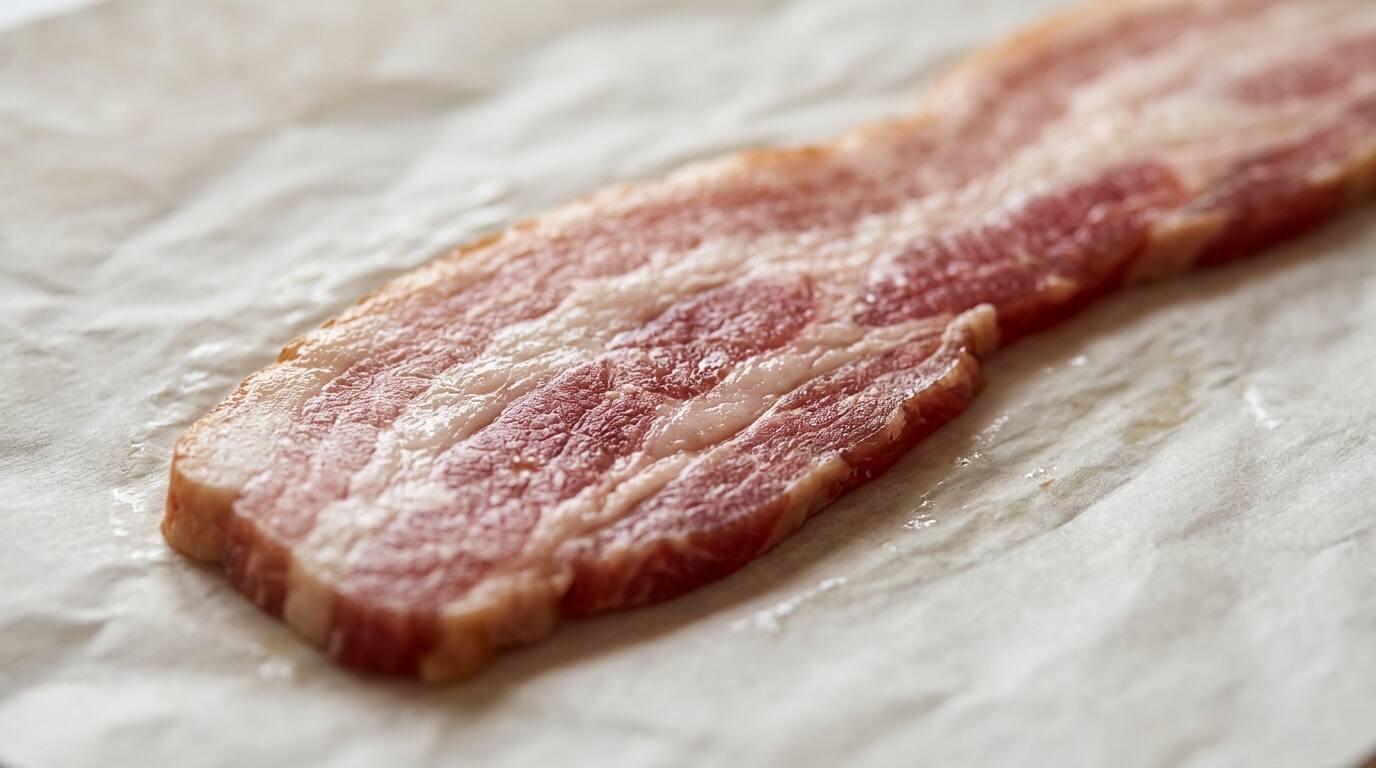
A strip of American bacon shows bands of white fat beside bands of pink muscle, and that mix is the root of the problem. A 1992 U.S. patent for an industrial bacon process, US 5,132,126 by John Sinkler and John G. Richardson, describes bacon as heterogeneous, with areas of fat and lean in the same slice. The patent notes that bacon slices tend to curl as they cook, which lets pools of melted fat collect on the surface and makes the cooking uneven. Cooked in oil or in a microwave, it says, bacon also shrinks unevenly and wrinkles into a rosette pattern the patent calls “blossoming.”
Water leaves too
Fat isn’t the only thing leaving the slice. Derek Laughren, then test kitchen manager at Food52, wrote in 2014 that thin or fatty bacon curls as water evaporates from the meat and the belly fat renders.
Fat first, or muscle first
Everyone agrees the two parts shrink unevenly. Which one pulls harder is less settled.
The fat pulls the strip in
The explanation most cooking sites give is that the fat shrinks faster. Mr. Cast Iron, in a January 2026 guide, says the fat renders and shrinks faster than the meat, especially when the heat is a little too high, and that this pulls the strip inward. It adds that sugar in store-bought bacon browns quickly and can contract unevenly, and that thick-cut bacon curls too, just more slowly. Tasting Table, in an October 2023 piece by Catherine Nyorani, puts it on the pan: immediate, intense heat makes the fat render out too quickly, which leads to shrinking and curling.
The same logic shows up in steak and pork chops, where cooks call it buckling. Tasting Table’s Chris Sands, writing in June 2022 about pork chops, explains that the band of fat around the edge renders and loses moisture faster than the meat beside it, curling the chop.
The muscle tightens on its own
Meat science adds the other half. In a video published by Britannica, meat scientist Robyn Warner describes testing the long-held idea that connective tissue causes muscle to shrink during cooking. Her team cooked isolated muscle cells under a microscope between 25°C and 95°C and saw them shrink in two separate events, around 55°C and around 75°C. Because the cells contained no connective tissue, she concluded the shrinkage comes from inside the muscle structure itself.
So the lean in a strip of bacon is contracting on its own schedule, while the fat beside it is melting and shrinking on another. Which side wins at any moment depends on the heat, the cut and how much fat the slice carries, and the sources above don’t settle it beyond that.
Water in the pan
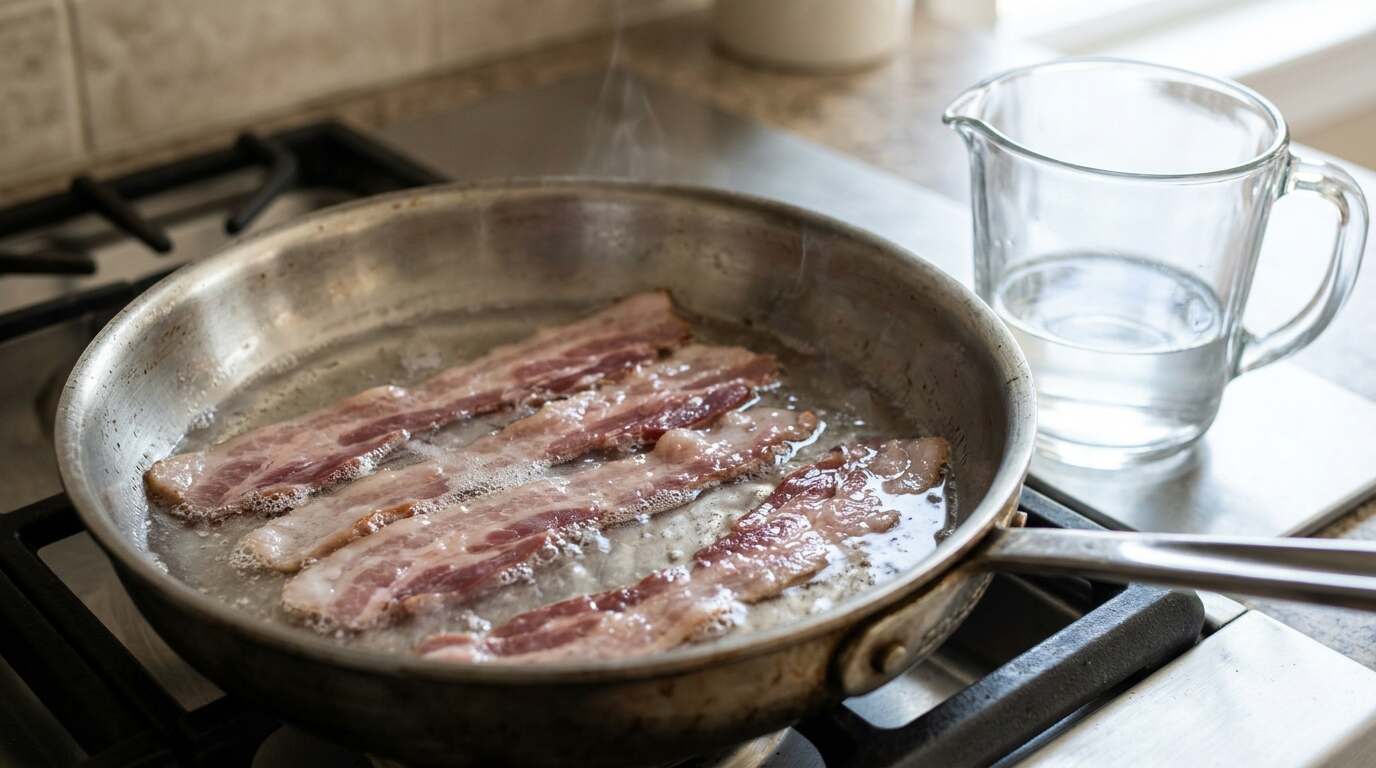
The fix most cited now is counterintuitive: add water. Cook’s Illustrated, in May 2022, recommended starting bacon in a cold pan with a tablespoon or two of water over medium heat. The water keeps the starting temperature low and gentle, so the meat holds onto its moisture while the fat renders, and by the time the water boils off, most of the fat has rendered already. The result, the magazine says, is bacon that is “tender and crisp, not dry and brittle.”
What the water does to the curl
Cook’s Illustrated didn’t frame the method as a curl fix. Lindsay Parrill, testing it for Taste of Home in February 2026, did. Because water can’t get hotter than its boiling point while it simmers, she wrote, a little in the pan caps the temperature early on, giving the fat time to render slowly and keeping the bacon from tightening, curling and scorching. Her pan splattered less, and the finished strips had fewer burnt edges and chewy spots.
Cold pans, presses and racks
The other fixes work on the same principle: slow the heat or hold the strip down.
- A cold start. Tasting Table recommends laying bacon in a cold skillet and bringing it up over low to medium heat, so the fat renders slowly and the strip keeps its shape. Mr. Cast Iron is less convinced, saying a cold start may slow curling slightly but won’t eliminate it, especially in cast iron.
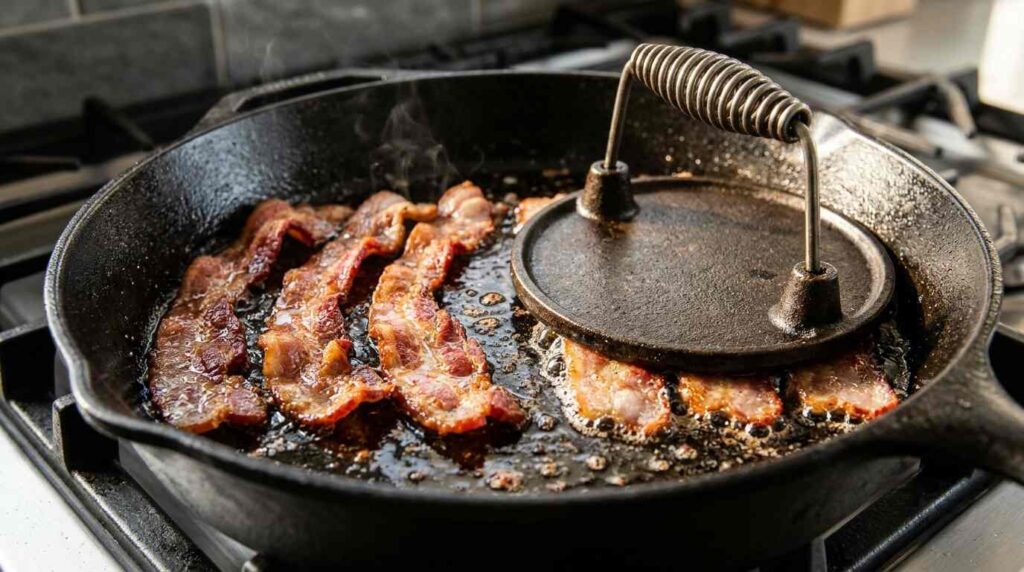
- A press. Mr. Cast Iron’s main recommendation is weight: set a grill press or bacon press on the strips once they start to curl, and put it back after each flip.
- A second rack. In the oven, Food52 bakes bacon on a wire rack over a foil-lined tray at 350°F or 375°F for about 10 to 20 minutes. For thin or fatty strips that still curl, it lays a second rack face-down on top.
- Slits in the fat. For pork chops, Tasting Table cites Food & Wine recommending cuts into the fat about every half inch, and Cook’s Country suggesting one about every two inches. None of the bacon sources above tested slits on bacon strips.
How the factories do it
The industrial answer is a cage. The 1992 patent sandwiches raw slices between a pair of screens and runs them through hot oil at 250°F to 300°F for about three to five minutes, holding them flat so they come out a uniform size and shape. It’s a bacon press, scaled up.
Why it matters on a sandwich
Flat bacon is a construction problem as much as a cooking one. A BLT depends on strips that cover the bread edge to edge, and a bacon, egg and cheese or a British bacon butty needs bacon that lies down under the next layer. The browning itself is the Maillard reaction at work, the same chemistry GrillCheesy covers in bread browning.

For flat bacon
The tools from the methods above.
- Norpro 8.75-Inch Cast Iron Bacon Press with Wood Handle, Round: a round cast iron bacon press for holding strips flat in the pan, the weight method Mr. Cast Iron recommends. See it on Amazon (affiliate link)
- Lodge Pre-Seasoned Cast Iron Grill Press, 6.75 x 4.5 Inches: a rectangular cast iron grill press, another way to weigh down curling bacon. See it on Amazon (affiliate link)
- Lodge Pre-Seasoned Cast Iron Skillet, PFAS-Free, 12 Inches: a 12-inch cast iron skillet wide enough for a full batch of strips. See it on Amazon (affiliate link)
As an Amazon Associate I earn from qualifying purchases. A commission may be earned if you buy through this link, at no extra cost to you.
Frequently asked questions
Why does bacon curl when cooked?
Fat and muscle in the same slice shrink at different rates as the fat renders and water leaves the meat, so the strip warps.
Does the fat or the meat shrink faster?
Sources disagree. Cooking guides such as Mr. Cast Iron say the fat shrinks faster; meat scientist Robyn Warner’s work shows muscle cells contract on their own at around 55°C and 75°C.
How can bacon be kept from curling?
Gentler heat (a cold start or a little water in the pan), a bacon press, or baking it between two wire racks.
Does cooking bacon in water stop curling?
Cook’s Illustrated says water renders the fat gently; Taste of Home’s test credits that slower rendering with keeping bacon from tightening and curling.
Sources
- John Sinkler and John G. Richardson, U.S. Patent 5,132,126, “Process for preparing a bacon product” (1992): https://patents.google.com/patent/US5132126A/en
- Derek Laughren, “How to Cook Flat Bacon,” Food52 (September 11, 2014): https://food52.com/blog/11257-how-to-cook-flat-bacon
- Mr. Cast Iron, “How to Cook Bacon Without It Curling” (January 25, 2026): https://mrcastiron.com/how-to-cook-bacon-without-it-curling/
- Catherine Nyorani, Tasting Table (October 7, 2023): https://www.tastingtable.com/1410437/tip-avoid-curled-back-start-cold-skillet/
- Chris Sands, “The Best Way To Prevent Pork Chops From Curling,” Tasting Table (June 14, 2022): https://www.tastingtable.com/895022/the-best-way-to-prevent-pork-chops-from-curling
- Britannica, “Hear about the experimental findings on meat tenderness, muscle cell shrinkage, and loss of water while cooking meat”: https://www.britannica.com/video/186252/findings-muscle-cell-shrinkage-meat-cooking
- Cook’s Illustrated, “Ensuring Crisp-Tender Bacon” (May 13, 2022): https://www.cooksillustrated.com/how_tos/6459-ensuring-crisp-tender-bacon
- Lindsay Parrill, “Cooking Bacon in Water,” Taste of Home (February 18, 2026): https://www.tasteofhome.com/article/cooking-bacon-in-water/