In this story
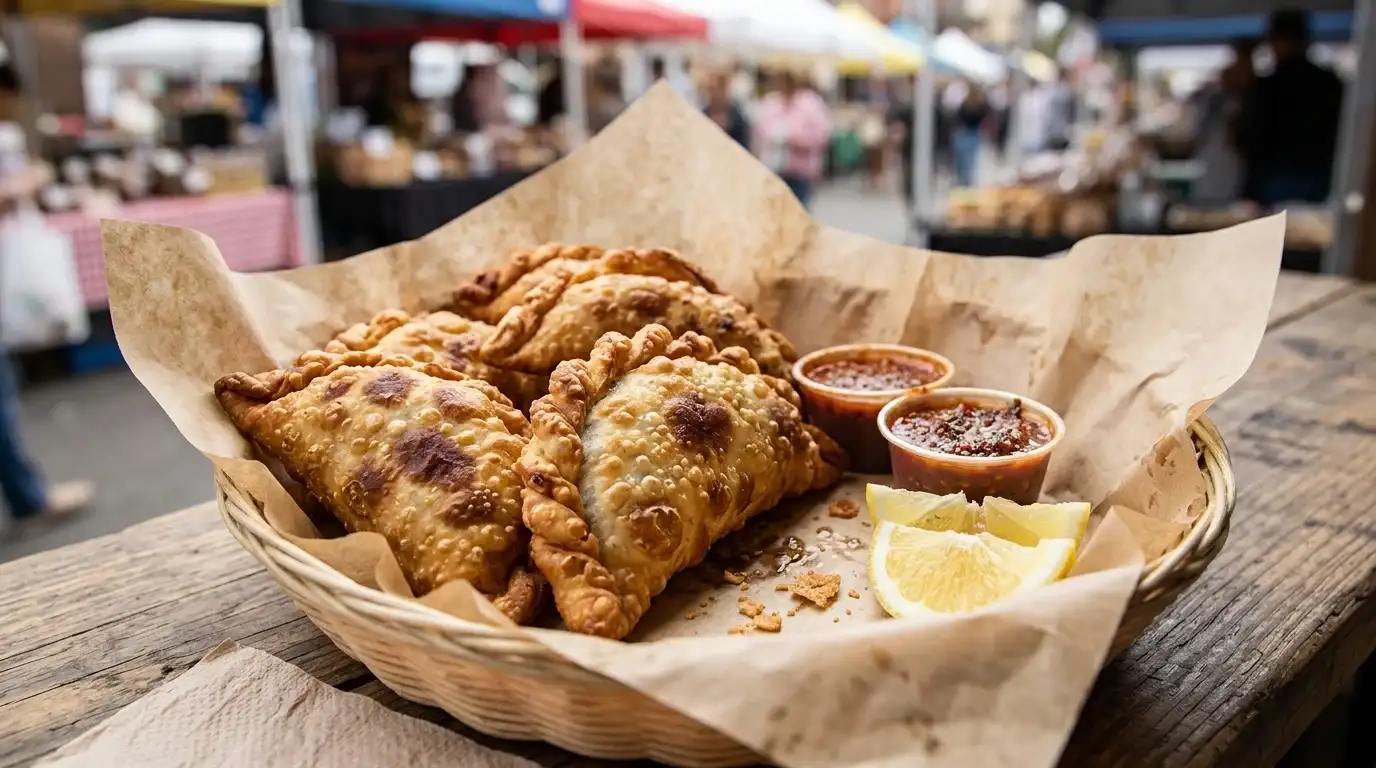
An empanada is a filling wrapped in dough and baked or fried. That definition covers a wide range: a big round pie cut into wedges in a Galician bakery, a palm-sized crimped half-moon in a Buenos Aires delivery bag, and dozens of regional versions in between. The name is Spanish and literal. The idea is older than Spain, and its most devoted modern home is across the Atlantic.
Video: Repulgue, The Disappearing Art of Sealing and Crimping Argentine Empanadas, from the Hugo RDU YouTube channel
Encased in bread
The name and the deeper roots
The word describes the method. John Barlow, writing for Foods & Wines from Spain, the Spanish trade promotion site, in 2023, explains that empanada likely comes from empanar, “to encase in bread.” He suggests that Arab pastries filled with lamb, such as fatays and sfihas, may have inspired the idea in Spain.
Some histories reach further back. A Google Arts & Culture story on the empanada’s long journey traces the earliest references to ancient Persia, as bread filled with vegetables that shepherds and travelers carried, and follows similar pastries across Asia Minor and North Africa under names like sfiha and samosa. The Moors, it says, brought such pastries to medieval Spain. These are broad lines of descent rather than documented recipes, and they show how many cultures arrived at the same solution: wrap food in dough and carry it.
Galicia and the pilgrims
An empanada carved in stone
Spain’s strongest empanada tradition belongs to Galicia, in the northwest. Barlow describes Galician empanadas as usually round, about 20 to 30 centimeters across, and among the region’s most widely eaten foods, sold in bakeries and bars and brought to celebrations.
The evidence for its age is in stone. At the Pórtico de la Gloria of Santiago de Compostela Cathedral, a twelfth-century carving shows a penitent trying to eat an empanada while a noose keeps him from swallowing, Barlow writes. El Español’s Galician edition, Quincemil, reported in 2020 that the sculptor, Maestro Mateo, also carved an empanada on corbels of the Palacio de Gelmírez in Santiago, showing four diners about to eat one, and that Alfonso X mentioned the empanada in his Cantigas de Santa María.
Pilgrims on the Camino de Santiago carried empanadas as portable meals, Barlow notes. A sealed pie travels well.

The Galician fillings
Zorza, tuna and cod with raisins
Galician empanadas are a bread dough wrapped around whatever the region has. Barlow describes the dough as usually wheat, sometimes with rye, lightly leavened, traditionally made with pig fat and glazed with egg. The fillings he lists include zorza and raxo, two preparations of seasoned diced pork; tuna, especially in the fishing town of Burela; cod with sultanas, traditionally eaten during Lent; sardines; eels, ray and octopus. In the Rías Baixas, corn-based dough wraps mussels, cockles or cuttlefish.
Quincemil adds scallops, meat with peppers, turnip greens and a lamprey version to the list.
Across the Atlantic
From conquistadors to the Andes
The Spanish brought the empanada to the Americas. The Google Arts & Culture story credits conquistadors and colonizers with carrying it there, where local ingredients and traditions reshaped it, and says it became especially popular in the Andean region.
Argentina took it furthest. The same story lists common Argentine fillings as beef, chicken, humita (sweet corn), ham and cheese, and vegetables. Meat versions often include onion, hard-boiled egg and olives, seasoned with cumin, sweet paprika and chili. It cites the early Argentine cookbook author Susana Torres de Castex, who recommended a brick or country oven with heat above and below.

Tucumán and the repulgue
Knife-cut beef, lemon and thirteen folds
Tucumán, in Argentina’s northwest, treats the empanada as its signature. Google Arts & Culture reports that the National Empanada Festival has been held in the town of Famaillá every September since 1979, ending with a national championship.
A Google Arts & Culture profile of Napo Castellote, a Tucumán-born cook who sells his empanadas in Buenos Aires, describes the provincial style: knife-cut matambre (beef flank), onion, cumin, paprika, green onion and hard-boiled egg, in a dough of wheat flour and lard, either baked in a clay oven or fried in lard. Tucumanos squeeze lemon on top. Castellote explains it simply: “The acid really accentuates the flavors.”
The seal is an art of its own. The braided crimp along the edge is called the repulgue, and the same profile reports a Tucumán tradition that an empanada should have exactly 13 folds, one for Jesus and each of the twelve apostles.
The empanada as a handheld
Built for walking, built for delivery
The empanada fits the same niche as the burrito and the taco: a sealed, portable meal that needs no plate. The pilgrim’s pie and the delivery-box half-moon solve the same problem. Castellote’s business, the profile notes, sells more than 120 dozen frozen empanadas a week for customers to bake or fry at home.
Frequently asked questions
Where do empanadas come from?
Spain, especially Galicia, where a twelfth-century carving at Santiago Cathedral shows one. Similar filled pastries existed earlier across the Middle East and North Africa.
What does empanada mean?
It comes from the Spanish empanar, to encase or wrap in bread.
What is a repulgue?
The braided crimp that seals an Argentine empanada along its edge.
Why do Tucumán empanadas have 13 folds?
Tradition holds the 13 folds honor Jesus and the twelve apostles.
Sources
- John Barlow, “Galician Empanada: Hooked on a Filling,” Foods & Wines from Spain (June 12, 2023): https://www.foodswinesfromspain.com/en/food/articles/2023/june/galician-empanada-hooked-filling
- Quincemil, El Español, “El humilde y discutido origen de la empanada gallega” (July 28, 2020): https://www.elespanol.com/quincemil/cultura/gastronomia/20200728/humilde-discutido-origen-empanada-gallega/508700698_0.html
- Google Arts & Culture, “From Ancient Persia to the Andes: The Long Journey of the Empanada”: https://artsandculture.google.com/story/TwXRamw9CP5rjA
- Google Arts & Culture, “Napo’s Empanadas Tucumanas”: https://artsandculture.google.com/story/1gWxswj6eTzszQ