
In this story
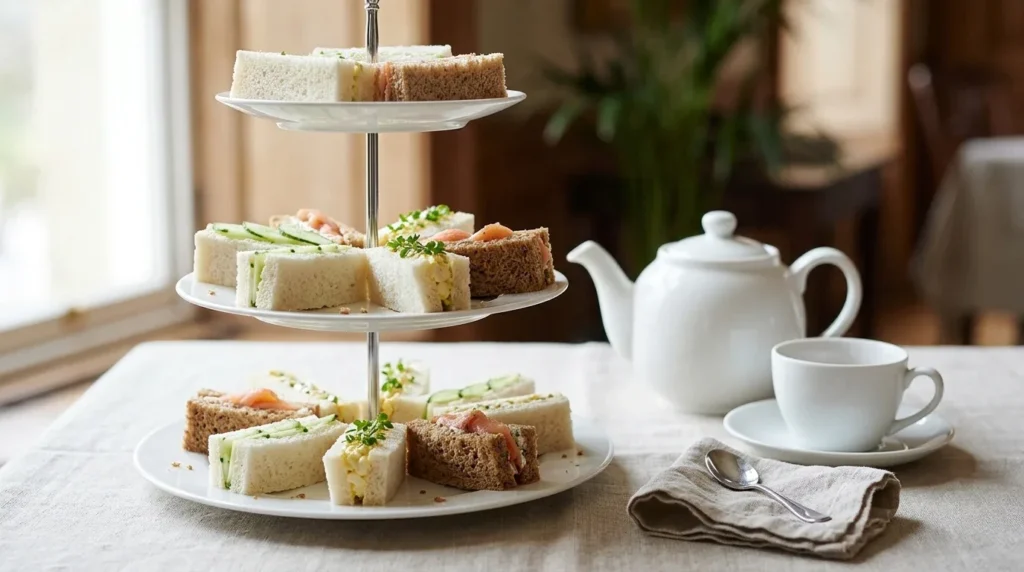
The English tea sandwich is a small, crustless, thinly sliced thing that exists to fill a gap between lunch and a late dinner. Its history is tied to the habit of afternoon tea, a meal usually credited to Anna Maria Russell, Duchess of Bedford, in the 1840s, although the sources that repeat the story also supply reasons to doubt it. The sandwich itself, with its cucumber, egg, salmon and chicken fillings, took shape later and in stages.
Video: Afternoon Tea Sandwiches, Auntie A’s Kitchen
The Duchess of Bedford and the 1840 story
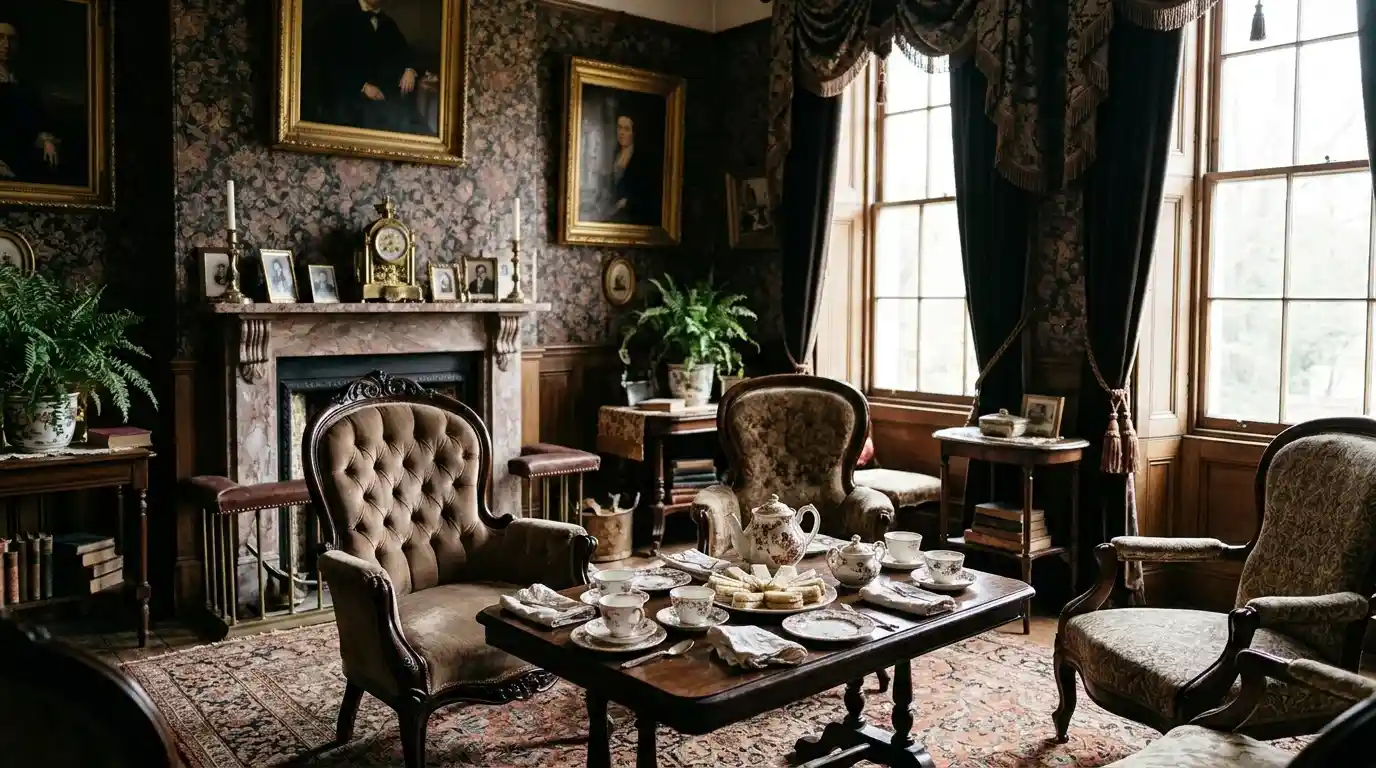
The most common account gives afternoon tea to Anna, the seventh Duchess of Bedford, and dates it to 1840. Historic UK describes the problem she supposedly set out to solve: the household dined at eight in the evening, which left a long stretch after lunch, so she asked for a tray of tea, bread and butter, and cake to be brought to her room. The habit stuck, and she began inviting friends to join her. Saveur gives the same year and the same reasoning, placing the invention between lunch and a fashionable eight o’clock dinner.
Other accounts move the date around. The British Museum says she invented the meal “sometime around 1840” and notes that she served as one of Queen Victoria’s ladies-in-waiting. The Irish Times reports that the invention is “widely attributed” to her and cites the Woburn Abbey website, which describes her position as a lady-in-waiting to the queen and says she began the custom of taking tea at around five in the afternoon. The Treasure Houses of England page puts her popularising of the custom in the 1840s and says she entertained friends at Woburn Abbey.
The sandwich is absent from the earliest versions of the story. The tray in the Historic UK account holds bread and butter and cake, and the Grundy Museum describes the original light meal as tea, bread and cake, with finger sandwiches, scones and pastries arriving later as the meal grew into a social event.
Competing credit and earlier tea
The attribution has never been settled. The Irish Times article cites a tea-focused website that dates a light late-afternoon meal to the 1740s, a century before the duchess, and questions how much of the modern ritual she originated. The article suggests her real contribution may have been fashion: the bite-sized sweet and savoury foods, the multiple trays, and the move of the whole affair into the drawing room.
The Wikipedia entry on tea as a meal, which compiles earlier references and is used here only as a pointer to them, goes further. It describes her as the commonly cited originator and presents two competing theories, one in which afternoon tea predates her because British mealtimes were already shifting, and another in which she formalised an informal custom by setting its etiquette and menu. It lists earlier mentions of afternoon tea, including letters by Madame de Sévigné (1626 to 1696) referring to “thé de cinq heures,” a description of afternoon tea or coffee at Harrogate in 1763, and a summons to tea in Fanny Burney’s novel Evelina of 1778. The Grundy Museum likewise mentions afternoon tea at spas in the eighteenth century.
A food blog, Condiment Claire, describes the duchess story as “potentially a legend,” while still treating it as the likeliest starting point. Taken together, the sources agree on a narrower point than the popular version does: afternoon tea became a fashionable meal in the middle of the nineteenth century, and the duchess is the name most often attached to it. No source fetched for this post names a rival claimant who took the title from her. The competition is between her and a slower, anonymous change in how late Britons ate dinner.
The cucumber sandwich
Of all the fillings, cucumber carries the most weight. Saveur calls peeled cucumber sliced wafer-thin onto buttered brown bread the apex of the English teatime snack, and points to Oscar Wilde’s play The Importance of Being Earnest, in which a character eats the entire plate before his aunt arrives.
The reason the filling was a status symbol is practical. Country Life explains that growing cucumbers in Britain took hothouses, which consumed fuel and space, so the vegetable was costly and linked with the elite. Victorian growers even forced cucumbers into straight shapes using hand-blown glass tubes. The same article cites historian Gillian Perry on the point that a cucumber sandwich signalled social standing, since afternoon tea was largely a pastime of the upper middle class and the aristocracy. Cheap coal in the middle of the nineteenth century made hothouse cultivation more widespread, according to the piece. Another account, from Condiment Claire, says cucumbers stayed a luxury until the Edwardian era, when they grew more affordable.
The origin of the sandwich is reported with hedges. Country Life says it began in India, where British officials reportedly cooled off with local cucumbers and then put them between slices of white bread and carried the idea home. Tasting Table also says British colonists in India reportedly invented it, and adds that the sandwich became popular in the Victorian era as part of tea and peaked in the Edwardian period. None of these pieces points to a dated recipe or a named inventor.
Preparation varies by author. Country Life reports that author Clarissa Dickson Wright recommended salting the cucumber, rinsing it, and dressing it with oil and pepper, while Mrs Beeton added vinegar or lemon juice for acidity. Sarah Tyson Rorer, in her 1894 book Sandwiches, advised soaking the slices in iced water to keep them crisp. Condiment Claire notes that the original combination was cucumber, butter and white bread, and that American versions later replaced the butter with cream cheese. Lovefood gives the classic form as thin slices of peeled cucumber with butter and a careful dusting of white pepper.
Thin bread and no crusts
The bread matters as much as the filling. Lovefood identifies the traditional loaf as a white Pullman loaf, named after railway carriages because its long, flat-sided tin produces a square loaf that slices into neat, even shapes. The crusts are removed. Country Life adds that Winston Churchill reportedly insisted on wafer-thin bread whose only job was to carry the filling, and that Dickson Wright was taught by a lady’s maid to cut slender slices with a knife heated in boiling water.
None of the pages fetched for this post explains why crusts are cut off. Country Life notes that a leading London hotel serves crustless fingers without stating a reason, and the other sources treat the trimming as the rule and move on.
Proportion is part of the same discipline. According to Lovefood, a tea sandwich should be small enough to be eaten in “no more than two bites,” and fillings stay sparing. Saveur puts the idea in a sentence: “Tea sandwiches should know their place.” The author means that they should be filling enough to dull appetite for the scones, cream, jam and iced cakes that come after, and nothing more. Country Life cites Mrs Beeton’s 1861 Book of Household Management for the view that sandwiches served at afternoon tea were too flimsy to satisfy real hunger, which suggests the lightness was understood as a feature of the form from early on.
Egg and cress, smoked salmon and other fillings
Egg and cress is the other standard. Saveur’s article describes eggs boiled not quite hard, mashed with butter, salt and pepper, and topped with watercress, a version made by the author’s grandmother’s cook. Saveur’s published recipe for it gives precise timings: boil the eggs for 5 minutes for slightly runny yolks or 6 minutes for firm ones, cool them under cold water, peel them while still warm, and mash them with softened butter until it melts. The mixture is spread on white bread, watercress goes on top, and the crusts come off afterward.
A different recipe moves the egg toward mayonnaise. delicious. magazine boils its eggs for 8 minutes and folds them, roughly chopped, into a homemade mayonnaise seasoned with English mustard, vinegar and cayenne, then adds crisp pancetta and rocket. The same recipe cooks salmon over Earl Grey leaves in a covered roasting tin, flakes it, and mixes it with crème fraîche, lemon zest and capers before spreading it on the bread with watercress. That is a long way from sliced smoked salmon, though Lovefood reports that smoked salmon, egg mayonnaise and ham are the fillings a London hotel serves at its afternoon tea.
The Victorian range was broader than the modern one. The British Museum mentions that finger sandwiches at Victorian afternoon tea came in assorted fillings, with cucumber already on the menu and more adventurous options including anchovy, sardine and beef tongue.
Coronation chicken
Coronation chicken belongs to a later moment than the cucumber sandwich and arrived as a salad before it became a filling. It was devised for the luncheon after Queen Elizabeth II’s coronation on 2 June 1953. Borough Market says the lunch was for several hundred foreign dignitaries in London and not, as is often claimed, the main banquet at Buckingham Palace. A report on the dish’s creation puts the number at about 350 and the venue at the Great Hall of Westminster School, and gives the original name as Poulet Reine Elizabeth.
The credit for the recipe is contested between two women. Florist Constance Spry organised the occasion and is often given the dish. Borough Market says it was actually the work of her friend and collaborator, the chef Rosemary Hume, who had founded a cookery school in Victoria in 1933. The Yahoo report quotes food historian Dr Annie Grey as crediting Hume almost entirely and says Spry played a smaller role than the legend gives her. The recipe first appeared in print in The Constance Spry Cookery Book in 1956, according to Borough Market.
The original was not a budget dish, despite a common belief. The Yahoo report says chicken was expensive and rationing continued, so it was a luxury. The first version, as that report describes it, was a poached chicken in a sauce of onion, curry powder, tomato purée, red wine, lemon and apricot purée, combined with whipped cream and mayonnaise, served with a rice salad. Borough Market describes Hume’s version as mild and creamy, with no sultanas, designed for a rice salad and not a sandwich. A theory linking the recipe to King George V’s Silver Jubilee is dismissed in the Yahoo report as a myth.
The sandwich came later. Neither source says exactly when or where chicken in curried mayonnaise first went between bread. Both report the result: a sweeter, yellow, curry-flavoured filling, sometimes with sultanas or pineapple, which turned into a popular supermarket sandwich.
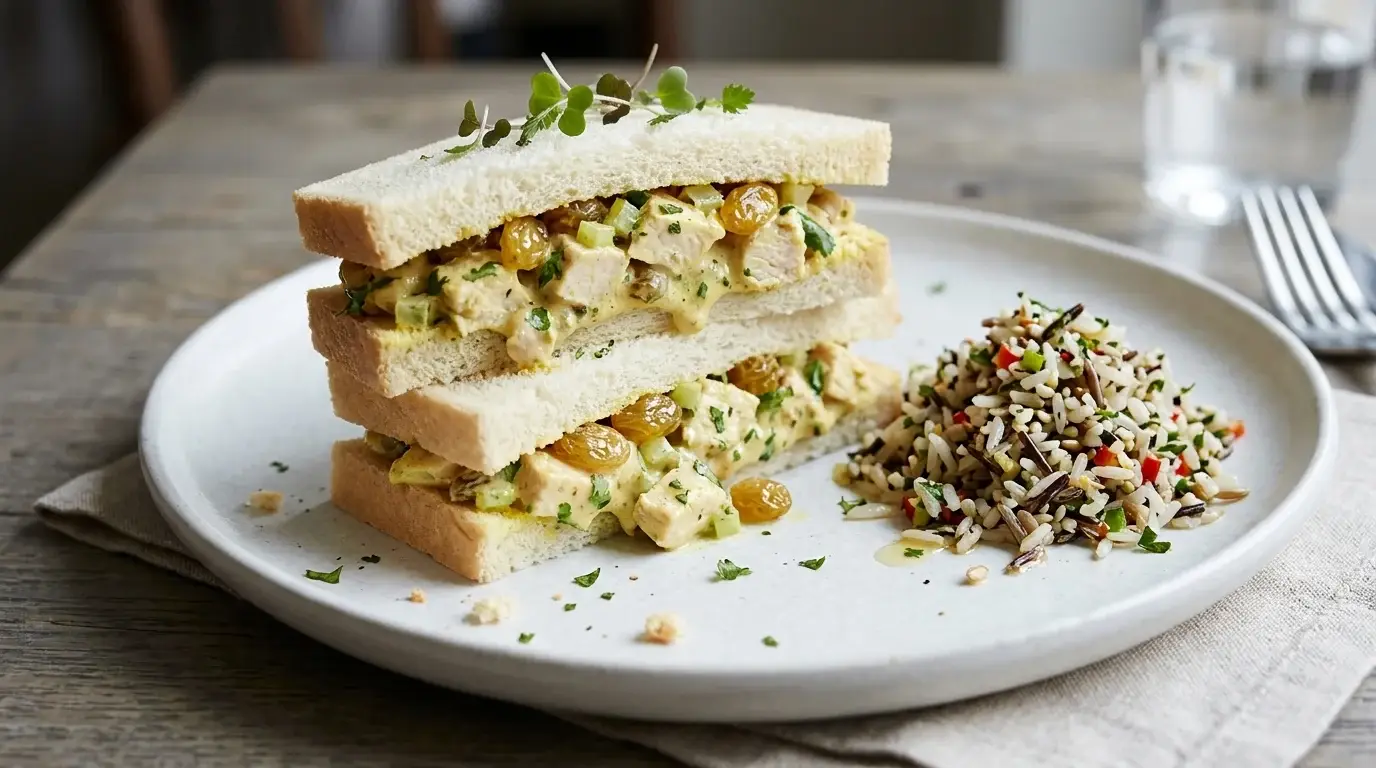
Cutting a finger sandwich
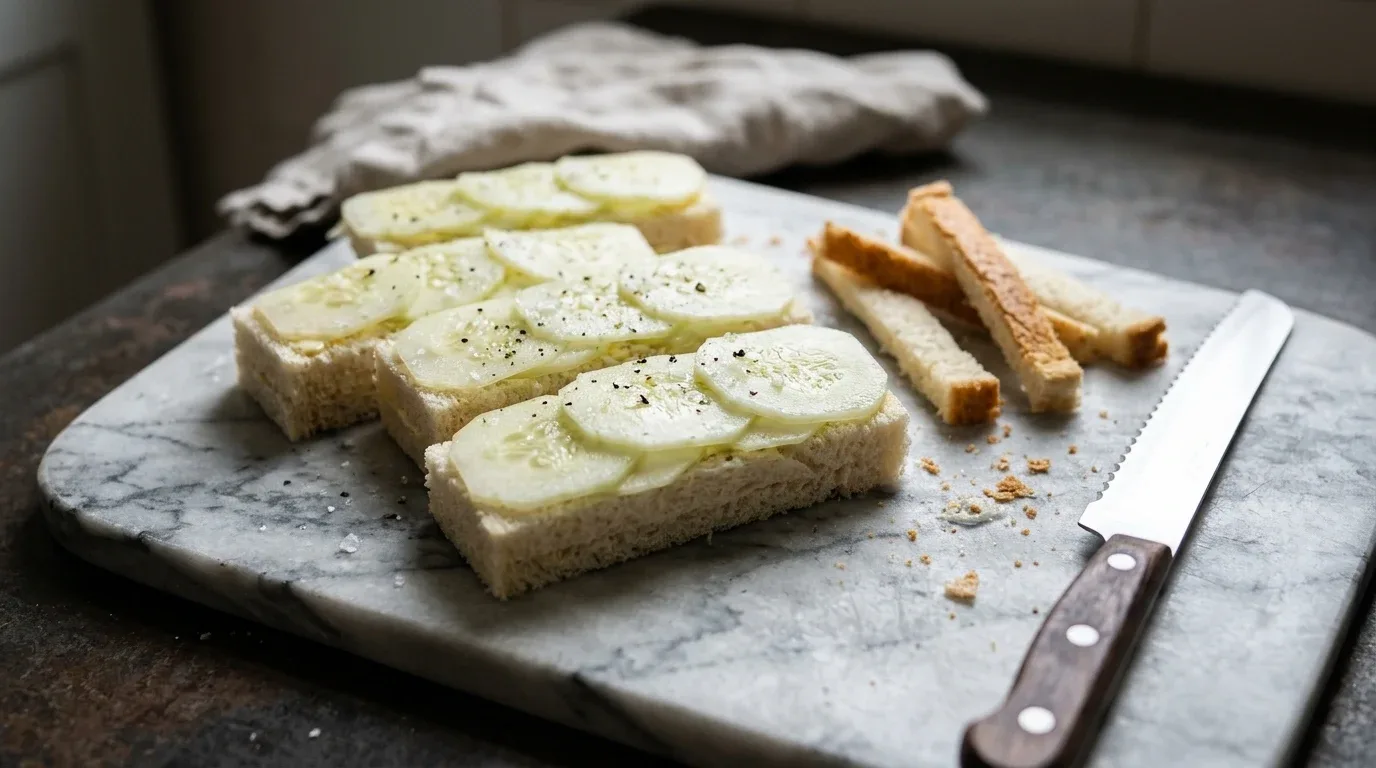
The recipes fetched for this post differ on shapes, but each ends the same way: a closed sandwich, trimmed of crusts and cut into small portions. Saveur’s recipe note says the finished sandwich is cut into four triangles or two rectangles, arranged in stacks of two. delicious. magazine cuts each into three fingers, using ten slices of bread to make fifteen fingers. A recipe on Culinary Ginger wraps the assembled sandwiches in plastic and chills them for fifteen minutes so the fillings set, then trims the crusts with a serrated knife and cuts each into three strips measuring roughly 7.5 by 4 centimetres.
The order of work differs between cooks. Saveur’s egg recipe assembles the sandwich and trims the crusts afterward, while delicious. magazine removes the crusts first and then butters the slices. No source claims that one sequence is correct.
Fillings are the part where the sources diverge most. Country Life notes that one London hotel works to a ratio of two parts bread to one part filling, though the source does not say how widely that rule is followed.
Sources:
- Historic UK, Afternoon Tea: https://www.historic-uk.com/CultureUK/Afternoon-Tea/
- Irish Times, Who invented afternoon tea?: https://www.irishtimes.com/life-and-style/food-and-drink/who-invented-afternoon-tea-1.3809973
- Saveur, Standing on Ceremony: The History of Tea Sandwiches: https://www.saveur.com/article/Travels/Standing-on-Ceremony-Tea-Sandwiches
- Saveur, Egg and Watercress Sandwich: https://www.saveur.com/article/Recipes/Egg-And-Watercress-Sandwich
- Country Life, The caviar of its day: How the cucumber sandwich conquered tea time: https://www.countrylife.co.uk/lifestyle/food-drink/the-caviar-of-its-day-how-the-cucumber-sandwich-conquered-tea-time
- British Museum, Tea-rific history of Victorian afternoon tea: https://www.britishmuseum.org/blog/tea-rific-history-victorian-afternoon-tea
- Treasure Houses of England, Afternoon Tea at the Treasure Houses of England: https://treasurehouses.co.uk/2018/08/afternoon-tea-at-the-treasure-houses-of-england/
- Grundy Museum, The Origins of Victorian Tea: https://grundymuseum.org/the-origins-of-victorian-tea/
- Wikipedia, Tea (meal): https://en.wikipedia.org/wiki/Tea_(meal)
- Condiment Claire, A brief history of afternoon tea: https://condimentclaire.substack.com/p/a-brief-history-of-afternoon-tea
- Tasting Table, How the Victorian Era Brought About Cucumber Sandwiches: https://tastingtable.com/899217/how-the-victorian-era-brought-about-cucumber-sandwiches
- Lovefood, Great British Sandwiches: The Tea Sandwich: https://lovefood.com/news/58998/great-british-sandwiches-the-tea-sandwich
- delicious. magazine, Finger sandwiches: https://www.deliciousmagazine.co.uk/recipes/finger-sandwiches/
- Culinary Ginger, 3 Classic Afternoon Tea Sandwiches: https://culinaryginger.com/wprm_print/3-classic-afternoon-tea-sandwiches-from-the-ritz-london
- Borough Market, Crowning glory: https://boroughmarket.org.uk/market-blog/crowning-glory/
- Yahoo News UK, How Le Cordon Bleu London created the iconic coronation chicken recipe: https://uk.news.yahoo.com/le-cordon-bleu-london-created-130000118.html
- YouTube, Afternoon Tea Sandwiches (Auntie A’s Kitchen): https://www.youtube.com/watch?v=1sLqwPpxcmc