In this story
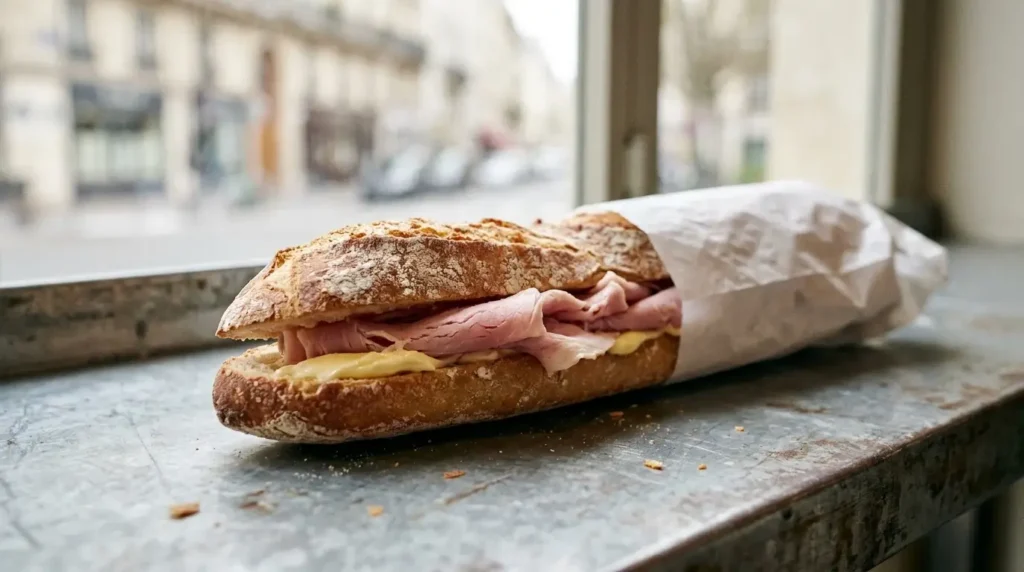
A jambon-beurre is a split baguette, a layer of butter and a few folds of cooked ham. Nothing else. It is also called a parisien, and it was long the best-selling sandwich in France, counted every year by a consulting firm that turned its price into an index. Its quality, by the accounts of those who make the good ones, nearly disappeared before it came back.
Video: Jambon Beurre in Paris – The Classic French Sandwich, from the Paris Undercurrent YouTube channel
Lunch for the Belly of Paris
Les Halles in the 19th century
The sandwich began at the market. Emily Monaco, writing for VICE in October 2017, placed the first jambon-beurre in 19th-century Les Halles, the central market district nicknamed the Belly of Paris. Market workers ate it as a protein-rich lunch, and it started on round country bread spread with butter and filled with local wet-cured Paris ham.
The baguette came later. Monaco reports that it replaced the round loaf and was the standard base, split lengthwise and buttered, by the 1920s. Her article repeats several legends about who invented the baguette and confirms none of them.
Jambon de Paris
Brined, boned, cooked nine hours
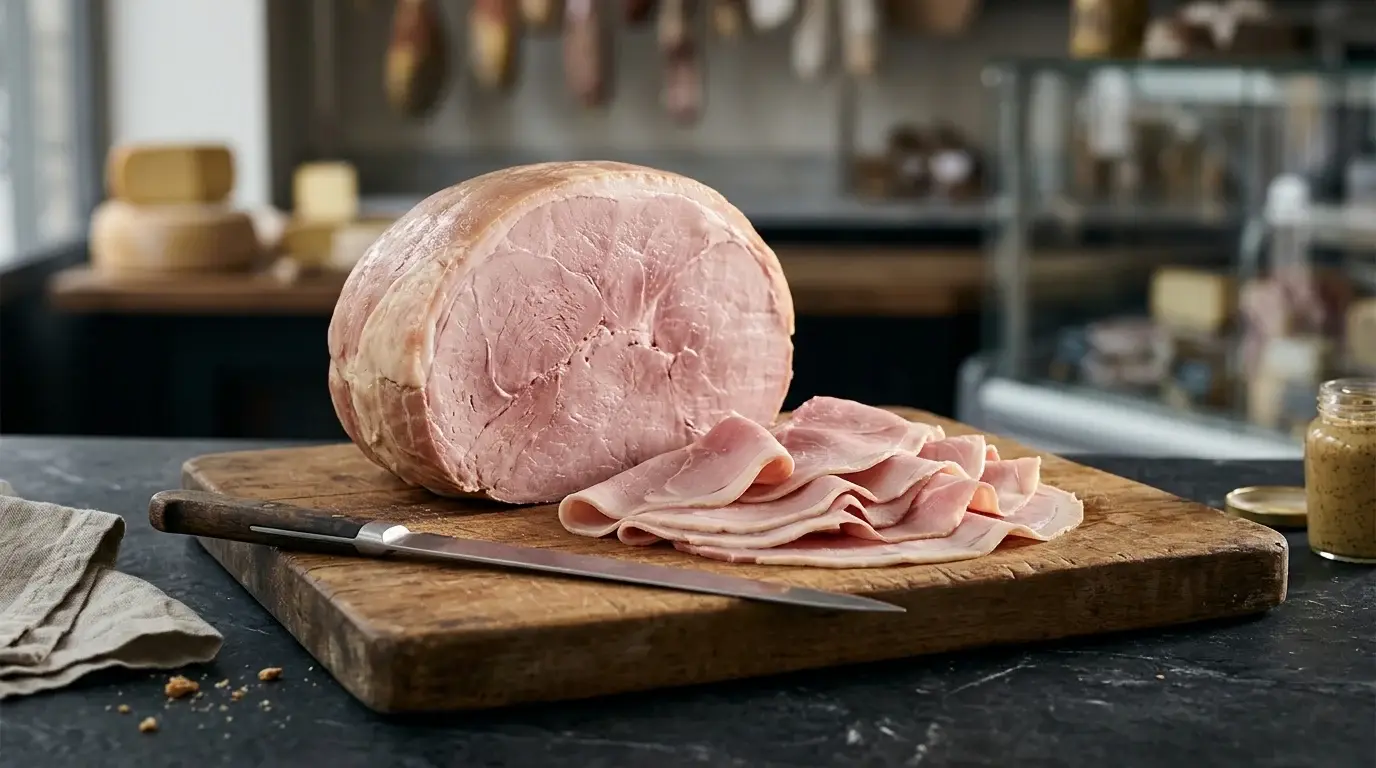
The ham has a specific method. The City of Paris’s gastronomy page, last updated in August 2022, describes the traditional recipe: the boned hind leg of the pig, injected through the artery with a brine of vegetables, spices and Guérande salt, cooked wrapped for eight to nine hours and cooled for several days.
The name is not protected. The city notes that “jambon de Paris” is now also used by industrial producers, and names one remaining artisanal maker in the capital, at 166 rue de Charonne in the 11th arrondissement, as the only producer of the ham Prince de Paris. Monaco profiled the man behind it, chemist Yves Le Guel, who bought the city’s last true Paris ham company in 2005. She reported about 500 hams a week, brined with vegetables and spices and cooked for nine hours at low heat, with a small amount of nitrite salt as the only additive.

How it got cheap
Bland baguettes and supermarket ham
The decline had two halves. By the 1980s and 1990s, Monaco writes, baguettes were bland and “jambon de Paris” had come to mean any sliced wet-cured ham in a supermarket. Food critic François-Régis Gaudry told her the industry had turned the sandwich into a kind of junk food.
The bread recovered first. Monaco dates the baguette de tradition to 1993 in Paris: sourdough starter, shaped by hand and about 40 cents more than a standard baguette. Le Guel described the return to quality bluntly: “People are sick of being cheated.”
The jambon-beurre index
Gira Conseil’s yearly count
The French count their jambon-beurres. The consulting firm Gira Conseil has produced an index of the sandwich’s price since 2008. A 2015 AFP report, carried by WMC, gave 2014 figures of more than 1.28 billion sold, about 58 percent of all sandwiches, at an average price of 2.74 euros.
The share slipped from there. Alice Flores of Réussir reported in March 2017 that 1.199 billion were sold in 2016, down 2.92 percent in volume, still 51 percent of sandwiches by volume, with burgers at about 1.2 billion the same year. The average price had risen 2.97 percent to 2.93 euros, with Paris the most expensive city.
Then the burger passed it. An AFP report published by macommune.info in March 2018 said burger sales reached 1.46 billion in 2017, the first time they topped the jambon-beurre, which sold 1.215 billion and held 50.8 percent of sandwiches, down from 65 percent a decade earlier. The average price was 2.94 euros: 4 euros in Paris, 3.34 in Lyon and Bordeaux, and 2.48 in Tulle, the cheapest city in the index.
For informational purposes only — consult a licensed attorney or financial advisor.
Where to find a good one in Paris
Butter, ham and bread from named suppliers
Monaco’s 2017 list traced each component. Chez Aline, run by Delphine Zampetti, sold its version for 5 euros with Le Guel’s ham, Norman salted butter and a baguette from baker Rodolphe Landemaine, made to order. Yannick Alléno’s Terroir Parisien used Le Guel’s ham with bread from Meilleur Ouvrier de France baker Frédéric Lalos. Eric Fréchon’s Lazare sold one at Gare Saint-Lazare for 7.90 euros. Those were 2017 prices; the city’s average that year, by the Gira index, was 4 euros.
At home, a serrated bread knife splits a crusty baguette cleanly, and butter does the job of a moisture barrier explained in why sandwiches get soggy. The Danish open-faced counterpart, also built on butter, is smørrebrød.

Questions people ask
What is a jambon-beurre? A baguette split and spread with butter and filled with cooked ham, also called a parisien.
Where did the jambon-beurre come from? Les Halles, the Paris central market, in the 19th century, where workers ate it for lunch, per VICE.
How many jambon-beurres are sold in France? Gira Conseil counted 1.215 billion in 2017, when burgers overtook it for the first time with 1.46 billion.
What ham goes in a jambon-beurre? Jambon de Paris, a cooked, wet-cured ham; the City of Paris describes the traditional version as brined by arterial injection and cooked eight to nine hours.
Salted or unsalted butter? Both are used; Chez Aline used Norman salted butter, per VICE.
Sources
- Emily Monaco, VICE, Paris’s Essential Two-Ingredient Sandwich Is Having a Renaissance (Oct. 4, 2017): https://vice.com/en/article/pariss-essential-two-ingredient-sandwich-is-having-a-renaissance
- Ville de Paris, De la frite au mille-feuille, petites et grandes histoires de la gastronomie parisienne (updated Aug. 25, 2022): https://www.paris.fr/pages/de-la-frite-au-mille-feuille-petites-et-grandes-histoires-de-la-gastronomie-parisienne-20064
- AFP via WMC, Le jambon-beurre, sandwich préféré des Français (Mar. 5, 2015): https://www.webmanagercenter.com/2015/03/05/161148/le-jambon-beurre-sandwich-prefere-des-francais-a-augmente-de-plus-de-1-en-2014/
- Alice Flores, Réussir, Le jambon-beurre recule (Mar. 9, 2017): https://www.reussir.fr/lesmarches/le-jambon-beurre-recule
- AFP via macommune.info, Le burger supplante pour la première fois le jambon-beurre en France (Mar. 20, 2018): https://www.macommune.info/le-burger-supplante-pour-la-premiere-fois-le-jambon-beurre-en-france-177431