In this story
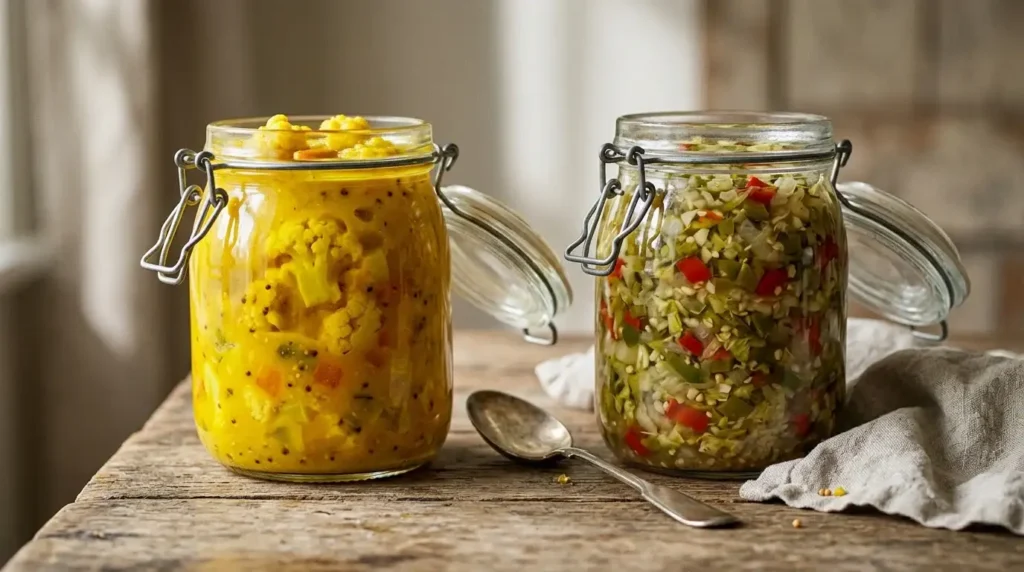
Piccalilli and chow-chow are both relishes of chopped vegetables put up in vinegar, spooned onto sandwiches, hot dogs, beans and cold meat. In Britain, piccalilli is bright yellow with turmeric and mustard. In the American South and Pennsylvania Dutch country, chow-chow runs from sharp to sweet, built on cabbage, peppers and green tomatoes. The two names have been tangled together for more than two centuries, and neither has a settled origin.
Video: Kardea Brown's Southern Chow Chow, from the Food Network YouTube channel
Indian pickle in English kitchens
Glasse, Raffald and the first piccalillo
Piccalilli began as an English imitation of South Asian pickles. The Dictionary of Traded Goods and Commodities 1550–1820 by Nancy Cox and Karin Dannehl, published by British History Online, defines it as a pickle of chopped vegetables and hot spices, nearly always including turmeric, which gives it its color. It was also sold as Indian Pickle, and as “English chow chow.”
The cookbook dates disagree. The dictionary says Hannah Glasse’s first edition of The Art of Cookery, in 1747, had no piccalilli recipe, but that her fifth edition, in 1755, included one for Indian pickle. Wikipedia’s piccalilli entry, used here only as a pointer, cites the Oxford English Dictionary tracing the word to Glasse’s 1758 recipe for Paco-Lilla, or India Pickle. The same dictionary entry credits Elizabeth Raffald with the first known use of the name in a 1772 recipe for Indian Pickle or Piccalillo, close to modern versions, while also noting an OED earliest date of 1769. Wikipedia places Raffald’s recipe in 1769.
Mason and Brown, cited in the dictionary, suggest the name may be a play on the word pickle.
A pickle for the garden glut
Cabbage, cauliflower, kidney beans
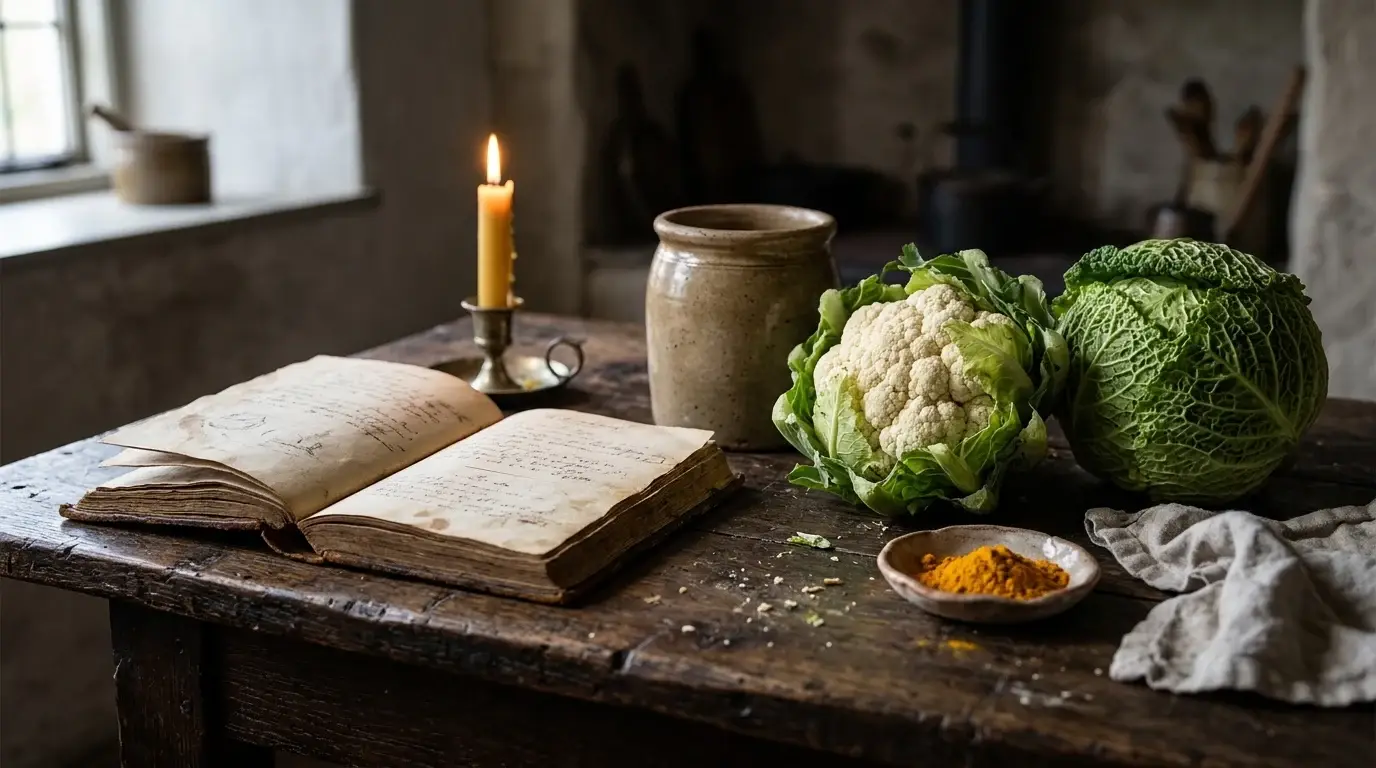
The English version went domestic fast. Cox and Dannehl note that Raffald’s recipe used common garden vegetables, cabbage, cauliflower, cucumber, radish pods, kidney beans and beetroot, or any other thing usually pickled. A trade card from around 1800 advertised a more exotic mix with mangoes, lemons, gherkins, samphire, French beans and carrots. Piccalilli became the favored home pickle, the dictionary says, because it absorbed whatever the garden overproduced.
The same entry records a darker side of commercial pickling: some makers used copper compounds to keep vegetables green, a problem Frederick Accum described in 1820.
Where “chow-chow” came from
Railroad workers, sweetmeats or cabbage
The American name has several explanations. Adrian Hale, writing in Saveur in December 2007, reported the claim that Chinese railroad workers brought chowchow to America in the early 1800s, presenting it as a claim rather than fact. Hale also noted that the word originally described something quite different: “a syrupy concoction of preserved Chinese sweetmeats such as orange peel and ginger.” Only later did it come to mean vegetables in mustard.
A competing theory points to French. Wikipedia’s chow-chow entry), again as a pointer, mentions the French chou, cabbage, and says the name is sometimes used interchangeably with piccalilli. The British trade-card evidence that piccalilli was sold as “English chow chow” in the 18th century, recorded by Cox and Dannehl, fits that overlap.
Northern and Southern
Sweet in Pennsylvania, sharper in the South
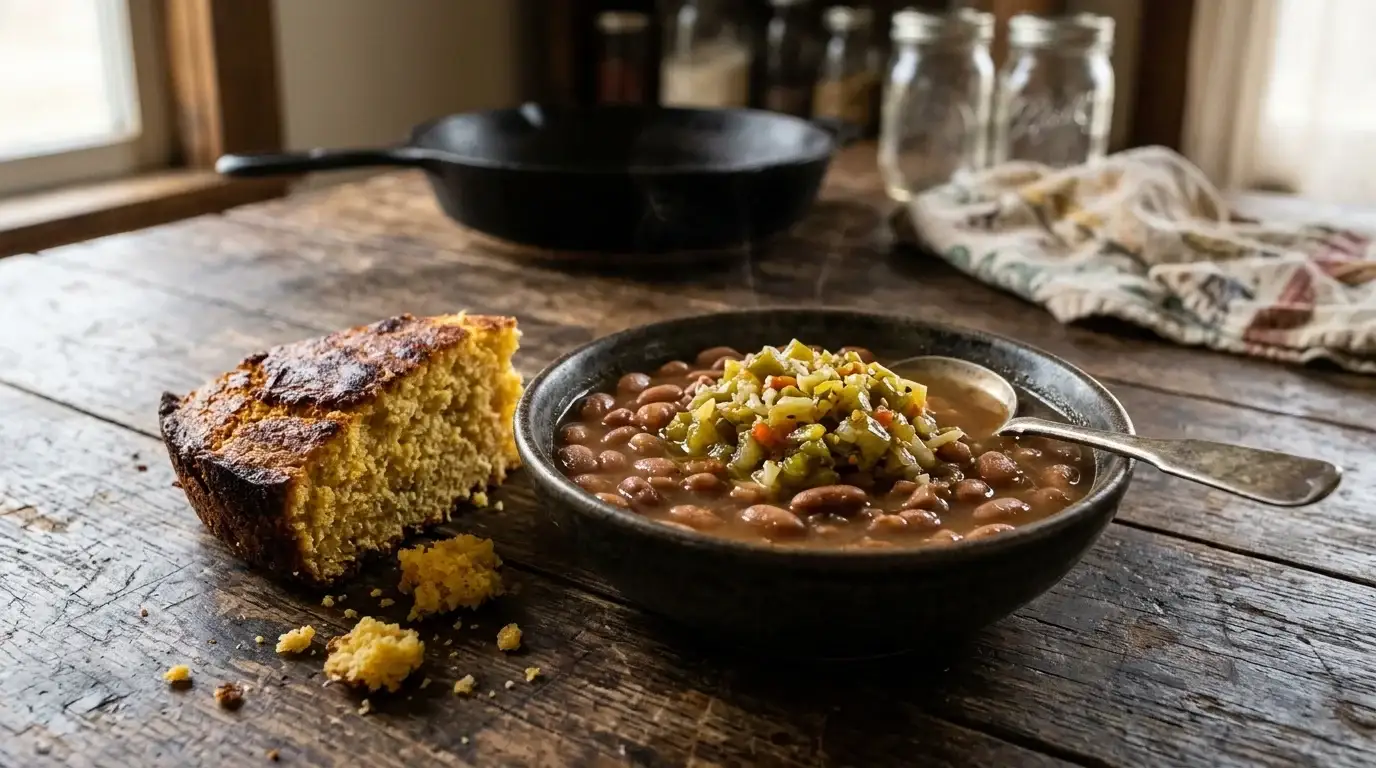
Chow-chow split by region. Northern, primarily Pennsylvania Dutch, chow-chow and Southern chow-chow differ in ingredients and sweetness, according to the Wikipedia entry, which also lists New Mexico, Appalachia and Canada’s Maritime provinces among the places where it is a fixture. It goes on pinto beans, hot dogs, burgers, fish cakes and biscuits.
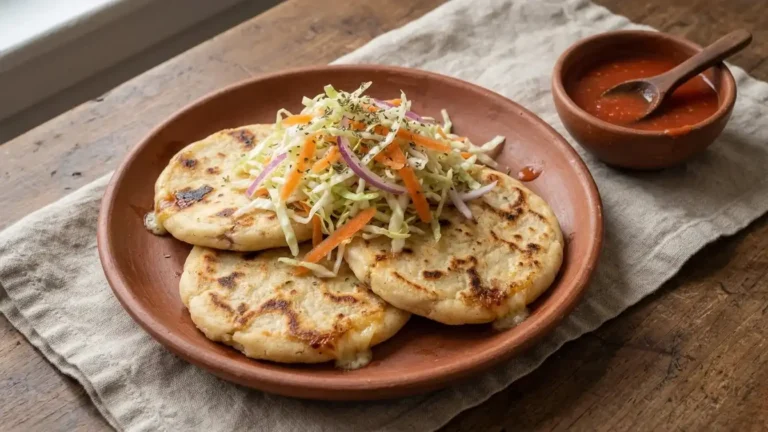
Relish tables on Grill Cheesy follow the same pattern: Chicago’s neon-green relish in the Chicago-style hot dog, the Italian vegetable pickle in giardiniera, Salvadoran cabbage in curtido, and the cucumber in half-sour pickles.
A tested recipe
USDA green tomato piccalilli
The American canning version leans toward chow-chow. The National Center for Home Food Preservation, adapting the USDA Complete Guide to Home Canning (rev. 2015), publishes a piccalilli of green tomatoes, cabbage, onions and red and green peppers, with no turmeric:
- 6 cups chopped green tomatoes
- 1½ cups chopped sweet red peppers
- 1½ cups chopped green peppers
- 2¼ cups chopped onions
- 7½ cups chopped cabbage
- ½ cup canning or pickling salt
- 3 tablespoons whole mixed pickling spice
- 4½ cups vinegar (5 percent acidity)
- 3 cups brown sugar
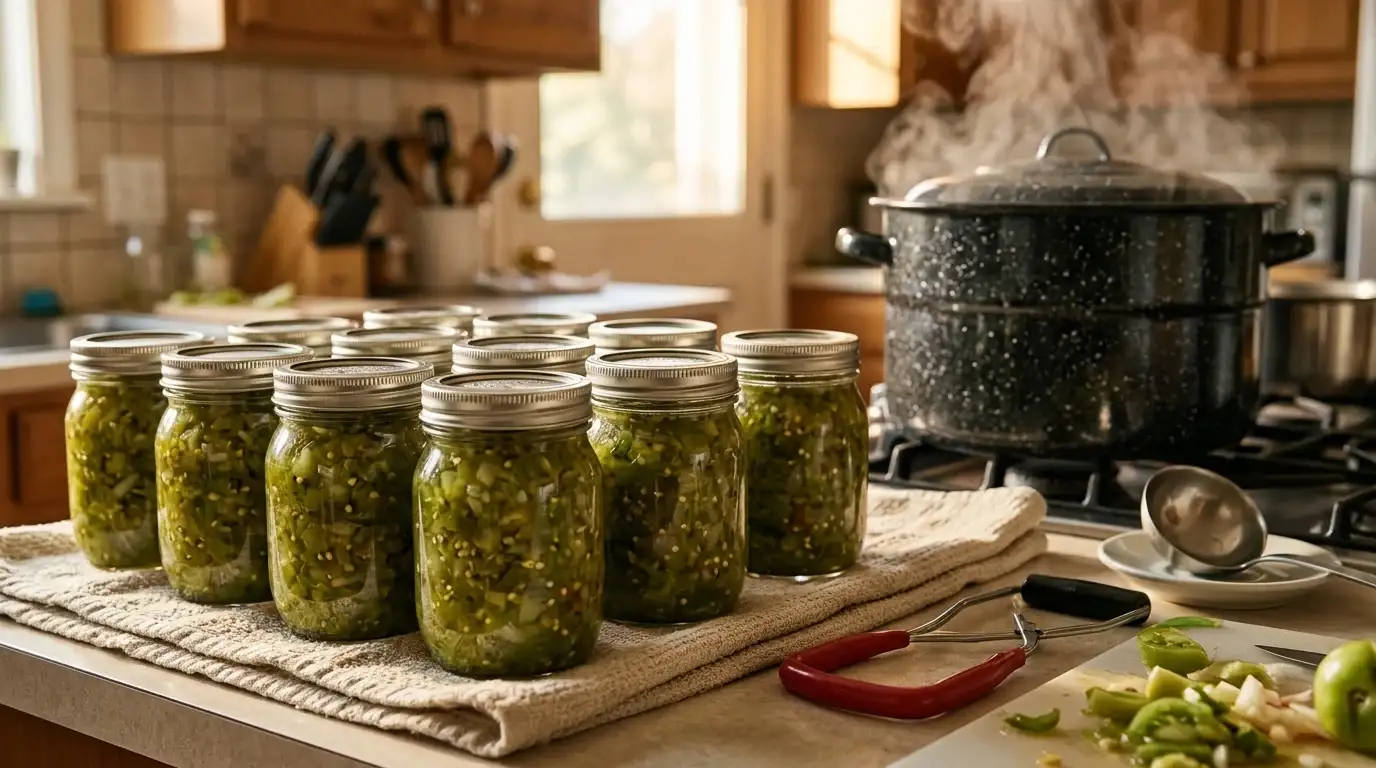
The vegetables are combined with the salt, covered with hot water and left 12 hours, then drained and pressed in a clean cloth. The vinegar and sugar come to a boil with the pickling spice in a bag; the vegetables go in and boil gently for 30 minutes, or until the volume is reduced by half. With the spice bag removed, the hot mixture goes into hot, sterile half-pint jars with ½-inch headspace, and the jars are processed in a boiling-water canner: 5 minutes from sea level to 1,000 feet, 10 minutes from 1,001 to 6,000 feet, and 15 minutes above 6,000 feet. The yield is about nine half-pints. NCHFP advises reading its boiling-water canner guidance before starting.
Questions people ask
What is the difference between chow-chow and piccalilli? British piccalilli is a turmeric-yellow mustard pickle; American chow-chow is a vegetable relish that varies from sweet (Pennsylvania) to sharper (Southern). The names have overlapped since 18th-century trade cards sold piccalilli as English chow chow.
Where does piccalilli come from? England, as an adaptation of South Asian pickles; early recipes appear in Hannah Glasse and Elizabeth Raffald.
Why is it called chow-chow? Disputed: a term first used for preserved Chinese sweetmeats, a story about Chinese railroad workers, or the French chou for cabbage.
What do you eat chow-chow on? Pinto beans, hot dogs, burgers, fish cakes and biscuits, among others.
Is piccalilli yellow? British piccalilli nearly always contains turmeric, per the Dictionary of Traded Goods; the USDA green-tomato version does not.
For canning
- Ball Half Pint (8 oz.) Regular Mouth Glass Mason Jars w/ Cap – Set of 12 AEP: half-pint jars, the size the NCHFP recipe calls for. See it on Amazon (affiliate link)
As an Amazon Associate I earn from qualifying purchases. A commission may be earned if you buy through this link, at no extra cost to you.
Sources
- Nancy Cox and Karin Dannehl, Dictionary of Traded Goods and Commodities 1550–1820 (Wolverhampton, 2007), Piccalilli – Pickling, British History Online: https://prod.british-history.ac.uk/node/50467
- Adrian Hale, Saveur, Chow Chow For Now (Dec. 11, 2007): https://www.saveur.com/article/Kitchen/Chow-Chow-For-Now
- National Center for Home Food Preservation, Piccalilli: https://nchfp.uga.edu/how/pickle/recipes/pickled-relishes/piccalilli/
- Wikipedia, Piccalilli (pointer only): https://en.wikipedia.org/wiki/Piccalilli
- Wikipedia, Chow-chow (food) (pointer only): https://en.wikipedia.org/wiki/Chow-chow_(food)