In this story
The Hot Brown is an open-faced turkey sandwich from Louisville, Kentucky, built on toast, covered in Mornay sauce, browned under a broiler and finished with bacon. The Brown Hotel, which opened in 1923, credits its original chef, Fred Schmidt, with creating it for late-night dinner-dance guests who wanted something better than ham and eggs. Its centennial year, by the hotel’s count, is 2026.
The story attached to the dish is tidy and repeated almost word for word across the food press, which is a reason to read the details closely. Dates, ingredients and even the number of dancers shift from one telling to the next, and the sandwich itself has changed in small ways since the 1920s.
Video: Today’s Special—The Hot Brown | Kentucky Life | KET, KET – Kentucky Educational Television
The hotel’s account
The Brown Hotel opened in 1923, built by the Louisville businessman James Graham Brown to compete with the Seelbach Hotel a few blocks away, according to the Wikipedia entry on the hotel, which is used here only as a pointer to the opening date and the builder. The Atlanta Journal-Constitution gives the same year and puts the cost at $4 million.
By the hotel’s own telling, the 1920s brought a dinner dance that drew more than 1,200 guests each evening. Late in the night, the diners wanted food more elegant than the usual ham and eggs. Schmidt answered with an open-faced turkey sandwich topped with bacon and Mornay sauce, and the hotel’s page sums up the result in one line: “The Hot Brown was born!”
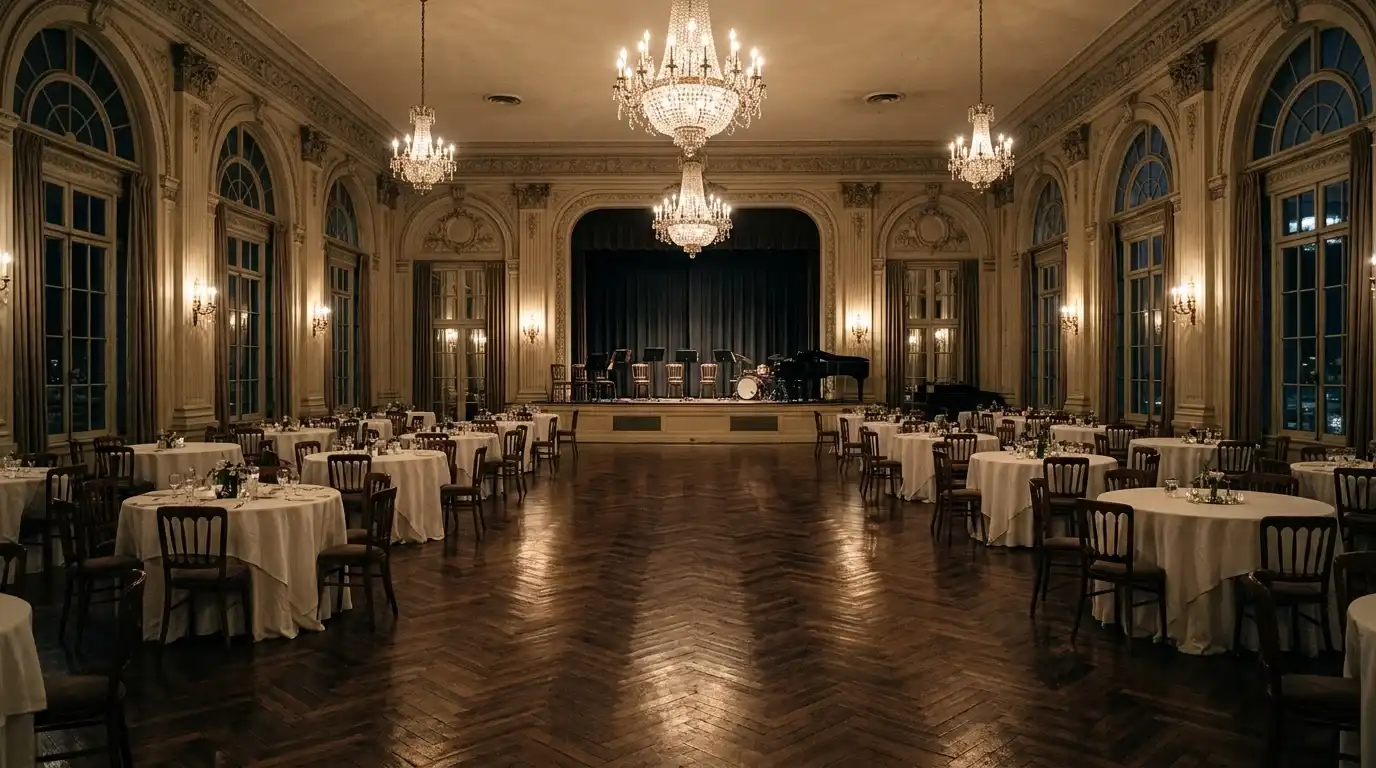
That page gives no year. The year comes from elsewhere. Marc Salmon, the hotel’s general manager, told Louisville’s tourism bureau that the hotel’s original chef, Fred Schmidt, invented the dish in 1926 for late-night diners The same article ties the sandwich to the Crystal Ballroom evenings of the Roaring Twenties and says the hotel’s recipe has stayed unchanged.
The band break
A longer version appears in a Kentucky Monthly article. Around midnight, as the orchestra took a break, dancers went down for the standard ham and eggs. Schmidt judged that too plain for the crowd, gathered what the kitchen had on hand, and assembled something grander. The magazine calls him the dish’s father and the hotel its mother, and it places the whole story in Prohibition.
Louisville Public Media tells it the same way, with the hotel’s human resources director, Marc Salmon, as the source. In that account the dancers headed to the restaurant when the band rested, and Schmidt, tired of cooking ham and eggs night after night, invented a replacement that Salmon says became a staple at once.
Where the accounts differ
The broad outline holds from source to source: the Brown Hotel, Schmidt, a late-night crowd, turkey and Mornay. The specifics do not.
The date. A Vice report dates the origin story to 1926 but treats it as a popular account rather than documented fact, and a photo caption in the same piece cites 1927 as the first known appearance of the Hot Brown on a menu. Neither date is contradicted by the hotel, whose own recipe page names only “the 1920s.” The one-year gap is small, but the 1926 centennial rests on the hotel’s account instead of on a surviving document that any of these sources show.
The motive. The hotel and most writers describe a search for something more refined than ham and eggs. Food Republic adds that some accounts treat the sandwich as a hangover meal for guests who had been drinking while they danced during Prohibition. Vice reports a different prompt: guests who danced until dawn challenged the chef to make something new.
The pimiento. The page at What’s Cooking America, which relays an account supplied by the hotel’s then-ownership, has hotel manager Rudy Suck telling a more detailed story. The maître d’ asks for “a little color,” Schmidt adds bacon, and Suck suggests pimiento. That account has Suck placing the sandwich three or four years after the hotel opened, which points to 1926 or 1927 if the 1923 opening holds, though it is not a date. The same page carries a reader comment claiming the original had two tomato slices under the bacon and no pimiento, a claim the page itself does not back up.
The original build. Wikipedia’s Hot Brown entry describes the original as sliced roast turkey on white toast with Mornay, Parmesan, pimiento and bacon, and lists tomato and mushroom as optional garnishes and canned peaches as very rare. Salmon, speaking to Louisville Public Media, said the 1920s version came with canned peaches and the current one does not. The hotel’s own page lists tomato in its recipe and mentions neither pimiento nor peaches. Whether tomato belonged to the first version is therefore not settled by these sources.
What goes into a Hot Brown
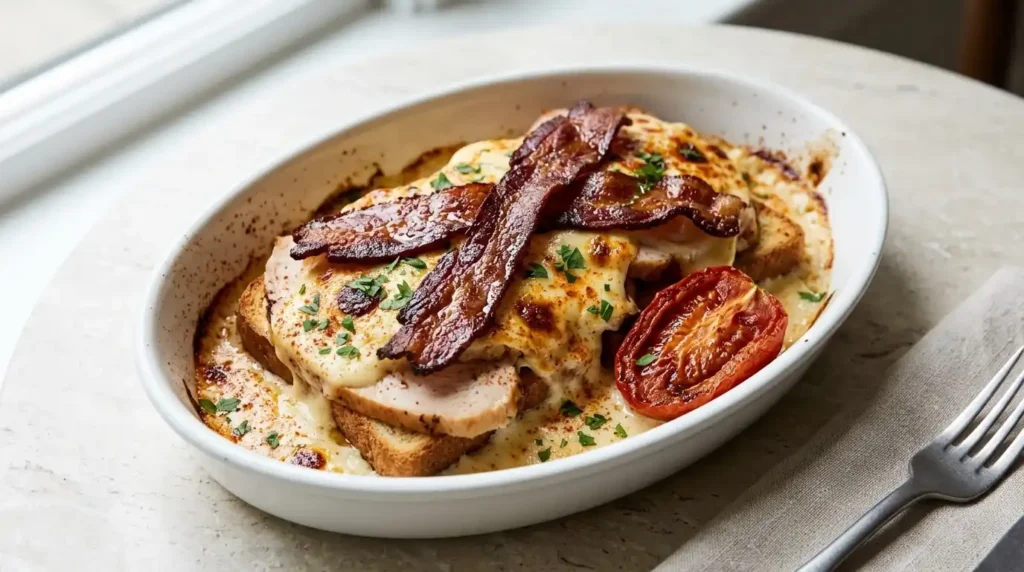
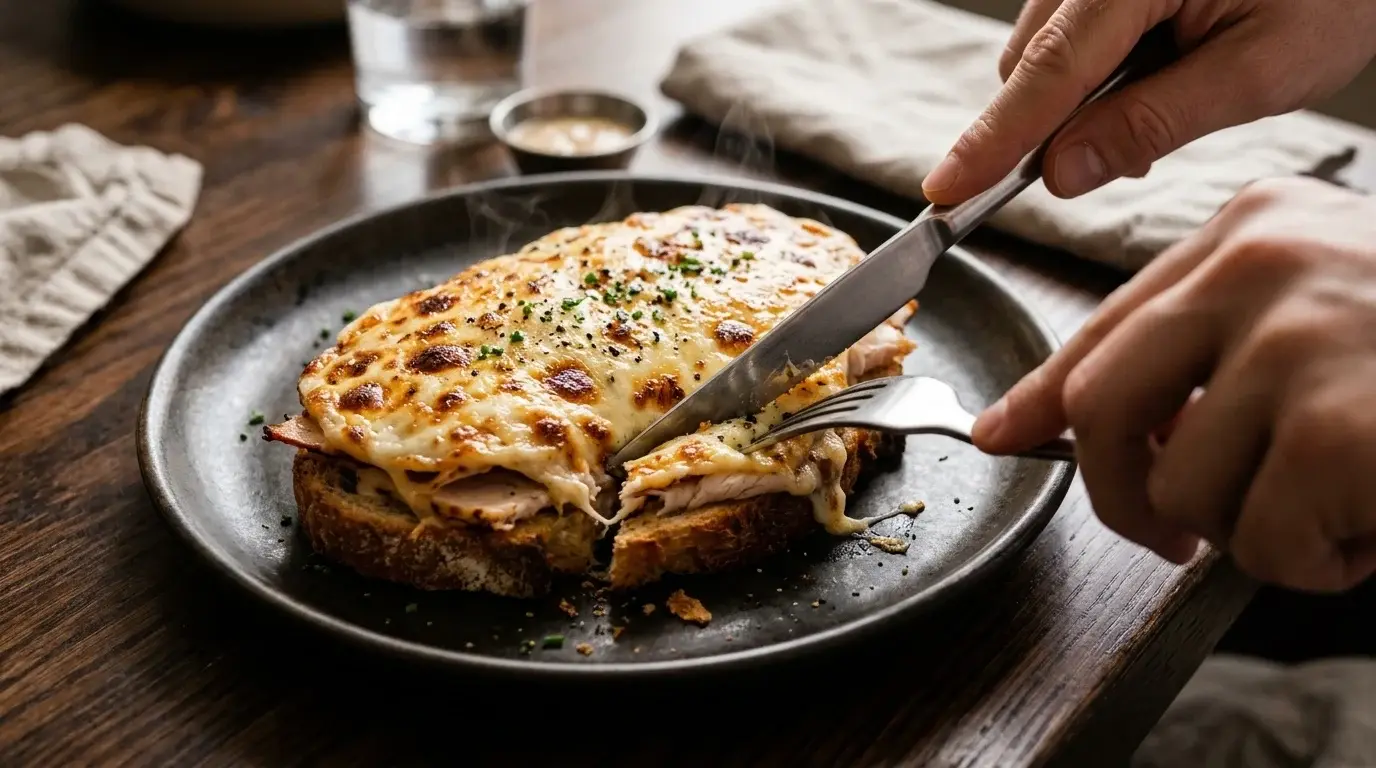
Strip away the arguments and the structure is consistent. Thick slices of roast turkey sit on toast. Mornay sauce, a béchamel enriched with cheese, covers the turkey. The dish goes under the broiler until the sauce browns and bubbles, and crisp bacon lands on top at the end.
The Louisville tourism bureau describes it as turkey, toast points, tomato and Mornay finished with bacon, paprika and parsley, and says the hotel first promoted it as “the Brown Hotel’s new hot sandwich” before the shorter name took over. Louisville Public Media adds that the sandwich is eaten with a knife and fork rather than by hand, quoting one diner who called it “almost pie-like.”
Why turkey was the point
The What’s Cooking America account notes that turkey was mainly a holiday meat in the 1920s and had only recently started to be sold year-round, which made sliced turkey an uncommon choice for a restaurant menu. Wikipedia makes a similar point. That context explains why a plate of roasted turkey felt like a step up from ham.
Relatives
Several writers place the Hot Brown in a family of rich, broiled, cheese-covered toast dishes. Kentucky Monthly calls it a cousin of Welsh rarebit and the French croque-monsieur, and Louisville’s tourism bureau suggests those two as possible inspirations. None of the sources documents Schmidt naming either one.
How the hotel makes it
The Brown Hotel publishes a recipe for two servings. Everything below is the hotel’s own version, not a reconstruction of the 1926 original.
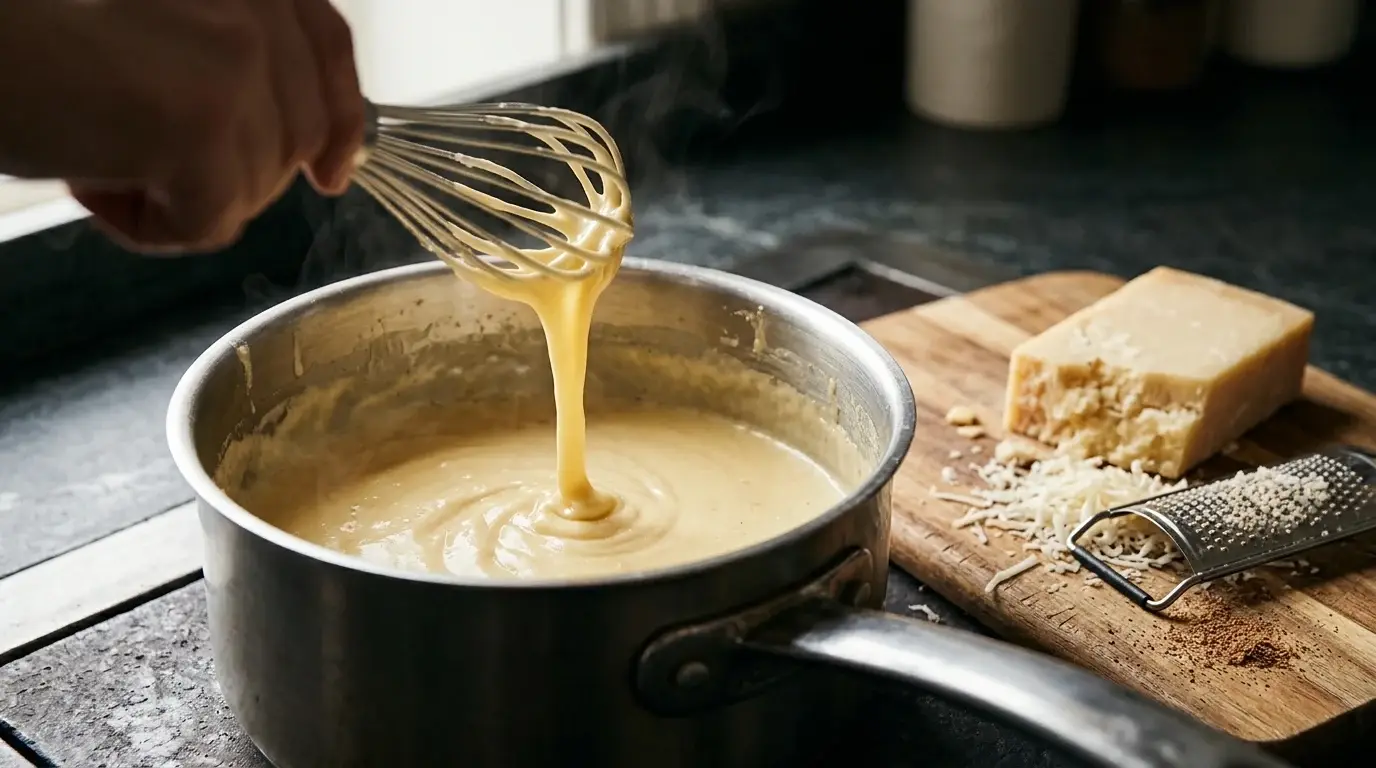
The sauce comes first. Two ounces of butter melt in a two-quart saucepan, and two ounces of all-purpose flour go in to form a thick paste. That roux cooks two minutes over medium-low heat with frequent stirring. Eight ounces of heavy cream and eight ounces of whole milk follow, heated over medium until the mixture starts to simmer, which takes two to three minutes. Off the heat, half a cup of Pecorino Romano goes in until the sauce is smooth, with nutmeg, salt and pepper to taste.
Assembly happens in an oven-safe dish. Two slices of Texas toast with the crusts trimmed go in, one cut diagonally into triangles and one left whole. Seven ounces of sliced roasted turkey breast, cut thick, goes over the toast. A tomato half and the toast triangles sit beside the turkey, and half the sauce covers the whole dish. A sprinkle of extra Pecorino Romano goes on top, and the dish is broiled until the cheese turns golden and bubbles. Two slices of crisp bacon cross in an X over the top, followed by paprika and parsley. The full ingredient list for two is 14 ounces of turkey, four slices of toast, four slices of bacon, two Roma tomatoes and a little Parmesan.
A second published method
Saveur’s version serves four and takes a different route: a roux of four tablespoons each of butter and flour, one and three-quarter cups of hot milk, grated Parmigiano-Reggiano, part of a beaten egg and a splash of heavy cream folded in. The dish broils for five to six minutes, and the bacon goes on afterward, as at the hotel.
| Brown Hotel | Saveur | |
|---|---|---|
| Servings | 2 | 4 |
| Cheese in the sauce | Pecorino Romano | Parmigiano-Reggiano |
| Liquid | Heavy cream and whole milk | Hot milk, plus cream folded in |
| Thickener beyond roux | None | Beaten egg |
| Bread | Texas toast | Thick white bread, toasted |
| Bacon | Added after broiling | Added after broiling |
Turkey advice from the kitchen
The Brown Hotel’s executive chef, Gary Palm, told the Atlanta Journal-Constitution that he steams the turkey breast in a roasting pan with chicken stock to 165 degrees Fahrenheit, favors thick slices over leftovers, which tend to run dry, and wants firm, uniformly red Roma tomatoes at room temperature, as reported by the AJC. The same article says only four staff members are approved to make the Mornay.
The years the hotel was closed
The Brown Hotel closed in 1971 after financial trouble, and the building went to the Louisville public school system, according to Wikipedia’s hotel entry and the AJC. A group called Broadway acquired it from the school system, began renovating in 1983 and reopened it as a Hilton.
What happened to the sandwich in the gap is described unevenly. The Wikipedia Hot Brown entry states the dish was unavailable at its birthplace from 1971 to 1985. The AJC says the recipe was kept through the changes. Vice puts the return later, reporting the Brown did not serve the sandwich again until chef Joe Castro arrived in 1992. These dates cannot all be right, and none of the sources cites a menu to settle it.
Vice adds that some locals still debate whether a Hot Brown counts as authentic unless it is served at the Brown Hotel.
From Louisville to St. Louis and beyond
The earliest known spread of the dish outside Louisville, per Vice, was at the Mayfair Hotel in St. Louis in the early 1930s. Wikipedia describes the Mayfair’s Prosperity Sandwich as a similar dish sometimes also called a hot brown, and lists Pittsburgh’s Turkey Devonshire from the 1930s as another close cousin. Those two claims rest on the encyclopedia’s own citations, which this post did not open, so the exact relationship to Schmidt’s sandwich is left as stated.
Cold Brown and other spinoffs
The hotel once offered a cold version too, per CulinaryLore: turkey or chicken, lettuce, tomato and hard-boiled egg on rye with Thousand Island dressing, never as popular as the hot original. Today Food Republic lists Louisville versions with fried egg and biscuits, seafood, prime rib, vegetables and pizza, plus hotel spinoffs such as Hot Brown pasta and fries. The AJC notes outside recipes that swap in cheddar, add ham or put beefsteak tomato over the sauce.
Counting the plates
Production figures from the Brown itself do not agree. Kentucky Monthly reports about 800 a week across the hotel’s two restaurants, rising to about 1,000 on Derby weekend, and Vice cites the hotel’s PR firm for more than 18,000 a year. In the Louisville Public Media article, chef de cuisine Allen Heintzman put his output at 60 to 100 a day, and over 10,000 in Derby week.
The centennial
Louisville’s visitor guide for 2026 put the Hot Brown on its cover, as the tourism bureau announced, and the city now runs an annual Hot Brown Week in which restaurants offer their own variations. Earlier anniversaries were marked at the hotel itself: Kentucky Monthly reports that chef Laurent Geroli made 85 variations for the 85th, and a $90 “Haute Brown” with foie gras and gold flakes came for the 90th.
Sources:
- The Brown Hotel, Hot Brown history and recipe: https://www.brownhotel.com/hot-brown
- Go To Louisville, A Century of Sizzle (2026 visitor guide cover): https://www.gotolouisville.com/media/news-stories/a-century-of-sizzle-louisvilles-iconic-hot-brown-graces-the-2026-visitor-guide-cover
- Go To Louisville, Hot Brown: https://gotolouisville.com/blog/hot-brown
- Louisville Public Media, Hot Brown: a brief history of the Louisville delicacy: https://lpm.org/news/2024-12-01/hot-brown-a-brief-history-of-the-louisville-delicacy
- Kentucky Monthly, A Century of Delectability: https://www.kentuckymonthly.com/food/a-century-of-delectability/
- Vice, Kentucky’s Most Famous Sandwich Is a Glorious Mess of Meat and Cheese: https://www.vice.com/en/article/kentuckys-most-famous-sandwich-is-a-glorious-mess-of-meat-and-cheese/
- Food Republic, The History of Kentucky’s Iconic Hot Brown Sandwich Began During Prohibition: https://www.foodrepublic.com/1708600/kentucky-hot-brown-sandwich-prohibition-history
- What’s Cooking America, Hot Brown Sandwich History and Recipe: https://whatscookingamerica.net/history/sandwiches/hotbrownsandwich.htm
- Atlanta Journal-Constitution, Chef embraces history of the Kentucky Hot Brown: https://www.ajc.com/food-and-dining/chef-embraces-history-of-the-kentucky-hot-brown/Z3ZPUEKXZJHBZAXUTOBXI3TPQI
- Saveur, Hot Brown: https://www.saveur.com/article/Recipes/Hot-Brown
- CulinaryLore, What Is a Hot Brown Sandwich: https://culinarylore.com/food-history:what-is-a-hot-brown-sandwich/
- Wikipedia (pointer only), Hot Brown: https://en.wikipedia.org/wiki/Hot_Brown
- Wikipedia (pointer only), Brown Hotel (Louisville, Kentucky): https://en.wikipedia.org/wiki/Brown_Hotel_(Louisville,_Kentucky)
- KET, Today’s Special: The Hot Brown (video): https://www.youtube.com/watch?v=3QyVJ4i0tgs