In this story
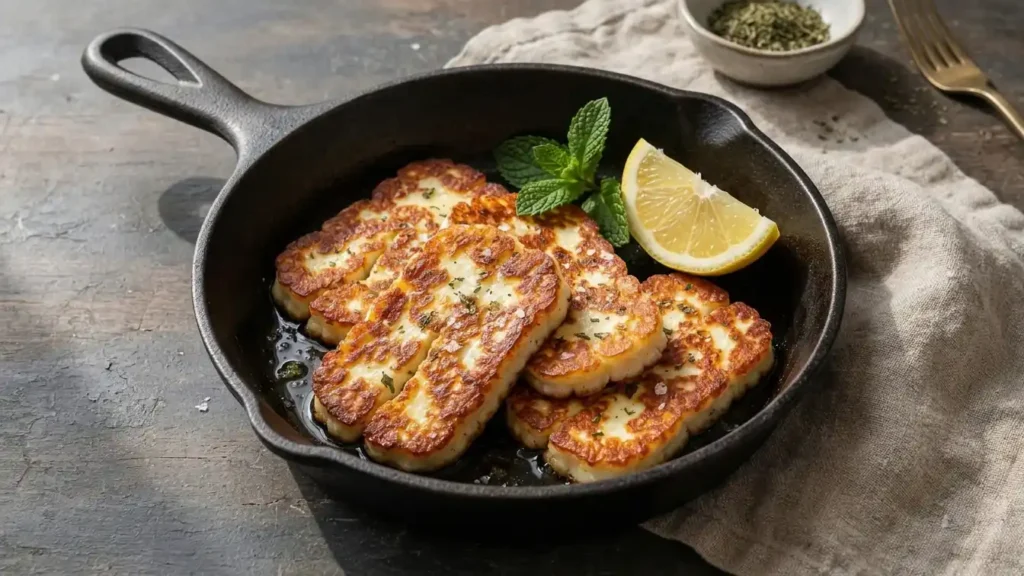
Put a slice of halloumi in a hot pan and it does something most cheese cannot. It browns. The outside forms a firm, golden crust while the inside softens and squeaks against the teeth, but the slice keeps its shape instead of running into a puddle. That trick comes from a single extra step in how the cheese is made, a cheese Cyprus spent years defending in Brussels, along with the question of whose milk goes into it.
Video: Halloumi Cheese from Cyprus, An All-Rounder for Classic and Modern Recipes, from the DW Food YouTube channel
Cooked twice
Rennet first, then a hot whey bath
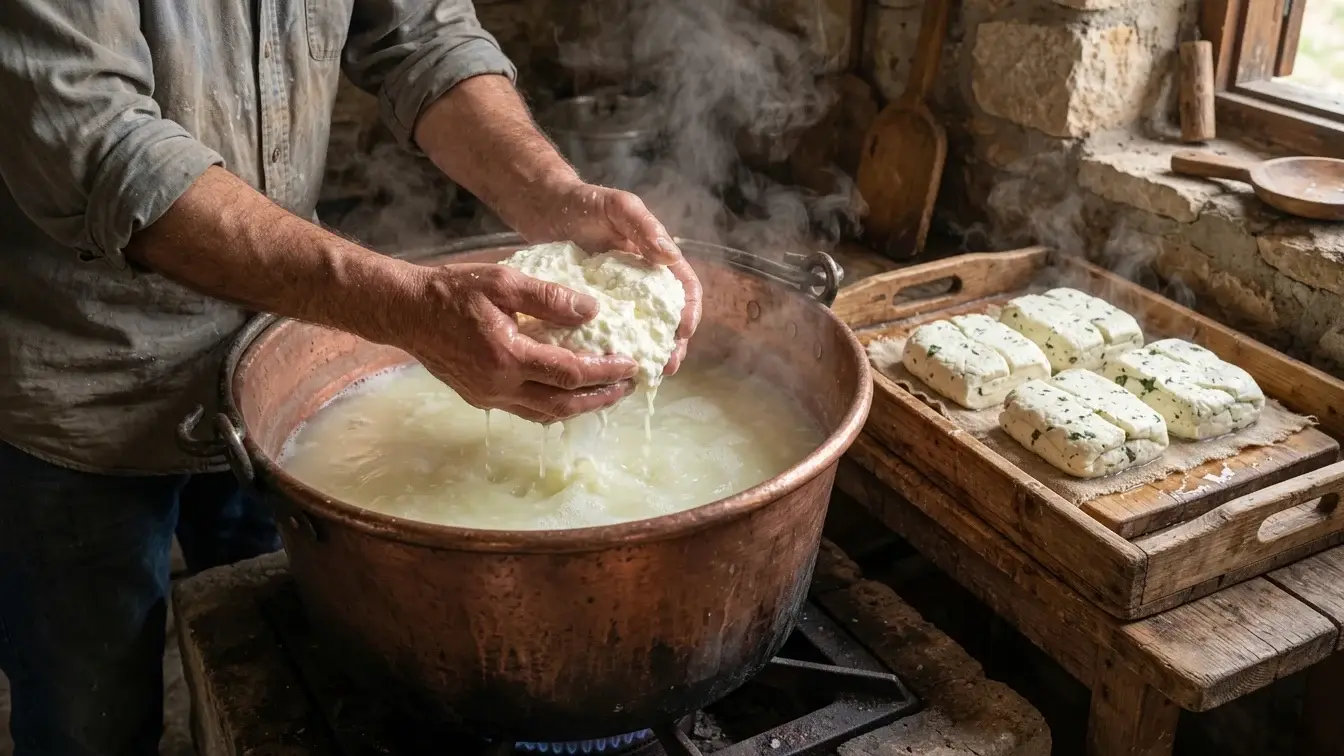
Halloumi starts like many cheeses. Cook’s Illustrated, in an August 2022 explainer, described the opening steps: milk is curdled with rennet and the curds are pressed to remove liquid. Then comes the part that sets it apart. Unlike most cheeses, halloumi is cooked in a bath of hot whey.
Greek Reporter’s August 2021 report on the cheese’s protected status gave the traditional profile: a semi-hard cheese made in Cypriot villages from goat’s milk, sheep’s milk or a blend, sometimes with cow’s milk added, with heated curds stored in brine and mint traditionally included for flavor. It is sold in a folded block.
Why it holds its shape
A rigid protein net
The second cooking is the whole explanation. Cook’s Illustrated laid out the chemistry with help from Photis Papademas, a dairy scientist at the Cyprus University of Technology. Most cheeses are emulsions held together by networks of the milk protein casein, linked with the help of calcium. In cheeses that melt, less calcium holds the network together, so the structure is flexible and flows when heated.
Halloumi’s network stays rigid. Cooking the curd in hot whey kills the bacteria and deactivates the leftover rennet. With no bacteria left to produce lactic acid, the cheese’s pH stays high, which means more calcium remains bonded to the casein. The result is a protein structure that softens in heat but does not collapse.
A crust like meat
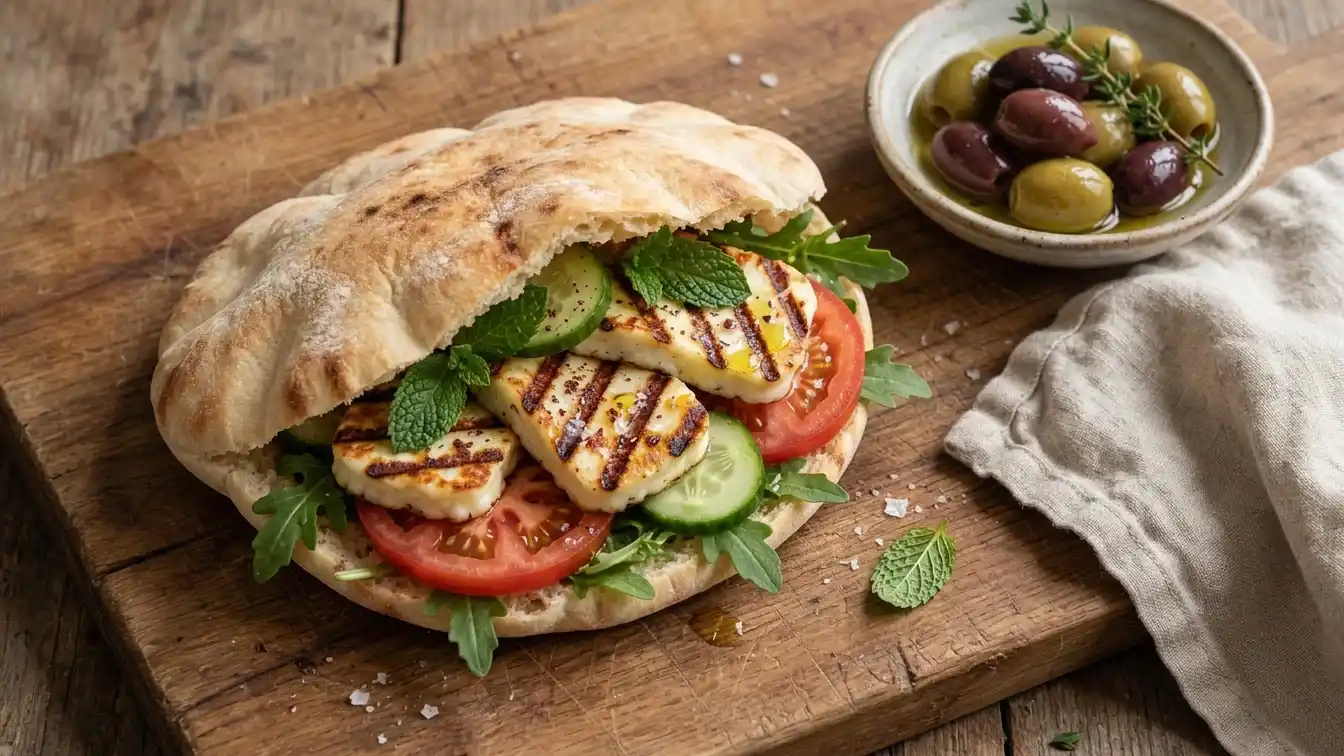
That rigidity makes halloumi behave in a pan like something else entirely. Cook’s Illustrated described fried halloumi developing a browned, crisp crust that “rivals that of a well-seared steak.” Its method: slice the cheese crosswise about half an inch thick, cook it in a nonstick skillet over medium-high heat and flip every couple of minutes to build the crust gradually. On a grill, it recommends high heat with the lid closed until the undersides are lightly browned.
A protected name
Registered in April 2021
Cyprus fought for years to keep the name. The European Commission registered “Χαλλούμι (Halloumi)/Hellim” as a protected designation of origin in Implementing Regulation (EU) 2021/591 of April 12, 2021. The name carries both its Greek and Turkish forms. In March 2023, the Commission announced that the first Turkish Cypriot producer had been awarded a PDO certificate after being found compliant with the specification, under a system meant to let producers on both sides of the island’s Green Line apply.
The objections
The road was contested. The regulation itself records objections raised during the process: that most halloumi actually sold was made with varying milk types and a predominance of cow’s milk, that the specification did not match the product as marketed across the island, and that mint should be optional. Opponents also challenged the claim that local sheep and goat breeds gave the cheese its character, noting that the Chios sheep and Damascus goat were introduced to Cyprus in the 1950s and 1930s.

The milk-ratio fight
51 percent sheep and goat
The sharpest disagreement was over the milk. Greek Reporter’s 2021 report said the PDO rules called for goat’s milk to exceed cow’s milk by 2024, making up at least 51 percent of the blend, and that dairy producers worried they could not meet the ratio or the mint requirement in time. The Cyprus Dairy Producers’ Association pointed out that the specification required local goats fed specific fodder, while 70 percent of the island’s sheep and goat population was not native.
Still unsettled in 2026
The argument has not ended. Cyprus Mail reported in June 2026 that the island’s sheep and goat farmers association was rejecting any attempt to change the PDO specification, insisting that sheep’s and goat’s milk make up at least 51 percent of the final product and rejecting proposals for a mixed PDO category. The association noted that the EU had granted a 15-year transition period for the production chain to adapt, and described halloumi as one of Cyprus’s most important exports and a cultural symbol.
Halloumi in a sandwich
The grilled cheese that stays put
A cheese that sears instead of melting changes how a sandwich is built. Halloumi arrives as a hot, crusted slab rather than a melted layer, so it works as the filling rather than the glue that holds bread together. That makes it the opposite of a slice of American cheese, engineered to melt evenly, and a different job from the one done by the loaves in GrillCheesy’s guide to the best bread for grilled cheese.
Its opposite numbers
For the chemistry of cheeses that do flow, see why cheese melts and turns greasy and the role of sodium citrate in smooth sauces. For a cheese built to melt over a fire, there is raclette.
A good nonstick skillet is the tool Cook’s Illustrated recommends for building halloumi’s crust:
- Tramontina Professional 10-Inch Non Stick Frying Pan: a heavy-gauge aluminum nonstick skillet suited to searing halloumi slices over medium-high heat. See it on Amazon (affiliate link)
Video: Tramontina 10-inch Nonstick Fry Pan Review, from the Chef Lauren's Insightful Product Reviews YouTube channel
As an Amazon Associate I earn from qualifying purchases. A commission may be earned if you buy through this link, at no extra cost to you.
Sources
- Cook’s Illustrated, What Is Halloumi Cheese? (2022): https://www.americastestkitchen.com/cooksillustrated/articles/5995-what-is-halloumi-cheese
- Greek Reporter, Iconic Cyprus Cheese Halloumi Receives Coveted PDO Status (2021): https://greekreporter.com/2021/08/31/iconic-cyprus-cheese-halloumi-receives-coveted-pdo-status/
- Commission Implementing Regulation (EU) 2021/591: https://eur-lex.europa.eu/eli/reg_impl/2021/591
- European Commission, First Turkish Cypriot Halloumi/Hellim cheese awarded PDO certificate (2023): https://commission.europa.eu/news/first-turkish-cypriot-halloymi-halloumihellim-cheese-awarded-protected-designation-origin-2023-03-28_en
- Cyprus Mail, Farmers reject changes to PDO halloumi standard (2026): https://cyprus-mail.com/2026/06/14/farmers-reject-changes-to-pdo-halloumi-standard