In this story
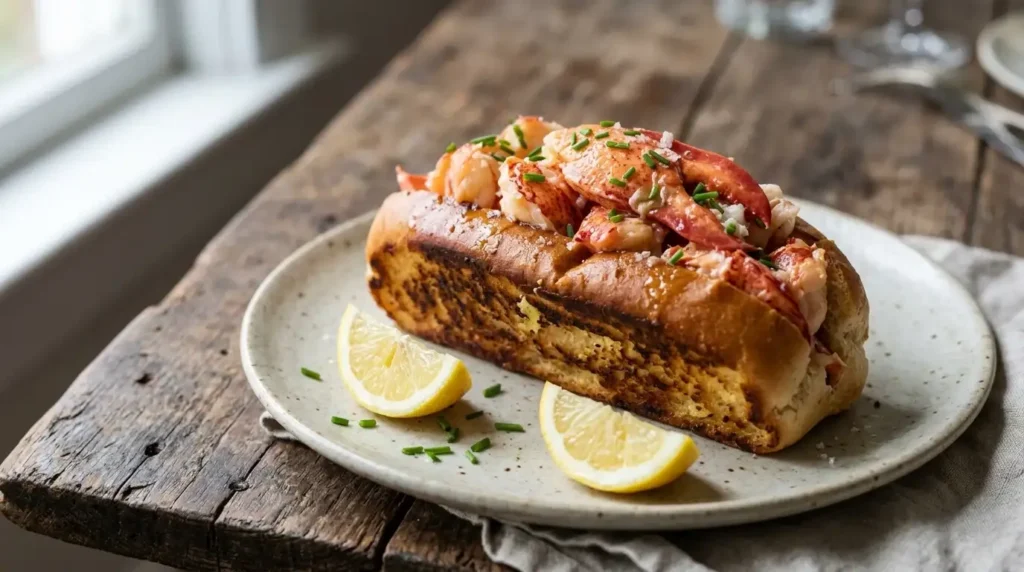
A lobster roll is lobster meat in a split-top bun, and nearly every argument about it starts with temperature. In Connecticut the meat is warm and finished with butter. In Maine it is cold and bound with a little mayonnaise. Both versions are served in the same kind of griddled, soft-sided roll, and neither region has settled who made the first one.
The origin story is a tangle of restaurants, years and customers that do not agree with one another, which is part of why the sandwich keeps turning up in food-history debates.
Video: Lobster Rolls Two Ways: Maine vs. Connecticut | Scott Conant, Scott Conant – PEACE • LOVE • PASTA
How the two styles compare
The shortest summary comes from a Tasting Table comparison: Connecticut rolls carry warm meat and plenty of melted butter, Maine rolls carry chilled meat in a salad, and the bun is the same on both sides of the border. That article also attaches a date to each tradition, the 1920s for Connecticut and the 1970s for Maine seafood stands, a pairing that other sources in this post complicate.
| Connecticut style | Maine style | |
|---|---|---|
| Lobster | Warm | Cold |
| Dressing | Melted butter | Mayonnaise, sometimes with celery, lemon, tarragon or chives |
| Bun | Split-top, buttered and griddled | Split-top, buttered and griddled |
Naming adds a wrinkle. Food Network’s 2016 write-up reports that Connecticut devotees reserve the plain name “lobster roll” for the warm version and call the cold one a lobster salad roll, a term used across most of the Northeast. The same article notes that the Maine style is the one found most often around the country.

The Connecticut roll
Warm lobster, butter, bread. That is close to the whole specification. In the Food Network account, the meat carries no dressing at all, and melted butter is served on the side to be poured over just before the first bite.
Restaurant kitchens handle the butter in different ways. At Neptune Oyster in Boston, chef John Ross builds the hot version with unsalted butter, lobster stock, salt and pepper, using about seven ounces of claw, tail and knuckle meat per roll, according to Boston.com’s 2017 piece. The same article passes along J. Kenji López-Alt’s explanation for why the warm style tastes the way it does: heat makes flavors easier to detect, and butter, being fat-soluble, carries them across the tongue.
A Tasting Table recipe shows one home method in steps. Butter is melted over low heat and skimmed until it is clarified, then kept warm. The outsides of the buns are brushed with some of it and grilled on a medium-high skillet or griddle until golden and crisp. Half a pound of cooked lobster meat goes into the warm butter, seasoned with salt, garlic powder, paprika and a little chopped tarragon, and is stirred gently so the pieces stay whole. Each bun gets half the mixture, then lemon juice and chives. The recipe lists 15 minutes of preparation and 5 minutes of cooking for two rolls.
The Maine roll
Large pieces matter more than anything else here. Visit Maine, the state tourism office, describes the Maine roll as big chunks of lobster with minimal additions, and calls shredding the meat a serious mistake. The mayonnaise is mixed in lightly. Chives or celery appear in some versions.
A Maine-based recipe published by Food Network, credited to a Portland, Maine, business and noted there as untested for home use, keeps the method short. One pound of chilled cooked lobster meat is torn into large chunks and folded with two tablespoons of mayonnaise, preferably the thick, yolk-rich kind. Rolls are brushed with melted butter on both sides and toasted in a hot pan. About four ounces of the lobster mixture goes into each roll, topped with chives and served with a lemon wedge. The contrast is deliberate: a warm, buttery bun around cool lobster.
Early cold lobster salads were not always built on mayonnaise. Sandy Oliver, quoted in Down East magazine, observes that they often used a vinegary, mustardy cream dressing. The same article says chef Scott DeSimon’s basic formula is just butter, a split-top bun, lobster and mayonnaise, with celery optional.
Julie Barker, co-owner of Helen’s Restaurant in Machias, Maine, sums up the bread in the Harvard Crimson as “A very inexpensive hotdog roll that is buttered and grilled on both sides.”
The split-top bun
The bun has its own disputed history. According to Food Republic, the New England split-top was developed in the 1940s for Howard Johnson’s restaurants, which commissioned the Maine bakery J.J. Nissen to produce a roll that would stand upright and hold cornmeal-dredged fried clams. Hot dogs came later. Food historian Bruce Kraig is cited there as crediting the Friendly’s chain with popularizing the buttered, griddled split-top for hot dogs.
Other sources place the roll earlier. Down East reports that the split-top hot dog roll appeared in the 1910s, and the Daily Meal ties the lobster roll’s emergence to the development of soft rolls in 1912, adding that earlier lobster sandwiches were probably served on other breads.
The shape explains the use. Flat sides give the bun two surfaces to brown in butter, and the open top holds loose meat in place. Boston.com notes that hot butter can turn a weak roll soggy, which is why a sturdy griddled one is preferred. Visit Maine describes the ideal as soft inside with flat sides for grilling, and several recipes accept a standard hot dog bun with the sides trimmed flat when a true split-top cannot be found.
Size and filling vary by kitchen, and the sources give figures that are not interchangeable. The Boston kitchen’s seven ounces of meat per roll is nearly double the four ounces in the Portland recipe, and the Tasting Table home version stretches half a pound across two buns. Dressing amounts differ in the same way: two tablespoons of mayonnaise for a full pound of lobster in one recipe, an unspecified light coating in the tourism office’s description. None of the sources sets a standard portion, which leaves the weight of lobster in a roll up to the cook.

Perry’s in Milford
The best-known claim belongs to Perry’s, a restaurant in Milford, Connecticut. The details shift depending on who tells it.
The year is the first point of disagreement. The Takeout dates the story to 1927 and calls it a legend: owner Harry Perry supposedly made a grilled lobster sandwich for a customer who wanted food to take away, first on white bread, then on a submarine-style bun that held the filling better. The Daily Meal also gives 1927 and says Perry added the sandwich to the menu after a customer asked for it. Tasting Table’s Perry’s article says the story “all started in 1929,” while the food writer John Mariani, whose encyclopedia is the usual citation, places it only in the 1920s. Down East gives 1929 as Michael Stern’s date.
The customer changes too. Tasting Table says one version has Perry making the hot, grilled sandwich for a traveling liquor salesman, while Mariani names a regular, Ted Hales. The same article adds that Perry’s worked with a Bridgeport bakery on a crusty bread that would not collapse under butter and warm meat, and that a sign calling the restaurant the “Home of the Famous Lobster Roll” stayed up until 1977.
Mariani’s own wording is cautious. The Tasting Table article quotes his encyclopedia saying lobster rolls “may well have originated at a restaurant named Perry’s in Milford”. That hedge is typical. The Takeout concludes that the history is murky and may never be pinned to a single person or restaurant.

Competing claims and the earliest records
Maine has several. Down East reports that Susan Bayley Clough says her great-grandmother made a lobster-and-mayonnaise sandwich in Scarborough in 1915, switching to a split-top hot dog bun when her great-grandfather disliked crusts. Visit Maine adds that many Mainers credit Bayley’s Lobster Pound in Pine Point, Scarborough, and mentions the Nautilus Tea Room in Marblehead, Massachusetts, as another candidate. The Daily Meal says Moody’s Diner in Waldoboro, Maine, reportedly has served a cold lobster roll since the late 1920s, which would put a Maine-style roll in the same decade as Perry’s.
That sits awkwardly beside the Tasting Table comparison placing the Maine style in the 1970s. Down East supplies one piece of that later chapter: Red’s Eats in Wiscasset, which Debbie Gagnon’s father bought in 1977 as a defunct stand, began making its own lobster rolls in the late 1980s, and customers followed.
Printed records are thinner than the legends. Down East says Mariani found the phrase in The New York Times in 1937. The Harvard Crimson reports that one of the earliest historical mentions comes from Connecticut in the 1920s and that the sandwich appeared regularly in Connecticut by the 1950s. Lobster on bread was older than any of it: the Takeout and Food Republic’s history both point to an 1829 cookbook recipe for cold lobster salad, by Lydia Maria Child, as an ancestor of the Maine filling, though a salad recipe is not a sandwich.
A 2016 Down East oral history of the sandwich, built from interviews with chefs, restaurant owners, authors and a food historian, opens its catalog entry by calling the lobster roll “a relatively new classic food of Maine”. The Portland Public Library record lists the article as running from page 100 to 118 of the August 2016 issue. The full text was not available to be read for this post, so the conclusions of its interviewees are not reported here.
The national spread came late. The Harvard Crimson credits Pearl Oyster Bar in New York City with carrying the roll out of New England in the 1990s, and Tasting Table’s Perry’s article says the restaurant had it on its menu in 1996, with chef Jasper White having made the roll more upscale in the 1980s.
Sources:
- The Takeout, “Where Does The Lobster Roll Actually Come From?”: https://www.thetakeout.com/1760650/lobster-roll-origin-history/
- Tasting Table, “Perry’s Restaurant In Connecticut Is Where The Lobster Roll Was Invented”: https://www.tastingtable.com/1539312/connecticut-restaurant-lobster-roll
- Tasting Table, “Connecticut Vs Maine Lobster Rolls: What’s The Difference?”: https://tastingtable.com/919845/connecticut-vs-maine-lobster-rolls-whats-the-difference
- Tasting Table, “Buttery Connecticut-Style Lobster Rolls Recipe”: https://www.tastingtable.com/689179/lobster-roll-recipe/
- Food Network, “The Great Lobster Roll Debate: Maine- Versus Connecticut-Style”: https://www.foodnetwork.com/fn-dish/recipes/2016/07/maine-versus-connecticut-style-lobster-rolls
- Food Network, “Maine-Style Lobster Roll”: https://www.foodnetwork.com/recipes/maine-style-lobster-roll-2656093
- Boston.com, “Mayo or butter? That is the question for lobster roll enthusiasts”: https://www.boston.com/news/maine/2017/07/17/mayo-or-butter-that-is-the-question-for-lobster-roll-enthusiasts/
- Visit Maine, “Lobster Rolls”: https://visitmaine.com/things-to-do/dining-nightlife/lobster-rolls/
- Down East, “The Ultimate Guide to the Lobster Roll”: https://downeast.com/maine-lobster-roll/
- The Harvard Crimson, lobster roll and Maine culture, April 16, 2024: https://www.thecrimson.com/article/2024/4/16/lobster-roll-maine-culture-economy-tradition-simple-evolution-article/
- Down East, “The Definitive Oral History of the Lobster Roll” (catalog record, Portland Public Library): https://digitalcommons.portlandlibrary.com/news_downeast/4595
- Food Republic, “Why New England Hot Dog Buns Are Split At The Top”: https://www.foodrepublic.com/1442565/why-new-england-hot-dog-buns-split-top/
- Food Republic, “How Lobster Rolls Became A Beloved New England Dish”: https://www.foodrepublic.com/2060819/how-lobster-rolls-new-england-staple-dish-history
- The Daily Meal, “The Storied History Of The Famous Lobster Roll”: https://www.thedailymeal.com/1241607/the-storied-history-of-the-famous-lobster-roll