In this story
Chimichurri is an uncooked sauce of parsley, garlic, oregano, vinegar and oil that Argentina and Uruguay (per Wikipedia) spoon over grilled meat and the sausage sandwich known as choripán. Britannica gives its origin as Argentine and its usual ingredients as parsley, oregano, garlic and red wine vinegar, while Merriam-Webster defines it as a savory Argentinean sauce or marinade. Where the sauce came from, and where its name comes from, have no settled answer.
Video: Chimichurri Original ARGENTINO [Historia+Receta] | MAG — from the Mundo Al Grill YouTube channel
What Chimichurri Contains
Parsley, garlic and vinegar, with the rest left to the cook
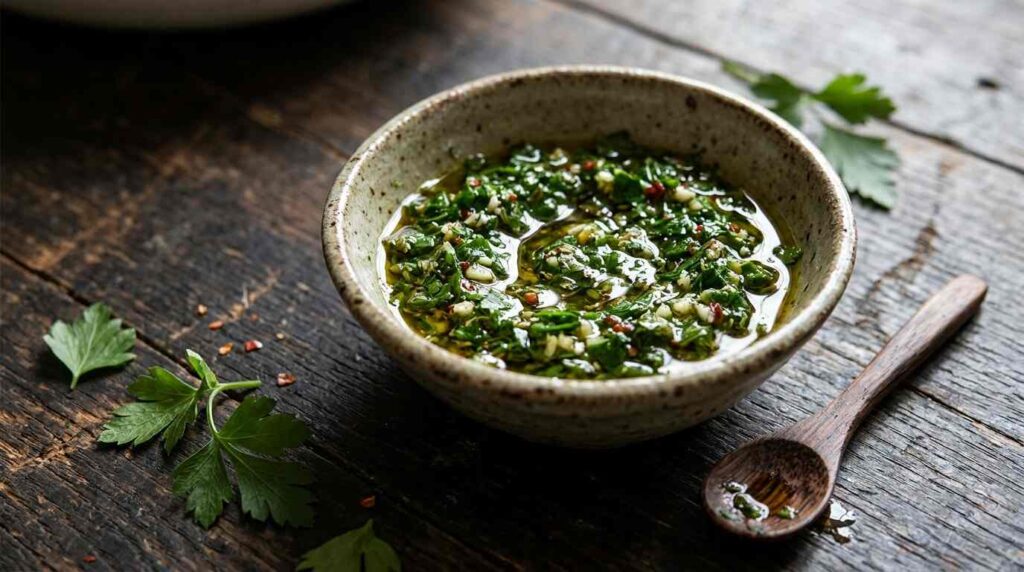
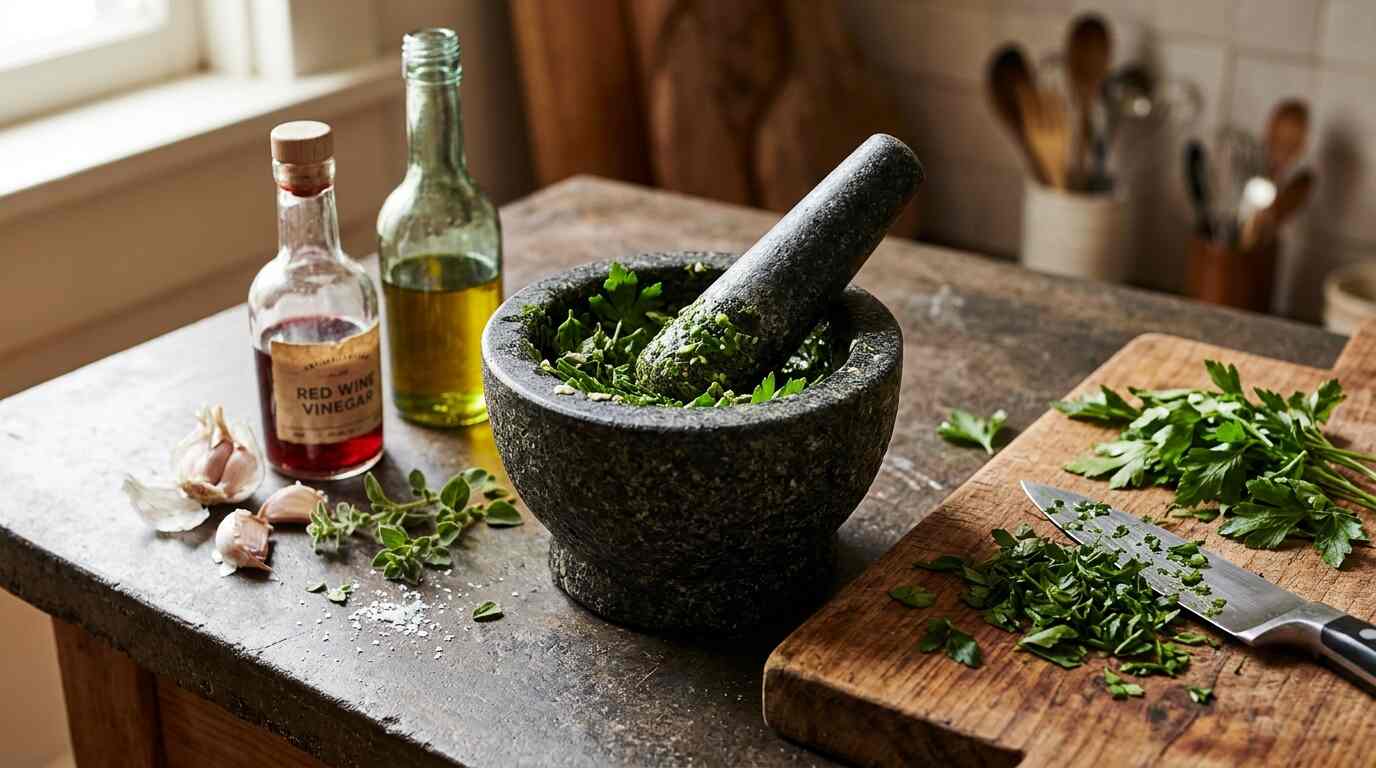
Britannica gives the Argentine base as fresh parsley, garlic, oregano and chilies, blended with vinegar, salt and olive oil, and adds that recipes vary by region and by chef. Elsewhere in Latin America, it says, coriander is popular, and tea, lemon, honey, mint and other herbs may appear. The English-language Wikipedia entry, used here only as a pointer to the cookbook citations it lists, names the same core and adds salt, black pepper, crushed pepper flakes and sometimes a splash of hot water.
Fresh herbs may not be the original form. The Daily Meal says the first versions were likely made with dried herbs, which kept longer before refrigeration, and that the sauce is traditionally made in a mortar or chopped by hand because a food processor can make garlic bitter and dull fresh herbs. The same article rejects the nickname “Argentinian pesto”: chimichurri shares oil and garlic with pesto, but it uses vinegar and has no cheese or nuts.
Vinegar sets the character. Britannica notes that Argentines typically season steak with only salt and pepper, and that chimichurri is the notable exception, with a tanginess that depends on the vinegar. Culture Trip reports that Uruguay adds red pepper flakes for heat.
When the Sauce First Appears in Print
Gauchos get the credit, but the cookbooks arrive late
Many accounts start with the gauchos. Britannica says many people believe the sauce began with the 19th-century gauchos of the Argentine, Uruguayan and Paraguayan grasslands, and then adds a caution: it does not appear in cookbooks until after the late 1950s. The Daily Meal puts written recipes at around the 1950s, including one in Time-Life’s Foods of the World, and Merriam-Webster dates the first known use of the word in the sauce sense to 1967.
That leaves a gap of unknown size between the open-fire cooking of the 19th century and the first printed recipe. Culture Trip says food historians suggest gauchos invented it to season meat cooked over open fires, probably with dried herbs, and The Daily Meal adds that its vinegar kept it from spoiling and let it travel easily by horse. Neither points to a document. Gulf News reports a further claim, that Spanish immigrants introduced it to mask the strong taste of freshly butchered, char-grilled meat.
Britannica adds that immigrants from various European countries later shaped the flavor. How much of the sauce was in place before they arrived is the question the sources do not answer.
The Basque Theory and the Dictionary
The one explanation with a dictionary behind it
The Basque theory has the best institutional backing. Britannica says the name probably comes from the Basque tximitxurri, which means roughly “a hodgepodge.” The Wikipedia entry, quoting the same sense, defines the Basque word as a mixture of several things in no particular order. The Daily Meal calls that meaning a fitting etymology for the sauce.
Merriam-Webster is more cautious. Its entry calls the Spanish chirriburri the probable source, related to churriburri and zurriburri, words meaning roughly “hubbub” or “rabble,” themselves probably borrowed from Basque zurrumurru or zurruburru, meaning “noise” or “rumor.” It adds that the route from those words to the sauce is unclear and undocumented.
Mashed reports the Basque account as a story of settlement, with Basque immigrants of the late 19th and early 20th centuries bringing a similar sauce and the Basque tx sound becoming ch in Spanish. BBC Mundo, in a piece republished by MDZ, describes the Basque tximitxurri as a herb sauce made with olive oil, vinegar, garlic and Espelette pepper, tied to wood-fire grilling traditions. Whether such a Basque sauce existed before the Argentine one is not documented in any of these pages.
The English Stories: McCurry and the Curry
Three tales that sound like English and have no paper trail
The most repeated legends turn the name into English. The best known, according to the BBC Mundo article, is that an Irish immigrant named James “Jimmy” McCurry missed Worcestershire sauce and improvised a local substitute, and that “Jimmy McCurry” became “chimichurri” in Argentine mouths. Mashed places him in the late 1800s. The Daily Meal and Gulf News tell it too.
A variant changes his nationality and surname. A recipe feature in the North Coast Journal describes an Englishman called Jimmy Curry, a meat importer who traveled with gauchos in the mid-1800s, alongside an Irishman named Jimmy McCurry who fought for Argentina’s independence. In both versions the locals struggled with the surname. Culture Trip tells a related story as “Jimmy’s curry,” after an Englishman who fought for Argentine independence.
A third tale involves soldiers. Culture Trip, The Daily Meal and the North Coast Journal attribute to the Argentine writer Miguel Brascó the account that British prisoners taken during an English invasion of the Río de la Plata, which Culture Trip dates to the failed 1806 attempt, asked for a condiment in mixed English and Spanish. The North Coast Journal gives the supposed phrase as “che-mi-curry,” meaning “give me curry.” Canal 26 dates the British-invasion version to 1806 and 1807, calls the story a popular legend and states that no historical documents confirm it.
Wikipedia is blunter. It classes the English etymologies as false and says no contemporary documentation supports them, citing Tara Austen Weaver (2010) and Francisco Ross Dobson (2010) for “Jimmy’s curry,” Weaver and Cinnamon Cooper (2010) for “Jimmy McCurry,” and John Torode’s BBC series A Cook Abroad (2015) for “gimme curry.”
Quechua, Sicily and a Grandmother’s Recipe
The older and the closer-to-home explanations
A few theories bypass the Atlantic crossing. The BBC Mundo article quotes the Argentine historian Daniel Balmaceda, who holds that the word is Quechua and predates the Europeans: “Era un término genérico que se usaba para describir salsas fuertes para acompañar y conservar diferentes tipos de carne.” In his account, then, it was a generic term for strong sauces that accompanied and preserved meat. The article adds that some people trace the sauce’s roots to before 1492, without naming who.
Sicily supplies another candidate. Culture Trip reports the chef Staffan Terje comparing the sauce to Sicilian salmoriglio, and Mashed says Italian immigrants may have inspired the recipe but probably not the name. Canal 26 calls the Italian origin one of the most accepted versions, with no dates and no named originator.
The BBC Mundo piece also records a more domestic claim: many Argentines say their grandmother invented it. The chef Eduardo Massa Alcántara is quoted there with a line that fits that spirit, “Hay tantas clases de chimichurri como habitantes en la República argentina,” meaning there are as many kinds of chimichurri as there are inhabitants of Argentina.
Red Chimichurri and Green Chimichurri
Two sauces under one name, and recipes that disagree
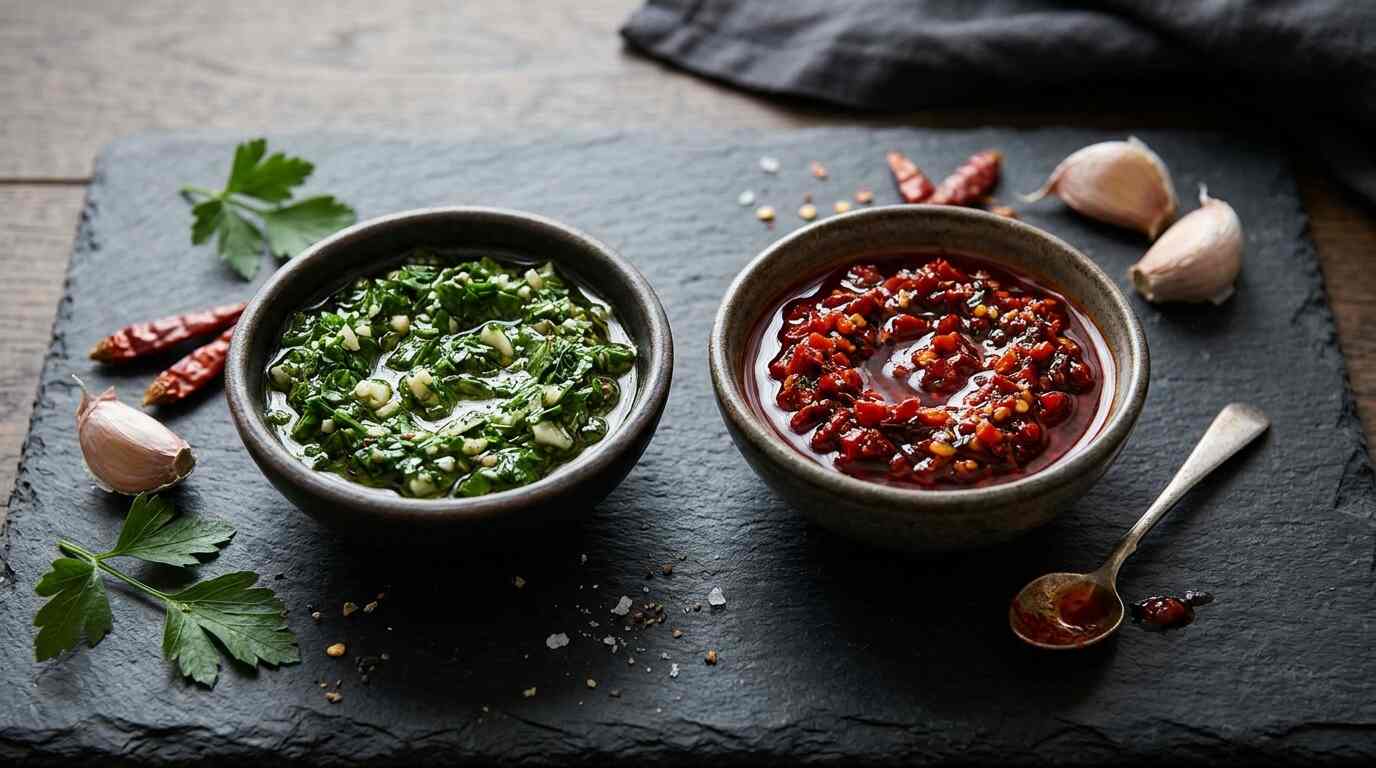
Argentine cooks make both chimichurri verde and chimichurri rojo, as Wikipedia and Culture Trip each note. The green is the parsley, garlic and oregano sauce above. The red is harder to pin down, because the recipes contradict one another.
The Daily Meal says red chimichurri swaps the green herbs for dried red chile powder and paprika, often smoked. The Milk Street library entry for red chimichurri describes it as potent, vinegary and bright red, and cilantro-free, built on vinegar and seasonings and not on fresh green herbs. Gulf News describes it as spicier, with bell peppers, tomatoes, cilantro, onion and red grape vinegar, which places cilantro back in.
Hank Shaw’s red chimichurri recipe keeps the parsley and calls for a roasted red bell pepper, a shallot, a hot chile, cumin and paprika. He writes that “This one adds sweet and hot peppers, plus paprika,” says the char and smoke are the main difference from green, and recommends chopping by hand because blending turns the red color orange. He names the sauce for grilled flat iron steak and for a choripán. A clean rule for what makes a chimichurri red has not been written down in any of these sources.
Chimichurri on Choripán and Other Sandwiches
The sauce that soaks into the roll
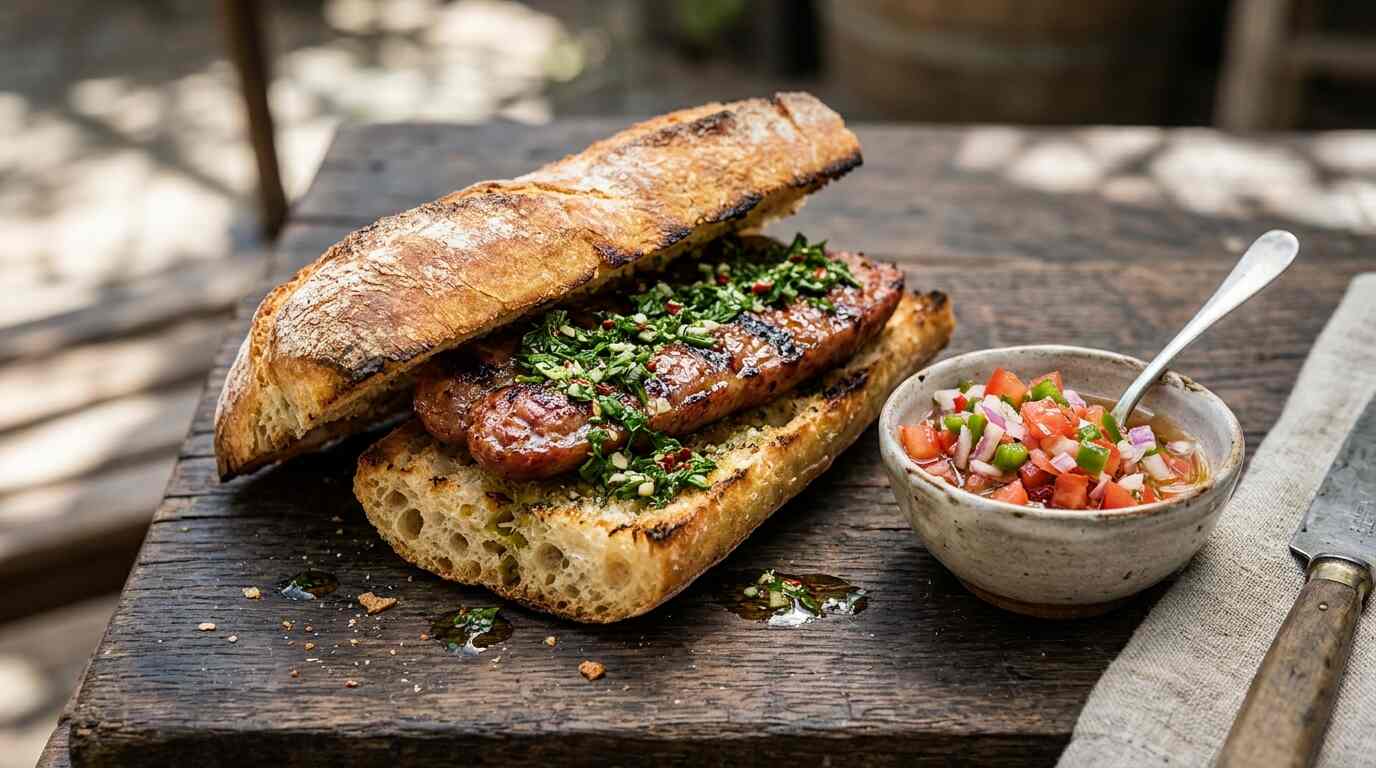
On a sandwich, chimichurri does the work of a condiment and a seasoning at once. Argentine Asado calls it the only condiment a choripán needs, spooned over grilled chorizo in a firm-crusted French-style roll, with a recipe that uses 4 to 6 tablespoons for four sandwiches. Tasting Table reports that Saveur calls the sauce the most important element, a mix of oil, vinegar, fresh herbs and onion that cuts the sausage’s richness and soaks into the bread. The sandwich itself, with its own disputed history, is covered in the choripán post.
Argentina and Uruguay both claim choripán, according to Argentine Asado, which describes the Uruguayan version as using milder, mostly beef chorizo, softer pan catalán bread and toppings such as mayonnaise, lettuce and tomato. A Uruguayan-or-Argentinian recipe on Where Is My Spoon mixes parsley, oregano, garlic, red chili, red wine vinegar, lemon juice and olive oil, then rests the sauce for about 30 minutes before serving.
Culture Trip says chimichurri is not a dip for fries or a topping for hot dogs and hamburgers. Elsewhere the name has wandered. Wikipedia records that in the Dominican Republic a “chimichurri” or “chimi” is a hamburger topped with chopped cabbage and salsa golf, and that in León, Mexico, the name belongs to an orange pizza topping of mayonnaise, mustard, chile de árbol, vinegar and garlic. Other sauce histories on the site include thousand island dressing and remoulade.
Sources
- Britannica, “Chimichurri”: https://www.britannica.com/topic/chimichurri
- Merriam-Webster, “chimichurri”: https://www.merriam-webster.com/dictionary/chimichurri
- Wikipedia, “Chimichurri” (pointer to cited books only): https://en.wikipedia.org/wiki/Chimichurri
- The Daily Meal, “The Unknown Origins Of Chimichurri Sauce”: https://www.thedailymeal.com/1319692/chimichurri-sauce-unknown-origins
- Culture Trip, “A Brief History of Chimichurri: Argentina’s Favorite Sauce”: https://theculturetrip.com/south-america/argentina/articles/a-brief-history-of-chimichurri-argentinas-favorite-sauce
- Gulf News, “Chimichurri on grilled meat? It’s never a ‘mis-steak'”: https://gulfnews.com/food/chimichurri-on-grilled-meat-its-never-a-mis-steak-1.1622640628742
- Mashed, “No One Can Agree On How Chimichurri Got Its Name”: https://mashed.com/1337282/argentinian-history-origin-chimichurri
- BBC Mundo via MDZ, “El disputado origen del chimichurri”: https://www.mdzol.com/bbc-mundo/2021/6/11/el-disputado-origen-del-chimichurri-la-famosa-salsa-que-une-los-argentinos-165362.html
- Canal 26, “El curioso origen de la palabra chimichurri”: https://www.canal26.com/general/2026/07/15/el-curioso-origen-de-la-palabra-chimichurri-la-teoria-que-vincula-a-los-britanicos-con-la-salsa-del-asado-argentino/
- North Coast Journal (chimichurri recipe feature): https://www.northcoastjournal.com/?p=47494
- Milk Street, “Red Chimichurri (Chimichurri Rojo)”: https://www.177milkstreet.com/digital-library/red-chimichurri-chimichurri-rojo-argentina
- Hank Shaw, Hunter Angler Gardener Cook, “Red Chimichurri”: https://honest-food.net/red-chimichurri-recipe
- Argentine Asado, “Choripán: The King of Argentine Street Sandwiches”: https://argentineasado.com/recipes/choripan-the-king-of-argentine-street-sandwiches
- Tasting Table, “Argentina’s Versatile Chorizo Sandwich, The Choripán”: https://tastingtable.com/1118829/argentinas-versatile-chorizo-sandwich-the-choripan
- Where Is My Spoon, “Choripán con Chimichurri”: https://whereismyspoon.co/wprm_print/choripan-con-chimichurri-uruguayan-or-argentinian
Keep reading
- Aioli vs Mayonnaise: Where Garlic, Egg and Olive Oil Draw the Line
- Duke’s Mayonnaise History: Eugenia Duke, Camp Sevier and the Sugar-Free Recipe
- Vada Pav: Mumbai’s Potato Fritter Sandwich, Its Disputed Origin and Political Life
More in this section: Sauces and Spreads guide.