In this story
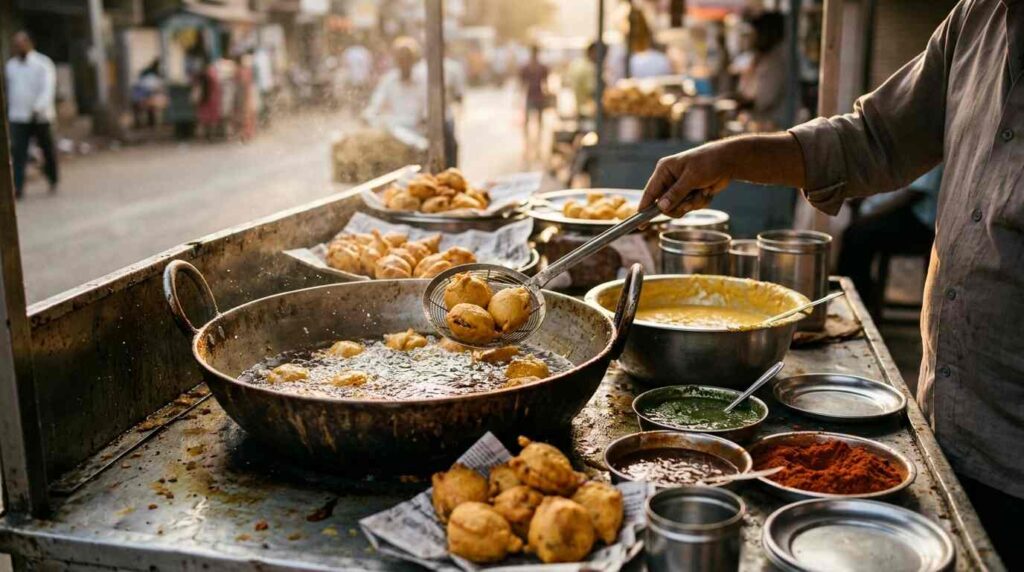
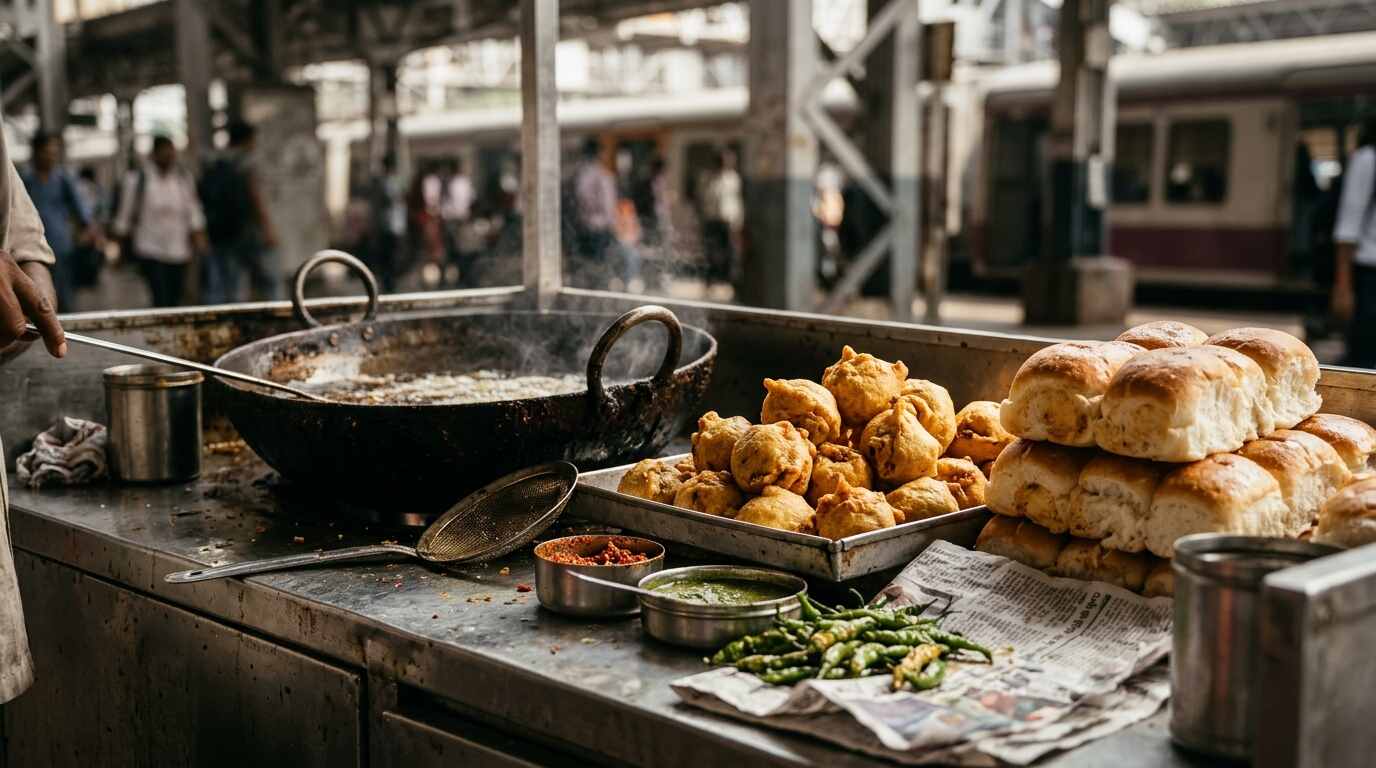
Vada pav is a deep-fried potato fritter pressed into a soft bread roll with chutneys, and its best-known origin story names one man, Ashok Vaidya, and one place, a stall outside Dadar railway station in Mumbai. The year attached to that story is usually 1966, but the sources do not agree on it, and at least two other makers have been named as early sellers. NPR reports that Vaidya introduced it from a handcart outside a busy local train station in 1966, and that his son Narendra still sells it near Dadar.
Video: Inside the kitchen of Best Vada Pav in Mumbai – Ashok Vada Pav | midday india
The Dadar stall and the 1966 claim
Mumbai Live, in a piece it credits to LBB, says that Ashok first sold only vada and poha from a stall outside Dadar station. Across from him another vendor sold omelette pav. Noticing how customers took to the bread, he began putting the vada inside it with chutney. Archaeologist and culinary anthropologist Kurush Dalal, quoted by Open magazine, recounts the same popular story, in which Vaidya took the idea from a neighbouring omelette seller’s cart.
The Better India, which spoke to Narendra Vaidya, describes the setting as the mid-1960s and says the dish was believed to have been invented in 1966. Narendra is quoted there as saying his father already sold traditional vadas and poha at a small shop, and that the bun pav had become a new trend among mill workers. The article says Ashok put a deep-fried potato vada between pav and served it with chutney, that people lined up for it morning, noon and night, and that others began selling it across the city. Ashok Vaidya died on July 6, 1998.
More recent coverage repeats the 1966 date. The Free Press Journal, reporting on a TasteAtlas list of iconic sandwiches, says Vaidya reportedly started a food cart outside Dadar Railway Station in 1966 to serve textile mill workers. The same article places the Ashok Vada Pav stall near Kirti College in Dadar West and says it ranked 25th on that list. The Cyprus Mail calls 1966 the most widely accepted account, placing the origin in the mill districts of central Mumbai.
Other claimants and dates that do not match
A 1966 start is not universal. An archived Deccan Herald piece begins by saying it is unclear who first sold vada pav and when, though most accounts put the first public sale in the mid-1960s in the mill district of Girangaon. It quotes Narendra Vaidya as saying, “My father started it around 1966-67 and slowly it evolved.” That is a looser claim than a fixed year.
The same Deccan Herald piece names a rival. Khidki Vada Pav in Kalyan, in Thane district, was started in the late 1960s by the Vaze family, who sold from a window of their house facing the road. Wikipedia, which should be treated here only as a pointer because the page does not name sources for the claim, lists Ashok Vaidya and Sudhakar Mhatre as creators in its infobox and says in the history section that some sources credit Mhatre with starting a business around the same time. No fetched source other than that page names Mhatre, so nothing further can be reported about him.
The dates also drift later. Open magazine says vada pav emerged in the early 1970s, crediting Vaidya, and the Quartz article on the snack’s political history opens by saying that Vaidya began serving it in 1971. Only the opening of the Quartz page could be read. Outlook India’s short history, for its part, does not name Vaidya at all, crediting an unnamed vendor on platform number 1 of Dadar station who slipped a batata vada between a pav.
The potato fritter itself was older than any of these stalls. NPR quotes food historian Mohsina Mukadam of Ramnarain Ruia College saying that Mama Kane’s was the first restaurant to serve batata vada, in 1928. Open magazine adds that Mukadam suggests the naan chaap, a meat patty served in pav-like bread, may have been an inspiration for the sandwich, though she does not confirm it.
Mill workers and a cheap meal
Girangaon, the textile mill belt, supplied the early customers. The Deccan Herald piece says the area once had more than 100 textile mills. Food writer Vikram Doctor told NPR that the first patrons were nearby crowds and daily train commuters. Wikipedia, again as a pointer only, says the snack was cheap, at about 10 to 15 paisa in 1971, and easier to eat on a crowded local train than batata bhaji with chapati.
When the mills closed, the number of sellers grew. NPR dates a major strike that left textile workers unemployed to 1982, after which many of them opened vada pav stalls. The Cyprus Mail places the closures in the 1970s and 1980s. Homegrown also reports that displaced workers from the Lower Parel mills started their own stalls.
The pav
The bread is as much a historical question as the fritter. Open magazine reports that the pav is believed to have been brought to Goa by the Portuguese, whose word for bread is pao, and that Goan cooks short of yeast used toddy to ferment the dough. It quotes Lizzie Collingham’s Curry: A Tale of Cooks and Conquerors on the toddy and notes her point that wheat bread carried religious weight for sixteenth-century Europeans because it was the only substance allowed for Mass.
Goan bakers are believed to have carried the bread to Mumbai. Dalal told the magazine that Goans were among Bombay’s first bakers and that Iranian refugees of the nineteenth century, trained in yeast baking, helped the trade flourish. Mukadam adds that many upper-caste Hindus avoided the bread at first, partly because of a rumor that the dough was kneaded by feet. She calls the claim that “pav” comes from a Hindi word for feet unsupported, and says resistance eased in the 1970s and 1980s as more women joined the workforce.
NPR makes a related observation about the dish as a whole: potatoes, chilies and bread all reached the subcontinent through European colonizers, with the Portuguese bringing the bread. A comparable story, a colonial-era bread wrapped around a local filling, is told in the post on banh mi.
The vada and the chutneys
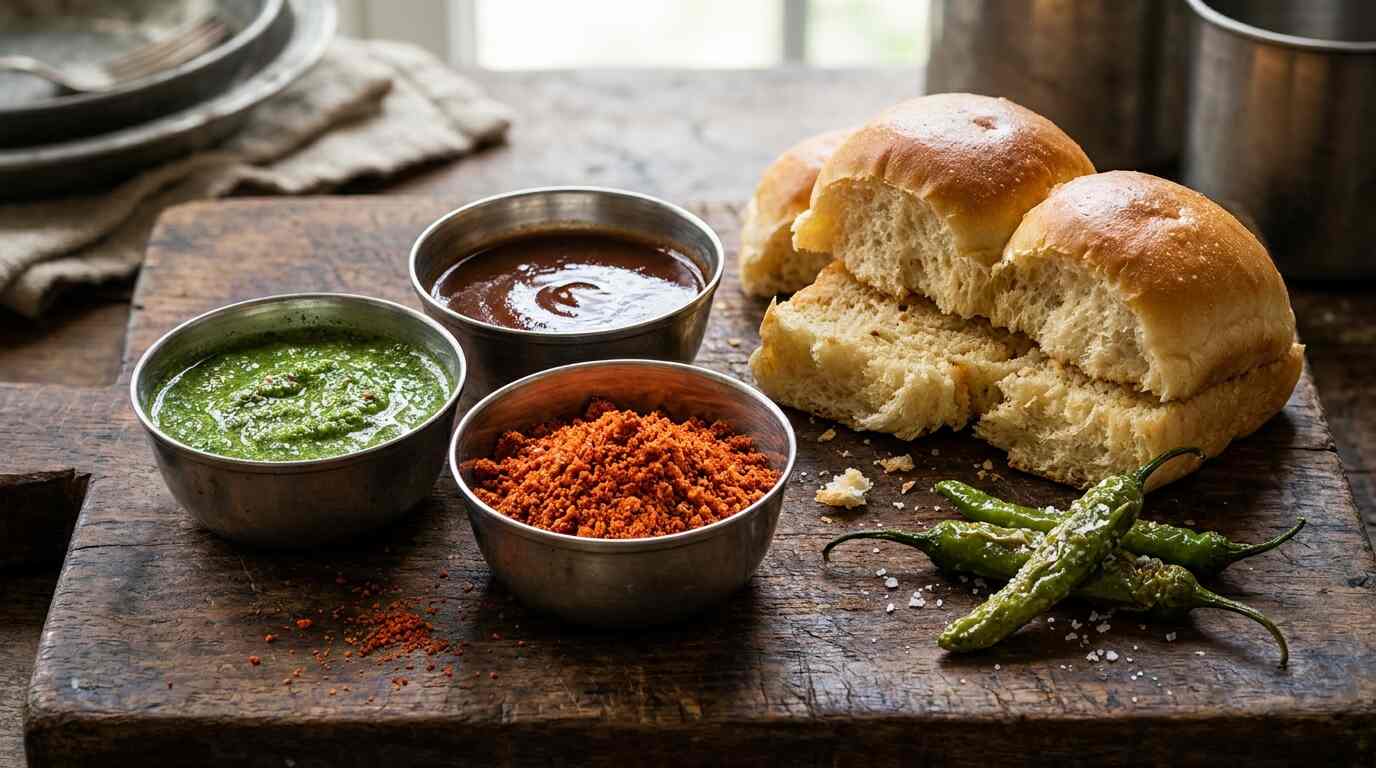
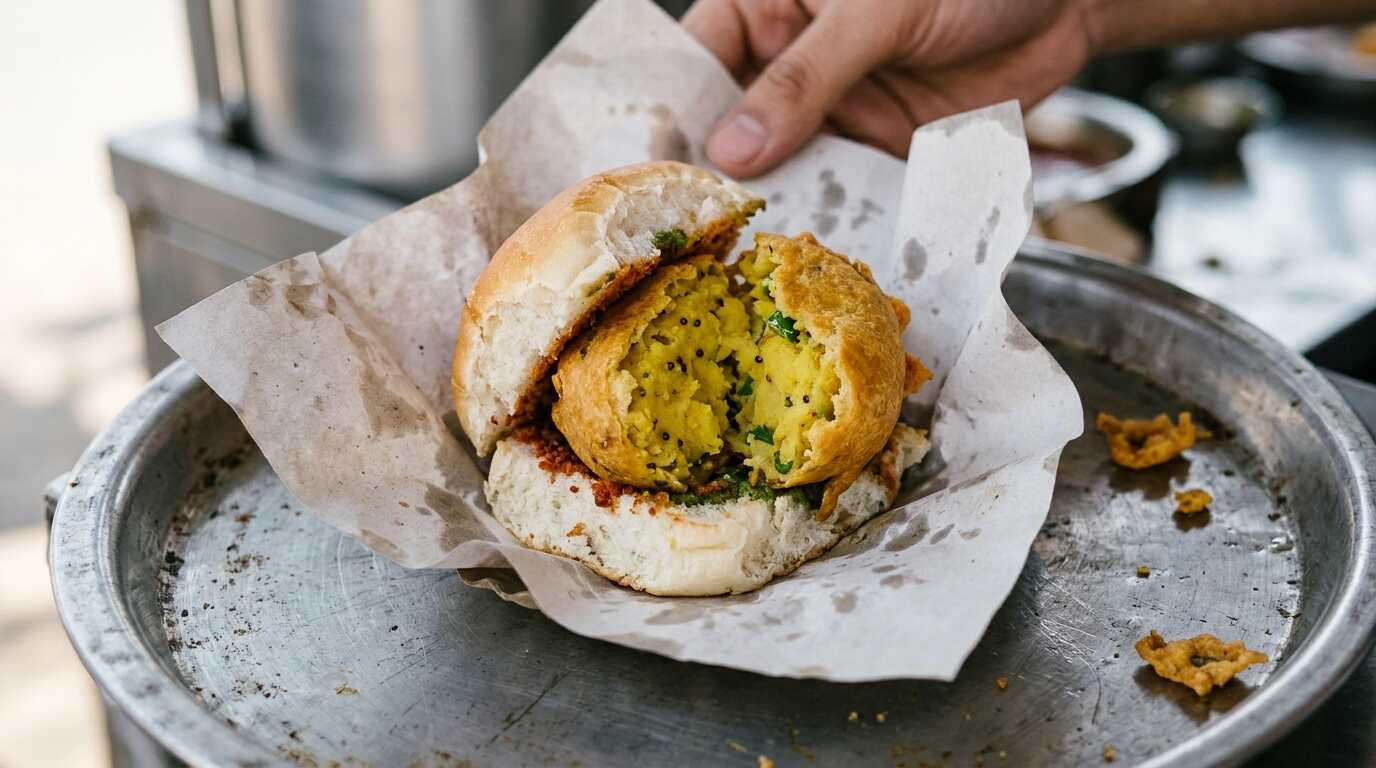
NPR describes the vada as potato balls dipped in chickpea batter and fried. Wikipedia’s preparation section, which does not show its source list on the page, gives the interior as boiled, mashed potato with chopped green chili, garlic, mustard seeds, asafoetida and turmeric, shaped into a ball, dipped in gram flour batter and deep-fried. The roll is cut almost in half and filled.
The chutneys vary by account. NPR counts three: a green one of cilantro and green chilies, a sweet and tangy tamarind, and a dry lasoon chutney of garlic and spices, with fried green chilies on the side. The Better India describes the Vaidya version as served with spicy red chutney and fried green chilies. The Cyprus Mail says chutneys are often made from garlic, coconut or chili, and that a whole green chili is typical. At the Dadar stall the TasteAtlas write-up singles out the chura pav, filled with crisp fried batter crumbs and served with a spicy garlic chutney and a sweet tamarind chutney.
A nutrition estimate exists as well. Chef Hiralal Patel, quoted in the Deccan Herald archive piece, put a 200-gram vada pav at about 290 calories. The figure is an estimate by one chef, not a measurement.
Shiv Sena and the stalls
Vada pav is entangled with the politics of the Shiv Sena, a party founded in 1966, the same year as the Vaidya claim. Homegrown says Bal Thackeray launched it to give a voice to the “Marathi manoos,” local working-class Marathi men who, in his view, were losing jobs to a growing South Indian population. It cites Duke University anthropologist Harris Solomon’s paper, which in turn cites 1960s party protest signs reading “Idli dosa bagao”, meaning stop idli and dosa. NPR says Mukadam credits Thackeray with encouraging locals to open eateries serving Maharashtrian dishes at a time when South Indian restaurants dominated Mumbai.
The party’s role in street vending is reported with attribution rather than as settled fact. Prakash Akolkar, author of Shiv Sena – Jai Maharashtra, says in the Deccan Herald piece that the party used vada pav stalls and push carts to promote itself, and that when a mill or factory laid off workers the party helped the jobless set up vada pav stands outside it. Homegrown quotes Solomon saying the party offered unlicensed vendors protection from the authorities in exchange for money, leaving vendors owing it. GOYA, a food and travel blog, says the Sena reportedly helped laid-off workers set up stalls without licenses in the 1970s and 1980s. These are accounts of a practice, and none of the pages documents a particular stall.
The party then tried to formalize it. DNA India reported that the Shiv Vada Pav scheme was first announced in 2008 at Shivaji Park, with the aim of globalizing the dish and providing jobs to Marathi youth. The original plan covered 125 stalls with space from the Brihanmumbai Municipal Corporation, and about 5,000 applications, mostly from party workers, had reached the civic body by the time the article ran. DNA’s page shows an update date of December 26, 2010, though other text on it is from later, so the launch year it promises cannot be confirmed. The Cyprus Mail describes the 2008 plan as a chain that would employ only Marathi workers, framed as an employment scheme. NPR says Mukadam recalls the party holding a “best vada pav” contest in 2008. GOYA gives 2009 as the launch year and says the Mumbai High Court ordered the stalls shut in 2016, after which the Sena removed the Shiv Vada trademark; that blog account was not checked against a court record.
Homegrown separately claims that about 5,000 Shiv Sena vada pav stalls operate today and gives no start year, so the figure is not used as a count here.
DNA India also tells a story about the first stall’s own fortunes. In 2015 it reported that the Brihanmumbai Municipal Corporation, then run by the Shiv Sena, refused to renew the licence of Narendra Vaidya unless he moved to a hawkers’ plaza built near Dadar station. Narendra refused, saying customers would not climb two floors for a vada pav. According to him, sales fell by 75 percent. The same article says his father had been close to Thackeray, held a municipal licence that was renewed for years, and in the mid-1990s was told to visit Matoshree after the Sena took power, but heavy security kept him from meeting Thackeray before his death in 1998. The corporation’s position comes only through the reporter’s wording, and no official is quoted. Whether the situation changed after 2015 cannot be told from the page.
Mumbai Live repeats several anecdotes of Thackeray protecting Vaidya from ward officers, but labels them hearsay and cites no primary source.
Chains and the stall that stayed
The sandwich also acquired corporate versions. NPR’s 2016 piece lists Jumboking, Goli and Wow Vada Pav as chains, says Jumboking had 82 outlets and aimed for 200, and says Goli reported 350 stores in 90 cities and 21 states on its website. Jumboking’s managing director, Dheeraj Gupta, calls vada pav “the single largest-selling snack in Mumbai”, though the article gives no sales figures. Doctor, for his part, says the snack is best enjoyed from local hawkers and that mom-and-pop shops will remain.
Narendra Vaidya works from Platform 1 on the Western Line at Dadar, where, according to Mumbai Live, he now sells samosa and pakora as well. The same listing gives Kirti Vada Pav, also called Ashok Vada Pav, on Kirti College Lane in Prabhadevi, while the Free Press Journal places the stall in Dadar West. What the sources can establish is the stall, its family and the 1966 date as the one most often repeated. What they cannot establish is that no one sold a vada inside a pav before it.
Sources:
- NPR, “Meet Mumbai’s Iconic Veggie Burger”: https://www.npr.org/sections/thesalt/2016/11/04/500539626/meet-mumbais-iconic-veggie-burger
- The Better India, “How Old is Mumbai’s Iconic Vada Pav?”: https://thebetterindia.com/243528/mumbai-best-vada-pav-stall-food-origin-ashok-vaidya-maharashtra-history-san196
- Mumbai Live, “History of Vada Pav: How it started and famous Vada Pav you must eat”: https://www.mumbailive.com/en/lifestyle/history-of-vada-pav-how-it-started-and-famous-vadapav-you-should-eat-in-mumbai-47726
- Free Press Journal, “Mumbai’s Ashok Vada Pav From Dadar Makes It To Top 40 World’s Most Iconic Sandwiches List”: https://www.freepressjournal.in/amp/lifestyle/mumbais-ashok-vada-pav-from-dadar-makes-it-to-top-40-worlds-most-iconic-sandwiches-list
- Cyprus Mail, “Mumbai’s iconic street snack”: https://cyprus-mail.com/2026/01/31/mumbais-iconic-street-snack
- Deccan Herald (archive), “Mouth-watering foodstuff, Mumbai”: https://www.deccanherald.com/archives/mouth-watering-foodstuff-mumbai-2008292
- Open magazine, “Breaking Bread”: https://openthemagazine.com/feature/breaking-bread
- Quartz, “How a right-wing political party crafted the legend of Mumbai’s most famous snack” (opening only): https://qz.com/india/358779/how-a-right-wing-political-party-crafted-the-legend-of-mumbais-most-famous-snack
- Outlook India, “A short history of the vada pav”: https://www.outlookindia.com/traveller/cuisine/a_short_history_of_the_vada_pav/
- Homegrown, “How The Shiv Sena Politicised Mumbai’s Vada Pao”: https://homegrown.co.in/article/803078/how-the-shiv-sena-politicised-mumbais-vada-pao
- GOYA, “The Politics of Vada Pav”: https://www.goya.in/blog/the-politics-of-vada-pav
- DNA India, “Sena to launch Shiv vada pav scheme in 10 civic markets”: https://www.dnaindia.com/mumbai/report-sena-to-launch-shiv-vada-pav-scheme-in-10-civic-markets-1486591
- DNA India, “Shiv Sena-run BMC refuses to renew licence of family of first vada pav maker”: https://www.dnaindia.com/india/report-shiv-sena-run-bmc-refuses-to-renew-licence-of-family-of-first-vada-pav-maker-2096874
- Wikipedia, “Vada pav” (pointer only): https://en.wikipedia.org/wiki/Vada_pav
- midday india (YouTube), “Inside the kitchen of Best Vada Pav in Mumbai – Ashok Vada Pav”: https://www.youtube.com/watch?v=iejHvqGEqK8