In this story
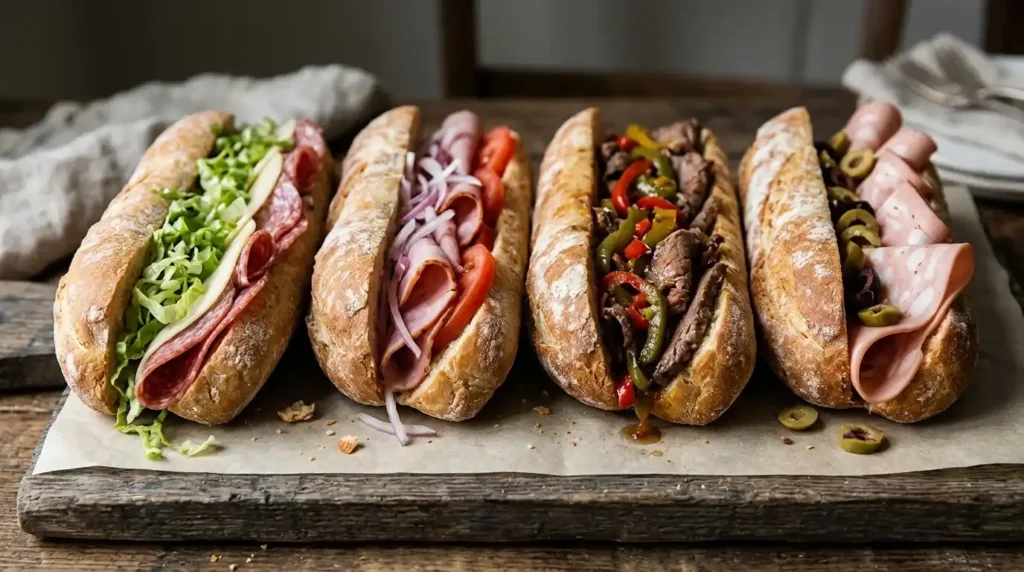
A split Italian roll filled with cold cuts, cheese and vegetables goes by a different name in almost every region of the Northeast, and some of the names change within a single state. Linguists have tracked the pattern since the 1960s, and the origin stories attached to each word are, for the most part, unresolved. Several rest on a single family’s memory, and a few collapse when checked against dated newspapers.
Video: A brief history of subs, grinders and hoagies., Food History Bites
The terms that follow are sorted by how widely they travel, starting with the one that has the most competing explanations.
Hoagie: Philadelphia and the Hog Island question
Hoagie is the Philadelphia word, and it is strongest in Pennsylvania and southern New Jersey, as the hosts of the public radio show A Way with Words describe it. A survey of Pittsburgh residents cited by the Philadelphia Inquirer found 44 percent saying hoagie there, though the paper notes that survey was more than a decade old.
The shipyard account
The most repeated explanation ties the word to Hog Island, the World War I shipyard near Philadelphia. In that story, Italian immigrant workers brought oversized sandwiches to the yard, the workers became known as Hog Islanders, and the sandwiches turned into “hoggies” and then “hoagies.” Philadelphia magazine attributes a version of this to Penn urban studies professor Dominic Vitiello, and the Inquirer says its own archives repeated it in 1968 and 1992.
The dates cause trouble. The shipyard closed around 1920, and the word was not documented until 1940, according to The Takeout. Lexicographer David Wilton, writing at Wordorigins.org, puts the gap at about fifteen years and treats the shipyard story as doubtful. He cites a 1945 Philadelphia phone directory, reported in a 1967 study by linguists Edwin Eames and Howard Robboy, and earlier spellings found by researcher Barry Popik: “hoogie” in January 1941, “hogie” in September 1943 and “hoggie” in October 1944.
The luncheonette account
Wilton finds a different story more plausible. Al De Palma, a South Philadelphia sandwich seller who called himself the “King of the Hoggies,” said he used the word as early as 1928 and opened a shop in 1936, a timeline that fits the 1941 spelling. His daughter, Rita Scaltrito, told the Inquirer in 1992 that her father had compared shipyard workers to hogs and sold “hoggies” near South 20th and Mifflin Streets. Robboy called this the most credible of the Hog Island stories, per the same article.
The rest of the field
Philadelphia magazine catalogues seven theories in all. Some are folk etymologies with no named source: an Irish shipbuilder named Hogan who coveted an Italian coworker’s lunch, or “hokies,” the scrap sandwiches handed to people “on the hoke,” a South Philadelphia phrase for poverty. Food historian William Woys Weaver, by contrast, proposed that the sandwich dates to the 1880s and the arrival of H.M.S. Pinafore, when street vendors called hokey-pokey men sold fillings on a long roll called a pinafore. Another family claim comes from the DiCostanza family of Chester, Pennsylvania, who date their sandwich to 1925, though the Inquirer notes that its source is the family’s own website, and the story does not account for the word itself.
Sub: the nationwide name
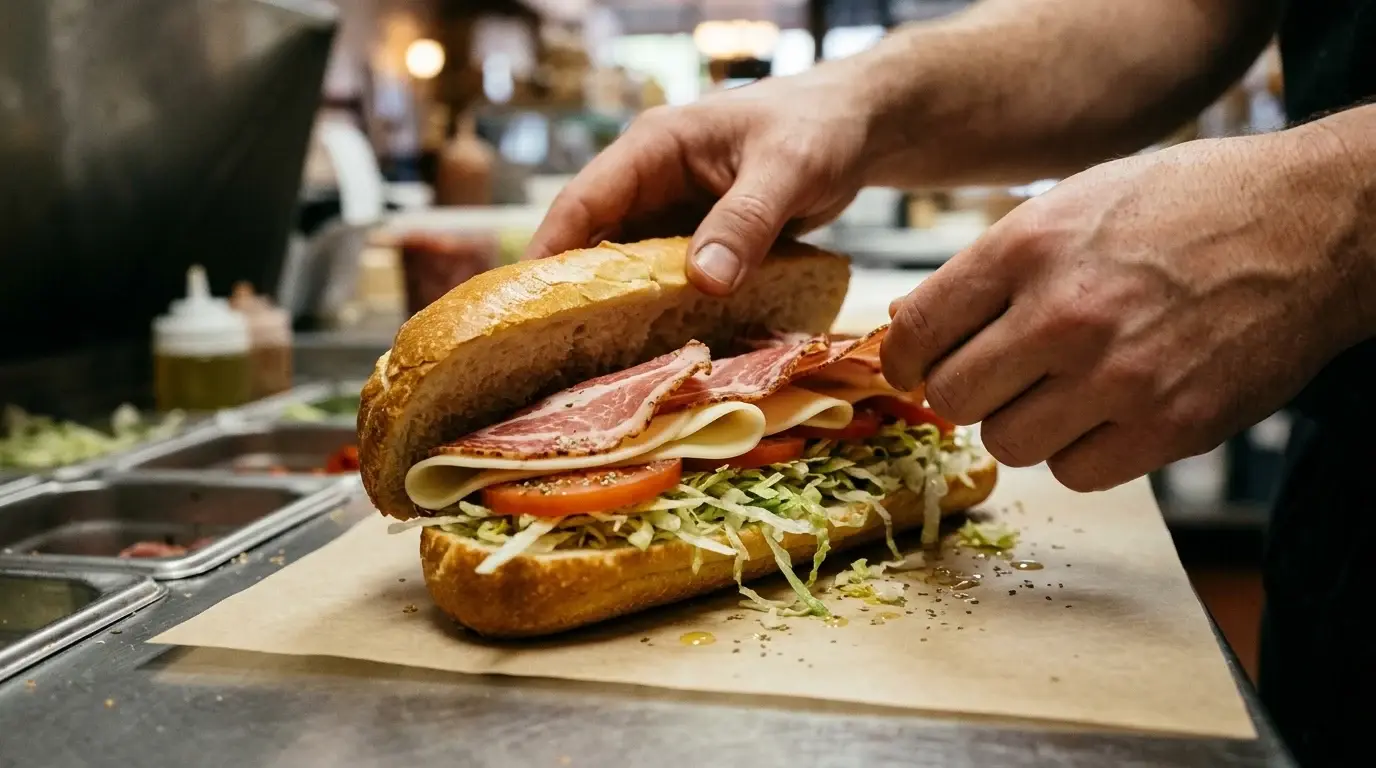
Sub is short for submarine sandwich and now dominates the country. Wilton traces the name to the sandwich’s long, tubular shape at Wordorigins.org, and the A Way with Words hosts point out that the word predates the best-known sandwich chain that now carries it.
Where it started is disputed in three directions.
Paterson, New Jersey
The Takeout reports a family account in which Dominic Conti, an Italian immigrant in Paterson, named his long-roll sandwiches after the Holland I submarine hull that was on display locally in 1927. It cites his granddaughter Angela as the source. The Houston Press summarizes a similar tale of an immigrant who started selling subs after seeing a submarine in a Paterson museum. Both rest on descendants’ recollection, and neither points to a dated advertisement or menu.
New England naval yards
A popular alternative holds that grinders became subs in Connecticut because the sandwiches looked like submarines built at a nearby naval shipyard, a version repeated by Yankee magazine. Another account in the Houston Press has a Boston shop baking bread in that shape for Navy servicemen. The Takeout, for its part, calls the Groton, Connecticut, wartime version incorrect, and Wilton says the New London story lacks evidence.
The dates
Wilton gives 1941 as the earliest citation, with an unverified 1967 claim reaching back to 1928. The Takeout instead points to a newspaper use in 1931. The two sources do not agree, and neither article reproduces the clipping.
Hero: New York
Hero belongs to New York City and the area around it, where it covers both hot and cold versions, according to The Takeout. The word is older than the usual stories suggest. Popik’s page collects citations beginning with a June 6, 1934, Associated Press item in the Albany Evening News about a hostess who served hero sandwiches, followed by an August 1936 Brooklyn Times Union column describing a hero as a husky man-sized sandwich (Barry Popik). Wilton’s earlier survey gives 1947 as the first printed appearance, a date those 1930s items push back.
The Paddleford story
Food writer Clementine Paddleford is often credited with coining the name through a remark that only a hero could finish one. The Takeout says no source for that remark has been found, and Popik’s page records only that her August 9, 1947, Herald Tribune article described the Manganaro grocery on Ninth Avenue, which sold about a thousand heroes a day. Her piece describes the sandwich. It does not claim to have named it.
The gyro theory
A second explanation links hero to the Greek gyro. The Oxford English Dictionary rejects it on chronological, formal and semantic grounds, Popik reports, and Wilton adds that the word gyros is not attested in English until 1968. The remaining explanation is the plain one, that the sandwich was simply large.
Grinder and spuckie: New England
Grinder is the main word in Connecticut and Rhode Island and is also heard in Vermont, New Hampshire and western and central Massachusetts, according to Yankee magazine’s reading of the Harvard Dialect Survey, a 2003 study by linguists Bert Vaux and Scott Golder. Boston is the exception.
Wilton dates grinder to at least 1946 and favors the chewy-crust explanation: the bread makes the jaw grind. Yankee magazine offers the same idea. The Takeout adds a different origin, crediting Benedetto Capalbo of New London, Connecticut, who sold big sandwiches in the mid-1920s, and then undercuts it by noting that no contemporary document supports his role. The same article calls the dock-worker explanation, in which “grinder” was slang for a longshoreman, undocumented as well.
Hot versions complicate the picture. Wilton writes that the original grinders were cold-cut sandwiches, and that heated ones came to be called oven grinders. In several states the word now more often means the hot kind.
Spuckie
Boston keeps its own word, spuckie or spukie, heard mostly in South Boston and Dorchester. It is generally traced to the Italian spucadella, “long roll,” a word that does not appear in most Italian dictionaries, so it may come from a regional dialect or be a Boston Italian invention (Yankee). The Takeout suggests a link to the Italian spaccatella and notes that the word is fading, with only a few businesses in Dorchester and Somerville still using it. The A Way with Words hosts say it survives mainly among older speakers.
Wedge, zep, cosmo and other local names
Some names exist in only a few towns.
Wedge
Wedge is used in Westchester County, New York, especially Yonkers. Popik’s earliest citation is a 1932 Standard-Star of New Rochelle describing a loaf of bread sliced in two and filled with meats, cheese and hot peppers (Barry Popik). Origin theories collected there include a wedge-shaped bread roll, as suggested by a White Plains restaurant owner, and the filling being wedged into the bread, as suggested by another manager. The Takeout reports the best-known story: Frank Landi’s wife, at Landi’s Deli, supposedly pronounced “sandwich” as “sang-wedge.” Alternatives in the same article include the diagonal cut and the stuffing, and claims about Fairfield, Connecticut, could not be verified.
Zep
Zeppelin, shortened to zep, is common in eastern Pennsylvania. Wilton lists the term with a 1960 date in Verbatim, and the Houston Press says the roll was named for its resemblance to the airship. In Norristown and nearby towns, The Takeout describes it as a particular build: one meat, thick raw onion and tomato, no lettuce, on a slightly larger roll. It gives no origin story beyond the airship shape.
Cosmo, torpedo and bomber
Cosmo is a Williamsport, Pennsylvania, word for a sandwich that is always heated. The likely source, according to The Takeout, is a worker named Cosmo at Cellini’s Submarine House in Montoursville who liked his subs toasted. Torpedo was common in upstate New York in the mid-1900s, and the A Way with Words hosts say it has faded. Southern California is an exception: in San Diego and Gardena it names a specific Italian sub, tied to a restaurant that began serving it in 1952. Bomber, another shape-based word, belongs to upstate New York, including Buffalo, Ithaca and Binghamton.
Italian and po’ boy: the naming outliers
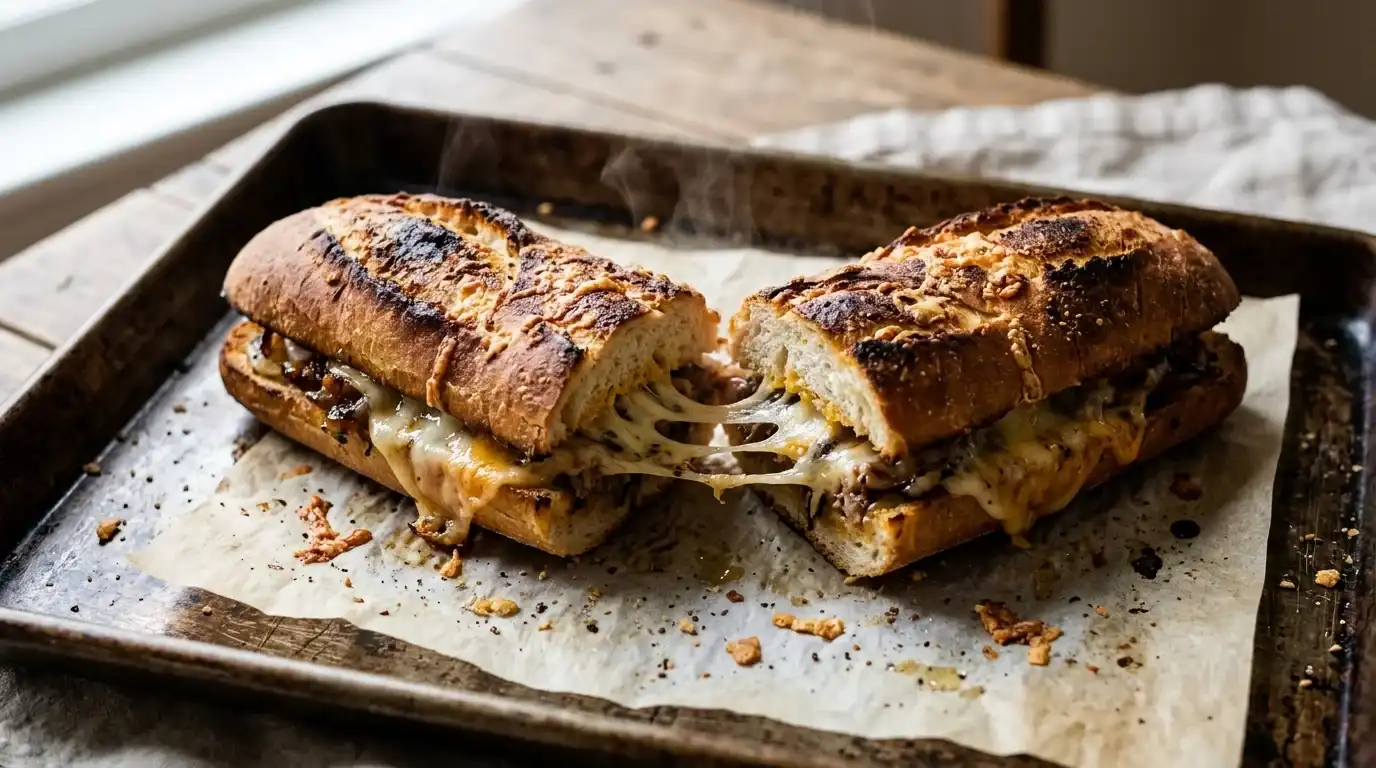
Maine uses Italian or Italian sandwich (Yankee), and in Portland it denotes a particular recipe with ham, pickles, green peppers and black olives rather than a loose category. The Takeout credits Giovanni Amato with starting it around 1900 for dock workers; local folklore, rather than a document, carries the story.
Louisiana’s counterpart is the po’ boy, which differs mainly in the bread. It grew out of the oyster loaf, and the Martin Brothers’ restaurant, open since 1922, is credited with popularizing it. A legend ties the name to the 1929 streetcar strike and the phrase “here comes another poor boy,” but The Takeout finds no documentation linking the strike to the name.
Dialect maps built from surveys such as Vaux and Golder’s show these names as overlapping regions, not clean borders. Yankee magazine cautions that grinders turn up in Boston, heroes in Connecticut and Italian sandwiches in Vermont. The word a person uses mostly reflects where that person grew up, and the written record behind most of the origin stories remains thinner than the stories themselves.
Sources:
- A Way with Words, “Names for a Sandwich Made on a Long Roll Cut Lengthwise: Hoagie, Sub, Hero, and More” – https://waywordradio.org/sub-hero-hoagie-sandwich-names/
- Philadelphia Inquirer, hoagie history – https://www.inquirer.com/food/hoagie-philadelphia-history-sub-20240715.html
- Philadelphia magazine, “Seven Theories You Might Not Know About Where the Word ‘Hoagie’ Comes From” – https://www.phillymag.com/2016/05/05/the-word-hoagie-origin/
- The Takeout, “12 Regional Names For Sub Sandwiches, Explained” – https://www.thetakeout.com/2154623/regional-names-for-sub-sandwiches-explained/
- David Wilton, “A Hoagie by Any Other Name,” Wordorigins.org – https://wordorigins.org/harmless-drudge/a-hoagie-by-any-other-name
- Houston Press, “The (Un)United States of Sandwiches: What Do You Call a Sub?” – https://www.houstonpress.com/restaurants/the-un-united-states-of-sandwiches-what-do-you-call-a-sub-6406408
- Barry Popik, “Hero Sandwich” – http://www.barrypopik.com/index.php/new_york_city/entry/hero_sandwich/
- Barry Popik, “Westchester: Wedge Sandwich” – https://barrypopik.com/blog/westchester_wedge_sandwich
- Yankee magazine, “Grinders, Subs, and Spuckies” – https://newengland.com/today/living/new-england-nostalgia/spukies-subs-grinders-sandwich-names/
- Verbatim, Autumn 2003 issue (Wilton article) – https://www.verbatimquarterly.com/v28_3
- Food History Bites, “A brief history of subs, grinders and hoagies.” (video) – https://www.youtube.com/watch?v=UTnwqbffS2g