In this story
The sloppy joe has no agreed birthplace. Iowa, Havana and Key West each have a claim, a New Jersey deli sells an entirely different sandwich under the same name, and survey articles such as the one in The Takeout lay out several stories without naming a document that settles them.
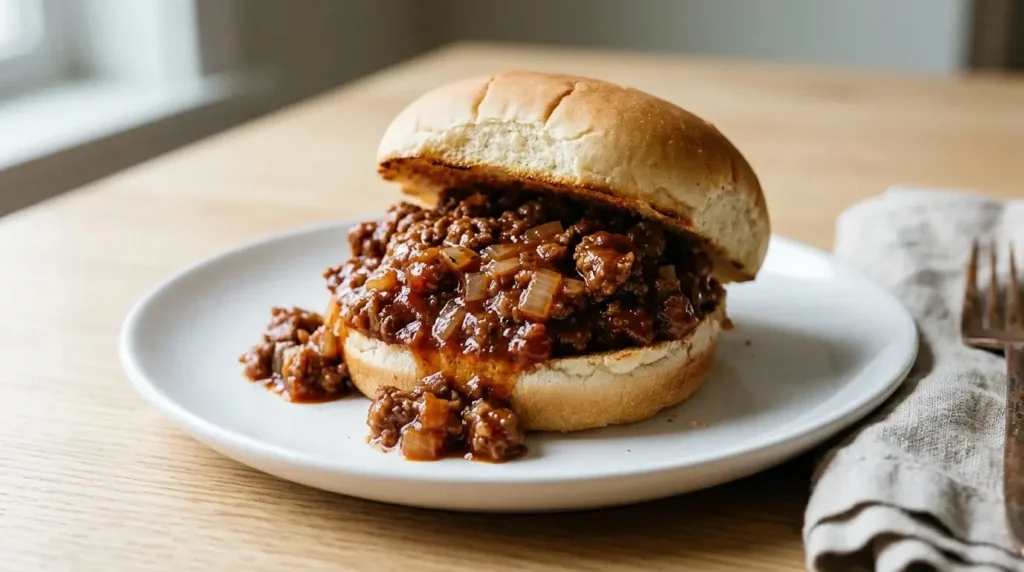
The American version, ground beef simmered in a tomato-based sauce and spooned onto a bun, is the one defined in Merriam-Webster as a dish of ground beef in a thick, spicy sauce, usually served on a bun. How it got there is the argument.
Video: School Cafeteria Sloppy Joe from the 1980s & ’90s, Tasting History with Max Miller
The Iowa claim: loose meat and a cook named Joe
The Midwestern story starts with a sandwich that has no sauce at all. Chopped or crumbled beef, steamed or fried and piled on a bun, was already a regional habit in Iowa when the first sloppy joe stories appear. Marilyn Brown, who directed the consumer test kitchen at H.J. Heinz in Pittsburgh, has said that company research points to loose-meat sandwiches sold in Sioux City, Iowa, in the 1930s, and that a cook named Joe added the tomato sauce, according to Charlotte News. Tasting Table repeats the same account and dates it to 1930.
Sioux City does have a documented loose-meat restaurant. Ye Olde Tavern, at 1322 Jackson Street, was opened by Dave Heglin, who sold ground beef sandwiches he called tavern burgers and guarded the recipe closely; Abe and Bertha Kaled bought the business and the recipe in 1934 and sold the sandwiches for a dime, according to a Wikipedia article that draws on Sioux City Journal reporting and a 1978 interview with Bertha Kaled. The article gives two founding dates, 1920 in its text and 1924 in its summary box, so the year stays uncertain. A Daily Meal history also describes a cook named Joe developing the tavern recipe, but places the restaurant in Sioux Falls while citing Sioux City sources, which makes it a weak citation for details.
The strongest objection comes from the video above. Its host calls the tale of a cook adding sauce almost certainly false and notes that no Maid-Rite source claims to have invented a sloppy joe, according to the episode summary. Nobody has produced a Sioux City menu or advertisement from the 1930s naming a tomato-sauced sandwich or a cook named Joe.
Maid-Rite and the tavern sandwich
Muscatine, Iowa, supplies the other Iowa claim, and it concerns the sauceless sandwich. Butcher Fred Angell opened the first Maid-Rite there on May 1, 1926, as a walk-up stand on Cedar Street, according to Notes on Iowa. The chain’s own history page says a deliveryman tasted the new sandwich and declared it “made right,” which became the name.
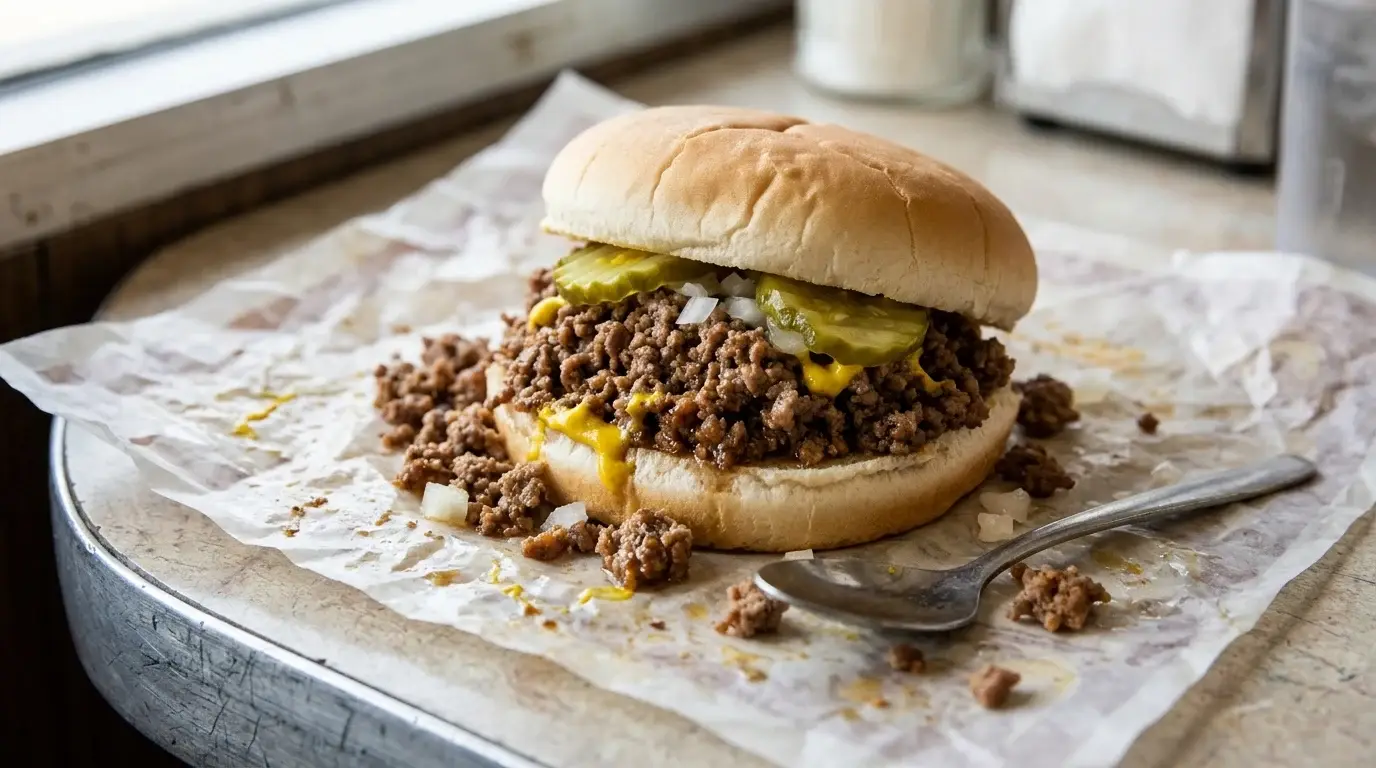
Encyclopedia.com describes the original method: beef cooked in a special steamer, served on a hot bun with mustard, pickles and onions, and a spoon for whatever fell out. Maid-Rite and Ye Olde Tavern therefore describe the same kind of sandwich from two Iowa towns in the 1920s, and both say theirs came first. A 1951 newspaper item from Le Mars, Iowa, quoting a Miss Watson, who said students preferred “loose meat sandwiches, such as taverns,” is among the earliest print citations that Barry Popik located. In northwest Iowa the sandwich goes by “tavern,” a usage that A Way with Words traces to Ye Olde Tavern.
Havana and Key West: two bars called Sloppy Joe’s
A second theory moves the name, and perhaps the filling, to Cuba. In the late 1910s, a Havana bar called Sloppy Joe’s drew American visitors, and The Takeout attributes it to José Abeal Otero, a bartender whose regulars nicknamed him Sloppy Joe. The same article says the bar served ground beef stewed in tomatoes, but adds that the link to ropa vieja or picadillo is speculation.
Sources disagree on the owner. Tasting Table and Chowhound call him José García, and they describe the sandwich as a handheld ropa vieja, shredded beef rather than ground beef. A rare-book dealer’s description of the 1932 Sloppy Joe’s Cocktails Manual confirms the bar and names the author as José Abeal, a Spanish immigrant who had worked in New Orleans and Miami. The listing says nothing about food. The Havana bar closed in the mid-1960s, per the same listing.
The documentary gap matters. Cocktail recipes prove the bar existed and was famous. They do not prove that it sold a sandwich anyone would now call a sloppy joe.
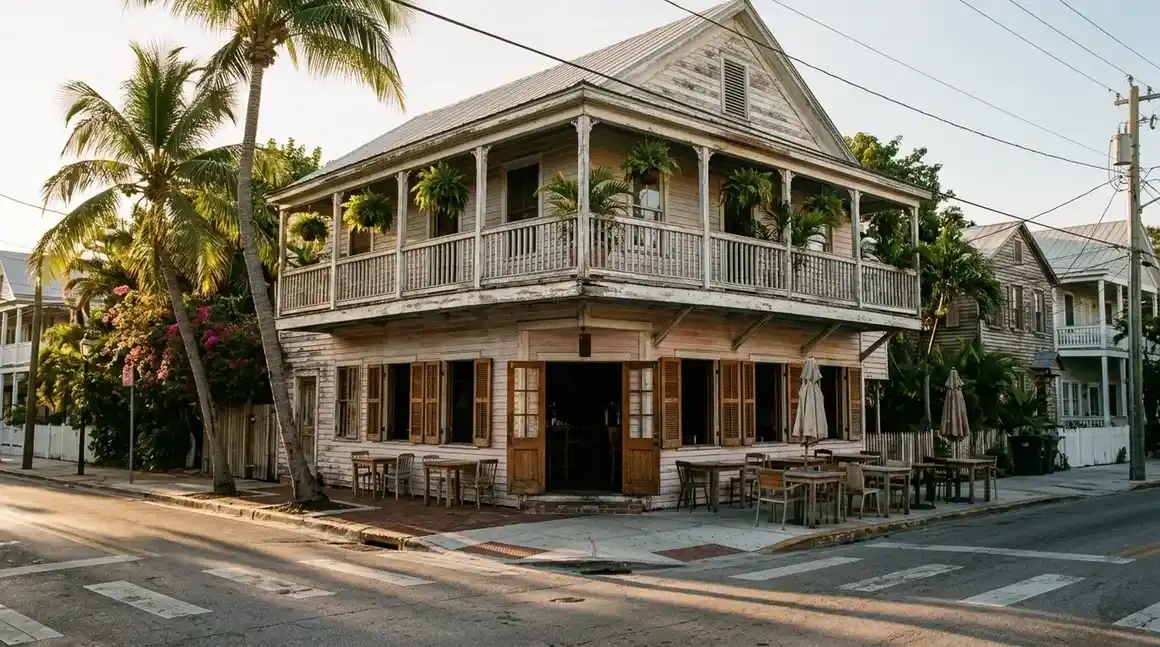
Sloppy Joe’s in Key West, Florida, is usually the third corner of the argument. By its own history, Joe Russell opened the business on December 5, 1933, the day Prohibition ended, after running a speakeasy, and moved it on May 5, 1937, to 201 Duval Street. Hemingway, a friend and regular, encouraged the name, which the bar says was borrowed from a Havana club run by a Spanish man named José García, where melting ice kept the floor wet and patrons teased the owner about the sloppy conditions.
That account explains the name without mentioning a sandwich. The Keys Weekly anniversary history is just as quiet: its only early food is fried bologna sandwiches sold from a window, and table service with food began in 1998. Even so, the bar sells a sloppy joe today, ground beef with a sweet tomato sauce, onions, peppers and spices, per Tasting Table, and Saveur reports that the bar sells more than 60,000 a year. The chain of reasoning from Havana to Key West to the American lunch counter rests on repeated retelling rather than a dated recipe.
The word before the sandwich
“Sloppy joe” meant other things first. Merriam-Webster dates its earliest recorded use to 1939, for a loose-fitting sweater, and says the term probably comes from the name Joe. The host of the video above adds that in the 1930s and 1940s the phrase covered many large, messy sandwiches, and that a 1944 Ohio advertisement already credited the sandwich to Cuba. By the 1950s, he says, the phrase had settled on ground beef in tomato sauce.
So the sandwich may have taken a name that was already circulating, which would explain why an Iowa lunch counter, a Havana bar and a Florida saloon can all appear in the story without any of them having coined it.
Sloppy joe versus loose-meat sandwich
Sauce separates the two. A sloppy joe is coated in a tomato-based mixture, often sweetened with ketchup or brown sugar. A loose-meat sandwich is seasoned beef with no sauce, “like a burger that was never formed into patties,” as Food Republic puts it, and it is drier, though still messy. Condiments carry the flavor instead: mustard, pickles and onions.
Mashed lists the Maid-Rite style as crumbly and often topped with pickles, onions and mustard, while the sloppy joe is saucier and sweeter and can be served plain on a soft bun. Popik’s file includes a 1986 dictionary entry in which a Milwaukee resident reports that in Yankton, South Dakota, a sloppy joe is called a loose-meat sandwich, so local usage blurs the line.
The New Jersey sloppy joe
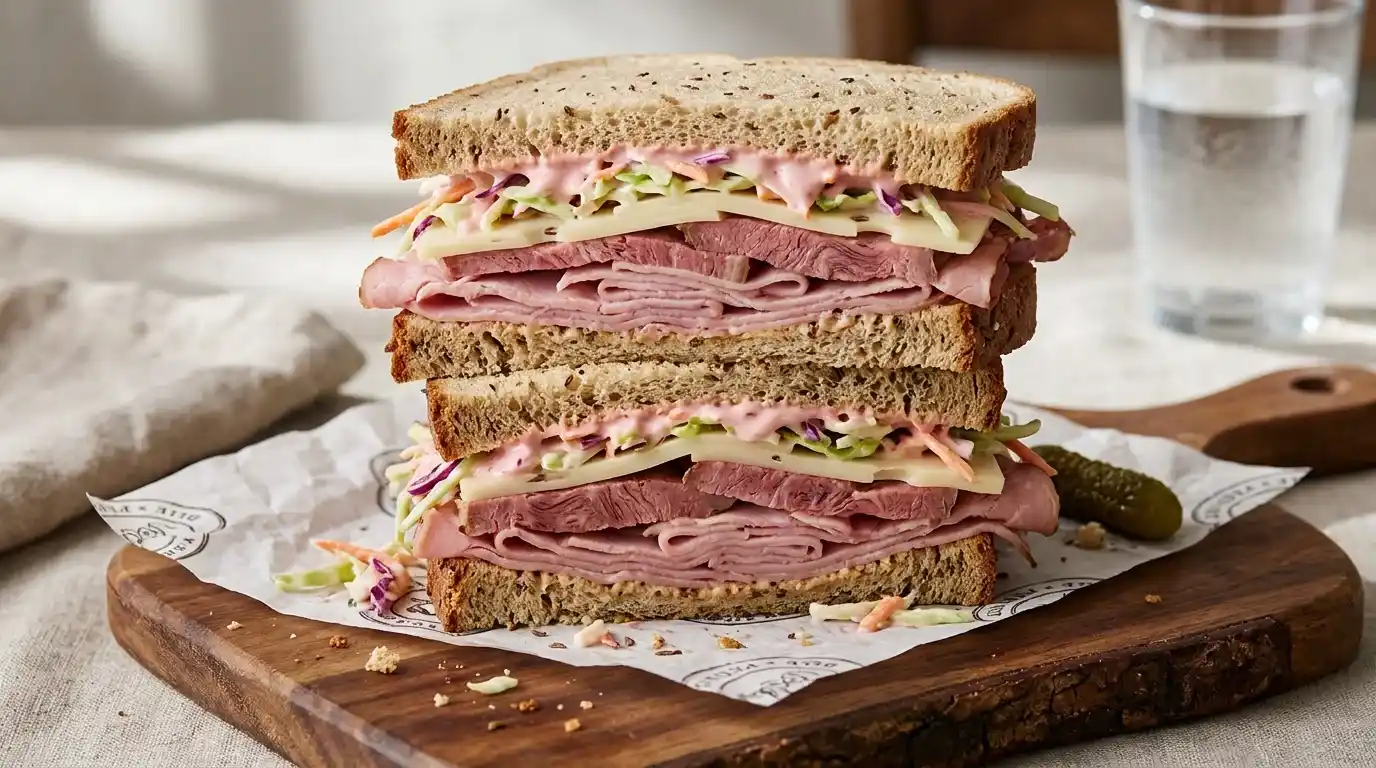
In northern New Jersey the name belongs to a cold deli sandwich. Gastro Obscura describes it as a double- or triple-decker on rye with two cold cuts, Swiss cheese, and coleslaw topped with Russian dressing. There is no ground beef and no sauce in the American sense.
Town Hall Deli in South Orange traces it to the 1930s. By its own telling, as Gastro Obscura relays it, Maplewood mayor Thomas Sweeney returned from Cuba wanting a sandwich he had eaten at the Havana Sloppy Joe’s and asked the deli to recreate it, and the first version used ham, tongue and Swiss. TASTE names the deli’s owners then as Heinz Burdorf and Fred Joost, and describes three slices of pullman rye, coleslaw brined for three days with no mayonnaise, and buttered bread to keep the dressing from soaking through. Other delis build their own versions, including a rye boule at one and three meat layers without cheese at another.
Unlike the Iowa story, the New Jersey one points straight to Havana, and the deli’s account is the only one of these origin claims that names a specific customer who asked for the sandwich to be copied.
How a sloppy joe is made
The method is short. America’s Test Kitchen starts by softening a chopped onion in oil for about 10 minutes, then adds garlic and chili powder for about 30 seconds, then a pound of 85 percent lean ground beef, broken up and cooked about 3 minutes until just pink, per its published recipe. Brown sugar, tomato puree, ketchup, water and hot sauce go in next, and the mixture simmers 8 to 10 minutes until slightly thicker than ketchup, then goes onto four hamburger buns.
The school-cafeteria version in the Tasting History episode comes from a 1988 U.S. Department of Agriculture food service cookbook, according to the episode summary. It browns the beef, drains the fat, cooks onion and garlic powder for about 5 minutes, then stirs in tomato paste, ketchup, water, vinegar, dry mustard, pepper and brown sugar and simmers 25 to 30 minutes.
Moisture decides whether the bun holds. Food Republic recommends cooking long enough for excess liquid to evaporate, using beef around 80 percent lean, and breaking the meat to a balance between chunky and fine.
Sources:
- The Takeout, “Who Is The ‘Joe’ Behind The Sloppy Joe?”: https://thetakeout.com/sloppy-joe-history-american-sandwiches-week-1830501155
- Merriam-Webster, “sloppy joe”: https://www.merriam-webster.com/dictionary/sloppy%20joe
- Tasting History with Max Miller, “School Cafeteria Sloppy Joe from the 1980s & ’90s” (video): https://www.youtube.com/watch?v=6cBhi_7c4to
- Episode summary and recipe notes: https://rosetta.to/u/tastinghistory/school-cafeteria-sloppy-joe-from-the-1980s-90s
- Charlotte News, “Sloppy Joes come with many origin stories and names”: https://www.charlottenewsvt.org/2025/06/26/sloppy-joes-come-with-many-origin-stories-and-names/
- Tasting Table, “The Controversial Origins Of The Sloppy Joe”: https://tastingtable.com/968736/the-controversial-origins-of-the-sloppy-joe/
- Wikipedia, “Ye Olde Tavern (Iowa)”: https://en.wikipedia.org/wiki/Ye_Olde_Tavern_(Iowa)
- The Daily Meal, “The Mysterious History Of Sloppy Joes”: https://www.thedailymeal.com/1402623/fascinating-history-sloppy-joes
- Notes on Iowa, “Iowa Time Machine: Maid-Rite, May 1, 1926”: https://www.notesoniowa.com/post/iowa-time-machine-maid-rite-may-1-1926
- Maid-Rite, “How We Maid History”: https://maid-rite.com/history.php
- Encyclopedia.com, “Maid-Rite Corporation”: https://www.encyclopedia.com/books/politics-and-business-magazines/maid-rite-corporation
- Barry Popik, “Loose-Meat Sandwich”: https://barrypopik.com/blog/loose_meat_sandwich
- A Way with Words, “Tavern Loose Meat Sandwich”: https://waywordradio.org/tavern-loose-meat-sandwich/
- Chowhound, “This Childhood Classic Is An Old School Sandwich With A Complicated Origin Story”: https://www.chowhound.com/1948567/depression-era-sloppy-joe-old-school
- Bauman Rare Books, “Sloppy Joe’s Cocktails Manual for 1932-33”: https://www.baumanrarebooks.com/rare-books/abeal-jose/sloppy-joes-cocktails-manual/117042.aspx
- Sloppy Joe’s Key West, “History of Sloppy Joe’s”: https://sloppyjoes.com/?p=398
- Keys Weekly, “Sloppy Joe’s: Hemingway Haunt Celebrates 85 Years”: https://keysweekly.com/42/sloppy-joes-hemingway-haunt-celebrates-85-years-as-cornerstone-bar/
- Saveur, “Decoding the Sloppy Joe”: https://www.saveur.com/decoding-sloppy-joe-supposedly-all-american-lunchtime-legend/
- Food Republic, “Is A Loose Meat Sandwich The Same Thing As A Sloppy Joe?”: https://www.foodrepublic.com/1750922/loose-meat-sandwich-vs-sloppy-joe/
- Mashed, “A Maid-Rite Is Not A Sloppy Joe”: https://www.mashed.com/2276728/maid-rite-vs-sloppy-joe-differences/
- Gastro Obscura, “New Jersey Sloppy Joe”: https://atlasobscura.com/foods/new-jersey-sloppy-joe
- TASTE, “New Jersey Sloppy Joe, Not Sloppy Joe You Know”: https://tastecooking.com/new-jersey-sloppy-joe-not-sloppy-joe-know/
- America’s Test Kitchen, “Sloppy Joes”: https://www.americastestkitchen.com/recipes/2358-sloppy-joes