
In this story
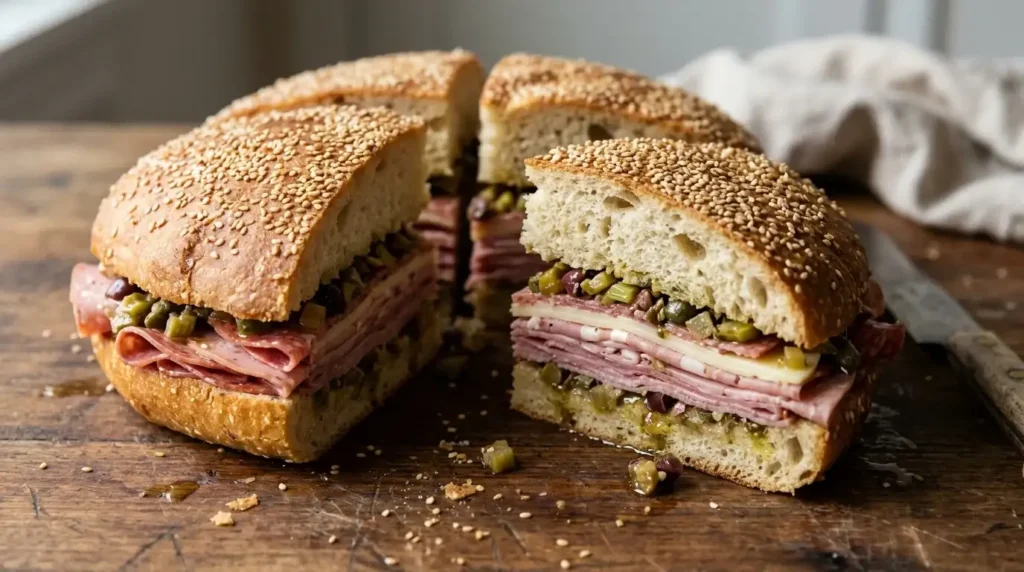
The muffuletta is a New Orleans sandwich built on a round, sesame-topped loaf, layered with Italian cold cuts and cheese, and finished with a chopped olive salad that soaks into the bread. It belongs to the city’s Sicilian immigrant community, not to Italy, and 64 Parishes, the Louisiana Endowment for the Humanities encyclopedia, describes it as a New Orleans tradition rather than an Italian dish.
The grocery most often credited with creating it is Central Grocery on Decatur Street in the French Quarter, though the date, the building and even the inventor are argued over.
Video: The Birthplace of the Muffaletta Sandwich, a New Orleans Classic — The Meat Show, Eater
The loaf and the name
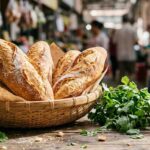
A muffuletto was a bread before it was a sandwich. According to 64 Parishes, the loaf came from Sicily, where it was baked for festivals including St. Martin’s Day, All Souls’ Day and the Eve of the Immaculate Conception. It is round and often flattened, with a soft, spongy crumb, a light crust and a scattering of sesame or fennel seeds on top.
Where the word comes from
The origin of the word is uncertain. The same entry lists the Italian muffa (mold) and the Latin muffula (a small sack or mitten) as possible sources and treats the Latin as more likely. Merriam-Webster gives muffaletta as the less common spelling, traces it to an Italian dialect word related to muffoletta, a diminutive of muffola (“muff”), and dates the first known use in English to 1967.
In Palermo and parts of western Sicily, according to Italo Americano, a muffuletta is a sesame-topped bread linked to the early-November commemoration of the dead. A similar loaf is eaten there cunzata, dressed with olive oil, oregano and cheese, and sometimes anchovy or tomato, a relative of western Sicily’s pane cunzato.
Little Palermo
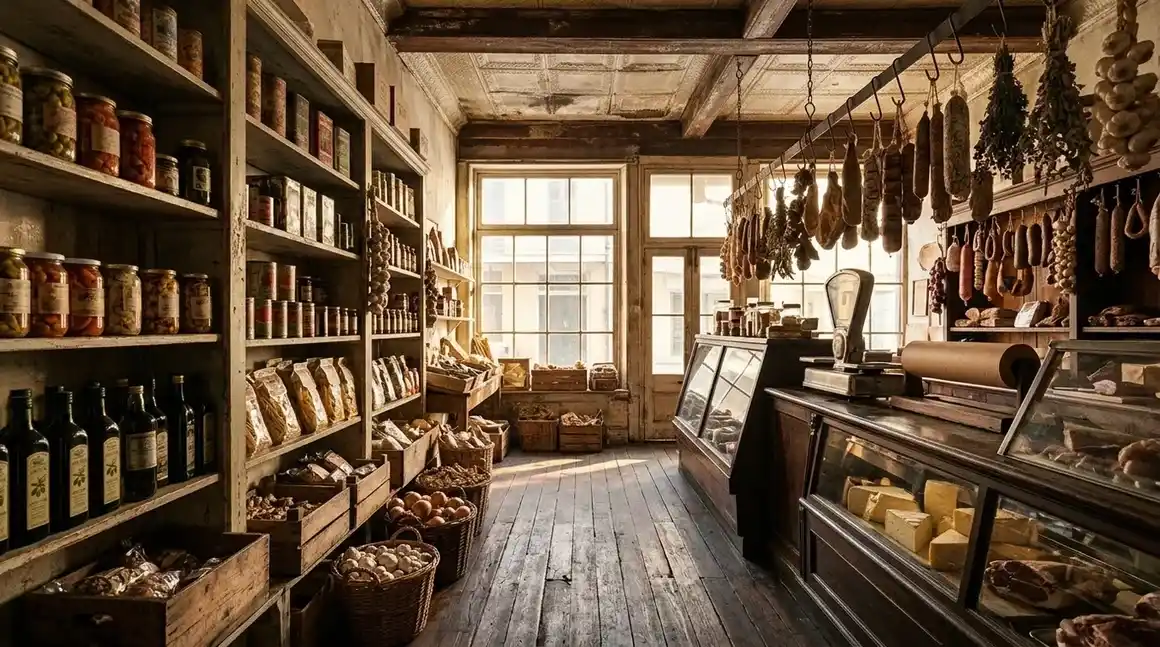
The sandwich needs the neighborhood to make sense. Between 1884 and 1924, Italo Americano reports, more than 250,000 Italian immigrants passed through the Port of New Orleans, most of them from Sicily. The lower French Quarter filled with their shops and boarding houses and picked up the nickname “Little Palermo.” WWNO adds that much of the trade at Central Grocery came from the nearby French Market, once a major food hub for the city.
The food of the Italian Colony reached the rest of New Orleans slowly, through grocers, bakeries and market vendors.
The Central Grocery account
Most tellings place the first muffuletta at Central Grocery, 923 Decatur Street, in 1906, under the Sicilian grocer Salvatore Lupo. The story comes from his daughter, Marie Lupo Tusa. Sicilian farmers and vendors from the nearby French Market bought cold cuts, cheese and olive salad at lunchtime and ate them with bread on the side. Lupo, as she told it, suggested putting everything inside the loaf. She also explained the name: “The sandwich was referred to as a muffuletta because that was the name of the bread.”
America’s Test Kitchen says that by nearly all accounts Lupo created the sandwich in 1906, in the context of rising Sicilian immigration tied to the citrus trade.
A dating problem
The records of the store itself complicate the tidy version. A second 64 Parishes article, on Central Grocery’s history, says Lupo arrived from Palermo in 1902 and opened Progress Grocery at 1001 Decatur Street in 1906 with a partner, Gaetano DeMajo. Only in 1919 did the pair move a block down Decatur, take over 923 Decatur and rename the business Central Grocery. Taken together, the two entries leave open whether the 1906 sandwich was first sold at Progress or at the later Central address. The history article adds that the origin is hard to prove, and that even if Central did not invent the sandwich, the store is closely tied to it.
Doubt came from inside the family as well. A 1971 States-Item interview with Charlie Tusa, son of one of Central Grocery’s founders, is quoted in a 2017 piece by Todd A. Price in which he says, “Nobody has ever been able to figure out for sure how the muffuletta started.”
Lupo died in 1957. His grandson Salvatore “Tommy” Tusa took over in 1970, according to the same article.
Rival claims
The Lupo story has never been the only one. 64 Parishes records several competing or overlapping accounts.
- Tony Lovoi. A baker said to have sold sandwiches wrapped in newspaper from a pushcart. His great-nephew dates this to 1901, but the entry says there is no historic proof. A Joseph Lovoi and Company bakery at 513 St. Philip Street does appear in the 1910 city directory.
- Frank Di Nicola. Remembered as the “muffuletta man” by John Ferrara of Ferrara’s Treme Market, who saw him in the early 1930s. Vendors called out “muffuletto, caldo, caldo!”, but it is unclear whether they sold filled sandwiches or only the bread.
- Montalbano’s Delicatessen. At 724 St. Philip Street, it sold a made-to-order sandwich called the “Roman” or “Roma,” with meat, cheese and olive salad weighed out to the customer’s request.
- Progress Grocery. Some residents recalled asking for an “Italian Sandwich” at Central or at the neighboring Progress Grocery.
The entry also notes that early New Orleans versions ran closer to Sicilian habits, with olive oil or lard, olives, oregano, anchovies, and ricotta or caciocavallo cheese. The sandwich rose in the same era and the same city as the po-boy, and Central Grocery’s history article notes the overlap.
Olive salad
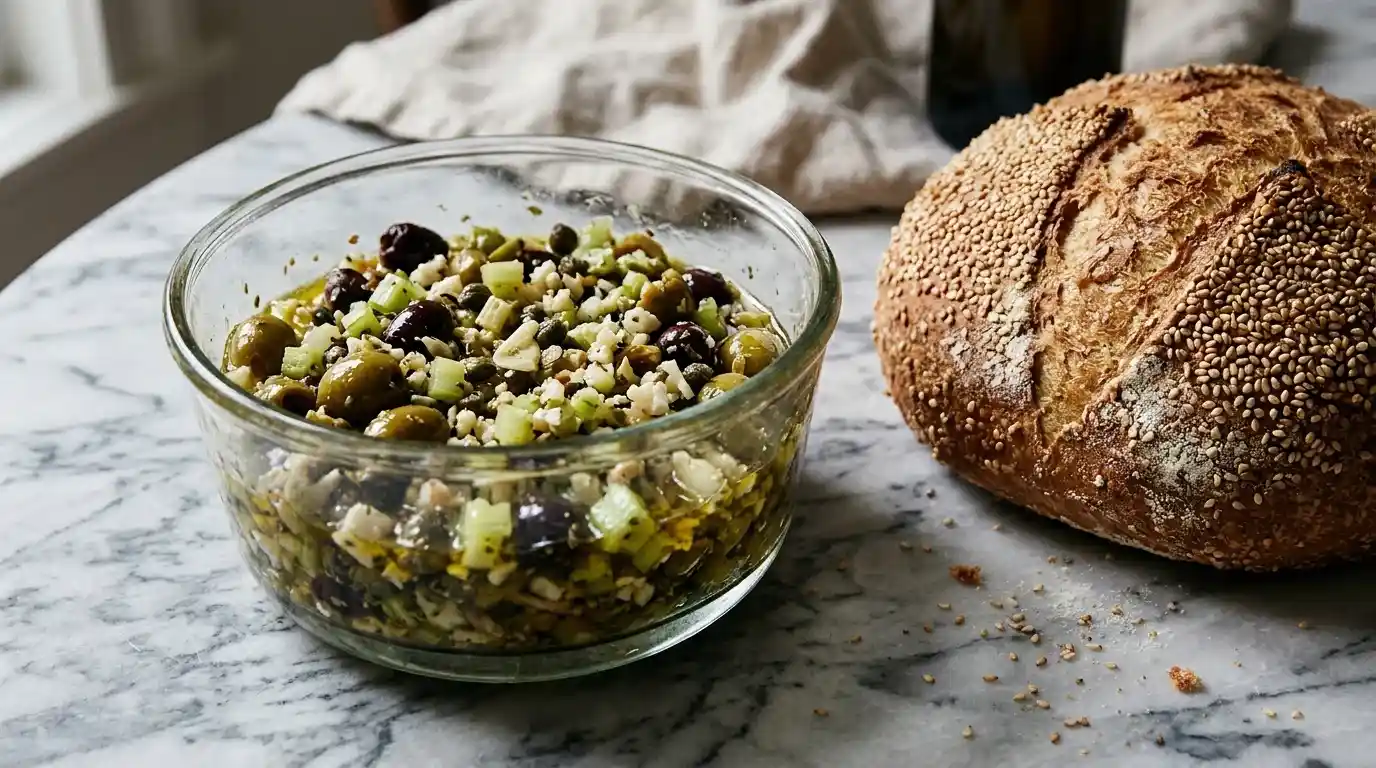
Italo Americano describes the olive salad as a chopped, marinated mix of olives and giardiniera-style vegetables with garlic, herbs and good olive oil, sometimes with capers, celery, carrot or cauliflower added. The same article is blunt about its role: “a muffuletta without a proper olive salad is just a sandwich.”
Central Grocery’s own blend is a secret. PBS NewsHour calls it a secret family recipe, and 64 Parishes says it is sold at many area supermarkets. The author of a Salon recipe essay lists what the original version is said to contain: pickled onions, pepperoncini, capers, pickled cauliflower and celery, alongside green and black olives.
Home recipes vary in their detail. A version by Liz Williams for Louisiana Cookin’ combines chopped green olives with pimiento, black olives, celery, carrot, fennel, garlic, capers, baby artichokes, lemon slices, oregano, extra-virgin olive oil and a single anchovy fillet. It rests in the refrigerator for an hour before use.
Assembly and serving
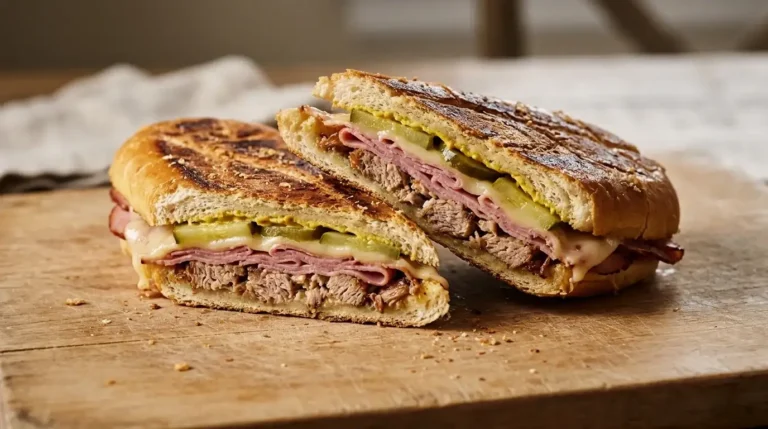
At Central Grocery the sandwich is a 9-inch round sesame loaf, filled with Genoa salami, ham, mortadella, cheese and the olive salad, and sized to feed four, according to PBS NewsHour. 64 Parishes adds that a quartered muffuletta was traditionally wrapped in the paper the bread came in, a habit still seen at times.
Whole or in pieces
Customers can buy it by the whole or the half, according to WWNO. In a home kitchen, the Louisiana Cookin’ recipe splits two loaves crosswise, layers the meat and cheese on the bottoms, spreads about two and a half cups of olive salad on each, then caps and cuts them into quarters. It can be made a few hours ahead and kept in the refrigerator.
Cold or warm
Cold is the default in most of the sources reviewed here, and at Central Grocery the sandwich is served unheated and left to rest so the oil soaks into the bread; purists, that article says, hold that heating it makes a different sandwich. The Salon author’s own recipe is a cold sandwich, wrapped, weighted and chilled for half a day or overnight so that it travels well and improves as it sits. The same author reports that Napoleon House, a restaurant on Chartres Street, serves a hot one and claims to have been the first to do so. The restaurant’s own site says its muffuletta gets “the additional step of warming, which intensifies the flavors.”

Where it stands now
By the 1970s the muffuletta was on local and national menus, 64 Parishes reports, and it had become a standard stop for visitors and a craving for locals. At peak Mardi Gras demand, PBS NewsHour says, Central Grocery sold up to 1,200 sandwiches a day.
Hurricane Ida changed that. The last in-house muffuletta sale was on August 27, 2021, two days before the storm, and a wall from a neighboring building then collapsed through the roof. The interior stayed exposed for more than 20 months, according to the same article. During the closure the muffuletta was sold through other retailers and shipped to customers.
Fox 8 reported the reopening in December 2024, after a closure of more than three years. Co-owner Tommy Tusa called the store, in the report’s words, “an institution.” WWNO described a rebuilt shop modeled on its original layout, with imported groceries, a deli counter and a line of customers, run by Tommy and his cousin Frank Tusa, the third generation of the Lupo descendants. The date of the first muffuletta, and the place it was made, remain unsettled.
Sources:
- Muffuletta Sandwich, 64 Parishes: https://64parishes.org/?p=37186
- A Century of Garlic and Olives, 64 Parishes: https://64parishes.org/a-century-of-garlic-and-olives
- How to Make New Orleans’ Legendary Sandwich, the Muffuletta, America’s Test Kitchen: https://www.americastestkitchen.com/articles/6864-how-to-make-new-orleans-legendary-sandwich-the-muffuletta
- Hurricane Ida forced this famous New Orleans deli to close. Now it’s coming back, PBS NewsHour: https://www.pbs.org/newshour/amp/arts/hurricane-ida-forced-this-famous-new-orleans-deli-to-close-now-its-coming-back
- Central Grocery, home of ‘original’ muffuletta, reopens after Hurricane Ida repairs, Fox 8: https://www.fox8live.com/2024/12/14/central-grocery-home-original-muffuletta-reopens-after-hurricane-ida-repairs
- Where Y’Eat: Remaking the muffuletta hub of Central Grocery, WWNO: https://www.wwno.org/podcast/where-yeat/2025-01-02/where-yeat-remaking-the-muffuletta-hub-of-central-grocery
- Celebrate Italian American ingenuity and the lore of New Orleans with this iconic sandwich, Salon: https://www.salon.com/2023/07/13/celebrate-italian-american-ingenuity-and-the-lore-of-new-orleans-with-this-iconic-sandwich
- Muffuletta recipe, Louisiana Cookin’: https://www.louisianacookin.com/muffuletta/
- Muffaletta, Merriam-Webster: https://www.merriam-webster.com/dictionary/muffaletta
- Napoleon House: https://www.napoleonhouse.com/
- The Muffuletta, Italo Americano: https://italoamericano.org/the-muffuletta-new-orleans/
- Culinary history: New Orleans’ other favorite sandwich (Todd A. Price, 2017), We the Italians: https://wetheitalians.com/news/culinary-history-new-orleans-other-favorite-sandwich
- Where Y’Eat: Famous for Muffulettas, an Italian Deli Plans its Return, WWNO: https://www.wwno.org/podcast/where-yeat/2023-08-11/where-yeat-famous-for-muffulettas-an-italian-deli-plans-its-return
- The Birthplace of the Muffaletta Sandwich, a New Orleans Classic, The Meat Show, Eater (YouTube): https://www.youtube.com/watch?v=CGSUuWrsKmA