In this story
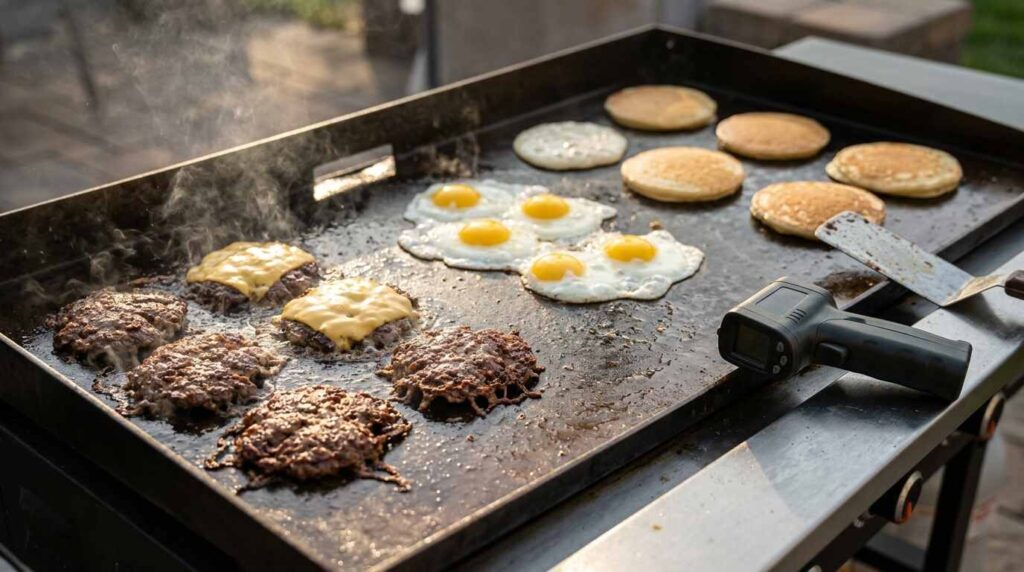
A flat-top griddle has no oven dial. The knob says low, medium or high, and the steel underneath does whatever the gas, the weather and the last batch of cold food tell it to. Diner cooks learn the surface by feel. Home cooks with a backyard griddle tend to buy an infrared thermometer, and then discover that the published temperature charts don’t all agree with each other.
Video: What temperature should you cook on a griddle, from The Flat Top King YouTube channel
The chart from the griddle maker
Blackstone, the best-known outdoor griddle brand, publishes a temperature guide, written by Conner Arvidson in September 2022, that sorts the surface into seven bands:
- Keep warm: 200°F to 225°F
- Low: 250°F to 300°F, for sweating vegetables
- Low-medium: 300°F to 325°F, for sweating and sautéing
- Medium: 350°F, for sautéing
- Medium-high: 375°F to 400°F, for sautéing and searing
- High: 425°F to 450°F, for searing
- Very high: 450°F to 550°F, for searing
Blackstone says its gas griddles can pass 650°F under ideal conditions, though few foods ever need it. Its broader advice is that almost anything cooks well somewhere between 300°F and 375°F to 400°F.
Searing, sautéing, sweating
The guide ties each band to a technique rather than a dish. Steak, burgers and some fish such as salmon get seared. Shrimp, bay scallops and fajitas get sautéed. Onions, peppers, carrots, celery and garlic get sweated, often on the way to fried rice. Bacon and breakfast potatoes can sit in a cooler zone to stay warm while other food cooks.
One number for almost everything
ThermoWorks, the thermometer maker, takes a simpler line. Its blog post How to Griddle Better, by Martin Earl, says that for nearly everything on the griddle the target is 375°F. The reasoning comes from two processes. Crisping means drying the surface, and water takes a lot of energy to heat and boil off, so a cool griddle won’t crisp. Browning comes mainly from the Maillard reaction, which starts in the low 300s and speeds up as the heat climbs. At 375°F food browns and crisps without burning before it cooks through.
The same post sets doneness targets for a few diner staples: sausage to at least 160°F inside for food safety, pancakes to at least 190°F in the center for a light texture, and hash browns to about 203°F so the potato starch gelatinizes. GrillCheesy’s post on the Maillard reaction and bread browning covers the chemistry behind the browning half of that argument.
Where the experts disagree
The charts line up on the middle of the range and split at the ends.
Pancakes and eggs
America’s Test Kitchen, working with an infrared thermometer, put its best pancake surface at 365°F, hot enough to cook them through quickly without scorching before the middle sets. ThermoWorks would cook them at 375°F. Neal Williams, who writes as The Flat Top King, says delicate items like eggs and pancakes should stay under 325°F.
Eggs show the widest spread. ATK’s omelet target is 250°F, which keeps them tender and unbrowned, rising to 300°F for a heartier scramble. Johnny Brunet, a former short-order cook and founder of Griddle 101, told Mashed in August 2026 that he aims for 300°F to 325°F for eggs and omelets.
Burgers and steak
At the hot end, ATK says steak needs at least 450°F for a proper sear, because a cooler surface browns too slowly and the meat underneath overcooks and turns gray. Brunet told Mashed he aims for 450°F and up for smash burgers and steaks. Blackstone’s searing bands run from 425°F to 550°F. GrillCheesy’s smash burger post covers why that first hard press needs a ripping-hot surface.
Grilled cheese
None of the general charts here gives a grilled cheese number. GrillCheesy’s guide to grilled cheese on a griddle works through that sandwich on its own.
Why the knob lies
The number on a chart only helps if the griddle actually holds it. Williams lists several reasons it won’t:
- Cold food drops the surface temperature, and it can take several minutes to recover
- On a gas griddle the flame stays on at any setting, so “even on low setting, the flat top grill surface continues to heat,” in his words
- Cold weather means a cooler start and a longer preheat
- The spot where cold food sat stays cooler, so flipping onto fresh steel gives a better crust
He also recommends preheating on low or medium-low instead of blasting it on high, which he says isn’t necessary and can warp the plate. And for forgiving foods like bacon and ground beef, he says the exact number matters less than people think; they cook fine anywhere from about 325°F to 425°F.
Brunet made a similar point to Mashed: “low, medium, and high mean different things on every griddle.” A four-burner griddle on low often runs hotter than a two-burner on low, he said, and weather changes the picture too.
Reading the surface
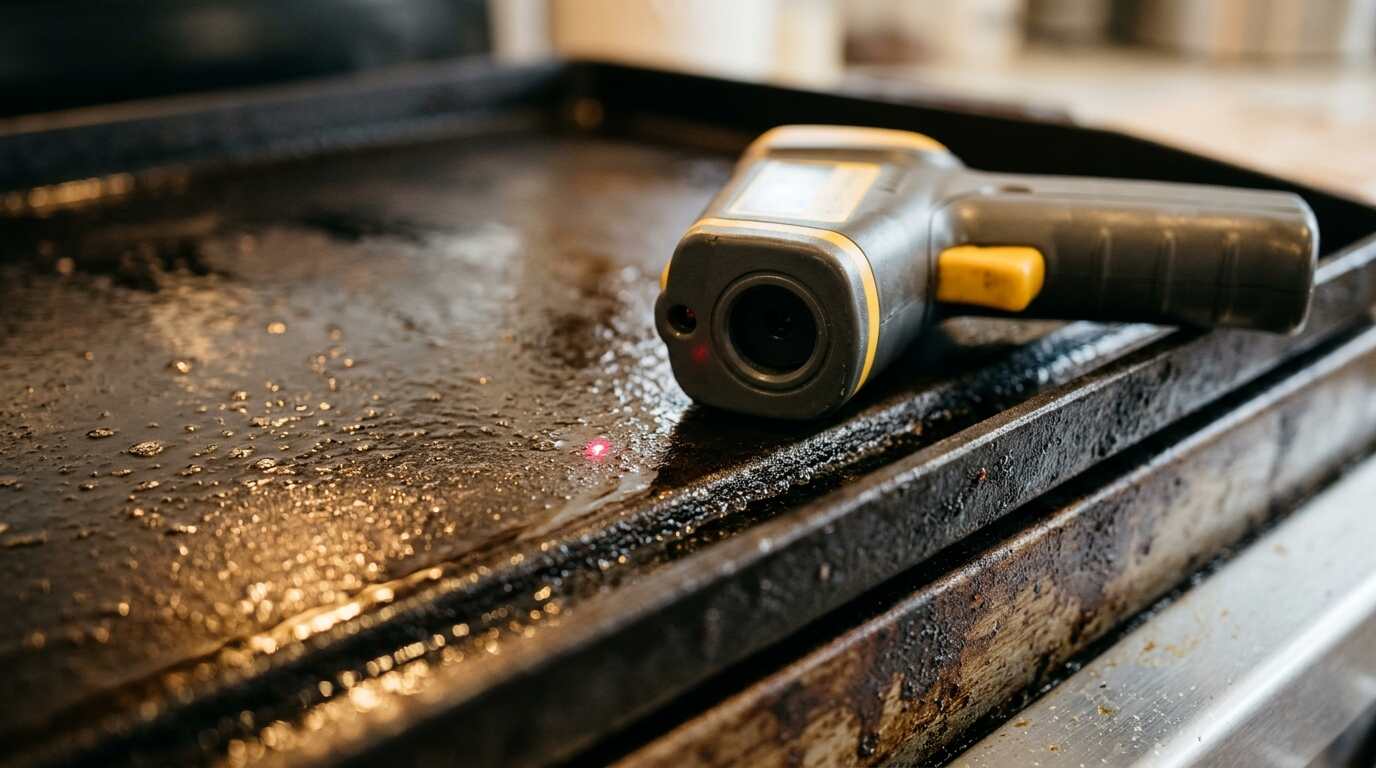
An infrared thermometer is the standard tool, and it comes with a catch. Infrared readings depend on emissivity, how much infrared energy a surface gives off. ThermoWorks notes that stainless steel has low emissivity while cast iron is close to 1, so a thermometer set for one will misread the other.
The oil trick
Both ThermoWorks and ATK offer the same workaround. ATK advises temping a thin film of oil on the pan, because oil emits infrared at a known rate. ThermoWorks says a small puddle of oil gives an accurate reading with the thermometer set to 0.95, and that the thermometer should be held at a right angle to the surface.
The water drop test
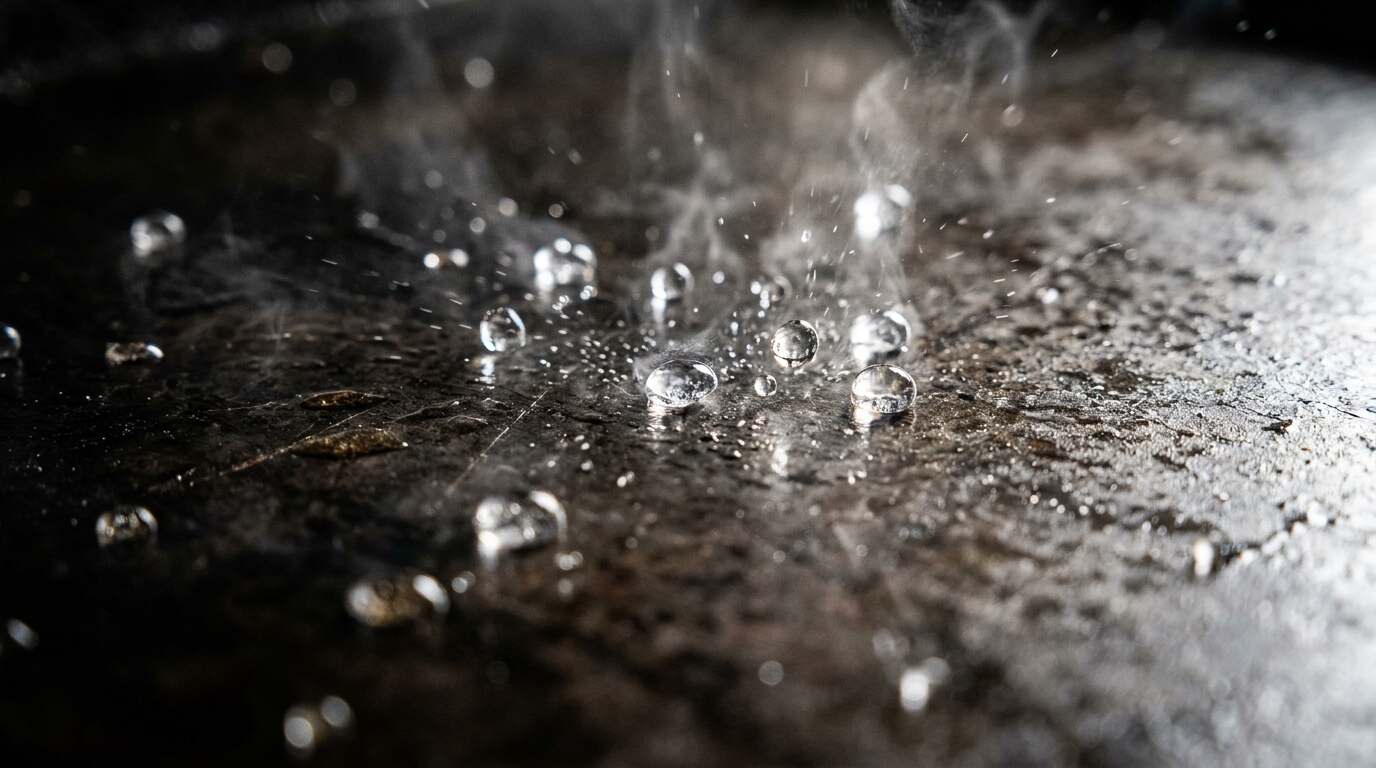
Without a thermometer, Blackstone suggests a teaspoon of water. If it puddles and evaporates in about 10 seconds, the surface is roughly 225°F. If it dances across the steel, it’s around 350°F. If it runs, pops and disappears within seconds, it’s likely above 400°F. Blackstone warns against the old habit of holding a hand over the griddle to judge heat.
The surface itself matters too. GrillCheesy’s guides to seasoning a flat-top griddle and griddle vs. grill cover the steel these numbers are measured on.
Tools for reading the heat
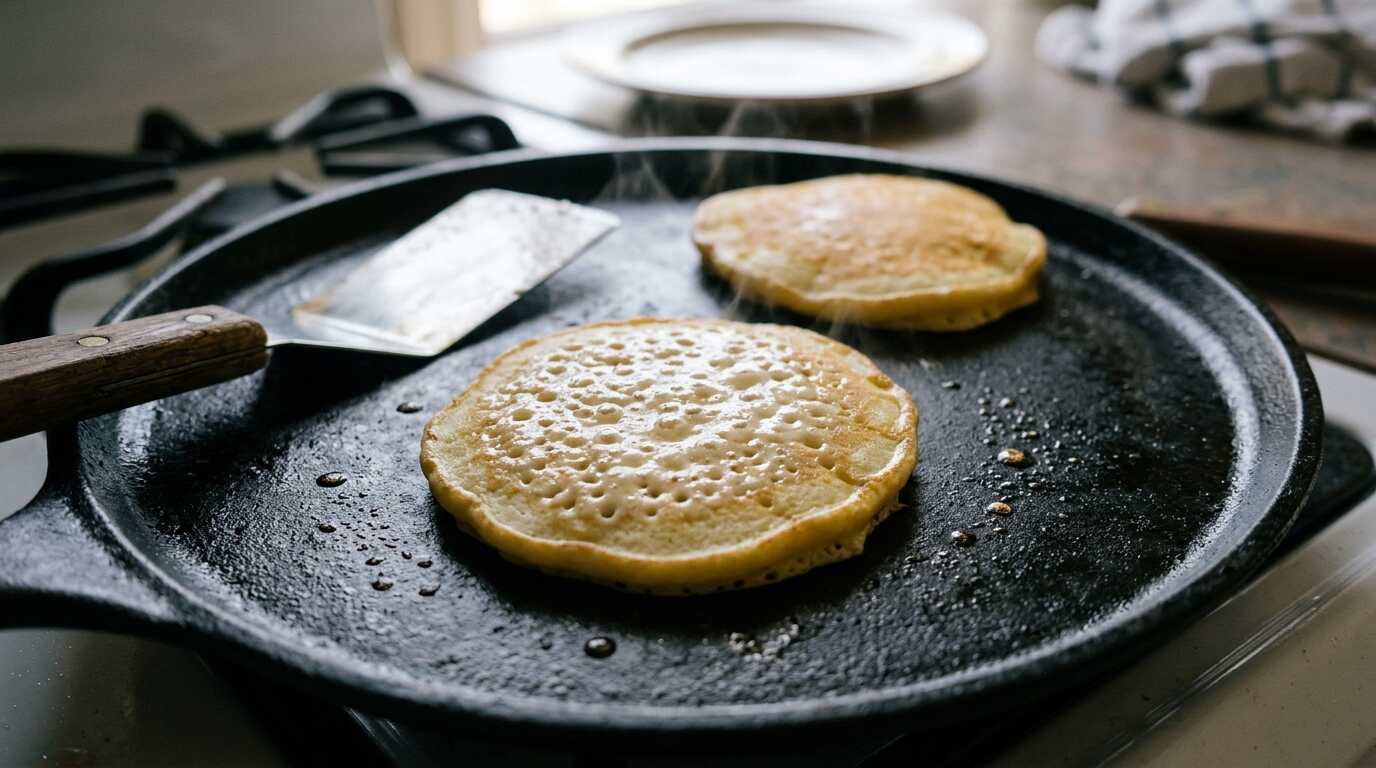
The thermometer and the surfaces mentioned above.
- Etekcity Infrared Thermometer 1022D (Not for Human) Dual Laser Temperature Gun Non-contact-58℉~1022℉ (-50℃ ~ 550℃) with: an infrared surface thermometer that reads up to 1022°F, covering every griddle band on the charts above. See it on Amazon (affiliate link)
- Presto 07061 22-Inch Electric Ceramic Griddle: a 22-inch electric griddle, the type ThermoWorks says should be checked against its dial with a thermometer. See it on Amazon (affiliate link)
- Lodge Pro-Grid Reversible Grill/Griddle, PFAS-Free, 20 x 10.5 Inches: a cast iron griddle that spans two stovetop burners, a high-emissivity surface for infrared readings. See it on Amazon (affiliate link)
- Cuisinart Heavy Duty 6 In. Stainless Steel Griddle Scraper, CCB-500A: a stiff stainless scraper for flipping onto fresh steel and clearing the surface between batches. See it on Amazon (affiliate link)
As an Amazon Associate I earn from qualifying purchases. A commission may be earned if you buy through this link, at no extra cost to you.
Frequently asked questions
What temperature should a griddle be?
ThermoWorks recommends about 375°F for nearly everything. Blackstone says most foods cook well between 300°F and 400°F.
What temperature for pancakes on a griddle?
America’s Test Kitchen found 365°F best. The Flat Top King keeps pancakes under 325°F; ThermoWorks uses 375°F.
How hot for smash burgers and steak?
At least 450°F, according to America’s Test Kitchen for steak and Johnny Brunet for smash burgers. Blackstone’s searing range runs 425°F to 550°F.
How can griddle temperature be checked without a thermometer?
Blackstone’s water drop test: water that dances across the surface means roughly 350°F; water that pops and vanishes means above 400°F.
Sources
- Conner Arvidson, “Griddle Temperature Guide,” Blackstone Products (September 1, 2022): https://blackstoneproducts.com/blogs/griddling-tips-tricks/griddle-temperature-guide
- Martin Earl, “How to Griddle Better: Diner-like Results at Home,” ThermoWorks: https://blog.thermoworks.com/how-to-griddle-better/
- America’s Test Kitchen, “Cooking Temperatures to Check with an Infrared Thermometer”: https://www.americastestkitchen.com/articles/7079-cooking-temperatures-infrared-thermometer
- Neal Williams, “Griddle Cooking Temperature: 7 Things You Need to Know,” The Flat Top King (2022): https://theflattopking.com/griddle-temperature/comment-page-1/
- Mashed, “9 Mistakes Beginners Make With Blackstone Grills”: https://www.mashed.com/2228738/mistakes-people-make-using-blackstone/