In this story
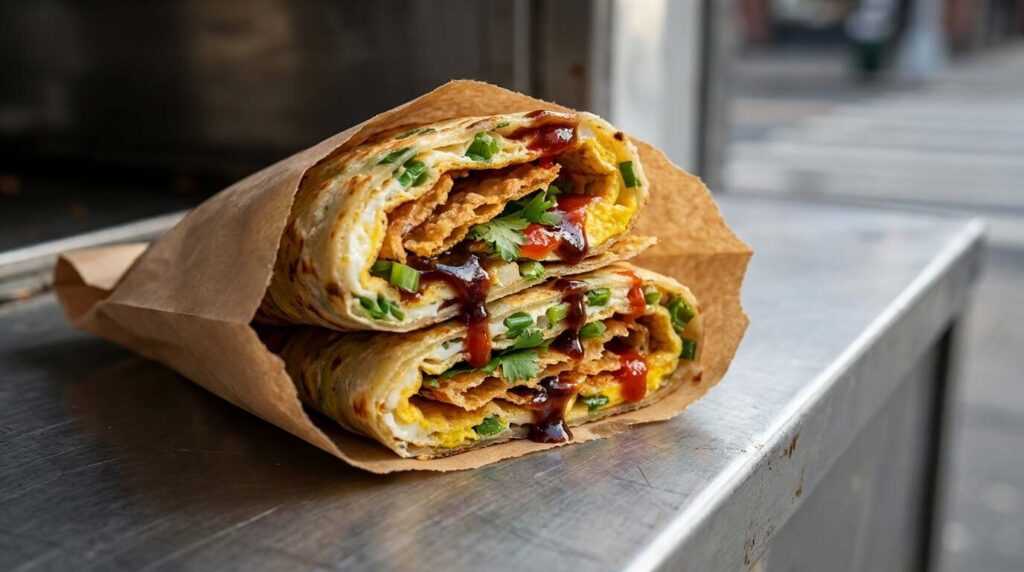
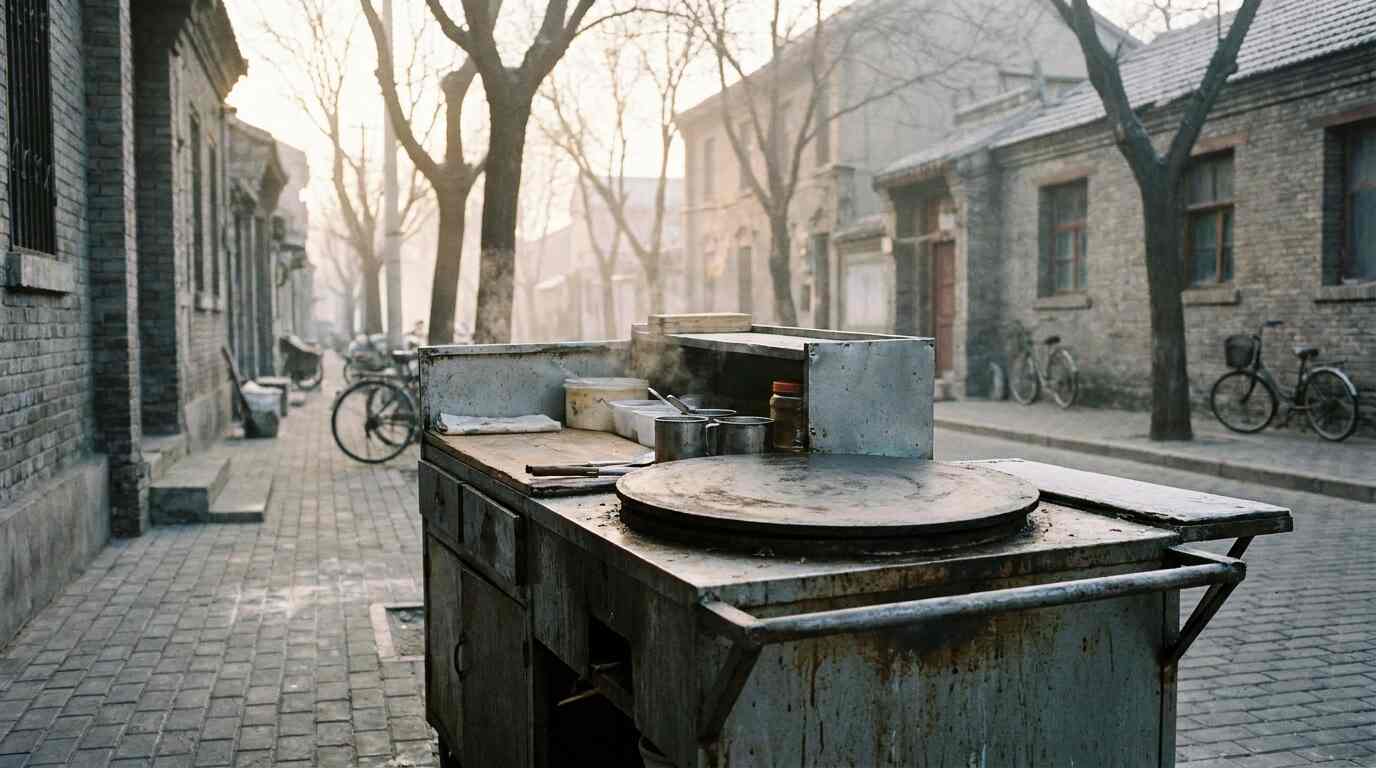
Jianbing is breakfast made in under two minutes on a round iron griddle. A ladle of thin batter goes down and gets spread into a wide disc, an egg is cracked over it and smeared to the edges, and then come scallions, sauce and something crunchy before the whole thing is folded into a square and handed over in a paper bag. Across northern China it is a morning street food, and the arguments about what belongs inside it are as old as the carts.
Video: How to make street food style jianbing guozi at home, from the Chinese Cooking Demystified YouTube channel
Shandong, Tianjin and a disputed birth
The name is usually traced to Shandong Province. Touch Shanghai, the English-language site of the Information Office of Shanghai Municipality, wrote in June 2017 that the modern Shandong version goes back to Tai’an during the Ming Dynasty (1368–1644), cooked on a flat griddle called an aozi. Shandong batter mixes corn, sorghum and millet flour, and locals roll it around scallions and eat it with soup.
Three origin stories
The legends are more colorful than the record. The World of Chinese, in an August 2017 piece by Sun Jiahui, collects several. One credits Zhuge Liang, the Three Kingdoms strategist, with inventing it to feed his troops; Touch Shanghai’s version has him ordering cooks to make a batter that could go on a flat griddle when the army’s woks were lost. Another tells of a Qing dynasty martial artist named Laodao who fled into exile after killing two thugs and cooked pancakes on his blade. The magazine notes that a recipe-like record in Ming dynasty sources puts the Shandong method at least 400 years old, and leaves the legends as legends.
Jianbing guozi, the Tianjin version
The best-known style comes from Tianjin, the port city southeast of Beijing. Touch Shanghai describes Tianjin’s jianbing guozi as a variation on the Shandong pancake, made with mung bean flour and filled with egg, youtiao or baocui, scallions, cilantro and a fermented bean curd sauce. Guozi refers to the fried filling: youtiao is a long fried dough stick, and baocui is a thin, crunchy fried wafer.
The World of Chinese calls Tianjin the city of jianbing, and quotes Tianjin native Song Feifei insisting that its batter must be mung bean. Shandong batter, by contrast, can be grain, corn, sorghum or sweet potato. Zhu Na, from Shandong, described her home version to the magazine as “a dry, thin, paper-like thing.”
What counts as heresy
Tianjin purists draw a hard line on fillings. Song gave the magazine her list of forbidden additions: “Fried chicken, bacon, ham, rousong (‘meat floss’), and lettuce are all heresy.” Touch Shanghai agrees that traditional Tianjin jianbing guozi contains no extra meats, and that those are more common outside the city.
Batter, egg, sauce, crunch
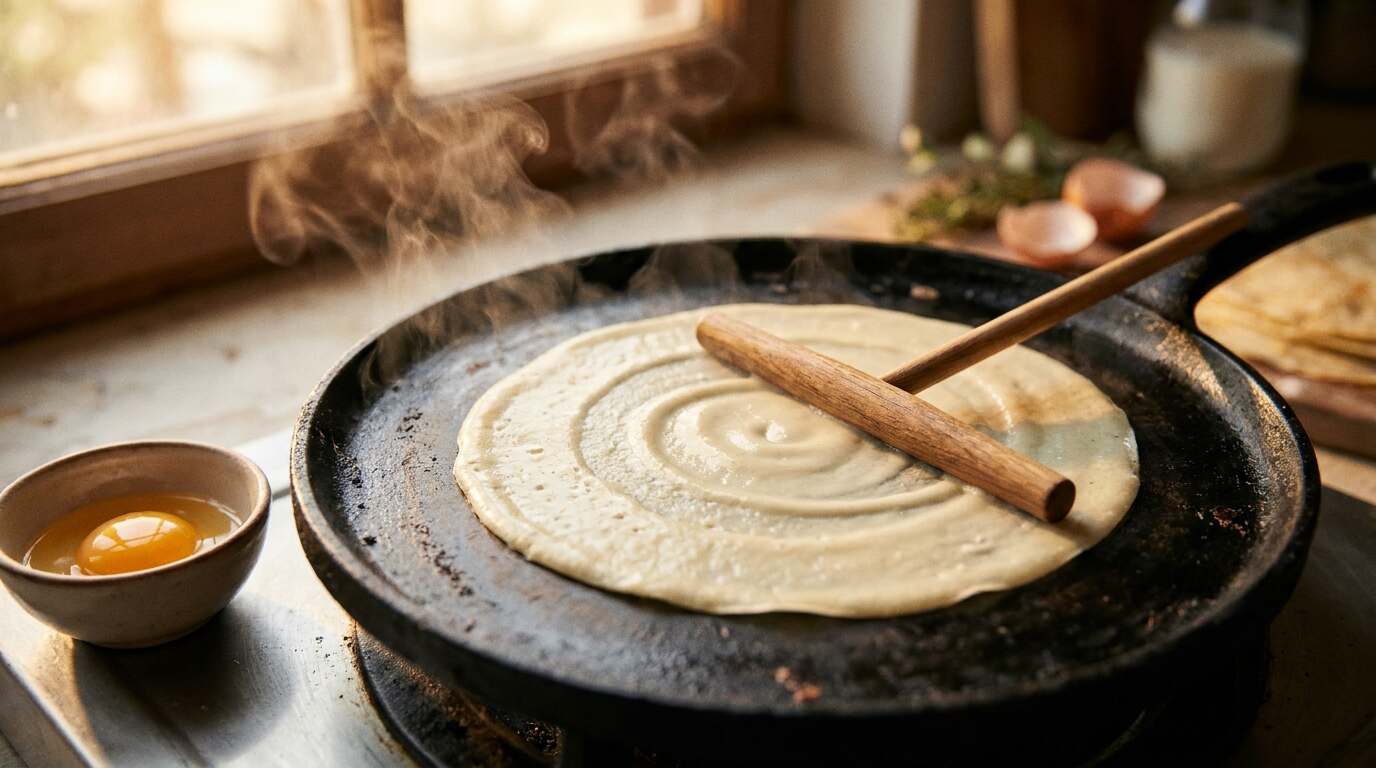
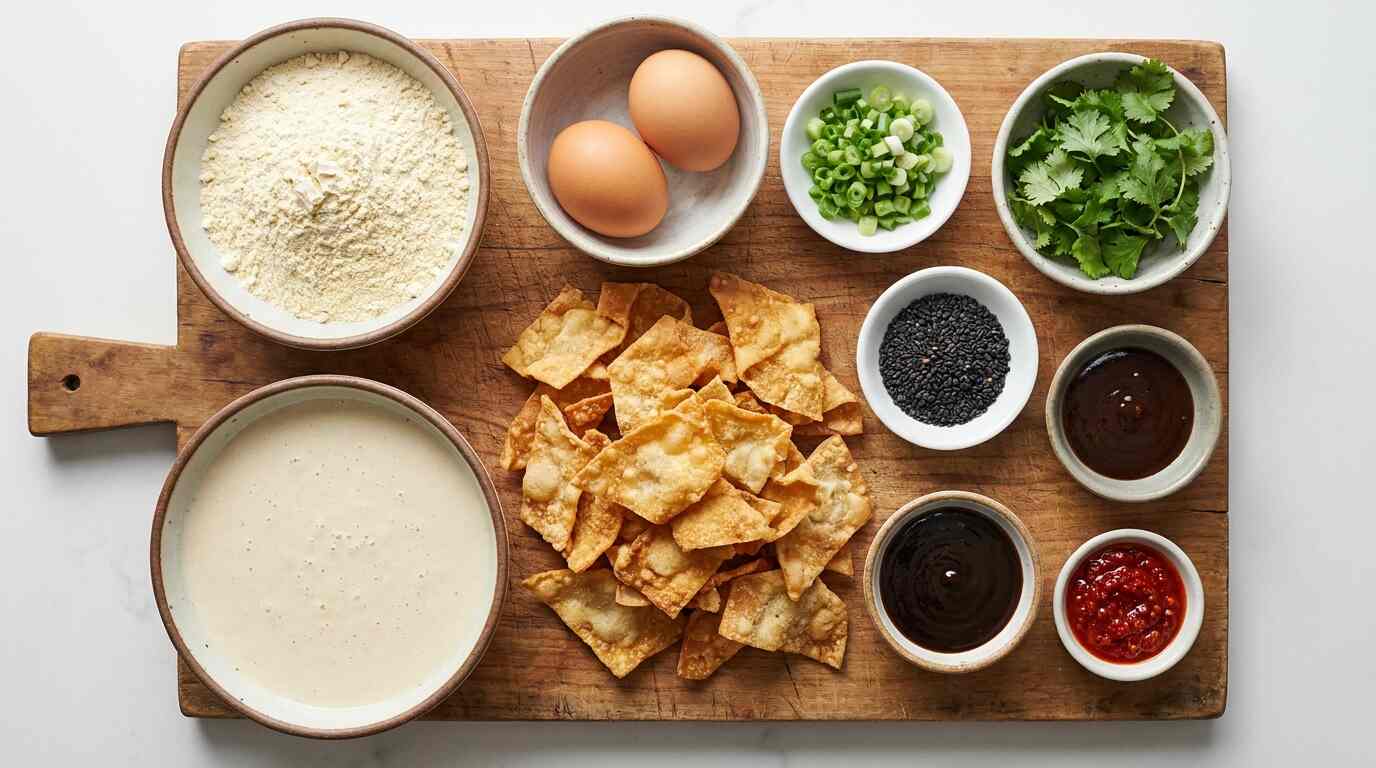
The Tasting Table recipe below lays out the sequence. A thin layer of batter is spread across a hot pan with a bench scraper. When its edges begin to curl, a beaten egg is poured over and spread, then scallions and sesame seeds go on. The crepe is flipped, brushed with sauce, scattered with crisp wonton chips and cilantro, and folded into a square around the filling.
The sauce varies by vendor. Touch Shanghai names fermented bean curd sauce for the Tianjin style, and Chinese Cooking Demystified, in a July 2025 post, calls tianjiang the traditional sauce. Tasting Table’s American recipe uses hoisin and chile paste.
Mung bean flour, not starch
Home cooks outside China run into one ingredient problem. Chinese Cooking Demystified notes that the batter calls for mung bean flour, not mung bean starch, and that the flour can be hard to find outside China. The same post says jianbing guozi starts to degrade within hours, which is part of why it stays a made-to-order street food. The Tasting Table recipe below splits its batter evenly between mung bean flour and all-purpose flour.
From street cart to New York
The dish travels well as an idea, if not as a leftover. Chinese Cooking Demystified says expats, exchange students and travelers consistently rank jianbing guozi among their favorite Chinese dishes. The World of Chinese listed carts in Flushing, Kips Bay and Midtown East charging between $3.50 and $15, along with Mr. Bing in Manhattan and Mei Mei’s Cart in London. McDonald’s in China even sold a “Mc-Jianbing.” Touch Shanghai named Flying Pig Jianbing, Jianbing Man and Jianbing Company in New York, selling versions with kung pao chicken, tuna melt or Peking duck for $8 to $10.
Back home it stays cheap. Touch Shanghai put the typical price at four or five yuan, well under a dollar. The World of Chinese found a basic one for 6 yuan near Beijing’s Chaoyangmen, or 10 with fried chicken, the kind of addition Song Feifei would refuse to eat.
The recipe
The card below follows Tasting Table’s Beijing Breakfast Crepes (Jianbing), adapted from Mr. Bing in New York and published in July 2016. It makes five crepes, uses fried wonton wrappers in place of youtiao or baocui, and calls for a crepe pan or large nonstick skillet with a bench scraper to spread the batter. The amounts are the recipe’s own; the steps are summarized here.
Jianbing (Beijing Breakfast Crepes)
Ingredients
Method
- Whisk the two flours with the salt in a medium bowl, then whisk in the water until smooth. Set the batter aside.
- Heat the 1 cup of oil in a cast-iron skillet over medium-high heat. Fry the wonton wrappers in four batches of four until golden brown, 30 to 45 seconds per batch. Drain on a paper towel-lined baking sheet, cool completely, then crush by hand into 1-inch chips.
- Heat 1 teaspoon oil in a crepe pan or large nonstick skillet over medium heat. Beat one egg in a small bowl. Pour 1/3 cup batter into the pan and quickly spread it across the whole surface with a bench scraper.
- When the edges begin to curl, 1 to 2 minutes, pour the beaten egg over the crepe and spread it evenly. Sprinkle with 1/4 cup scallions and 1 teaspoon sesame seeds and cook about 1 minute more, until the egg starts to set.
- Flip the crepe. Brush it with 1 tablespoon hoisin and 1 tablespoon chile paste, then scatter 1/3 cup crushed wonton chips and 1/4 cup cilantro over it.
- Fold the crepe into a square, like a letter, horizontally and then vertically. Cut in half and serve right away. Repeat with the remaining batter.
Notes
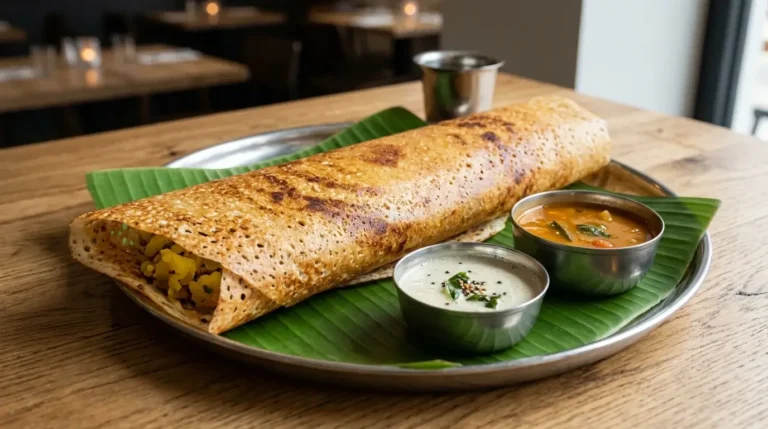
A well-seasoned round griddle does the same job as the street vendor’s iron plate. GrillCheesy’s guide to seasoning a flat-top griddle covers that surface, and the dosa is South India’s own thin batter crepe cooked on a similar iron pan. Japan’s okonomiyaki is a thicker griddle cousin.
For the griddle
The recipe and the street method call for a wide pan or griddle, a spreader and a handful of pantry items.
- SENSARTE 12 Inch Nonstick Crepe Pan Ceramic Coating Pancake Pan White: a 12-inch nonstick crepe pan, the kind of pan Tasting Table’s recipe calls for. See it on Amazon (affiliate link)
- Lodge Round Seasoned Cast Iron Griddle, PFAS-Free, 10.5 Inches: a round cast iron griddle, a smaller home version of the street vendor’s flat iron plate. See it on Amazon (affiliate link)
- Crepe Spreader 2 Pieces 6.1 Inches x 4.7 Inches Natural Wooden T-Shaped Tool for Crepes Wooden Crepe Maker Pancake Maker: a pair of wooden T-shaped spreaders for pushing thin batter across a hot pan. See it on Amazon (affiliate link)
- Pride of India Mung Bean Flour, 1 lb (454g): a one-pound bag of mung bean flour, sold as flour rather than starch. See it on Amazon (affiliate link)
- Yupik Raw Black Sesame Seeds, 2.2 lb (35.2 oz), Gluten-Free, Kosher, Vegan, Natural Black Seeds, Unroasted, Unsalted, Pl: black sesame seeds, sprinkled over the egg in the Tasting Table recipe. See it on Amazon (affiliate link)
As an Amazon Associate I earn from qualifying purchases. A commission may be earned if you buy through this link, at no extra cost to you.
Frequently asked questions
What is jianbing?
A thin Chinese crepe cooked on a round griddle, topped with egg, scallions, sauce and a crisp filling, then folded. It is eaten mainly for breakfast.
What is the difference between jianbing and jianbing guozi?
Jianbing guozi is the Tianjin style, made with mung bean batter and wrapped around youtiao or baocui. Shandong-style jianbing uses other grain flours and is often rolled around scallions.
Where does jianbing come from?
Shandong Province, by most accounts, with the Tianjin version developing later. Origin legends credit Zhuge Liang or a Qing dynasty fugitive, neither verified.
Can mung bean starch replace mung bean flour?
No. Chinese Cooking Demystified specifies mung bean flour, not starch. Tasting Table’s recipe blends the flour half and half with all-purpose flour.
Sources
- Touch Shanghai, Information Office of Shanghai Municipality (June 9, 2017): https://touch.shio.gov.cn/jsp/jrsh_detail_en.jsp?id=2981
- Sun Jiahui, “The Bing Dynasty,” The World of Chinese (August 12, 2017): https://www.theworldofchinese.com/2017/08/the-bing-dynasty/
- Chinese Cooking Demystified, “Breakfast Bing” (July 3, 2025): https://chinesecookingdemystified.substack.com/p/breakfast-bing
- Tasting Table, “Beijing Breakfast Crepes (Jianbing)” (July 10, 2016): https://www.tastingtable.com/686645/chinese-breakfast-crepes-jianbing-recipe-mr-bing-nyc/