
In this story
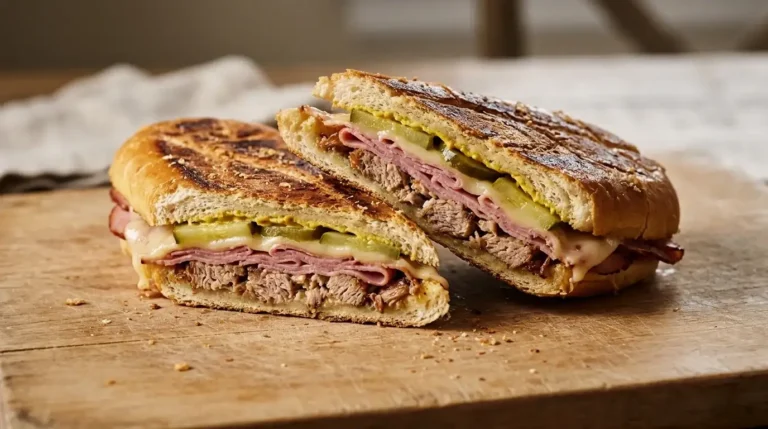
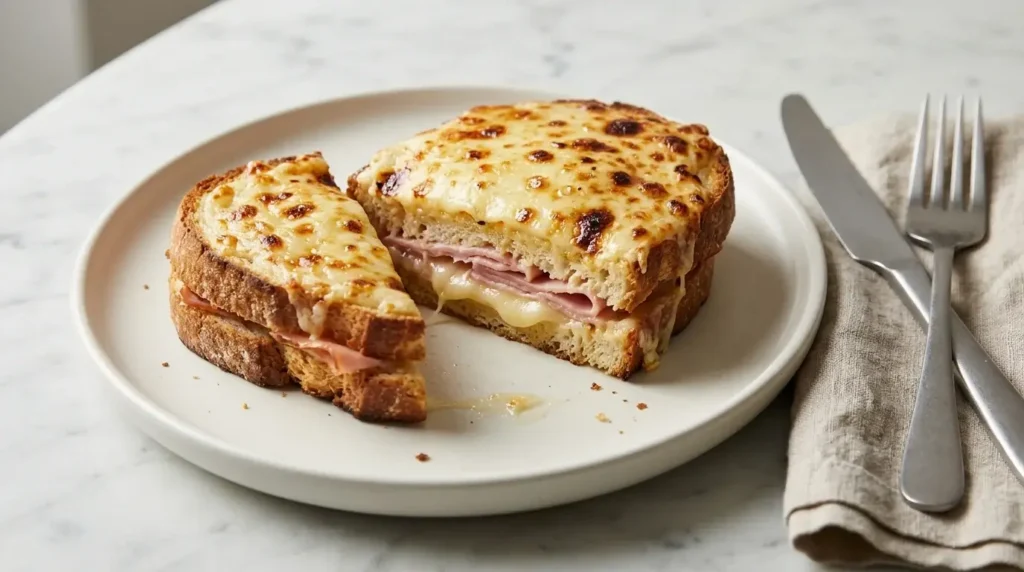
A croque monsieur is a hot ham-and-cheese sandwich from France, built from ham and sliced cheese, usually Gruyère, between slices of pain de mie, then topped with grated cheese and baked or fried until the top forms a crust. Some brasseries add béchamel. The name joins croquer, “to crunch,” with monsieur, and the reason for the second word is unknown.
The sandwich is old enough to have a paper trail and contested enough that the trail does not agree with the legend. It also sits close to American grilled cheese without being a version of it, which is why the two keep getting compared.
Video: How to Make a True French Croque Monsieur (Bistro Style), Le Gourmet French Chef
Where the name first turns up
The legend most often repeated puts the first croque monsieur in a Paris café on the Boulevard des Capucines in 1910. Barry Popik’s research file quotes the English edition of Larousse Gastronomique (1988): “The first croque-monsieur was served in 1910 in a Parisian Café on the Boulevard des Capucines.” Tasting Table likewise says the sandwich was on Paris menus as early as 1910.
Printed evidence reaches further back. A word-history survey dates the earliest attestation to 1891, in a serialized novel in the Paris magazine La Revue Athlétique, where characters improvise the snack for lunch and one calls it exquisite. The same survey turns up a 1893 article by Fernand Vandérem listing croque-monsieur among dishes served at grand dinners, and a 1908 Daily Telegraph item from London in which a Paris correspondent admits to having no idea what the dish is. Judging by those early texts, the survey’s author suggests the dish began as an upper-class item.
The 1918 appearance in Proust’s In Search of Lost Time is often given as the first literary use. Popik’s file reports that Wikipedia traces it to the second volume, and the Oxford English Dictionary, according to the same file, lists 1918 as the first French attestation. The 1891 novel predates both.
English-language print came a little later. A 1915 Belgian Cook-Book edited by Mrs. Brian Luck gives a recipe titled “Entrée (Croque-monsieur)” for buttered rounds of bread with cheese and ham, fried and served hot. A 1984 New York Times answer, as Popik records it, placed the sandwich in Paris brasseries between the wars, possibly at the Brasserie Weber on the Rue Royale. That account conflicts with the earlier dated texts.
There is also a kitchen-accident story. Tasting Table relays an account, credited to Allrecipes, in which a sandwich left near a radiator melted and toasted by accident, and calls the tale possibly apocryphal. It names no person, place or date.
The bread
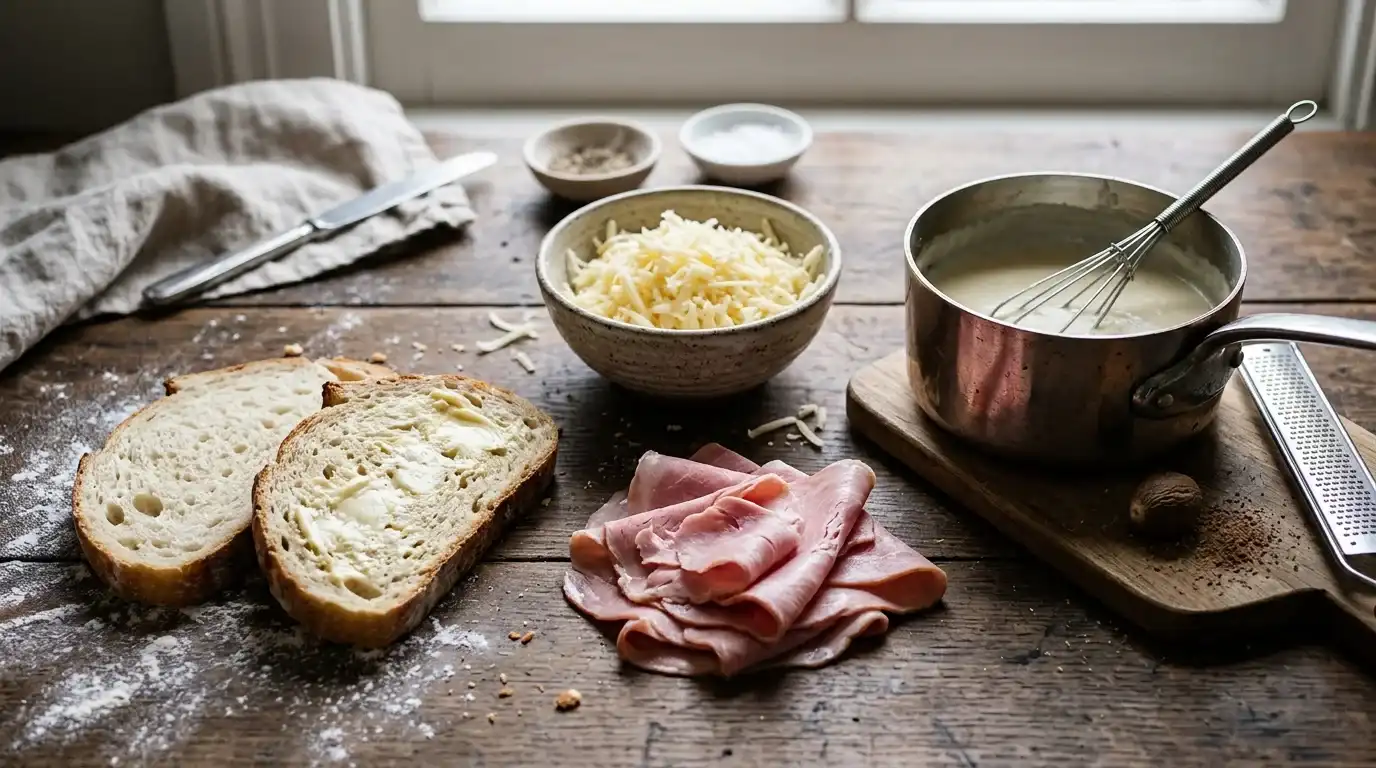
Most recipes ask for a soft, plain loaf, and the sources give reasons. Delicious magazine calls for thick-cut soft white bread with the crusts removed and says chewy sourdough works against the sandwich. America’s Test Kitchen tested baguette and sourdough before settling on white sandwich bread, which stayed tender while still crisping. Each slice there is brushed with melted butter on both sides and toasted in the oven before the sandwich is assembled.
Thin versus thick
Milk Street went the other direction on thickness. Its version uses thin slices, with brioche-style or Pullman loaf preferred over supermarket sandwich bread; the Paris sandwich that inspired it was three thin slices of round brioche-style bread stacked together. The French tourism body Taste France, for its part, specifies four slices of country bread for a two-sandwich recipe, buttered on one side and turned so the butter faces outward for the pan.
So the loaf varies, but the logic holds across the recipes: a bread that is neutral in flavor, sturdy enough to carry a sauce and crisp on the surface.
The ham
The traditional filling is baked or boiled ham. Taste France specifies superior cooked ham with the Label Rouge mark, one slice per sandwich. America’s Test Kitchen used Black Forest ham, sliced very thin at the deli counter and folded over on itself rather than laid flat, so that it does not slide out of the sandwich when bitten. Delicious magazine asks for two thick slices of good ham, smoked if wished.
Béchamel and cheese
Béchamel is the point on which the recipes divide. Wikipedia describes the classic sandwich as cheese-topped and says only that some brasseries add béchamel. Chowhound, on the other hand, says béchamel is optional on the monsieur but more common on the madame.
The sauce itself is a roux of butter and flour loosened with milk or cream, and Mornay is the same base with cheese stirred in. Taste France follows that sequence: butter and flour cooked about two minutes, cream added gradually, then grated Emmental stirred in until smooth. Delicious magazine starts the sauce by softening a diced shallot and a bay leaf in butter for about five minutes, cooks the flour for three to four minutes, whisks in the milk, then finishes with Dijon mustard and nutmeg.
Shortcuts exist. America’s Test Kitchen merges béchamel and cheese into a single Mornay-style sauce made with whole milk and mostly Gruyère, with a little Parmesan and a pinch of nutmeg. Milk Street skips cooking altogether: “Ditch the béchamel! We use a no-cook crème fraîche, Gruyère and mustard mix instead.” The test cooks there found that more than about a tablespoon per sandwich made the cheese separate, and that adding flour turned the mixture gummy.
Which cheese
Gruyère is the name that recurs. It is the cheese in Wikipedia’s description, and the 1915 Belgian Cook-Book recipe also calls for Gruyère and ham. Other sources substitute: Taste France uses Emmental de Savoie, and both Delicious magazine and Milk Street allow Comté. For readers weighing which melting cheese suits a hot sandwich more generally, the notes on the best cheese for grilled cheese apply to the croque monsieur’s filling as well.
The broiled finish
What separates the croque monsieur from a pan-fried ham and cheese is the top. Wikipedia’s description has the sandwich covered in grated cheese and then baked or fried so that the cheese forms a crust. The recipes spell out how.
Delicious magazine toasts the buttered bread under the grill first, builds the sandwich in a tray with mustard, béchamel, ham and cheese, adds more béchamel and cheese on top, and then bakes it for about 12 minutes at 200°C fan until the toasts bubble. America’s Test Kitchen spreads more sauce over the assembled sandwiches, sprinkles Parmesan and Gruyère, and broils until the top is browned and bubbly. Milk Street bakes for about 20 minutes, flipping halfway, then gives a final slather of the cheese mixture a brief turn under the broiler, warning cooks to watch the edges. Its sauce is spread to the edges so they do not scorch before the center is done.
The pan-only route also has a pedigree. Taste France cooks its sandwiches in a frying pan over medium-low heat, turning once, and gives no oven or grill setting at all. The same page says the croque monsieur has been served in Parisian brasseries and bistros since the early 1900s as a quick hot dish for busy customers.

Croque madame, the family of names and relatives outside France
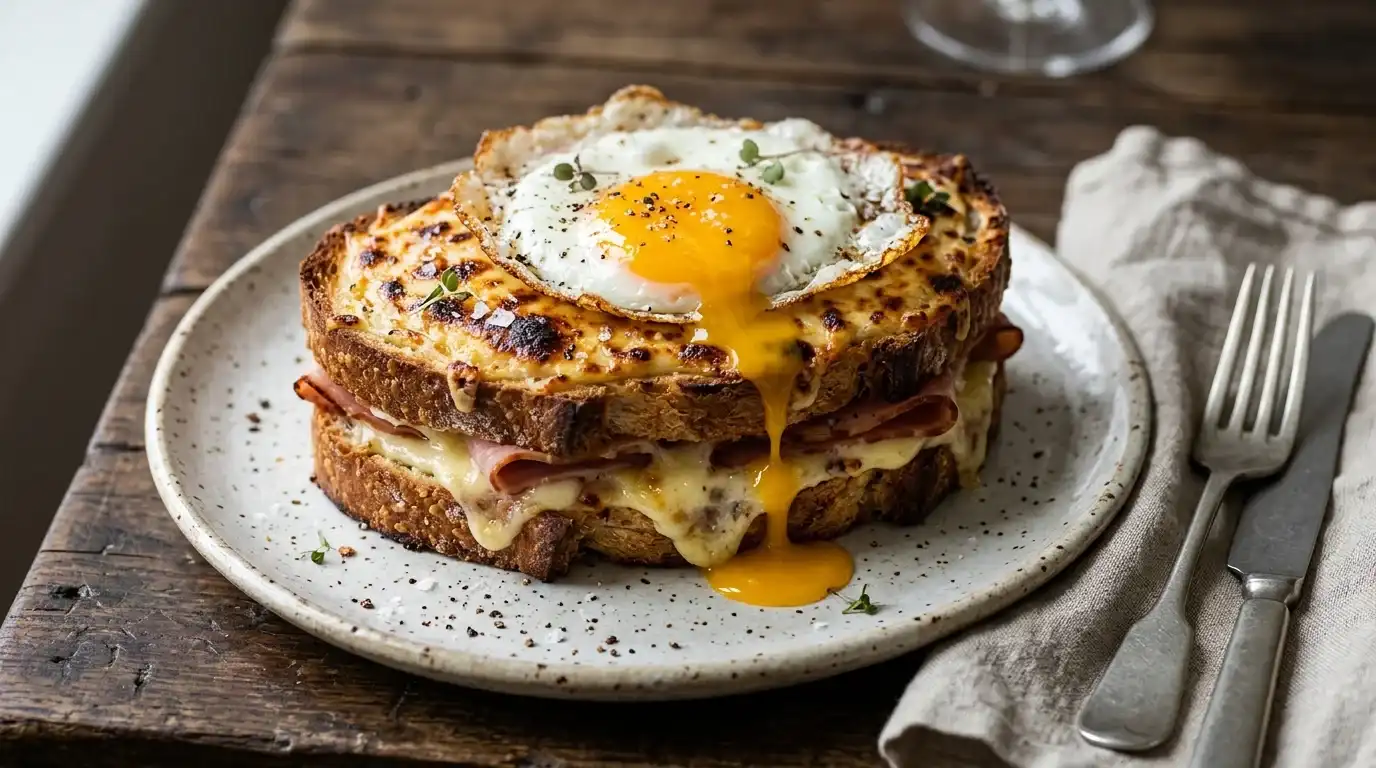
Add an egg and the sandwich changes name. The croque madame is a croque monsieur topped with a fried or poached egg, and many dictionaries tie the name to the egg’s resemblance to a woman’s hat. Culture Trip repeats the hat explanation and says the madame became common in the 1960s. Popik’s file dates the first print mention to 1951, in Newman’s European Travel Guide, and says the Petit Robert dictionary dates the name to about 1960.
The definition has not been stable, though. The 1951 guide, by Popik’s account, used croque-madame for the version made with chicken, and Wikipedia notes that Jacques Pépin also describes it as made with chicken instead of ham. In parts of Normandy, the egg-topped version goes by croque-à-cheval.
Chowhound adds a claim about origin that other sources do not support: that the sandwich is believed to have been invented by Michel Lunarca at Le Bel Age café in Paris, while granting that its origins are debatable. No other source fetched for this article mentions that name.
The list of croques keeps growing. Wikipedia lists the croque mademoiselle (a lighter vegetarian version with cucumber, chives and lettuce), croque provençal with tomato, croque norvégien with smoked salmon, and croque auvergnat with Bleu d’Auvergne. Taste France adds the croque forestier with mushrooms and a croque chèvre with goat’s cheese.
Several sandwiches elsewhere either descend from the croque monsieur or resemble it closely enough to be grouped with it.
Monte Cristo (United States)
Chowhound says the Monte Cristo almost certainly traces its roots to the croque monsieur, differing in that it is dipped in beaten egg and often includes turkey. The same article reports that precursors showed up in 1930s American cookbooks under names like “French toasted cheese sandwich,” that the 1949 Brown Derby Cookbook uses the modern name, and that Disneyland added the sandwich to two New Orleans Square restaurants in 1966 without having originated it.
Francesinha (Portugal)
Wikipedia credits Daniel David da Silva, who had lived in France and Belgium, with trying to adapt the croque monsieur to Portuguese tastes and introducing his version in 1953 at A Regaleira, a restaurant in Porto. Bread, ham, linguiça, chipolata and steak sit under melted cheese and a tomato-and-beer sauce, and each establishment keeps its own sauce recipe.
Barros Jarpa (Chile)
This is a ham-and-cheese sandwich named for Ernesto Barros Jarpa, who ordered it at the restaurant of Chile’s National Congress. He found his cousin President Ramón Barros Luco’s beef-and-cheese order hard to eat and swapped the beef for ham. The page does not connect it to the croque monsieur; Wikipedia’s croque monsieur page does list it among variants.
Wikipedia’s variant list also includes the Netherlands’ tosti, which it calls very similar, and Popik’s file likewise names it as a related sandwich.
Croque monsieur and American grilled cheese
Is a croque monsieur just French grilled cheese? Milk Street calls it essentially grilled ham and cheese with a creamy, flavorful topping. America’s Test Kitchen, in contrast, treats it as something well past that: so rich and runny that it “requires a fork and knife to eat.”
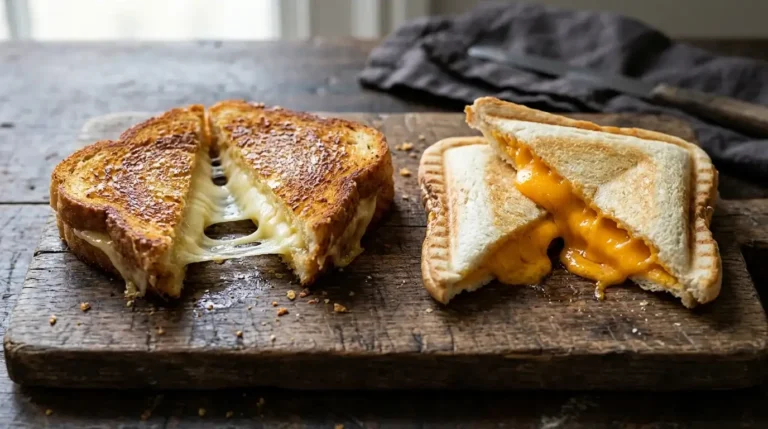
The histories run on separate tracks. Tasting Table’s survey of the American sandwich starts with warm cheese on bread in antiquity, moves through Welsh rarebit and Victorian cookbooks that mention toasted cheese, and notes that in 1891 the French were putting ham and melted cheese on bread, the basis of the croque monsieur. The American chapter proper begins in 1916 with the patent for processed cheese, and continues with pre-sliced bread in the 1920s, the 1924 electric sandwich maker, wartime Navy kitchens making “American cheese filling sandwiches,” and the phrase “grilled cheese” entering common use in the 1960s. The article says the grilled cheese has no single birthplace and does not claim a direct line from France. The full American story is laid out in the history of grilled cheese.
Milk Street’s account of the difference is procedural: the grilled-cheese version leans on bread thickness, butter, cheese choice and pan technique, while the croque monsieur is baked and finished under the broiler, with the topping spread to the edges so they do not scorch.
Sources:
- Croque monsieur (Wikipedia): https://en.wikipedia.org/wiki/Croque_monsieur
- Croque Monsieur (Croque Madame), Barry Popik: https://barrypopik.com/blog/croque_monsieur_croque_madame
- ‘croque-monsieur’: meaning and origin, Word Histories: https://wordhistories.net/2020/09/11/croque-monsieur/
- How A Mistake May Have Created The First Croque Monsieur, Tasting Table: https://www.tastingtable.com/1115247/how-a-mistake-may-have-created-the-first-croque-monsieur
- A Brief History of the Croque Monsieur, France’s Cheese Toastie, Culture Trip: https://theculturetrip.com/europe/france/articles/a-brief-history-of-the-croque-monsieur-frances-cheese-toastie
- The Single Difference Between A Croque Monsieur And Croque Madame Sandwiches, Chowhound: https://www.chowhound.com/1737812/croque-madame-monsieur-difference
- The Shaky Origin Story Of The Monte Cristo Sandwich, Chowhound: https://www.chowhound.com/1673424/sandwich-monte-cristo-history/
- Croque monsieur recipe, Delicious magazine: https://www.deliciousmagazine.co.uk/recipes/croque-monsieur/
- We take grilled cheese to new heights with our croque monsieur recipe, America’s Test Kitchen: https://www.americastestkitchen.com/articles/1317-we-take-grilled-cheese-to-new-heights-with-our-croque-monsieur-recipe
- French call it croque monsieur, Milk Street: https://www.177milkstreet.com/2023/12/french-call-it-croque-monsieur
- Croque monsieur recipe, Taste France: https://www.tastefrance.com/recipes/french-classics/croque-monsieur
- Béchamel sauce (Wikipedia): https://en.wikipedia.org/wiki/B%C3%A9chamel_sauce
- Francesinha (Wikipedia): https://en.wikipedia.org/wiki/Francesinha
- Barros Jarpa (Wikipedia): https://en.wikipedia.org/wiki/Barros_Jarpa
- The Murky History Behind The Classic Grilled Cheese Sandwich, Tasting Table: https://www.tastingtable.com/1859125/history-grilled-cheese-sandwich