In this story
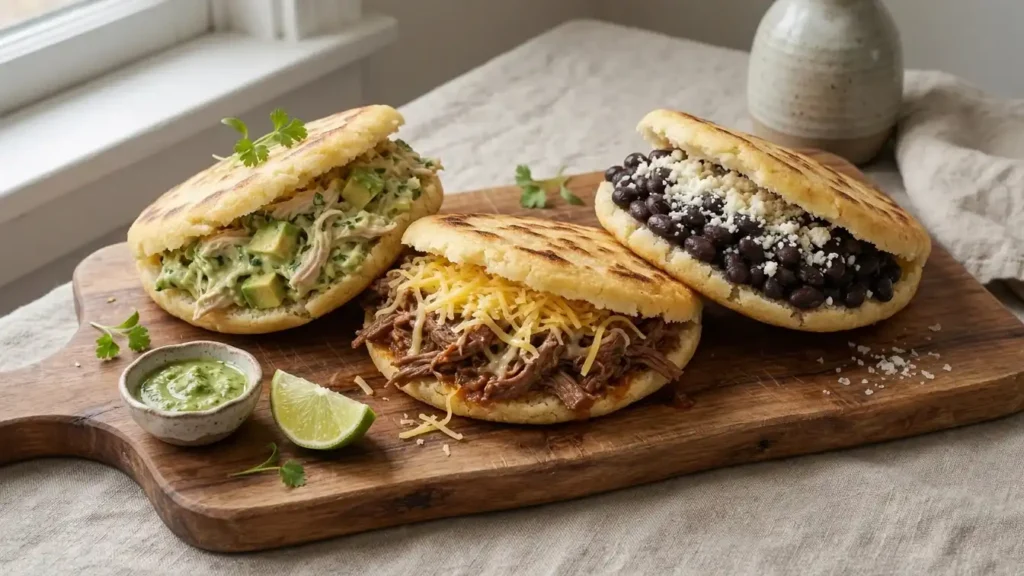
An arepa is a round cake of cooked corn dough, toasted on a griddle until the outside forms a thin crust and the inside stays soft and steamy. In Venezuela it is usually split open like a pita and packed with a filling, which turns it into a sandwich. In Colombia it is more often eaten whole beside a meal, with cheese or egg. Both countries claim it. The historians and cooks quoted on the question mostly agree it is older than either of them.
Video: How to Make the Traditional Venezuelan Arepas, from the Enriqueta Lemoine (by enrilemoine) YouTube channel
Older than the map
What the first records show
The written record starts with the Spanish. Ocarina Castillo, an anthropologist at the Universidad Central de Venezuela, told Voz de América in April 2023 that the first records of the arepa come after Christopher Columbus’s third voyage, which reached the coast of eastern Venezuela in 1498. She treated the national argument as beside the point: “la arepa existe desde antes de que existieran nuestros países,” the arepa existed before our countries did.
The same report quoted Weildler Guerra Curvelo, a Colombian anthropologist and former governor of La Guajira, making the same case from the other side of the border, calling it a food thousands of years old.
The word
The Venezuelan claim leans on language. Venezuelan historian Miguel Felipe Dorta, author of ¡Viva la arepa!, traces the name to “erepa,” the word for maize among the Cumanagotos, an Indigenous people of what is now northern Anzoátegui state, according to CNN Chile’s September 2023 report on the dispute. Castillo cautioned that this is mainly a linguistic argument: had the Spanish landed somewhere else, a different local word might have stuck.
Two countries, two styles
Stuffed or served alongside
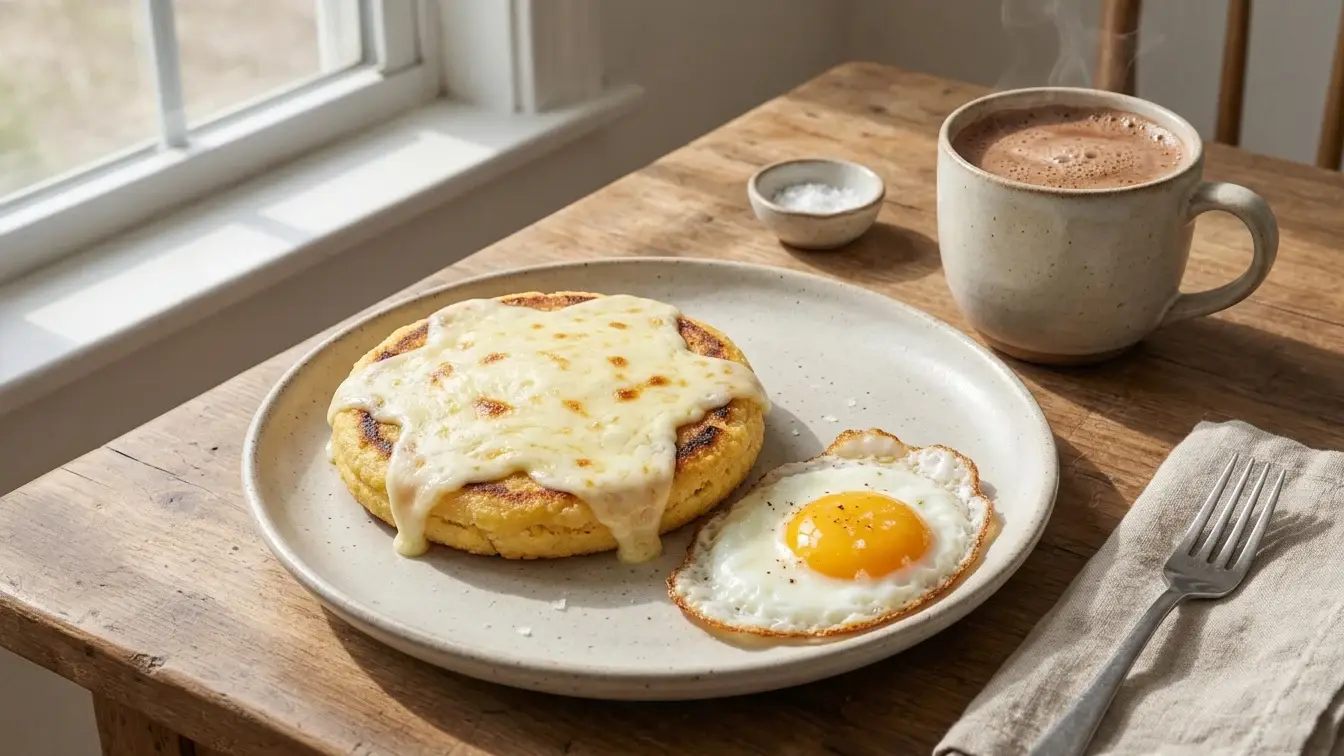
The CNN Chile report laid out the difference in practice. Venezuelan arepas are usually filled and eaten as a main dish. Colombian arepas are more often a side or a starter, eaten with egg at breakfast or with cheese or chorizo, and small arepitas go with broth, hot chocolate or lechona. Colombian chef and researcher Carlos Gaviria, author of Arepas colombianas, counted about 60 kinds of arepa in Colombia, made from corn, yuca, rice, potato and plantain among other bases, and said the dish has no nationality.
Ricardo Estrada, the Venezuelan writer behind Arepólogo, put the difference in one line to CNN Chile: “El relleno es lo que lo hace distinto,” the filling is what sets it apart. He listed Caracas fillings with their own names, such as the pelúa, shredded beef with yellow cheese, and the rumbera, roast pork with cheese.
The flour that changed the kitchen
From whole kernels to a bag
Before precooked flour, arepa dough meant a day’s work. Writing in Caracas Chronicles in March 2014, Rodrigo Linares reconstructed his relatives’ home method: clean the corn, wash off the starch, boil it in plenty of water, topping it up as it evaporated, rinse, cool, grind and knead. Precooked flour collapsed that into one step. In his summary, “It is precooked because the corn is cooked, then ground, then dried.”
Linares credited the process to Luis Alberto Caballero Mejías, a Venezuelan engineer who patented it and later sold it to Polar. Empresas Polar launched Harina P.A.N. on December 10, 1960, a date given in a 2022 brand profile in which Héctor García, a P.A.N. commercial manager, described the company as a pioneer in mass-producing precooked cornmeal. Polar’s own account of who developed the process was not checked for this post.
Made in Turmero, sold everywhere
The flour now travels further than the people who first ate it. Rafael Osío Cabrices reported for Caracas Chronicles in April 2021 that Harina P.A.N. has been made in Turmero, in Aragua state, since 1960 and is also produced at a plant near Bogotá, a plant in Greenville, Texas, and two smaller plants in Italy.
Reina pepiada
Named for a beauty queen
The most famous Venezuelan filling has a date attached. Susana Duijm was crowned Miss World in London in 1955, the first Venezuelan to win, and Honduras’s El Heraldo, reporting her death in June 2016, noted that she inspired the reina pepiada, an arepa filled with chicken and avocado.
Chef Edgar Maldonado’s February 2025 piece for Edible Northeast Florida credits the Álvarez brothers, owners of a Caracas arepera, with inventing it in her honor that same year, and gives the name’s rough meaning as “voluptuous queen.” The filling is a chicken salad bound with mayonnaise and avocado, served cold inside the hot arepa.
Building one on a griddle
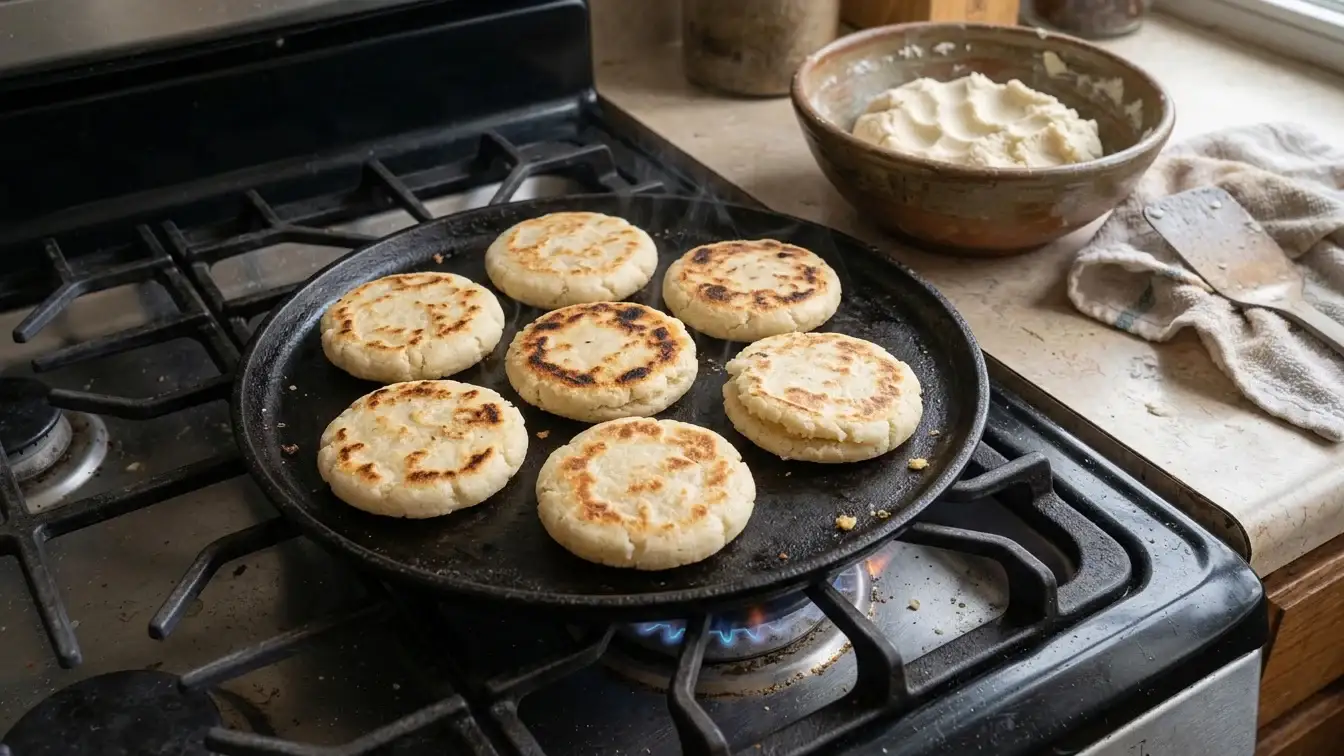
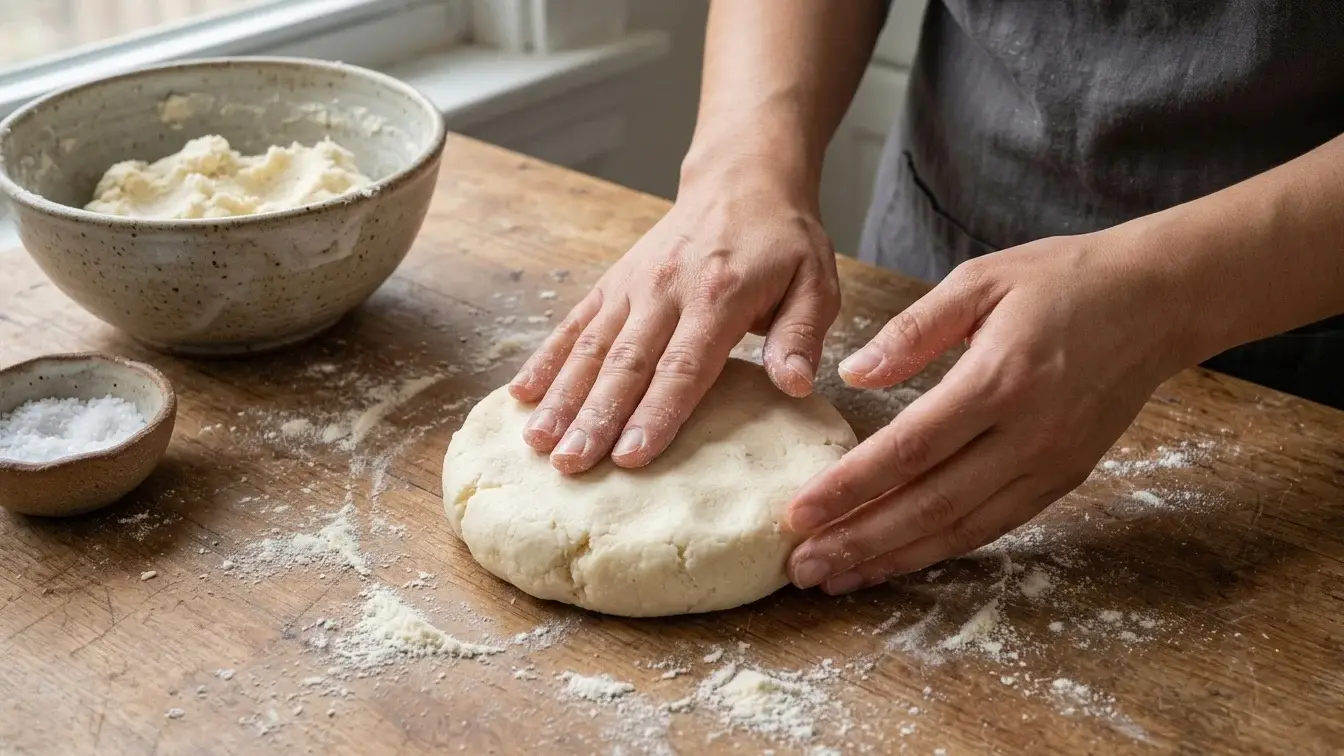
Cornmeal, water, salt, heat
The dough needs little more than precooked white cornmeal, water and salt. Patties are shaped by hand and browned on a hot, flat griddle, and a seasoned cast-iron surface works for the job; the habits covered in GrillCheesy’s guide to the flat-top griddle apply.
Once split, an arepa takes the role a bun or tortilla plays elsewhere. It sits in the same handheld family as the quesadilla, the empanada and the gua bao, and a spoon of Salvadoran curtido brings the same acid to a pork filling that it brings to a pupusa. For more on what a flat griddle does differently from open grates, see griddle vs grill.
- P.A.N. White Corn Meal – Pre-cooked Gluten Free and Kosher Flour for Arepas (5 lb): the precooked white cornmeal launched in Venezuela in 1960. See it on Amazon (affiliate link)
- Lodge Round Seasoned Cast Iron Griddle, 10.5 Inches: a flat, round cast-iron griddle for browning arepas on the stove. See it on Amazon (affiliate link)
Video: Arepas con Harina P.A.N., from the P.A.N. Corn / P.A.N. Maize YouTube channel
As an Amazon Associate I earn from qualifying purchases. A commission may be earned if you buy through this link, at no extra cost to you.
Sources
- Voz de América, La arepa: ¿venezolana o colombiana? (2023): https://www.vozdeamerica.com/a/la-arepa-venezolana-o-colombiana-/7039427.html
- CNN Chile, arepas Venezuela y Colombia (2023): https://www.cnnchile.com/cultura/arepas-venezuela-colombia_20230909/
- Caracas Chronicles, The Arepa Wars (2014): https://www.caracaschronicles.com/2014/03/18/the-arepa-wars/
- Boston Business Review via Issuu, P.A.N. brand profile (2022): https://issuu.com/brochures2020/docs/harina_p.a.n._bbr_sep2022_english
- Caracas Chronicles, The Globalization of Harina P.A.N. (2021): https://caracaschronicles.com/2021/04/25/the-globalization-of-harina-p-a-n
- El Heraldo, Fallece la venezolana Susana Duijm (2016): https://www.elheraldo.hn/entretenimiento/fallece-la-venezolana-susana-duijm-primera-miss-mundo-latinoamericana-NDEH971840
- Edible Northeast Florida, Arepas de Reina Pepiada (2025): https://ediblenortheastflorida.ediblecommunities.com/post/arepas-de-reina-pepiada