In this story
A brass plaque inside Caffè Mulassano, a small café on Piazza Castello in Turin, reads, in the words reported by Turismo Torino, “In 1926, Mrs. Angela Demichelis Nebiolo, invented the tramezzino.” The sandwich it credits is soft white pancarré with the crusts cut off, filled cold and usually cut into a triangle or a rectangle. The poet Gabriele D’Annunzio is said to have supplied the Italian name, and each part of that account, the year included, changes depending on who tells it.
Video: Tramezzini : I migliori da mangiare a Venezia — from the Alessandro Del Monte YouTube channel
Caffè Mulassano and the Nebiolo couple
A bottle shop that became a café, then a sandwich counter
According to Turismo Torino, the business began in the late 1800s as a bottle shop at 3 Via Nizza, owned by Amilcare Mulassano, who also owned the Distilleria Sacco, maker of a well-known mint syrup. It moved to Piazza Castello in 1907 and became a café in its early years. The interior, about 31 square meters of bronze, wood and brass fittings and mirrors, was designed by the Turin engineer Antonio Vandone.
In 1925, by the account of Gambero Rosso International, Angela Demichelis and her husband Onorino Nebiolo bought the café from Amilcare Mulassano with savings from America. The same article says Angela left Piedmont for the United States at fifteen in the early 1900s and married Onorino in Detroit, where he ran restaurants and nightclubs with his brothers and brothers-in-law, and that she brought the first toaster to Turin.
La Voce di New York gives sharper numbers: Angela, fifteen, went to Detroit in 1919 to marry Onorino, thirty. The Nebiolos bought the licence for Caffè Mulassano at Piazza Castello 15 for 300,000 lire in 1925, a figure La Voce gives without a source. Both articles mention a rumour that the Italian-American underworld in Detroit had taken an interest in the family, which La Voce says led to the return to Turin and, in its telling, a kidnapping threat against their son. Neither offers documentation for that part.
What the couple served first is also reported in more than one way. La Voce says American-style toast failed because Italian bread of the day suited it poorly, so the Nebiolos moved to small sandwiches of soft white pancarré, untoasted, crusts removed, served with coffee or vermouth. The Italian food site Dissapore says the couple, returning from America, served English-style tea sandwiches at five in the afternoon. Domani reports that toast came first and that in 1926 the bread stopped being toasted and the range of fillings widened.
Angela Demichelis Nebiolo died in Turin in 2003 at the age of 99, according to Gambero Rosso International.
One year or two: 1925 or 1926
The purchase is dated 1925 and the plaque says 1926
Most sources split the story into two dates. The café changed hands in 1925, and the plaque dates the invention to 1926. Domani notes that the most widely cited date is 1925, while the café itself says the sandwich was born in 1926, and that staff at the counter repeat the later date. Chowhound writes 1926 and calls the origin “pretty much undisputed.” Wikipedia, used here only as a pointer to the La Stampa articles it lists, gives 1925. The company Tramezzini NYC, a Brooklyn-based sandwich business founded by two Venetians, gives 1925 as well.

The 2026 headline in La Voce, “The Tramezzino Turns 100,” follows the 1926 date.
The name and D’Annunzio
A poet, a campaign against foreign words and three meanings of an in-between
The word is a diminutive of tramezzo, which means something in between, a partition wall among other senses. That much is agreed. The route from the word to the sandwich is not, and neither is the poet’s role.
Gabriele D’Annunzio is the person the standard account names, as in Turismo Torino, which says he gave the snack its name a few years after the Nebiolos began. Gambero Rosso International reports that he was a regular at Mulassano and, before lunch, ordered “uno di quei golosi tramezzini” (“one of those delicious little sandwiches”). That article adds that no record survives of any payment for the word, though D’Annunzio lent his name to many products. The suggested sources of the name there are the wooden partitions (tramezzi) in D’Annunzio’s home in Abruzzo and the snack’s position in between breakfast and lunch.
Dissapore sets the naming against the Fascist campaign against foreign words, in which champagne and brioche were transliterated and brandy and cocktail got invented Italian substitutes that did not last. According to that article, F.T. Marinetti proposed traidue in his 1932 Cucina futurista, and D’Annunzio’s proposal won out. The word appears in Alfredo Panzini’s Dizionario moderno in 1935, as Dissapore reports. Le Petit Journal gives the same Fascist-era context and adds that the poet coined the name on a trip to Turin where he was served small sandwiches as an aperitif.
Three readings of tramezzino circulate in Italian sources. Dissapore lists a dividing wall, a small dish served between two main courses and a snack between meals. Domani says the poet’s association with a between-meal snack is contested by some, and that the name does not come from the triangular shape at all but from tramezzo because the sandwich was originally rectangular.
What goes into it
Pancarré, soft and uncooked, with butter and anchovy as the legendary start
The bread is white pancarré, the square sandwich loaf Italians also call pane a cassetta. Dissapore quotes a 1936 passage from La Cucina Italiana as reported by the food historian Alberto Capatti in Storia del panino italiano: “I tramezzini si preparano col così detto pane a cassetta, detto anche pane inglese per via della sua origine.” The loaf is thus described there as English in origin. Gambero Rosso International adds a Turin legend about the loaf’s shape that involves the city’s last executioner and a royal ban on upside-down bread; the article presents it as legend.

Gambero Rosso International names butter and anchovies as the legendary first filling, and Le Petit Journal says butter and anchovy remains the most popular original version at Mulassano. Chowhound says early examples included anchovies and butter, and sliced veal in a tuna, caper and egg sauce, and that Mulassano bakes its soft white bread in-house.
The range at Mulassano today is reported with different counts. Turismo Torino says over thirty varieties, with lobster, truffle and bagna cauda the most popular. Chowhound says around thirty, naming lobster salad, smoked goose breast and truffle pâté with mascarpone. Le Petit Journal says about forty. Domani lists ham, blue cheese and pears, roast fassona beef, tuna and artichoke, anchovies in green sauce, Piedmontese tongue, shrimp with palm heart, devilled eggs and lobster salad, which the café’s owner recommends.
The tramezzino was never bound to the triangle. Chowhound says the sandwiches are often triangular but Mulassano makes square ones, and Gambero Rosso International says the ones at Caffè Platti in Turin are rectangular.
Related reading on this site includes tea sandwiches, the English model the tramezzino is said to have replaced, the Earl of Sandwich story and the invention of sliced bread.
Venice, Rome and who owns the idea
The Veneto adopted it, and Turin’s owner is reported to concede the point
Gambero Rosso International reports that the sandwich travelled to Venice, where it was called el tramesin, and then through the Veneto. It also records that La Cucina Italiana published the first recipe in July 1936. In Domani’s description, Venetian tramezzini are triangles with a swelling of filling in the middle, almost always eaten with one hand, while Roman ones spread the filling more evenly, are somewhat larger and lack the bulge.
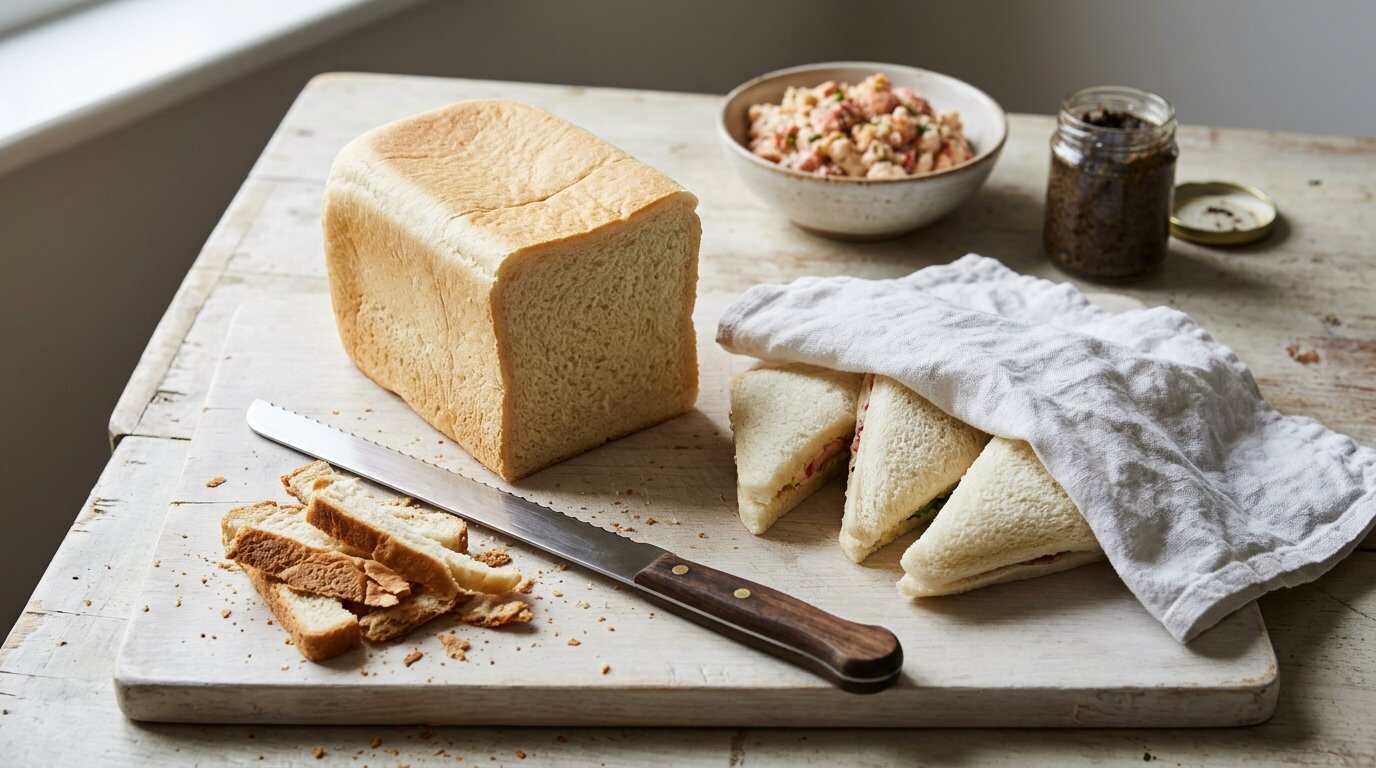
Le Petit Journal ties the Venetian tradition to cicheti, the small bites eaten with an ombra (a small glass of wine) or a Spritz. The article says pancarré suits Venice’s humidity and that the sandwiches are often kept under a damp cloth, and it names tuna and egg and ham and mushroom as the commonest fillings. A Venice wine-bar blog lists ham and eggs, tuna and olives, shrimp in pink sauce and crab among typical fillings and singles out the bars Rosa Salva, Toletta and Birreria Forst. The same blog says the birreria’s sandwiches are rectangular, with thicker black and white bread and spicier fillings. A Venice travel journal describes the sandwich as Italy’s answer to the English tea sandwich and says tramezzini are eaten at all hours in the city’s bacari.
Le Petit Journal states flatly that Venice and Turin both claim the invention. Domani reports that the owner of Mulassano acknowledges the Venetians’ paternity of the sandwich while saying theirs is “very different” from the Turin one. Gambero Rosso International, for its part, records the spread from Turin to Venice, not the other way round, and none of these accounts dates a Venetian tramezzino earlier than the Turin one.
Piedmont has a second sandwich word. Gambero Rosso International describes sanguis, a Piedmontese adaptation of “sandwich,” as a heartier filled roll and not a sliced pancarré, with Caffè Roma in Porta Palazzo reviving the tradition. Back on Piazza Castello, under the plaque that names an inventor, the owner told Domani something close to the opposite: “Non ci sentiamo padroni della ricetta, né tanto meno dell’idea”, roughly, the café does not consider itself the owner of the recipe, still less of the idea.
Common questions
Who invented the tramezzino?
It is credited to Caffè Mulassano on Piazza Castello in Turin. A plaque inside reads, as reported by Turismo Torino, that Angela Demichelis Nebiolo invented it in 1926.
Was it 1925 or 1926?
Domani notes that the most widely cited date is 1925, while the café itself says the sandwich was born in 1926.
What does the name mean?
The word is a diminutive of tramezzo, which means something in between, a partition wall among other senses. The route from the word to the sandwich, and the poet Gabriele D’Annunzio’s role, are told differently by different sources.
Sources
- Turismo Torino, “Caffè Mulassano”: https://www.turismotorino.org/en/your-trip/where-to-eat/caffe-mulassano
- Gambero Rosso International, “Turin, where it all began: the legend of the tramezzino”: https://www.gamberorossointernational.com/news/turin-where-it-all-began-the-legend-of-the-tramezzino/
- La Voce di New York, “The Tramezzino Turns 100” (September 2, 2026): https://lavocedinewyork.com/en/food/2026/09/02/the-tramezzino-turns-100-how-an-italian-sandwich-was-born-in-detroit/
- Dissapore, “Chi ha inventato il tramezzino? Storia anglo-fascista del sandwich senza crosta”: https://www.dissapore.com/cucina/chi-ha-inventato-il-tramezzino-storia-anglo-fascista-del-sandwich-senza-crosta/
- Domani, “Tramezzino, quel pasto minuscolo che ha conquistato la penisola”: https://www.editorialedomani.it/idee/cultura/tramezzino-quel-pasto-minuscolo-che-ha-conquistato-la-penisola-vhvun3vl
- Le Petit Journal Milan, “Histoire du tramezzino” (January 31, 2019): https://lepetitjournal.com/milan/comprendre-italie/histoire-du-tramezzino-symbole-de-lart-de-vivre-italien-249181
- Chowhound, “This Crustless Italian Sandwich Dates Back To The 1920s”: https://www.chowhound.com/2179958/tramezzino-italian-sandwich-explained/
- Tramezzini NYC, “The Story”: https://tramezzininyc.squarespace.com/the-story
- The Wine Bars of Venice, “Tramezzini sandwiches in Venice”: https://the-wine-bars-of-venice.blogspot.com/2026/01/tramezzini-sandwiches-venice.html
- Journal, “The Art of Tramezzini in Venice”: https://www.msecchi.com/journal/tag/sandwich
- Wikipedia, “Tramezzino” (used as a pointer to its listed La Stampa references only): https://en.wikipedia.org/wiki/Tramezzino
Keep reading
- Bauru Sandwich: Origin of São Paulo’s Roast Beef and Melted Cheese Classic
- Lobster Roll: Connecticut Style vs Maine Style
- Panini vs Panino: Meaning, History and How to Press One
More in this section: Sandwiches Around the World guide.