In this story
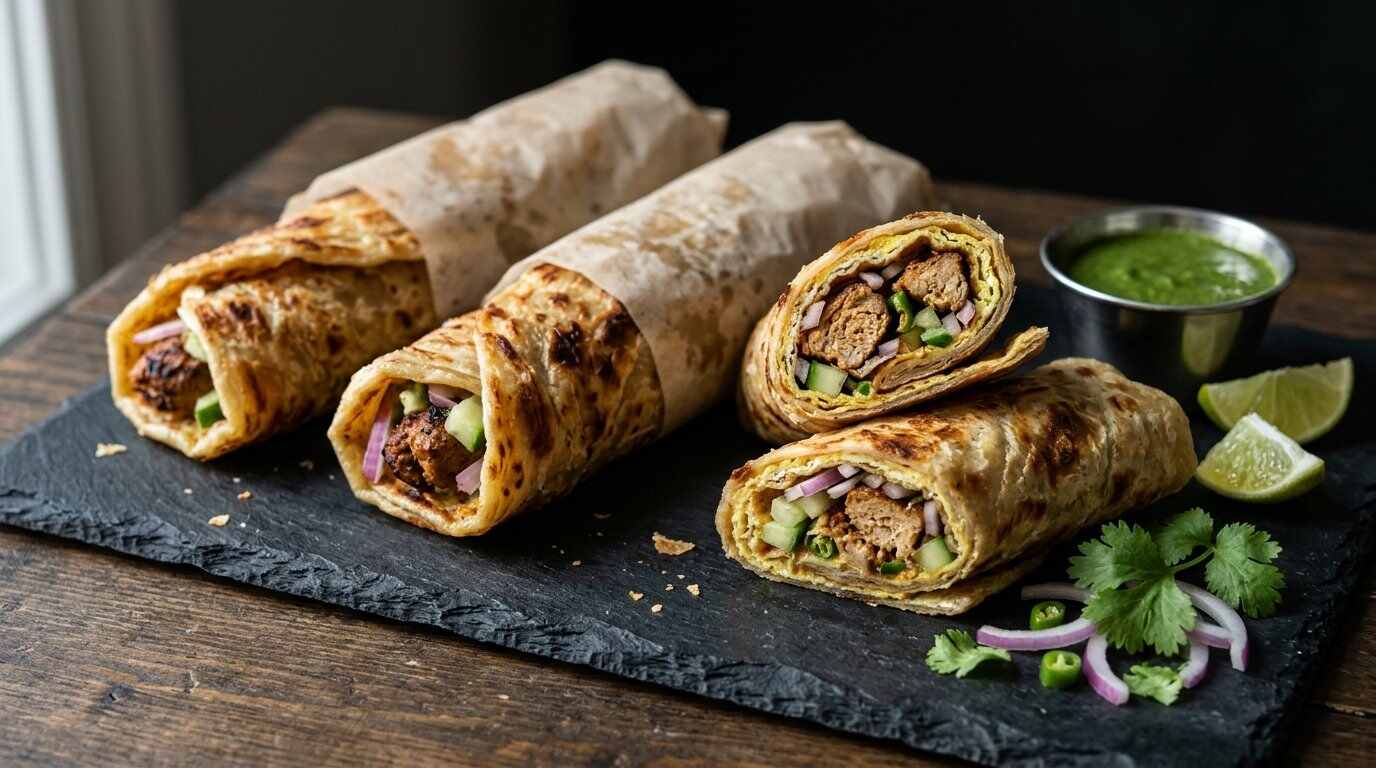
Around 1964, a Kolkata kebab shop traded its heavy iron skewers for bamboo, and by several accounts the snack it sold ended up named after the stick. That snack, the kati roll, is a flaky paratha cooked on a flat griddle, wrapped around skewer-roasted kebab, egg, onion and chutney and handed over in paper. Most accounts trace the format to a single Mughlai restaurant, Nizam’s, near New Market in Kolkata, although no official version of the story exists, and the published accounts disagree on when the restaurant opened, who owned it and who the first customer was.
Video: 30 Kinds Of Kebab Kathi Rolls at Nizam’s in Kolkata | Curly Tales — from the Curly Tales YouTube channel
The Nizam’s origin story
One restaurant, several versions of the same afternoon
Nizam’s stands in Kolkata’s New Market area, once called Sir Stuart Hogg Market. Atlas Obscura describes it as a kebab-and-paratha stall that became a brick-and-mortar restaurant in 1932. The Better India and Local Samosa give 1932 as well and name the founder as Raza Hassan Saheb. Homegrown names the same founder but dates the shop to 1937, and a November 2025 article on the T2 lifestyle site gives the owner as Sk. Hasan Reza, whose kebab recipe is said to have come from forefathers in Lucknow.
The moment of invention is told in at least three ways. In the version carried by The Better India, a European sahib stood in a long queue for mutton kebabs, and the owner, with the kebabs ready, slipped them into a spare paratha and served them. In the version favoured by Atlas Obscura, British patrons who disliked eating kebabs with their hands had the meat rolled into paratha and served in paper. Homegrown instead puts the weight on office workers heading to the Dalhousie Square business district, since the kebabs were slow to grill on long iron skewers and, in the article’s wording, “too greasy to be eaten on the go.”
Wikipedia, used here only as a pointer to the other sources it lists, adds that the most likely explanation may be “more mundane” than any of these tales. It also says Nizam’s held a near-monopoly on the format for decades before the roll spread through Kolkata. Culture Trip uses the word “monopoly” as well and attributes no individual inventor.
No menu, receipt or dated newspaper item from the period appears in any of these accounts. The Nizam’s origin rests on repeated oral tradition, hedged with phrases such as “said to have.”
Why it is called a kati roll
A stick, a skewer and a date that keeps turning up: 1964
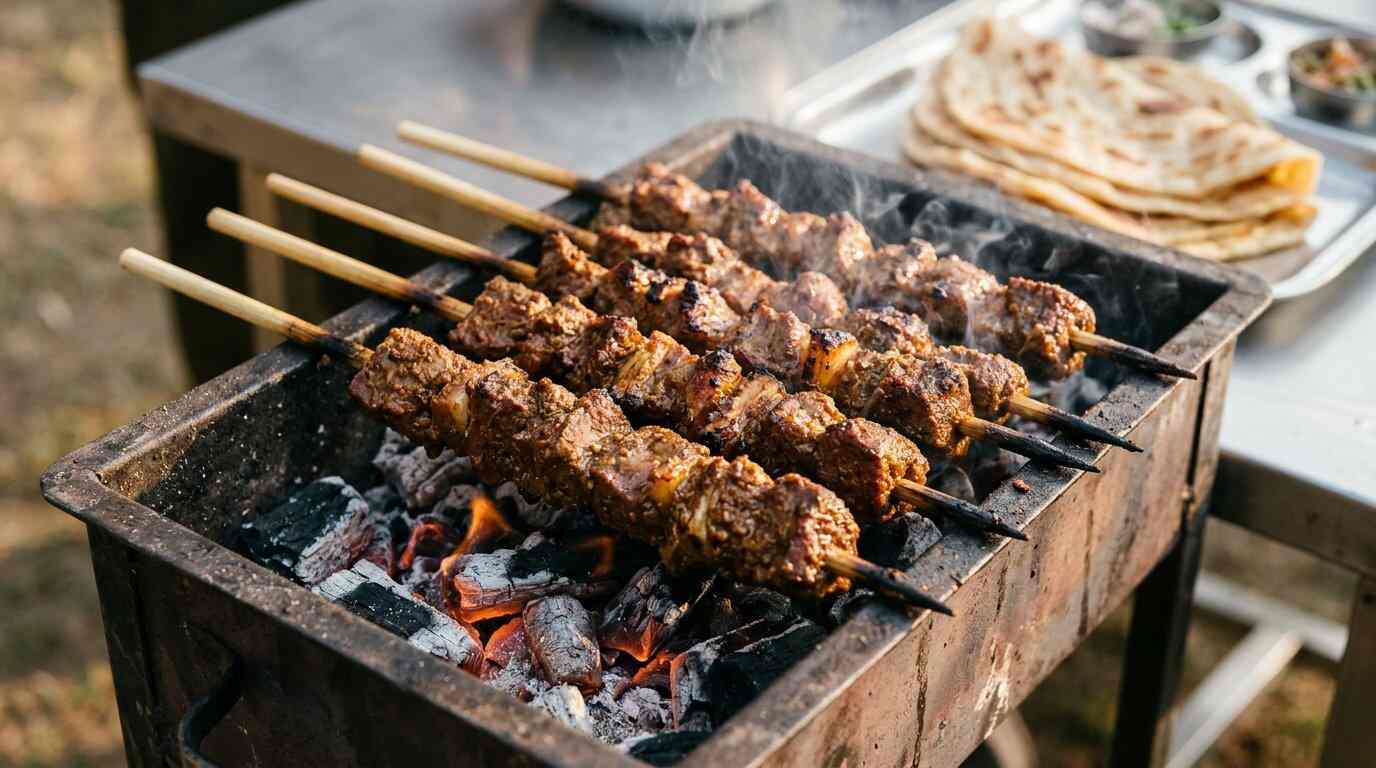
Kati (also spelled kathi) is the Bengali word for a stick. Several sources tie the name to a change in the kitchen: Nizam’s replaced heavy iron skewers with bamboo ones in 1964, according to Culture Trip and Homegrown. Atlas Obscura says “the 1960s” and adds that iron skewers were too expensive to buy in the needed quantities, while Gulf News cites a Dubai restaurateur who says iron was heavy and unsuitable for mass production.
Homegrown reports that before the bamboo skewer the item was simply called “rolls.” The name “kati kabab” and then “kati roll” followed. Over time the term widened. The Wikipedia entry notes that it came to cover any paratha roll with a filling, egg or potato versions included, and even rolls made with naan or rumali roti.
Culture Trip takes a stricter line on what qualifies: whether a dish counts as a kathi roll depends on the paratha wrapper, not on the type of skewer used to cook the filling. Atlas Obscura quotes a counterpoint from the food writer Vir Sanghvi, who holds that “a kati roll is a dish in itself” and not merely a way of carrying a kebab.
How a roll is built
Paratha first, egg second, filling last
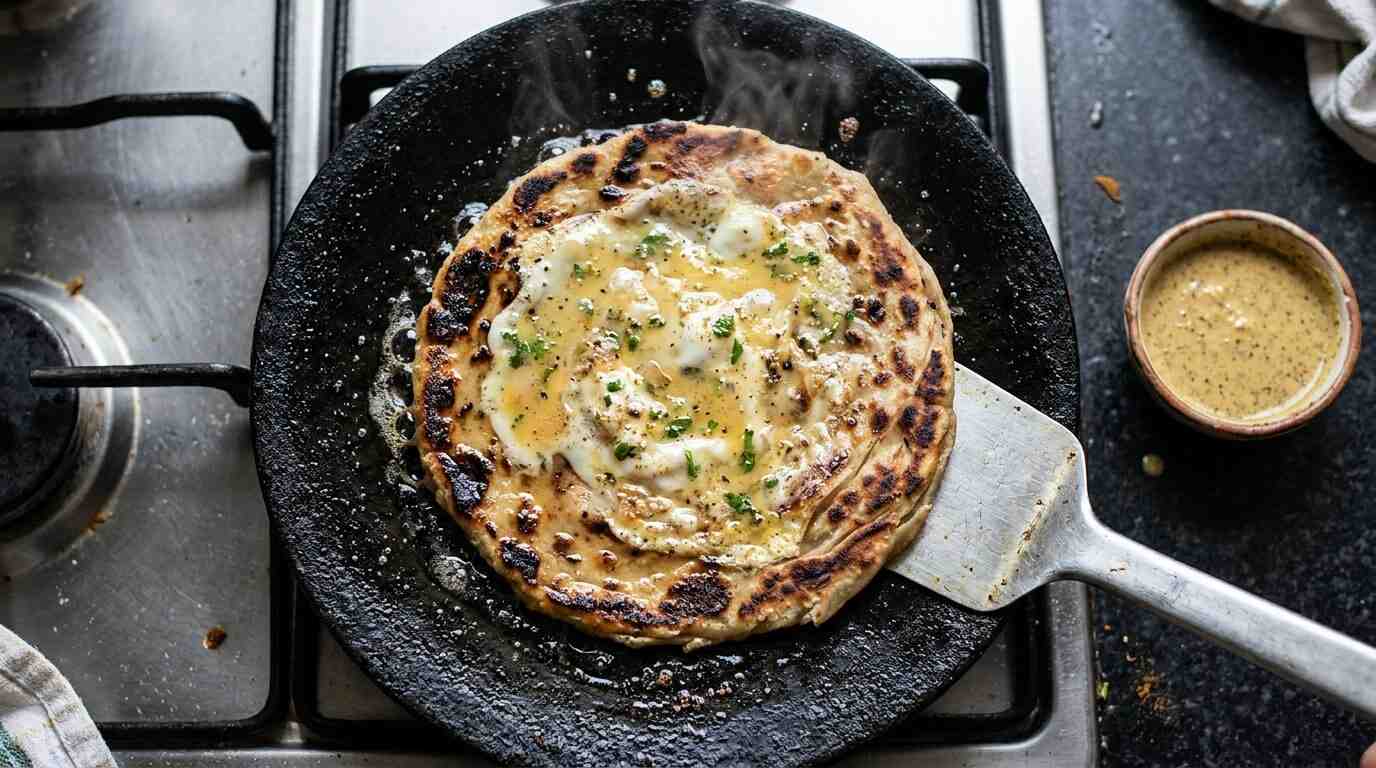
At a roadside stall the sequence is consistent from account to account. A ball of dough is rolled out and fried on a flat tawa, and the Migrationology travel blog describes the paratha at Kusum Rolls on Park Street as fried in a pool of oil on high heat, which crisps the edges. Atlas Obscura describes a vendor cracking an egg onto the dough before the fillings go on. Sanghvi, quoted in The Better India, recalls a maida (refined flour) paratha rolled out on a large tawa, with the egg cooked on both sides until the result sat between a paratha and an omelette.
The filling comes next. Gulf News lists meat or kebab, onion, cucumber, kasundi (a Bengali mustard sauce), pickled green chillies and chaat masala, and quotes Hricha Saraf, a Dubai restaurant owner from Bengal, on the sauce: “The heart of it all lies in the addition of kasundi.” Local Samosa describes onions and cucumber for freshness and a mustard sauce and mint chutney as essential, while Business Standard, in a 2010 survey of Kolkata roll shops, describes the meat grilled on bamboo skewers over a coal sigri and rolled with sliced onions, green chillies and pudina (mint) chutney.
The Kolkata habit of wrapping paper around only half of the roll, leaving one end exposed, is recorded on the Wikipedia page, which adds that elsewhere the paper often covers more or all of it.
Nizam’s own manager, Mohammed Islam Khan, told Business Standard in 2010: “The secret of our kathi rolls is the masalas with which we marinate our meat.” That article also reports the restaurant selling more than 800 kathi rolls a day at the time, and records that Nizam’s added no synthetic sauce or chutney.
Egg rolls, chicken rolls and the Kolkata shops
Kusum, Hot Kathi, Campari and the rest of the roll economy
Early fillings were beef or mutton. The Wikipedia entry says the original kati kebabs were beef, and Homegrown says Nizam’s no longer serves beef; today the common versions are chicken and mutton. Egg occupies a place of its own, and Sanghvi’s memory of the dish in The Better India is specific: “I can never forget those days in 1986 when I would eat a Nizam’s roll for lunch every day.” The same article notes that the egg roll draws crowds at Durga Puja stalls. A plain egg roll in Kolkata is a paratha with an egg cooked into it, a point the Migrationology author makes by distinguishing it from a Chinese spring roll.
Competitors changed the format during the second half of the twentieth century. Culture Trip credits Kusum Rolls, founded on Park Street in 1971, with popularising cheese in the filling, and Hot Kathi Roll, further along the same street, with wraps made from deep-fried paratha. The 2025 T2 article dates Hot Kati Roll to 1987 and also names Badshah on Lindsay Street (since 1968, known for a mutton Badshahi roll), Haji Saheb in Behala (founded 1995, known for a double chicken roll) and Campari in Gariahat (known for a tandoori fish roll). It describes Anamika Roll Centre in New Alipore, established in 1979, as serving non-kathi Bengali rolls.
Vegetarian rolls came later. Atlas Obscura lists paneer and chickpea fillings among the additions, and Culture Trip mentions vegan chickpea and paneer kebab versions.
In the 2010 Business Standard survey, the critic Nandan Bagchi gave his view of the local character: “The roll is a unique Kolkata product which has been copied in other parts of the country.” He credited the charcoal sigri and the marinade, and noted that rolls elsewhere often wrap chicken curry in chapati.
Mumbai, Delhi and the doubt about descent
Rolls with the same shape and perhaps a different parentage
Other Indian cities have their own wrapped snacks, and the sources are not in agreement over whether they derive from Nizam’s. Gulf News describes the Mumbai “Frankie” as thin rotis with egg, chicken, onion, diced capsicum, green chillies and chaat masala, toasted on the tawa again after rolling. A food blogger quoted there credits the brand Tibbs with popularising the term.
The Delhi “Khan Chacha” roll is made with rumali roti. Sanghvi, as reported by Gulf News, describes three kebabs (chicken tikka, a thin seekh and a kakori-style kebab) that can be ordered alone or wrapped in roti, and doubts they descend from the Nizam’s roll. Atlas Obscura summarises his position that the Frankie and Khan Chacha rolls have little in common with the Kolkata original.
The Wikipedia entry also lists a paratha roll from Karachi as a similar dish, without arguing for any direct line between the two. A Kolkata-centred view and a pan-Indian view sit side by side, and no dated record in these sources settles which wrapped kebab came first.
Closely related items in the Grill Cheesy archive show the same pattern of disputed origin and shared technique: vada pav from Mumbai, doner kebab carved into flatbread, sabich with its egg and pita, and bunny chow from Durban.
From Kolkata to New York and London
A late-night shop in Greenwich Village in 2002
Outside India the best-documented expansion is a New York company. The Kati Roll Company was founded by Payal Saha, who is from Kolkata. A press release dated January 10, 2011 says it opened in Greenwich Village in 2002, with a larger midtown location in 2005 and a London shop in 2008. American Kahani dates the London opening to 2007 instead, which makes the year another point of disagreement. The same profile reports that the first day’s sales were $50, quoting Saha: “On day one we made $50 and that was such a moment of high.”
The 2011 press release is promotional, and it quotes Saha: “Having a kati roll at the end of a night out has become an urban rite of passage.” It also records that a whole wheat roti was by then offered alongside the original paratha. Nation’s Restaurant News, in a March 2017 profile, counted four New York locations and one in London, described the roll as “essentially an Indian burrito,” and reported that the first shop was a 300-square-foot space near New York University. The NRN article also says the concept’s name was meant as a joke.
Saha’s status as the first to bring the roll to the United States is her own claim, as Atlas Obscura and Gulf News both present it; neither confirms it independently.
The format has also drifted into other cuisines. The Wikipedia entry records that Taco Bell India released the “Kathitto,” a Mexican-inspired burrito crossed with a kati roll, in 2012, and that some shops use Thai or Sichuan curries as fillings. In 2021 the MasterChef Australia contestant Depinder Chhibber, an Indian-origin home cook, made a version with crayfish and lobster masala, according to The Better India.
Back in Kolkata the rolls remain the older, plainer thing: paratha, egg, kebab, a squeeze of mustard sauce and a sheet of paper that covers half.
Common questions
Where did the kati roll originate?
Most accounts trace the format to Nizam’s, a Mughlai restaurant near New Market in Kolkata. No official version of the story exists, and the published accounts disagree on when the restaurant opened, who owned it and who the first customer was.
Why is it called a kati roll?
Kati, also spelled kathi, is the Bengali word for a stick. Culture Trip and Homegrown say Nizam’s replaced heavy iron skewers with bamboo ones in 1964, while Atlas Obscura says only “the 1960s.”
Who brought the kati roll to New York?
The Kati Roll Company, founded by Payal Saha, who is from Kolkata. A press release dated January 10, 2011 says it opened in Greenwich Village in 2002.
Sources
- Atlas Obscura, “The Kati Roll Can Be Traced Back to One Kolkata Restaurant”: https://www.atlasobscura.com/articles/the-kati-roll-can-be-traced-back-to-one-kolkata-restaurant
- Culture Trip, “How The Famous Kathi Roll Originated At Kolkata’s Nizam’s Restaurant”: https://theculturetrip.com/asia/india/articles/how-the-famous-kathi-roll-originated-at-kolkatas-nizams-restaurant
- Homegrown, “What’s In Nizam’s Kolkata Kathi Roll? Finding History In A Flatbread”: https://homegrown.co.in/article/804973/whats-in-nizams-kolkata-kathi-roll-finding-history-in-a-flatbread
- Gulf News, “The legend of the Indian Kathi roll and its many avatars”: https://gulfnews.com/food/the-legend-of-the-indian-kathi-roll-and-its-many-avatars-1.1652103544762
- The Better India, history of the Kolkata kathi roll and Nizam’s: https://thebetterindia.com/356183/history-behind-kolkata-iconic-food-kathi-roll-nizams-kebab-snack-cuisine
- Local Samosa, “History of Kathi Rolls: How Did Nizam’s Kebab Made Their Place in Everyone’s Heart”: https://www.localsamosa.com/2023/06/06/history-of-kathi-rolls-how-did-nizams-kebab-made-their-place-in-everyones-heart
- Business Standard, “A kathi above the rest” (September 5, 2010): https://www.business-standard.com/article/beyond-business/a-kathi-above-the-rest-110090500004_1.html
- T2, “Dig into the Calcutta kathi roll, the sixth best wrap in the world”: https://t2online.in/goodlife/food-beverage/dig-into-the-calcutta-kathi-roll–the-sixth-best-wrap-in-the-world/2002015
- Migrationology, “Kati Roll: Enlightening Indian Fast Food at Kusum Rolls (Kolkata)”: https://www.migrationology.com/indian-kati-roll-kusum-rolls/
- Newswire press release, “Kati Roll Craze Sweeps Through the US” (January 10, 2011): https://www.newswire.com/news/kati-roll-craze-sweeps-through-the-us-115987
- American Kahani, “How Payal Saha rolled the dice on Calcutta street food”: https://americankahani.com/lifestyle/how-payal-saha-rolled-the-dice-on-calcutta-street-food-and-won-big-in-the-big-apple/
- Nation’s Restaurant News, “Breakout Brands 2017: Kati Roll Company”: https://nrn.com/emerging-chains/breakout-brands-2017-kati-roll-company
- Wikipedia, “Kati roll” (used as a pointer to its listed references only): https://en.wikipedia.org/wiki/Kati_roll
Keep reading
- Bocadillo: Spain’s Crusty-Loaf Sandwich, Its Name and Its Regional Forms
- Choripán: The Argentine and Uruguayan Chorizo Sandwich, Its Name and Disputed Origins
- Francesinha: Porto’s Sandwich, Its Origin Story and the Sauce
More in this section: Sandwiches Around the World guide.