In this story
The building that gave Branston Pickle its name was put up to make machine guns, and it closed before a single one came off the line. Crosse & Blackwell, a London preserved-food firm, took over the site near Burton upon Trent in Staffordshire and put the village’s name on a dark, sweet-and-sour relish of diced vegetables. The company’s own history page gives 1922 as the year of first production and 1929 as the year the Branston trademark was registered. The jar went on to become a common filling in the British cheese and pickle sandwich.
Video: Bring out the Branston… Branston Pickle advert from the seventies — from the advertarchive YouTube channel
A machine gun factory in a Staffordshire village
The building came first, the pickle second
The plant stood on the north side of Burton Road, opened apparently early in 1918 and closed later that year when the First World War ended, before production had started, according to the Victoria County History entry on Branston’s economic history. In 1920, the same entry says, the government sold it to Crosse & Blackwell, which stayed until 1924 and adopted Branston as a brand name for its sauce and pickle recipes.
Other accounts push the dates by a year. A Chip Paper history says the sale was finalized in 1921, when Crosse & Blackwell moved from Soho, and that production at the Branston factory wound down between 1924 and January 1925. The magazine The Microbiologist also dates the move to 1921, from Soho Square to a former machine-gun factory, and says the move inspired the product name. The Spectator, in a 2022 piece by Ameer Kotecha, says production shifted to Bermondsey, closer to raw materials, and continued there until 1969.
The factory did not stay a food plant for long. The county history lists a silk company there from 1927 to 1930, and an ordnance depot for the War Office from 1937, a use that continued under successive departments into the 1990s.
The Graham recipe and Branston Lodge
Who wrote the recipe is a story with several versions
The recipe is usually credited to a local household. Cook’s Info says it is said to date from the early 1900s and to have come from Mrs Caroline Graham and her daughters, Evelyn and Ermentrude, at Branston Lodge, and that Crosse & Blackwell bought it in 1921. The newsletter The Sword and the Sandwich repeats the Graham attribution and adds that the recipe used 23 ingredients bought at London’s Covent Garden market, including onions from Holland, dates from Pakistan and gherkins from India. That article describes the company as founded in 1706.
Country Life, in an April 2022 piece by Alec Marsh, tells it differently: Caroline Graham is described as one of about 600 workers at the Crosse & Blackwell factory, and the pickle was reportedly invented at the lodge by the railway lines, a building set aside for single women employees. The Chip Paper history describes Branston Lodge as a residence for the company’s female workers. A post on batterseabus.co.uk, partly behind a paywall, says a farmhouse in the village was bought in 1921 to house single women working at the factory, and notes that the popular Graham story leaves out the fact that Crosse & Blackwell already owned a Branston factory.
None of these accounts cites a primary document for the Graham attribution, and the lodge appears either as a family home or as company housing, depending on the writer. The company’s own history page names no individuals and does not mention the lodge.
The founding date of Crosse & Blackwell is also unsettled. The Sword and the Sandwich says 1706, while The Microbiologist says Thomas Blackwell and Edmund Crosse were apprenticed to a pickle and sauce firm in 1819 and bought the business about ten years later.
What is in the jar
Diced vegetables in a brown sauce, cooked for hours
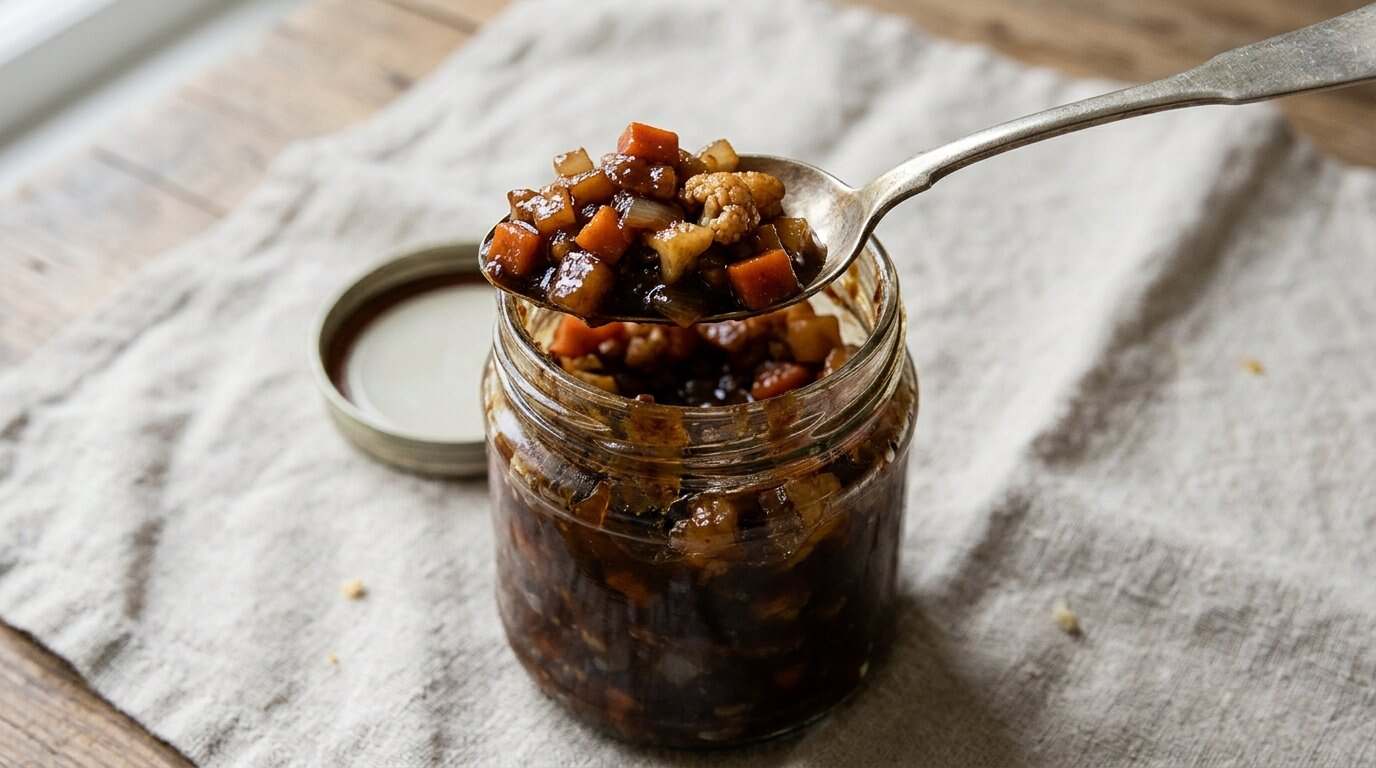
Cook’s Info lists the vegetables as carrots, cauliflower, gherkins, marrow, onion, swede and tomatoes, diced to about a centimetre, in a sauce of sugar, malt and white vinegar, apple puree, dates and spices. Tasting Table says the original recipe included dates and apple puree, and that the current ingredient list looks abridged. The Spectator names carrot, swede (labeled “rutabaga” on the jar), onion and cauliflower, with barley malt vinegar, sugar, apple, tomato, dates, herbs and spices.
The vegetables cook for two and a half hours in large vats with what the maker calls its secret sauce, per Country Life’s 2022 feature on the brand, which also says the Small Chunk variety launched in 1988 and is now the best seller. Cook’s Info lists the range as Small Chunks, Smooth, Rich & Fruity and Spicy.
The exact method is not published. The company says the same secret recipe is used, and the batterseabus.co.uk post notes that the claim of an unchanged recipe since the 1920s comes from the manufacturer.
Branston compared with chutney and piccalilli
Where chutney, piccalilli and Branston meet and part
Cook’s Info describes Branston as similar to a North American idea of chutney, but more exactly a relish of diced pickled vegetables in a thick, dark, sweet-and-sour sauce, with a texture like ketchup or HP sauce. It adds that Branston is more popular in the south of England, while piccalilli is preferred in the north.
Chutney is the older import. The Encyclopedia of Food and Culture entry on chutney, by William Woys Weaver, calls the word an anglicized form of the Hindi chatni and says Indian chutneys reached England and France as luxury imports in the late 1600s. By the nineteenth century India produced chutneys for export that were sweeter and less salty or peppery than the versions Indians preferred. The Online Etymology Dictionary records the first English use in 1813.
Piccalilli was known in early recipes as Indian pickle. British History Online’s traded goods dictionary defines it as a pickle of chopped vegetables and hot spices, invariably including turmeric, which gives the yellow color. The earliest known record of the name there is Elizabeth Raffald’s 1772 recipe for “Indian Pickle or Piccalillo,” although the Online Etymology Dictionary records the word in English from 1769. The Microbiologist adds that a former chef to Napoleon, “Senor Qualiotti,” introduced piccalilli at Crosse & Blackwell for Christmas 1832.
The brand sells a piccalilli of its own, as the LBB Online report on its 2023 advertising shows, in which a dry bun asks a woman to “piccalilli me.”
Wikipedia’s Branston article), used here only as a pointer, says the pickle was based on Indian pickles and chutneys liked by Anglo-Indians during the Raj, citing Patricia Brown and Lizzie Collingham.
The ploughman’s lunch and the cheese and pickle sandwich
Bread, cheese and pickle had a campaign behind them
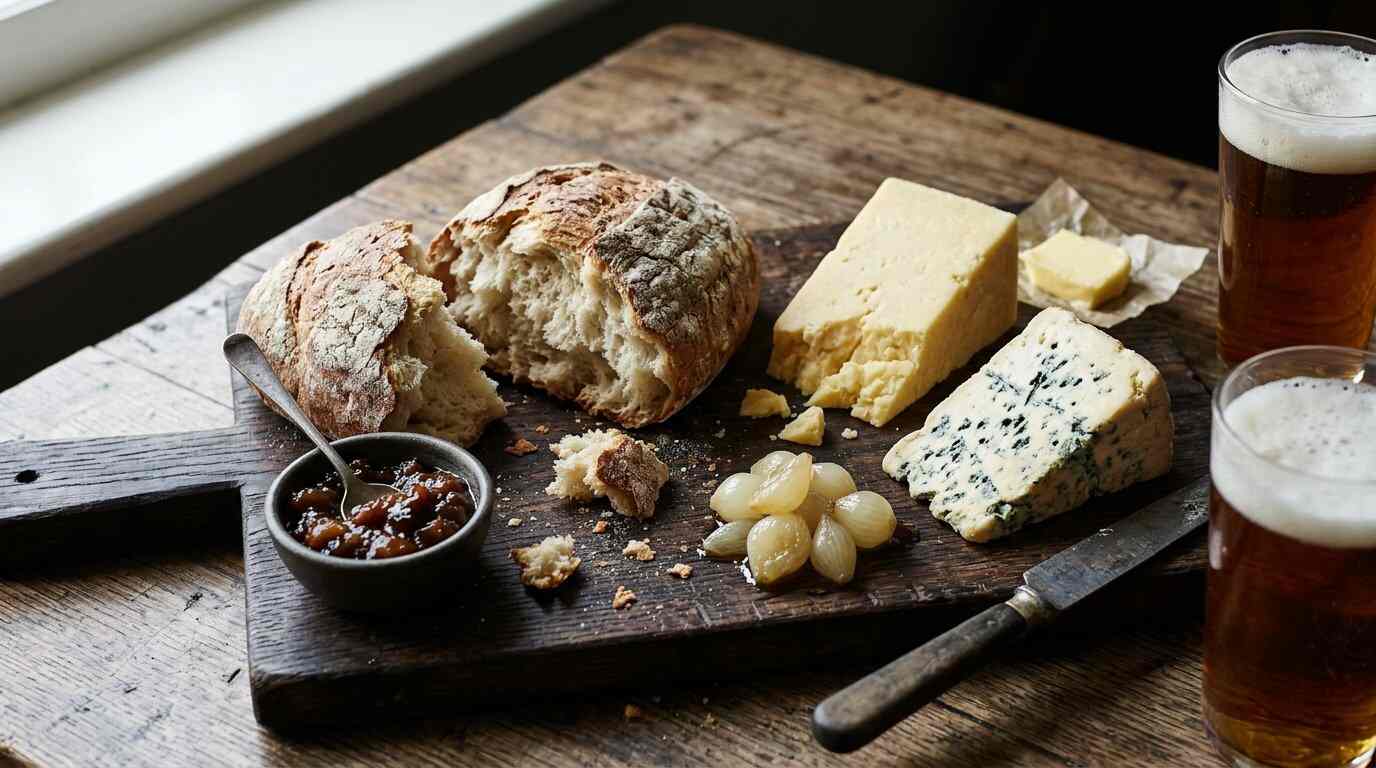
Pickle and cheese appear together in the ploughman’s lunch, and the history of that meal is itself disputed. Zythophile, a blog on beer and pub history, traces the phrase to the Brewers’ Society’s A Monthly Bulletin: in July 1956 the Cheese Bureau was trying to restore the pub combination of bread, beer, cheese and pickles that rationing had broken, and the writer Adrian Bell urged pubs to serve the meal as a “Ploughboy’s Lunch.” The blog’s author finds the exact phrase “Ploughman’s Lunch” in June 1957, and Milk Marketing Board minutes from November 1960 budget for 5,000 showcards for pubs.
The blog sets that record against the popular line. The 2005 BBC programme and others call the dish a 1960s marketing invention, while the blog’s author argues it was a pre-war pub staple that the Cheese Bureau revived. Pong Cheese credits the Milk Marketing Board with promoting the name in the 1960s, and The Takeout lists Branston among the chutneys that typically accompany bread, cheese and pickled onions.
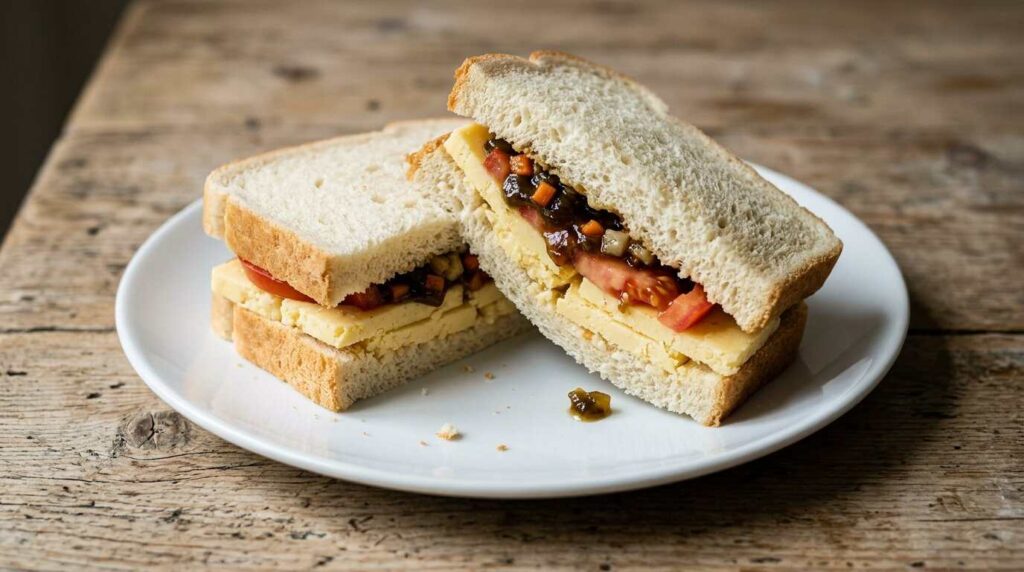
The sandwich is the same meal compressed. Food Republic writer Jess Kapadia describes thick slices of mature cheddar with Branston and sliced tomato, and notes that the crisp maker Walkers briefly released a flavor modeled on it. The Spectator’s Kotecha writes, “Branston and cheddar cheese were made for each other.” A restaurant in Greenwich Village, Tea & Sympathy, has served it since 1990; owner Nicky Perry told The Sword and the Sandwich of the pickle, “It’s an English staple.” The cheddar side of the pairing has its own account in cheddar cheese history.
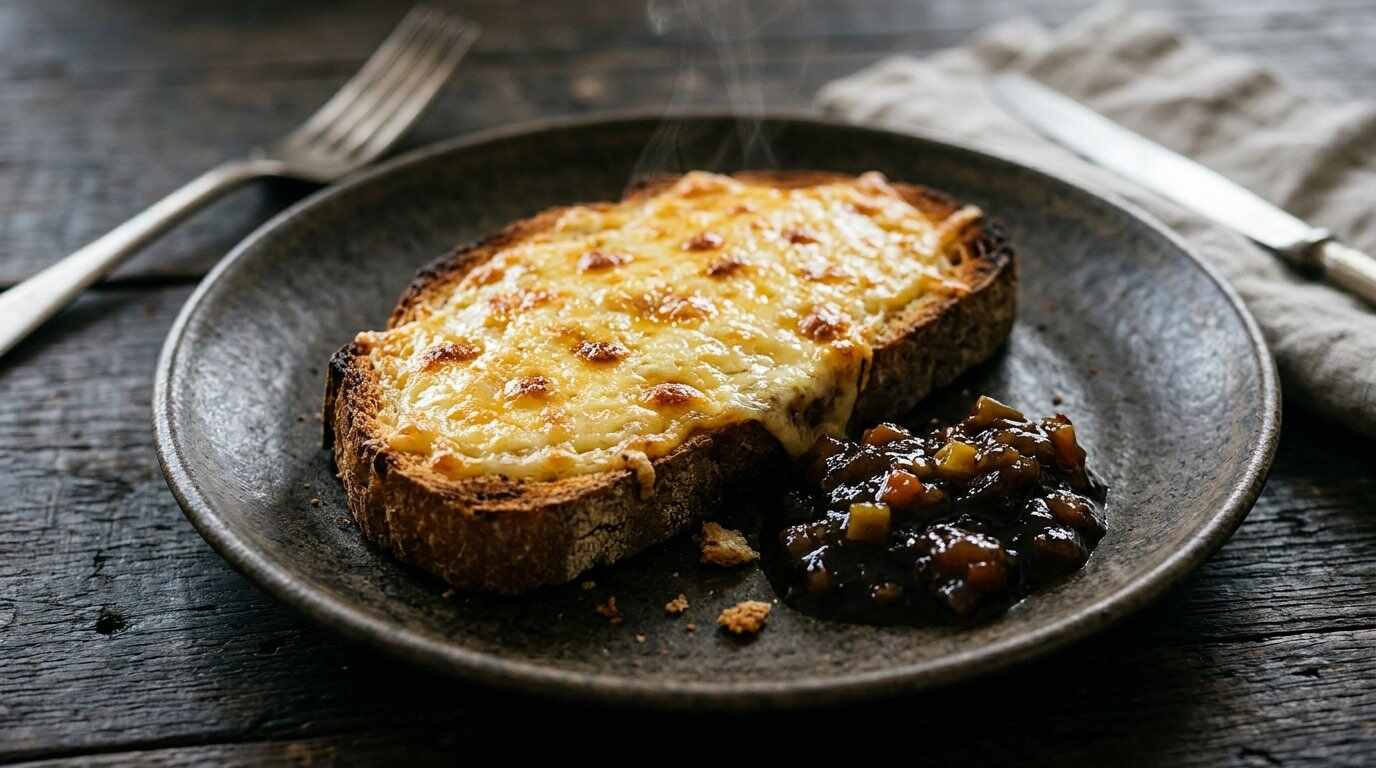
Cook’s Info also lists cheese on toast as a standard use, which puts it in the neighborhood of the cheese toastie and Welsh rarebit, and notes the pickle occasionally turns up on pizza.
Owners, advertising and dates that differ
A brand that changed hands several times
The ownership chain is clear in outline and murky in detail. Grace’s Guide and Wikipedia date Nestlé’s purchase of Crosse & Blackwell to 1960, while Cook’s Info and Tasting Table give 1950. Grace’s Guide says Premier Brands bought Nestlé’s ambient foods business in 2002, and the company’s history agrees on 2002 for Premier Foods, with production moving to Bury St Edmunds in 2004. The Wikipedia article places Premier’s purchase of the pickle business in 2004.
The sale to Japan’s Mizkan has two years attached. The company says Mizkan Euro acquired Branston in February 2013, while Grace’s Guide says 2012, and Wikipedia reports a late-2012 sale for £92.5 million. The Grocer says Mizkan bought the sweet pickles and sauces business from Premier for £92.5 million and puts Branston’s share at 37 percent of a £30 million chutney and relish category.
A fire at the Bury St Edmunds plant in autumn 2004 triggered panic buying. Cook’s Info dates it to October 2004, the batterseabus.co.uk post to November, and the Spectator says it temporarily halved availability.
Advertising supplies the other dates. The company and the Spectator say the “Bring out the Branston” slogan began with a 1972 television advert; the 1970s clip embedded above is an archive upload of such an advert. Decision Marketing notes that the jingle was revived in a 2023 campaign by Wonderhood Studios, and quotes the agency’s joint executive creative director, Guy Hobbs: “all food really wants from us is a hit of Branston.” Sales figures drift more than the jingle does, from the company’s 28 million jars in 2006 to estimates of more than 17 million a year in later pieces, among them Tasting Table (citing Food52), that give no company source.
Common questions
When was Branston Pickle first made?
The company’s history page gives 1922 as the year of first production by Crosse & Blackwell and 1929 as the year the Branston trademark was registered. The name comes from the village of Branston, near Burton upon Trent in Staffordshire.
What is in Branston Pickle?
Cook’s Info lists carrots, cauliflower, gherkins, marrow, onion, swede and tomatoes, diced to about a centimetre, in a sauce of sugar, malt and white vinegar, apple puree, dates and spices.
How does Branston differ from chutney and piccalilli?
Cook’s Info describes Branston as similar to a North American idea of chutney but more exactly a relish of diced pickled vegetables in a thick, dark, sweet-and-sour sauce. It adds that Branston is more popular in the south of England, while piccalilli is preferred in the north.
Sources
- Bring out the Branston, “Our History” (Mizkan, company site): https://bringoutthebranston.co.uk/about/history
- Victoria County History via British History Online, “Branston: Economic history”: https://prod.british-history.ac.uk/node/5871
- Chip Paper, “Condiment Curiosity: Branston Pickle”: https://chippaper.substack.com/p/condiment-curiosity-branston-pickle
- The Microbiologist, “The perplexing progress of pickling and preservation”: https://the-microbiologist.com/features/the-perplexing-progress-of-pickling-and-preservation/88.article
- The Spectator, Ameer Kotecha, “Three cheers for Branston Pickle” (November 25, 2022): https://spectator.com/article/three-cheers-for-branston-pickle/?edition=us
- Cook’s Info, “Branston Pickle”: https://www.cooksinfo.com/branston-pickle
- The Sword and the Sandwich, “Notable Sandwiches 32: Cheese & Pickle”: https://buttondown.com/theswordandthesandwich/archive/notable-sandwiches-32-cheese-pickle/
- Country Life, Alec Marsh, “There’s pickle in the jar” (April 27, 2022): https://magzter.com/fr/stories/Lifestyle/Country-Life-UK/Theres-pickle-in-the-jar
- Country Life, “What a pickle” (April 27, 2022): https://www.pressreader.com/uk/country-life/20220427/282359748271164
- batterseabus.co.uk, “Bring out the Branston”: https://www.batterseabus.co.uk/branstonpickle/
- Tasting Table, “What’s Really In Branston Pickle?”: https://tastingtable.com/897768/whats-really-in-branston-pickle
- Encyclopedia of Food and Culture, “Chutney” (William Woys Weaver), via Encyclopedia.com: https://encyclopedia.com/food/encyclopedias-almanacs-transcripts-and-maps/chutney
- Online Etymology Dictionary, “chutney”: https://www.etymonline.com/word/chutney
- Online Etymology Dictionary, “piccalilli”: https://www.etymonline.com/word/piccalilli
- British History Online, Traded Goods Dictionary, “Piccalilli (pickling)”: https://www.british-history.ac.uk/no-series/traded-goods-dictionary/1550-1820/piccalilli-pickling
- LBB Online, “Branston brings back its catchy 70s jingle in new advertising campaign” (June 1, 2023): https://lbbonline.com/news/branston-brings-back-its-catchy-70s-jingle-in-new-advertising-campaign
- Decision Marketing, “‘Bring Out The Branston’: Still rolling back the years” (June 2, 2023): https://www.decisionmarketing.co.uk/reviews/bring-out-the-branston-still-rolling-back-the-years
- The Grocer, “Branston back on TV after five-year hiatus”: https://www.thegrocer.co.uk/branston-back-on-tv-after-five-year-hiatus/352122.article
- Zythophile, “The ploughman’s lunch: guilty or innocent?” (July 16, 2007): https://zythophile.co.uk/2007/07/16/the-ploughmans-lunch-guilty-or-innocent
- Pong Cheese, “A history of the ploughman’s lunch”: https://www.pongcheese.co.uk/blog/a-history-of-the-ploughmans-lunch/
- The Takeout, Joe Hoeffner, on the ploughman’s lunch (January 1, 2026): https://www.thetakeout.com/2061030/age-old-british-lunch-tradition-ploughmans/
- Food Republic, Jess Kapadia, “England’s Cheese And Pickle Sandwich” (2012): https://www.foodrepublic.com/2012/02/08/englands-cheese-and-pickle-sandwich
- Grace’s Guide, “Branston Pickle”: https://www.gracesguide.co.uk/Branston_Pickle
- Wikipedia, “Branston (brand)” (pointer only): https://en.wikipedia.org/wiki/Branston_(brand)
Keep reading
- Aioli vs Mayonnaise: Where Garlic, Egg and Olive Oil Draw the Line
- Duke’s Mayonnaise History: Eugenia Duke, Camp Sevier and the Sugar-Free Recipe
- Thousand Island Dressing Origin: Boldt, Sophia LaLonde and the Blackstone Claim
More in this section: Sauces and Spreads guide.