In this story
Cheddar takes its name from a village in Somerset, in south-western England, and that is about the only point on which every source agrees. Saveur dates the first recorded cheese from Cheddar to the twelfth century, while the official product specification for West Country Farmhouse Cheddar puts the earliest evidence of production in the area at the fifteenth. The cheese then crossed the Atlantic, was standardized by regulators in the United States, and picked up a color that has nothing to do with taste.
Video: Real Cheddar: The World’s Most Popular Cheese (History, Production, Flavour & Examples), Cheese Scientist
A village in Somerset and a disputed date
Cheeses were first named for the place they came from, not for the way they were made, according to Saveur. Cheddar fits that pattern. Culture magazine traces the cheese to the twelfth century and reports that King Henry II bought 10,240 pounds of it in 1170, calling it the best cheese in England. The text published by the Cheddar Gorge Cheese Company on a Cheddar village history page gives the same weight, credits the Great Roll of the Pipe as the record, says the price was a farthing a pound, and words the king’s verdict as the best cheese in Britain. That page reproduces company copy and is not an independent check.
The government-registered specification tells a more cautious story. In the product specification for West Country Farmhouse Cheddar, the variety is linked to Somerset with evidence of production in the Cheddar area as far back as the fifteenth century. Twelfth century or fifteenth: the sources do not reconcile the gap, and the Pipe Roll entry itself was not available for this post.
A local legend fills the silence. A milkmaid left a pail of milk in a cave, and by the time she returned it had turned to cheese. Culture calls it a myth and the village history page calls it local legend; neither offers a date.
The caves of Cheddar Gorge
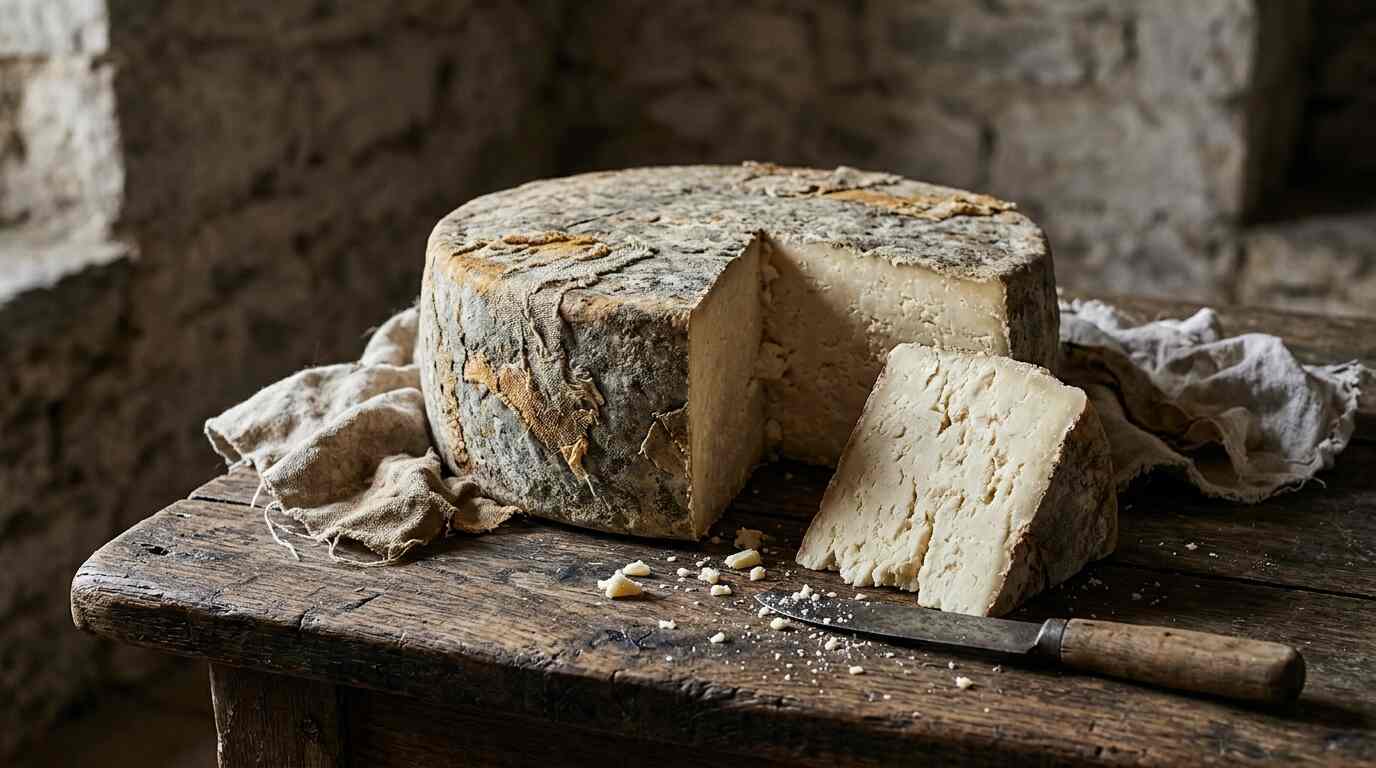
The gorge and its caves are the part of the story that attracts the most claims. Culture says the area’s caves and gorges let farmers keep milk cool. The cheese was matured in caves beneath the Mendip Hills, according to the product specification, and Spotlight English adds that wealthy Londoners visited the caves and ate the local cheese, which spread its fame from the fifteenth century onward.
The Cheddar Gorge Cheese Company’s page says the caves held a constant 7 degrees Celsius all year, and that cheese is no longer kept there because vermin were attracted to it. A profile at Cheese Professor describes the cave humidity as suited to aging, allowing mold to grow on the rind, and names Gough’s Cave as the one originally used. The gorge’s land and caves are partly owned by the National Trust and partly by a private landowner, the same article says. In 2006, John and Katherine Spencer, who had opened the Cheddar Gorge Cheese Company in 2003, negotiated with that landowner to age some of their cheese in the cave for up to 24 months.
The article also calls the company “the only producer of farmhouse Cheddar, made and aged in the namesake village.” The wording is the article’s, and it was not independently verified here.
Royal demand is the other recurring detail. Culture says Charles I pre-ordered his wheels, and Spotlight English says demand under his reign was so high that the king reserved orders for himself and his court. The Cheddar Gorge Cheese Company’s page, citing parliamentary records, says the cheese was sold before it was made. Culture adds that Queen Victoria received a wheel of aged cheddar weighing more than half a ton as a wedding gift, which the company page converts to eleven hundredweight made from the milk of more than 700 cows.
What cheddaring means
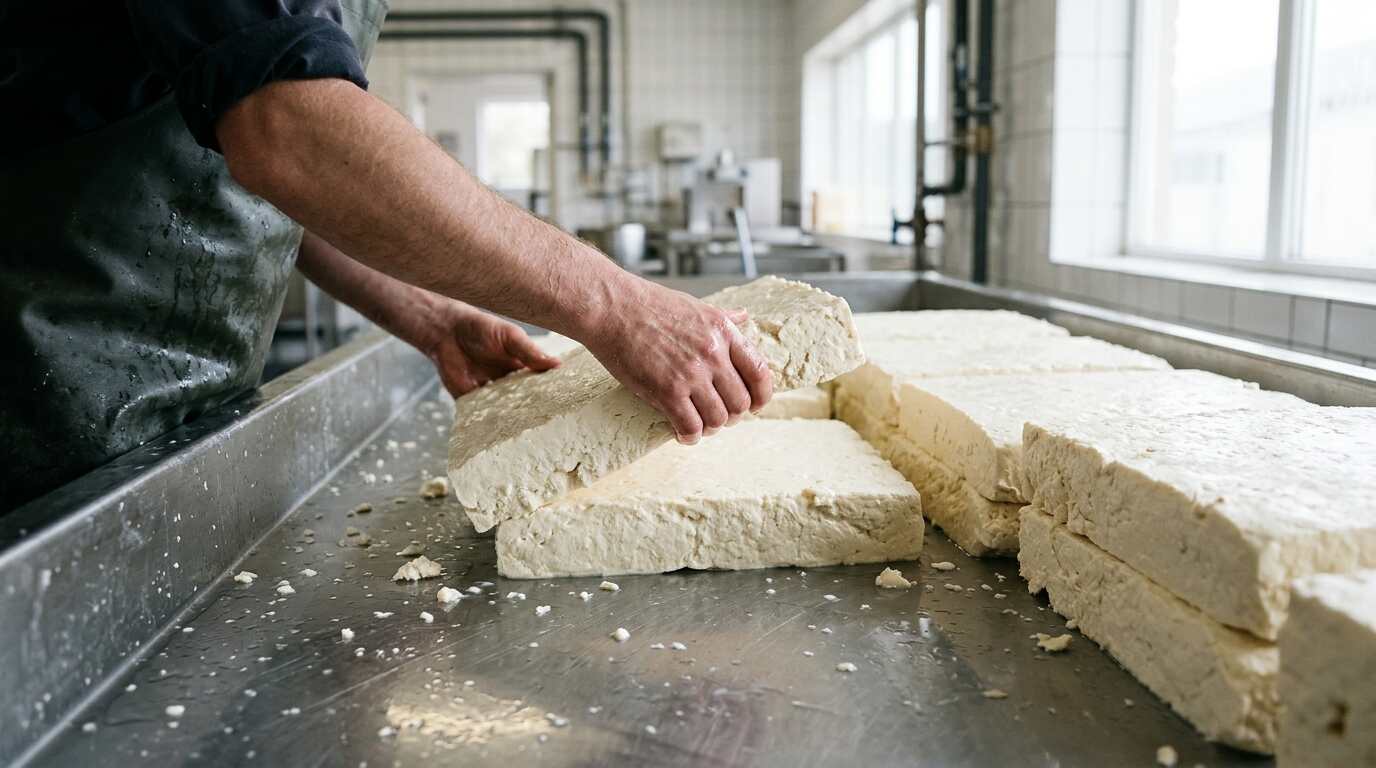
The word cheddar names a place, but “cheddaring” names a step. Saveur defines it as piling slabs of curd on top of one another to expel excess whey, which made the cheese drier, more durable and less prone to spoilage, and which replaced the labor-intensive stirred-curd method. Slow Food’s profile of Artisan Somerset Cheddar gives the hand-work version: blocks of curd are stacked and turned by hand for an hour, which changes crumbly lumps into pliable, elastic slabs.
The specification for the PDO cheese calls the step unique to Cheddar manufacture and still done by hand. Curd pieces are turned and stacked along the vat or cooling table to drain whey until the required acidity is reached. Modern industrial cheddars, Saveur notes, use automated curd-stirring equipment and are no longer cheddared in the old sense. United States regulation avoids the word but describes the act: in 21 CFR 133.113, the curd is cut into slabs, piled and handled to drain whey and develop acidity, then cut into pieces, salted and pressed.
Spotlight English dates the method earlier than most sources, saying Cheddar makers began scalding curds at high heat in the fourteenth century and developed cheddaring afterward. Saveur places the technical improvements that made the method standard in the mid-1800s. No source fetched for this post could say who first stacked a slab of curd.
Joseph Harding and the nineteenth-century rules
One name keeps surfacing in the mid-1800s. Joseph Harding, born in 1805 to a Somerset farming family, is known as the father of cheddar cheese, according to the Neal’s Yard Dairy history of the Harding family. The dairy credits him with slip-scalding, rapid ripening, a curd-breaker, better dairy hygiene and testing cheese acidity, collectively called the Joseph Harding System. Most of his experiments took place at the Marksbury dairy of his aunt, Elizabeth Harding.
Harding spread the method by writing it down. He taught cheesemakers through reports, lectures and demonstrations, and an 1860 article in the Journal of the Royal Agricultural Society of England. A deputation from the Ayrshire Agriculture Association visited Somerset in 1854, and the article says its report helped make cheddar viable in Scotland. Saveur summarizes his contribution as pairing technical improvements with rules for timing, temperature and acidity so that the cheese came out consistently good, and says cheddar was codified in the mid-nineteenth century as producers in England, Canada and the United States compared practices.
Culture credits him with improving the curd mill and with scalding the curd for a fine texture, citing The Oxford Companion to Cheese. The Neal’s Yard article does not use the word mill, but it lists a curd-breaker.
West Country Farmhouse Cheddar and the protected name
The word cheddar itself is not protected, but one regional version is. West Country Farmhouse Cheddar holds protected designation of origin status, and the specification lays out what that requires:
- Place: the historical counties of Dorset, Somerset, Devon and Cornwall, using the 1955 county boundaries, with milk from cows grazed in the area. Some milk may come from Gloucestershire and Wiltshire during shortages.
- Method: cows’ milk, pasteurized or raw, a starter culture, curd scalded at around 103 to 106 degrees Fahrenheit, then milled, salted and pressed, with cheddaring done by hand.
- Finish: cylinders are bandaged in muslin dipped in melted lard or another natural fat, and the bandage helps form a hard rind.
- Aging: at least nine months. Cheese that does not develop the required flavor is sold as standard cheddar.
- Composition: minimum 48 percent fat in dry matter, maximum 39 percent moisture, with a nutty, round flavor and a hint of sharpness.
The specification states there is no evidence that cheese made outside the area was ever called West Country Farmhouse Cheddar. It also allows milk from elsewhere in England for seasonal shortfalls, which sits awkwardly beside the stated origin rule.
The traditional cheese nearly vanished. Slow Food says centralized cheesemaking and official moisture requirements after World War II eliminated moister cheddar types, and that rindless block cheeses and pasteurized milk wore down the character of South West English cheddar. Spotlight English reports that small UK cheese businesses fell from over 3,500 before World War I to fewer than 100 by the end of World War II. Slow Food’s presidium cheese, made with traditional starter cultures and calf rennet, weighs 50 to 60 pounds and is aged at least 11 months.
Cheddar crosses the Atlantic
The colonists who moved to America brought their cheesemaking with them, and by 1790 they were exporting cheddar to Britain, Culture reports. The bigger change came in the middle of the next century. Another Culture article, on Jesse Williams and the first cheese factory, dates the birth of the factory system to 1851, when Williams, a farmer in Rome, New York, combined his milk with his son’s at a central location after his son’s marriage. His farm already produced 25,000 pounds of cheese a year, and the first factory season yielded 100,000 pounds. Within fifteen years, the article says, there were 500 such factories in New York alone.
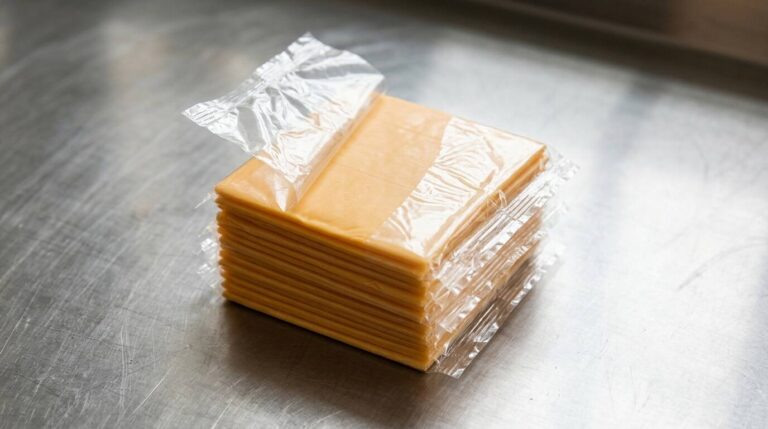
From the mid-nineteenth century, per Saveur, cheddar was the most widely produced cheese in the United States, and it stayed that way for 150 years. The country’s rules fix the definition by numbers. Under 21 CFR 133.113, cheddar must have a milkfat content of at least 50 percent of solids and a moisture content of no more than 39 percent by weight, and coloring is a permitted optional ingredient. Cheddar then became the base of the processed slice: Culture reports that James L. Kraft developed the Kraft Single recipe in 1916 using repasteurized shredded cheddar and sodium phosphate. The patent itself is covered in the post on American cheese.
Why some cheddar is orange
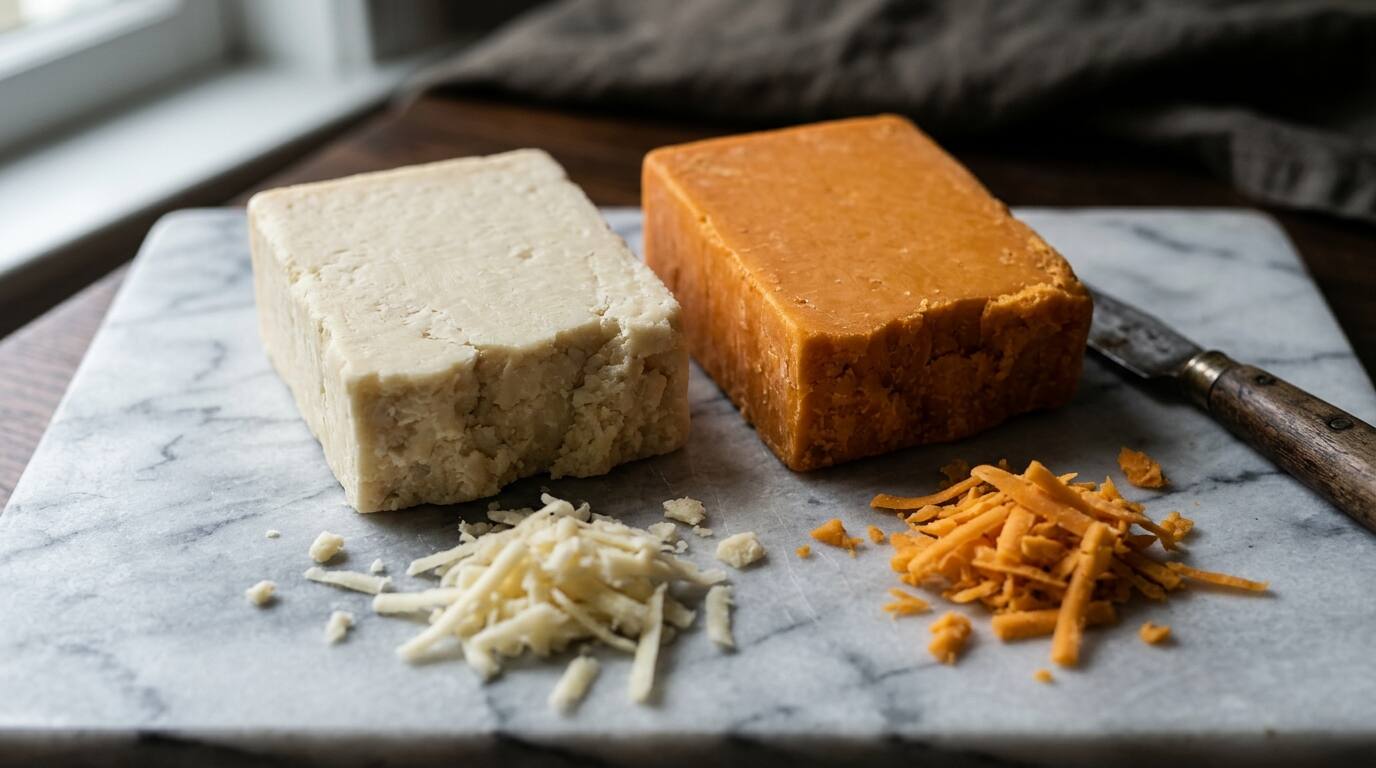
Color has nothing to do with age or sharpness. The U.S. dairy industry’s explainer, Why Is Cheese Orange?, says cheesemakers add annatto, a natural coloring from the seeds of the achiote tree, in small amounts, mainly for appearance. Orange and white cheddar made by the same methods and aged equally have essentially the same flavor.
The historical reasons are several. Grass in spring and early summer is high in beta-carotene, which passes into milk and tints it gold, and winter diets produced paler milk. David McCoy, quoted there, suggests makers added color to keep the cheese looking consistent through the year. Paul Kindstedt links it to the thirteenth-century English butter trade, in which deep yellow butter was prized and sometimes colored with marigold. Dean Sommer of the University of Wisconsin-Madison instead traces coloring to Leicestershire cheese, cheddar’s ancestor, where annatto may have distinguished it from similar seventeenth-century cheeses. The Daily Meal names saffron and carrot juice as earlier dyes, with annatto later becoming the most common colorant.
In the United States, coloring did not catch on at first, according to the dairy explainer, and much domestic cheddar stayed pale until export markets grew in the late nineteenth century. Midwestern makers began coloring cheddar to compete with European cheeses, which likely explains why orange is more common in the Midwest and white in parts of the Northeast. The Daily Meal, citing America’s Test Kitchen, says buyers in the eastern states prefer white cheddar and that yellow and orange grow more popular toward the West Coast. Saveur says Wisconsin cheddar typically carries a tint from annatto.
Cheddar in a grilled cheese sandwich
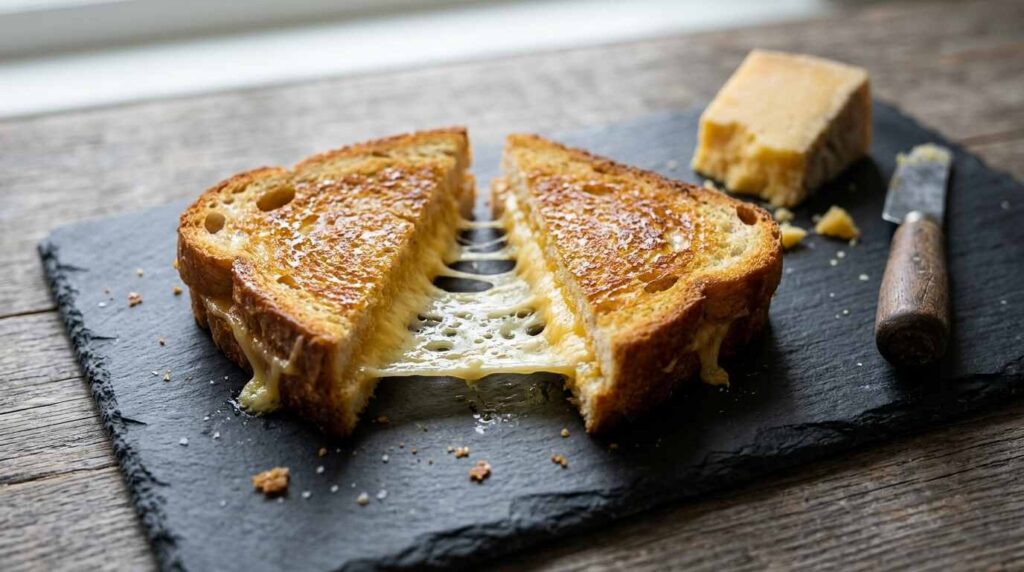
Cheddar’s role in the sandwich comes down to age. America’s Test Kitchen baked cheddars aged 3, 16 and 24 months on inverted metal cups. The 3-month cheddar melted smoothly, the 16-month cheddar clumped as it slid down, and the 24-month cheddar split into two large pieces and never melted. The explanation offered is that the casein network in young cheese is flexible, while in older cheese the proteins bond more tightly and can release separated fat.
By that test, a young cheddar suits a hot pan and a cheddar aged two years does not. How cheddar compares with other melting cheeses is laid out in the guide to the best cheese for grilled cheese. The wider story of the sandwich itself, from open-faced toasted-cheese recipes to the pan-grilled version, is in the history of grilled cheese.
Sources:
- Saveur, “A Brief History of Cheddar Cheese”: https://www.saveur.com/history-of-cheddar-cheese
- Culture magazine, “A Sharp Story: The Origin of Cheddar”: https://culturecheesemag.com/blog/sharp-story-origin-cheddar/
- Culture magazine, “Jesse Williams & the Cheese Factory”: https://culturecheesemag.com/cheese-iq/jesse-williams-cheese-factory/
- UK government, Product specification, West Country Farmhouse Cheddar (PDO): https://assets.publishing.service.gov.uk/media/5fd3693f8fa8f54d59e8b750/pfn-west-country-farmhouse-cheddar.pdf
- Slow Food UK, Artisan Somerset Cheddar: https://www.slowfood.org.uk/artisan-somerset-cheddar
- Cheddar Gorge Cheese Company text, “The History of Cheddar Cheese”: https://cheddarsomerset.co.uk/History/Cheddar%20Cheese.htm
- Cheese Professor, “Cheddar Gorge Cheese Company: A Story Of Revival”: https://cheeseprofessor.com/blog/cheddar-gorge-cheese-company
- Spotlight English, “The town that lost its cheese”: https://spotlightenglish.com/food-drink/the-town-that-lost-its-cheese/
- Neal’s Yard Dairy, “Women in Cheese: The Harding Family”: https://www.nealsyarddairy.co.uk/blogs/cheese/women-in-cheese-the-harding-family
- eCFR, 21 CFR 133.113, Cheddar cheese: https://www.ecfr.gov/current/title-21/chapter-I/subchapter-B/part-133/subpart-B/section-133.113
- U.S. Dairy, “Why Is Cheese Orange?”: https://www.usdairy.com/news-articles/why-is-cheese-orange
- The Daily Meal, “The Fascinating History Behind Why Some Cheese Has That Bright Orange Color”: https://www.thedailymeal.com/1239511/the-fascinating-history-behind-why-some-cheese-has-that-bright-orange-color
- America’s Test Kitchen, “Why Young Cheese Melts Better than Aged Cheese”: https://www.americastestkitchen.com/how_tos/6679-why-young-cheese-melts-better-than-aged-cheese
- Cheese Scientist (YouTube), “Real Cheddar: The World’s Most Popular Cheese”: https://www.youtube.com/watch?v=4RsDuhHhz-Q