In this story
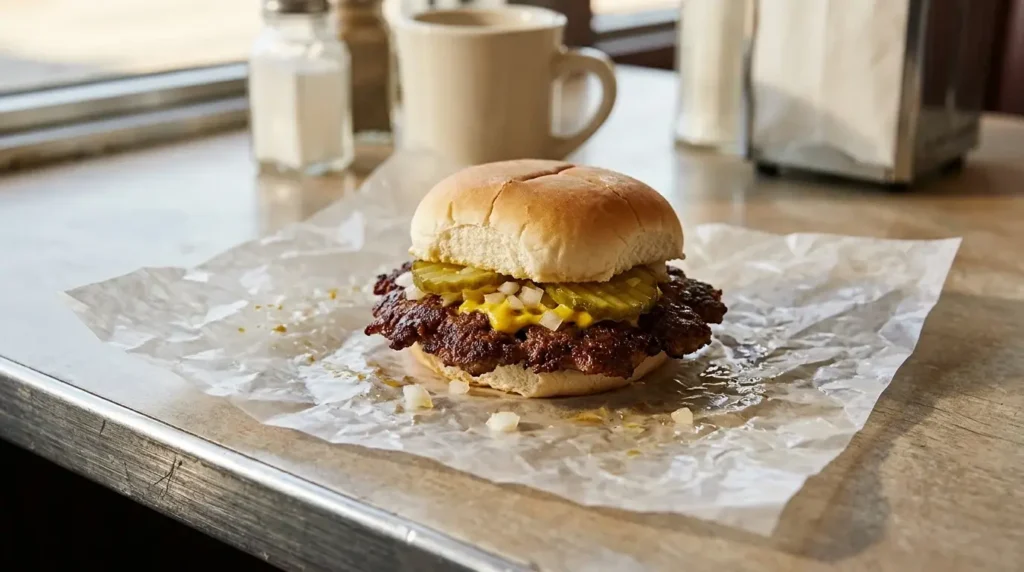
A slugburger is a thin patty of ground meat, usually pork, stretched with soy meal or flour, deep-fried until the outside crisps, and served on a small bun with mustard, onion and pickle. It comes from Corinth, in the northeast corner of Mississippi, where it sold for a nickel during the Great Depression. The name is generally traced to that price. Nearly everything else about its origin is argued over.
Video: How to Cook a Mississippi Slugburger with George Motz, from the First We Feast YouTube channel
Meat and filler
The extender is what defines it. Anna McCollum of The ‘Sip Magazine, writing in spring 2017, sums up the part no one disputes: a mixture of meat and extender, pork and soymeal, flattened into a disk, fried and sold for a nickel, which was often called a “slug” in Depression-era Corinth.
The filler changed over time. McCollum reports Willie Weeks, a descendant of one of the founding families, saying potato flakes were the original extender and were replaced by soy grits before 1950. Atlas Obscura, in an undated entry, describes the Depression-era version as beef or pork stretched with potato flour and fried in animal fat, and the modern one as soybean meal fried in vegetable oil.
Recipes stay close to the chest. McCollum writes that one shop listed pork, flour, salt, water and soymeal without giving proportions, and that the owners of the White Trolley Cafe say theirs includes beef, which they say no other local shop uses.
A nickel, or something else
The price explanation is the standard one. Cook’s Country, in an undated profile of Borroum’s Drug Store, reports that Corinth sold the burgers for a nickel during the Depression and that the name came from “slug” as slang for a nickel.
The town’s own festival lore offers others. Atlas Obscura lists three theories it attributes to the Slugburger Festival’s “sluglore”: that “slug” meant a counterfeit coin, because the slugburger only poses as a real burger; that a patty left sitting turns cold and soggy and looks like a slug; and that eating too many leaves the diner feeling slugged in the stomach. McCollum adds a fourth reading from Sara Wood, a Southern Foodways Alliance historian, who says the word signals soymeal as the filler.
Similar burgers went by other names. McCollum lists doughburger, crackerburger, cerealburger, Pennburger, Weeksburger and Johnnieburger.

The Weeks family, and others
Who made the first one is the most contested question. McCollum gathers the competing accounts. Camille Mitchell of Borroum’s told her: “Mrs. Weeks made the first one as far as I know.” Wood reports that people she interviewed described the Weeks family’s hamburger carts as having come from Chicago.
Willie Weeks offered a longer chain: his father’s oldest brother probably got the recipe from German immigrants and gave it to the McEwen brothers’ meat market around 1917. Local owners Linda and Jeff Rickman told McCollum they believe the McEwen recipe passed to C.F. Gray, who opened his own market in 1957. The White Trolley’s owners say their recipe came with a trolley brought from Memphis nearly a century earlier, though McCollum notes it is unclear whether its first owner got the recipe from the Weeks family or the McEwens.
McCollum’s article, the most detailed fetched for this post, names “Mrs. Weeks” and the Weeks family rather than a single founder.
Borroum’s and the burger shops
The best-known counter is older than the burger. Cook’s Country reports that Borroum’s opened in Corinth in 1865 as a pharmacy and soda fountain and began selling slugburgers in the late 1970s. Owner Lex Mitchell told the magazine they are typically served with mustard, onion and pickle. McCollum describes Borroum’s pressing patties flat in plastic bags and freezing them until ordered.
Most shops deep-fry the patties, McCollum writes, so they turn crisp outside and stay soft inside; Cook’s Country credits the filler with keeping the inside moist. One exception, the Front Street Snack Bar in Iuka, grills its patties in their own fat.
McCollum lists other Corinth-area stops: the White Trolley Cafe on U.S. 72, Lloyd’s Harper Road Cafe, Joe’s Diner and Brewer’s Drive-In. Atlas Obscura gives the White Trolley’s address as 1215 US-72.

The festival
Corinth celebrates it every July. McCollum and Atlas Obscura disagree by a year on when that began: McCollum says the Slugburger Festival started in 1988, while Atlas Obscura says it has been held since 1987. Both agree it takes place downtown.
Other regional American burgers on Grill Cheesy include the thin, pressed smash burger and Minneapolis’s cheese-stuffed Jucy Lucy. The broader history of the patty on a bun is in the hamburger’s origin.
Questions people ask
What is a slugburger? A deep-fried patty of ground meat, usually pork, stretched with soy meal or flour, served on a bun with mustard, onion and pickle.
Why is it called a slugburger? Most often because it cost a nickel, slang “slug.” Festival lore adds other theories, including a counterfeit-coin meaning.
Where did the slugburger come from? Corinth, Mississippi, during the Great Depression.
Who invented the slugburger? Undocumented. Accounts credit the Weeks family, with links to Chicago carts and to the McEwen meat market around 1917.
When is the Slugburger Festival? Every July in downtown Corinth; it began in 1988 or 1987, depending on the source.
Sources
- Anna McCollum, The ‘Sip Magazine, The Slugburger (May 5, 2017): https://thesipmag.com/the-slugburger/
- Cook’s Country (America’s Test Kitchen), On the Road: Burgers Born of Thrift (undated): https://www.americastestkitchen.com/cookscountry/articles/3091-on-the-road-burgers-born-of-thrift
- Atlas Obscura, Slugburger (undated): https://assets.atlasobscura.com/foods/slugburger-mississippi