
In this story
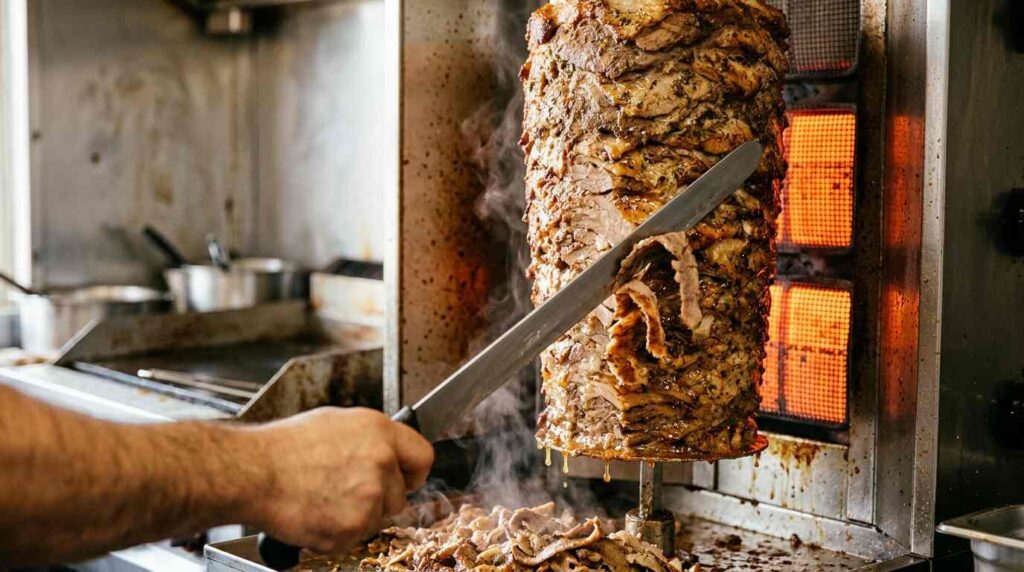
The gyro is a Greek sandwich with Ottoman roots and an American industrial history, and each stage of that path has its own disputed claims. The name comes from a Greek word for turning, the cooking method comes from the vertical spits of Anatolian kebab shops, and the cone of pressed meat that most American restaurants slice from was perfected in Chicago by competing Greek-American manufacturers who still disagree about who started it. Merriam-Webster dates the sandwich sense of the English word to 1971, a date that falls inside the early-1970s window when Chicago firms were starting to produce cones.
Video: Dining & Wine: The Making of a Gyro Cone | The New York Times
The word and how it is said
Merriam-Webster traces the sandwich sense to Modern Greek gyros, meaning “turn,” and says the name refers to the rotation of the meat on a spit. The same entry gives two pronunciations for the sandwich: YEE-roh, or ZHIHR-oh. It lists a separate JEYE-roh for the shortened form of gyroscope and for the service club that shares the spelling.
Greek speakers say “yee-ros,” a point made by the Greek Reporter’s history of the dish, which gives the same pronunciation. Chicago has its own habit. WTTW’s David Hammond writes that in Chicago, good luck getting served unless the order is “guy-rohs”. Mashed notes that pronunciation varies widely in the United States, from “yee-roh” to “jeer-oh.”
The Greek Reporter article also glosses the name as “round” or “loop” instead of “turn.” The two glosses describe the same motion, though Merriam-Webster’s is the one tied to a dictionary entry.
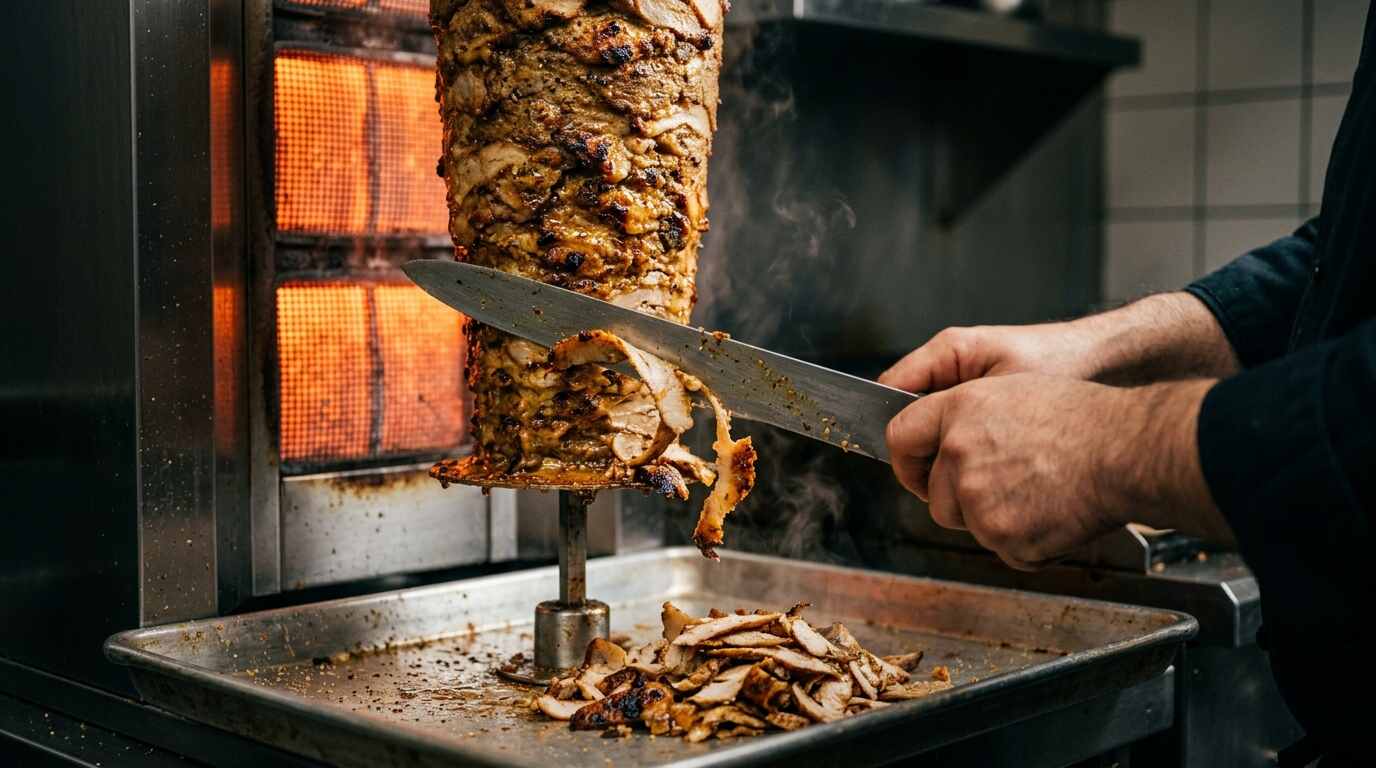
Doner on a vertical spit
The gyro’s closest relative is the Turkish doner kebab. The National Herald calls it the gyro’s closest ancestor, a vertical-spit dish developed under the Ottomans that reached Greece in the 19th or early 20th century and later turned into the pork-heavy Greek gyro.
The earliest dates for the vertical spit are not settled. Per Meurling’s history of the doner on Berlin Food Stories says written records credit Hamdi Usta of Kastamonu with tilting the kebab upright in 1835, and that Iskender Efendi of Bursa seems to have arrived at the vertical rotisserie independently about a decade later. National Geographic’s guide to doner credits both men with developing the vertical method in the mid-19th century and notes that the spit was originally horizontal. Istanbul’s kebab restaurants switched to vertical spits in the 19th century, probably to save space, and the upright position lets the meat baste itself. The same article reports that food historian Mary Işın says the term “döner kebap” was first documented in writing in 1908, while doner’s roots reach back to miniature paintings from 1616 to 1620.
A Greek food site, thegreekfood.com, places the current form in Bursa, a city it describes as having a large Greek population, and suggests the line may run back through an older oltu kebap from a town near Erzurum, cooked horizontally and cut thicker. The same page admits that origins are disputed among countries. Its account is a single site’s, and the doner histories above do not mention oltu kebap.
From Asia Minor to Athens
The route from Anatolia to Greece runs through displacement. The Greek Reporter says gyros became famous after Greek immigrants arrived from Asia Minor in the 1920s, and that the newcomers adapted the Turkish kebab with Greek meat and local ingredients. Mashed gives a matching account: the 1919 to 1922 Greco-Turkish War led to a forced population exchange, and the 1920s saw Greek, Turkish and Armenian immigrants from Asia Minor popularizing rotisserie cooking. The thegreekfood.com page says the dish spread slowly through Greece in the decades after 1922.
Alexander the Great sometimes appears in this story. The Greek Reporter mentions a theory linking gyros to his army, which roasted meat on long swords, and states that none of the origin theories can be verified. Mashed reports that The New York Times connected the gyro’s roots to spit-roasted meats served to that army in Persia, then adds that the modern upright rotisserie appeared much later, in the Ottoman Empire around the 1830s.
What changed on the way into Greek kitchens was the meat. Thegreekfood.com argues that Muslims who avoided pork used lamb or beef for doner, while Greeks had the “privilege” of pork, which the page calls the main historical difference between gyros and doner. Mashed likewise says gyros in Greece are mostly pork, against a blend of lamb and beef in the United States. Newer Greek versions use chicken, per the Greek Reporter.
Shawarma, the third name
Turks call the dish doner and Arabs call it shawarma, according to thegreekfood.com. Merriam-Webster’s entry for the Arabic name gives the lineage: it comes from Levantine Arabic shāwurma, and the Arabic term comes from Turkish çevirme, which means “turn” or “rotation.” Meurling’s Berlin Food Stories history makes the same link. The dictionary dates the sandwich sense of shawarma to 1953, eighteen years before its first recorded use of the sandwich sense of gyro.
All three names, then, describe turning meat. The Turkish çevirme, the Arabic word derived from it, and the Greek gyros each point at the same mechanical fact. Mashed adds that doner also influenced tacos al pastor, a claim that rests on that one site here.
Chicago and the contested first cone
American gyro history begins in Chicago, and no source agrees on a single founder. The Daily Meal states that the exact person who first introduced the gyro in America remains unknown, though the trail likely starts in Chicago.
The claim most often repeated belongs to George Apostolou. The Tasting Table says he is the most common answer when Chicagoans are asked who the “father of the gyro” is, and that Opa Chicago says he served gyros at the Parkview Restaurant in 1965. Mashed and the National Herald also place him at Parkview, which the National Herald locates in Lawndale. The Daily Meal adds that, in an interview with The New York Times, he claimed to have begun mass-producing gyros in 1974.
That is where the arguments multiply. The Daily Meal says Peter Parthenis, who started out building rotisseries, claims to have beaten Apostolou to mass production by a year. Tasting Table reports that Parthenis says his company, Gyros Inc., began making gyros in 1973, a year before Kronos, and that Chris Tomaras of Kronos Foods says he was himself the first to bring the gyro from Greece to Chicago. A third name enters through Andre Papantoniou, founder of Olympia Food Industries, who says the American gyro was first developed by his coworker John Garlic. The Daily Meal reports that Garlic’s wife claimed the couple began mass-producing cones at a sausage plant before anyone else, without giving a date, city or company.
Estiator’s “Tales of Gyro and Pita” gives still other dates. The article reports that Pete Parthenis Sr. formed Gyros Incorporated in 1971 or 1972, later renamed Grecian Delight; that Christos Tomaras founded Kronos in 1975 after patenting a vertical rotisserie he called the Kronomatic; and that Central Gyros Wholesale, Apostolou’s company, began mass-producing cones in 1974, nine years after the Parkview gyro. Kronos, the same page says, acquired Central Gyros Wholesale in 1986.
Dates for the same company differ by a year or more from source to source, which is typical of founder stories told decades later. Only two things hold across the accounts: the Parkview claim of 1965 and a cluster of Chicago firms producing cones in the early to mid 1970s.
What the cone industry changed
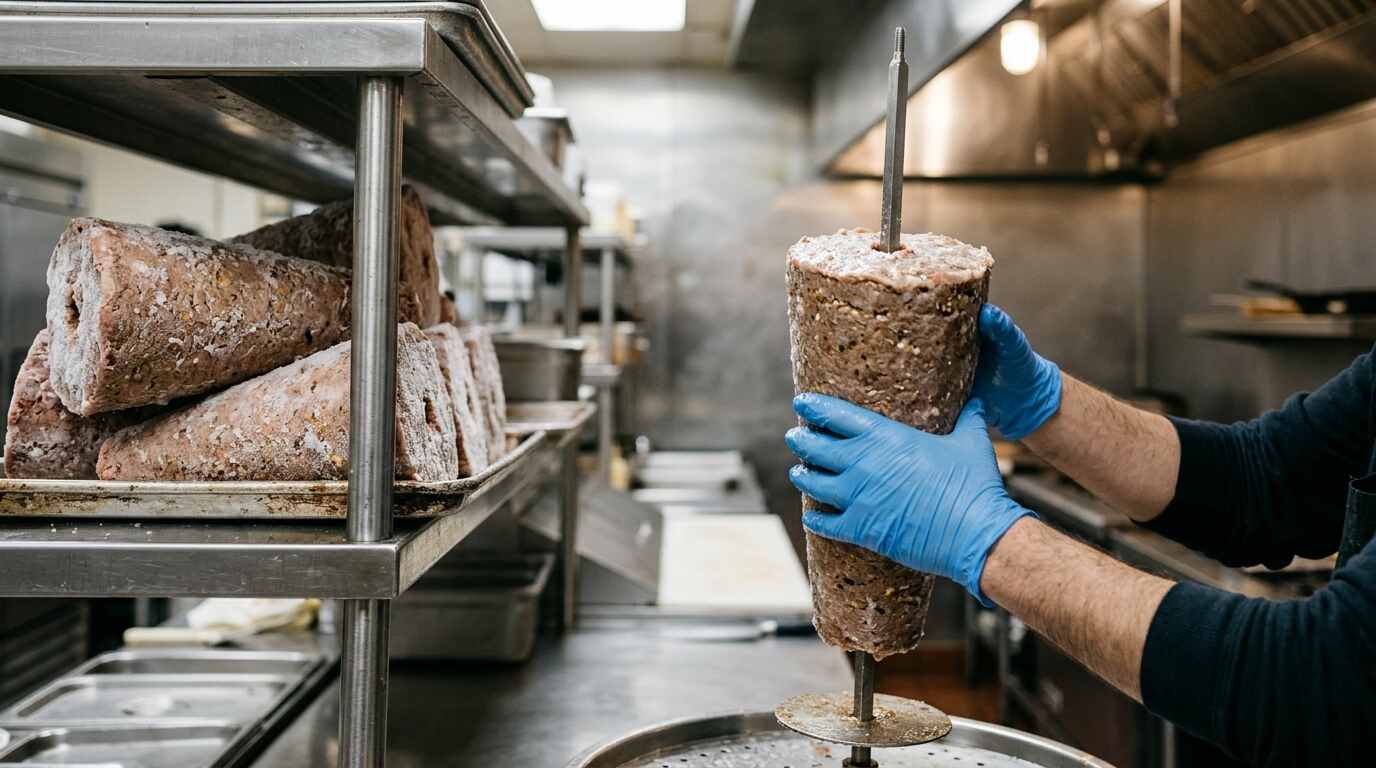
Hand-built cones were slow work. Grecian Delight’s own company history says that before automation, workers formed gyro cones by hand in about 30 minutes, and that Parthenis Sr. cut the time to about one minute with an automated process that took nearly a year to develop. The first cones went to Atlanta by Greyhound bus, frozen solid and wrapped in bubble wrap, and stayed frozen for 24 hours. The page gives no year for that shipment. It also records that some Greek restaurateurs at first resisted the product, seeing a “poor man’s sandwich from Greece,” and that Parthenis Sr. had to teach restaurant owners how to make gyros.
Mashed describes the commercial product: ground meat trimmings, seasoned with breadcrumbs and spices, pressed under hydraulic pressure and flash frozen. A cone made that way can be shipped across the country and sliced thin to order. WTTW says the pre-formed, freezable cones made gyros faster and more consistent to serve, and that Chicago blends of beef and lamb reflect both the beef supply from the Union Stockyards and the dietary laws of a mixed population. That explanation comes from one writer’s summary, with no company history behind it.
Papantoniou of Olympia offers a different emphasis. Estiator’s article reports him saying the gyro was not invented by Greek Americans, since in Greece individuals made ground-meat gyros, which raised food safety concerns and led to government regulation. In the United States, he says, production falls under USDA supervision, and Chicago’s central location suits national distribution. Olympia, per the same article, began as a pita maker: the Papantoniou brothers opened The Acropolis on Sheridan Road in 1971, founded Olympia Foods a year later, and by 1974 had built what the article calls the world’s first automated pita line.
The industry’s reach is large. Mashed reports a claim by Kronos’s chief executive that Americans ate more than 100 million gyros a year as of 2012, and that Arby’s reportedly sold 27 million a year in 2017. Neither figure was checked against a primary source. Another Chicago product line shows up beside gyros at one supplier: Estiator says gyros and Italian beef are the biggest lines at Devanco Foods, and the beef sandwich has its own page in the post on Italian beef.
A 1969 Chicago Tribune column by Kay Loring, quoted by WTTW, described the product at an earlier stage, as “a great round meat cake resembling meatloaf being broiled on a large spit”. The cone industry soon made that description obsolete.
Pita and tzatziki
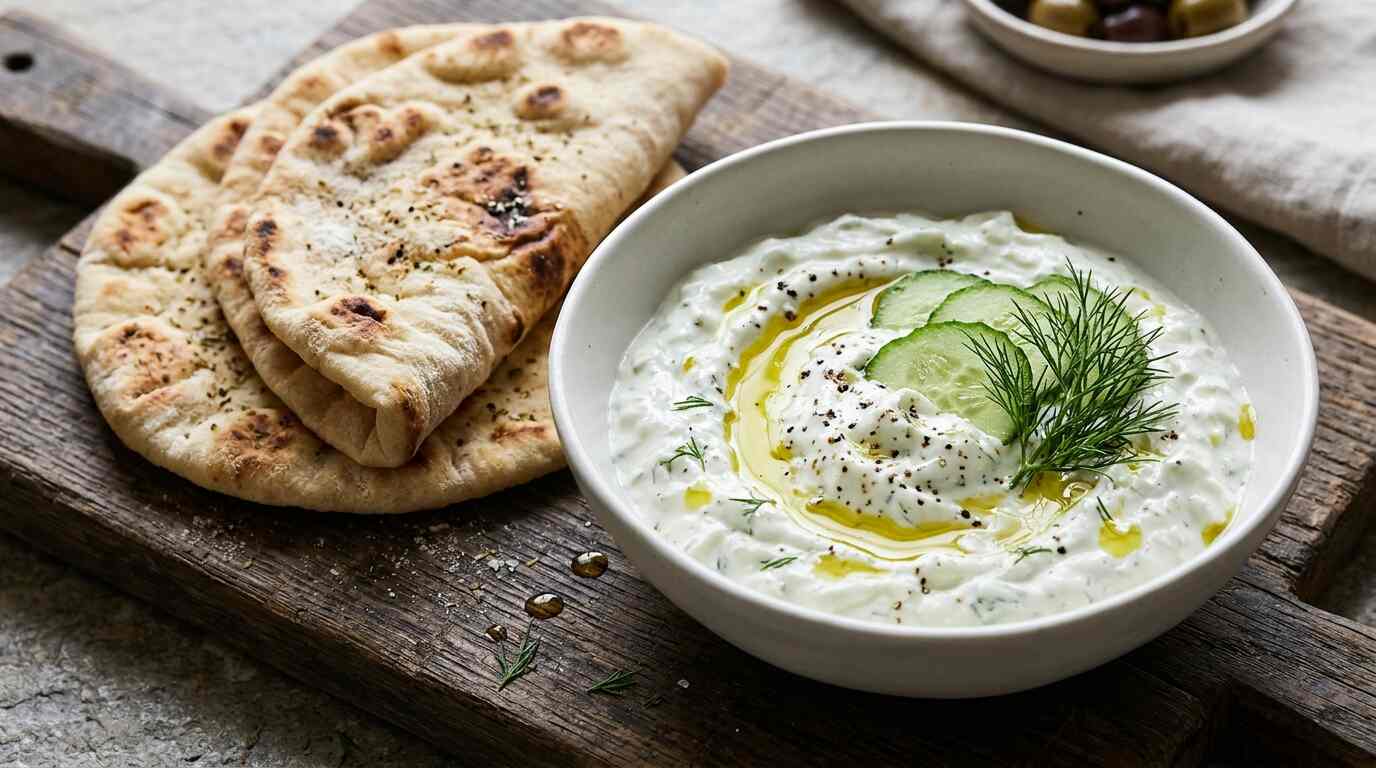
Two supporting players carry as much weight as the meat. In Greece, gyros usually arrives in lightly grilled pita with sliced tomato, chopped onion, lettuce, french fries and tzatziki, per thegreekfood.com. The Greek Reporter lists soft pita, onions, tomatoes, Greek fried potatoes and tzatziki, and defines tzatziki as Greek yogurt, cucumbers and garlic.
The bread is a variety of its own. A bakery guide describes Greek pita as a “pocketless pita”, the type usually used to wrap gyro meat, and contrasts it with the pocket pita that puffs in a hot oven as water turns to steam. Tasting Table traces pita, a yeast-leavened flatbread, to the Middle East and the Fertile Crescent, with flatbreads in general going back more than 10,000 years. It says Middle Eastern styles such as khubz have pockets, while Mediterranean styles including Greek pita are denser. The article gives no date for pita itself and does not explain the word. The Olympia story above adds a commercial footnote: an American pita industry was being automated in Chicago at about the same time as the cone.
Tzatziki shares the doner’s tangled passport. Mental Floss reports that the earliest use of the word recorded by the Oxford English Dictionary dates to the 1960s, in Robin Howe’s cookbook Greek Cooking, and that many sources credit cacik, the Ottoman version, as tzatziki’s origin even though the dip is strongly associated with Greek cuisine. Cacik typically uses labneh, a strained yogurt cheese. The same page gives two pronunciations: “dzad-zee-kee,” per Merriam-Webster, and “tsat-see-kee,” per Cambridge.
Sources:
- Merriam-Webster, “gyro”: https://www.merriam-webster.com/dictionary/gyro
- Merriam-Webster, “shawarma”: https://www.merriam-webster.com/dictionary/shawarma
- Greek Reporter, “National Gyro Day: The History of the Famous Greek Fast Food”: https://greekreporter.com/2018/12/05/gyros-the-history-behind-the-famous-greek-delicacy/
- WTTW (David Hammond), “Born in Greece, the Gyros’ Spinning American Soul Belongs to Chicago”: https://www.wttw.com/node/50070
- Mashed, “The Untold Truth Of Gyros”: https://www.mashed.com/673875/the-untold-truth-of-gyros
- The National Herald, “The History of the Greek Gyro and How its Glow-Up Stemmed from Chicago”: https://www.thenationalherald.com/the-history-of-the-greek-gyro-and-how-its-glow-up-stemmed-from-chicago/
- Berlin Food Stories (Per Meurling), “A Brief History of the Döner Kebap”: https://berlinfoodstories.com/editorials/a-brief-history-of-the-doner-kebap
- National Geographic (Emma Al-Mousawi), “What is doner kebab and where to eat it”: https://www.nationalgeographic.com/travel/article/what-is-turkish-doner-kebab
- thegreekfood.com, “What is a Gyro? The origins of the special Greek delicacy”: https://www.thegreekfood.com/?p=22743
- The Daily Meal, “The Murky Chicago Origins Of The First Gyro Meat Served In America”: https://www.thedailymeal.com/1858652/gyro-meat-chicago-origins-and-history
- Tasting Table, “The Debated History Of The Gyro”: https://tastingtable.com/1144626/the-debated-history-of-the-gyro
- Estiator, “Tales of Gyro and Pita”: https://estiator.com/?p=7025
- Grecian Delight | Kronos, “50 Years of Gyro Innovation”: https://gdkfoods.com/news/50-years-of-gyro-innovation/
- Julie’s Cafe Bakery, “Gyros vs. Pita: What Are the Differences?”: https://juliescafebakery.com/?p=2946
- Tasting Table, “The Fascinating Ancient History Of Pita”: https://www.tastingtable.com/1018824/the-fascinating-ancient-history-of-pita
- Mental Floss, “How to Pronounce Tzatziki”: https://www.mentalfloss.com/language/pronunciation/how-to-pronounce-tzatziki
- The New York Times (YouTube), “Dining & Wine: The Making of a Gyro Cone”: https://www.youtube.com/watch?v=pO2A4svt-kU