In this story
Burrata is a small sack of fresh mozzarella-style cheese, tied at the top and filled with stracciatella, a soft mix of torn curd and cream. Cut it open and the center spills across the plate. It comes from Puglia, in the heel of Italy, and it is one of the youngest famous cheeses in the country, though exactly how young is a matter of argument.
Video: How Italian Burrata Cheese Is Made | Regional Eats, from the Insider Food YouTube channel
Shell and filling
The protected version is Burrata di Andria, a Protected Geographical Indication registered on December 2, 2016, according to Qualigeo, the database of Italy’s Qualivita foundation. Despite the town in the name, the production area is the whole Apulia region.
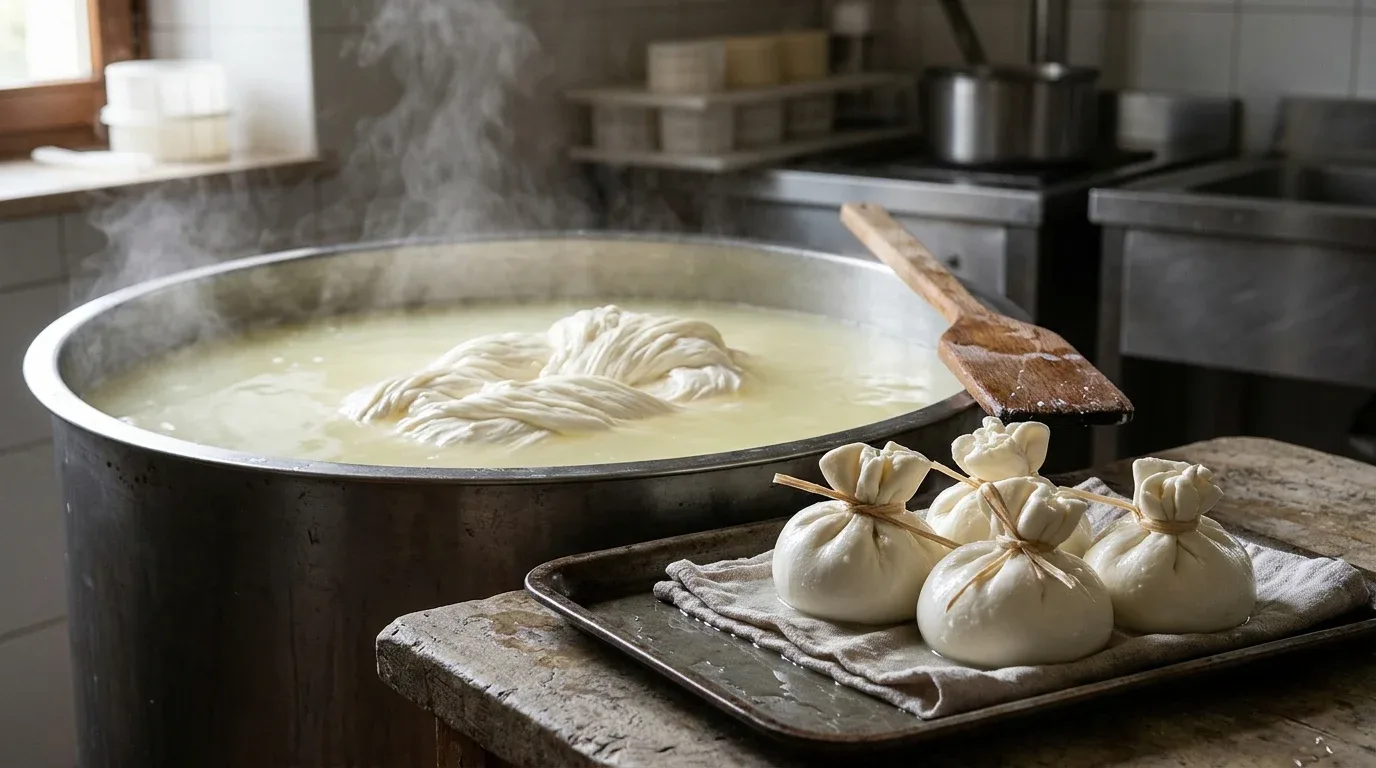
The rules describe two parts. The outer shell must be made entirely of spun-paste cheese, the stretched curd used for mozzarella, at least 2 millimeters thick. The filling is stracciatella: strands of spun paste separated by hand, cooled into a spongy mass and mixed with cream. The milk is cow’s milk, raw or pasteurized at 72°C for 15 seconds, with calf rennet and either food-grade acids or a whey starter.
The size range is wide. Qualigeo lists weights from 100 grams to a kilogram, a small, round, white, shiny sack closed by hand at the top with enough left to tie with food-grade raffia. It is stored at 4 to 6°C and has a short shelf life.
How the sack is made
The process is quick and manual. Scatti di Gusto, an Italian food site, in a 2023 article by Nico Cristiani, describes cow’s milk curd being stretched, shaped into a pouch, filled with hand-torn mozzarella mixed with cream, then tied and chilled. It is unaged and should be eaten within a few days, kept in the refrigerator.
In Southern California the timeline is tighter still. The Cheese Professor, in an April 2025 article by Alec Scott, reports that at Di Stefano, a family cheesemaker, milk arrives around 11 p.m., becomes burrata by 1 p.m. the next day, and ships soon after.
Five dates for one cheese
Burrata’s birth is genuinely disputed. The sources fetched for this post give at least five answers.
The oldest account is oral. Qualigeo says tradition credits Lorenzo Bianchino, an early-20th-century farmer who could not take his milk to town during heavy snow, and who adapted the method used for mantèche, a local spun-paste cheese, combining leftover spun paste with cream and wrapping it in a spun-paste skin. The Cheese Professor names him Lorenzo Bianchino Chieppa and places the first burrata in the 1920s.
The print record pushes back against later dates. Both Qualigeo and The Cheese Professor cite a first written mention of burrata in a 1931 Touring Club gastronomic guide of Italy.
The most repeated date is 1956. Scatti di Gusto says Bianchino invented burrata that year, during an exceptional snowfall that blocked deliveries, by wrapping cream and stracciatella in mozzarella. That snowstorm version is the one most often retold, yet a 1931 printed mention, if accurate, would put the cheese well before it.
A fifth date comes from a cheesemaker’s memory. Cheese Underground, a Wisconsin cheese blog, reported in 2007 that Mimmo Bruno, who grew up in Puglia, remembered a local cheesemaker introducing burrata there in the 1970s, after which it quickly became a regional favorite. That is a memory of when it reached his corner of the region, not necessarily when it was invented.
From Puglia to Los Angeles
Burrata stayed regional for a long time. Bruno told Cheese Underground that when he left Italy in 1986 it was still largely unknown outside Puglia.
Bruno is also central to its American story. The Cheese Professor reports that he moved to Southern California, worked first in building maintenance, and then founded a cheese firm, Tutto Latte, using milk from a farm in Ontario, California. Mozzarella and mascarpone sold. Burrata did not, even to Italian-American buyers.
The turn came through a restaurant. Around 1990, according to the same article, Bruno brought burrata to Nancy Silverton, then running Campanile in Los Angeles, and her dish using it won a special mention in a Los Angeles Times review. Stefano Bruno, Mimmo’s son, who now runs Di Stefano, told the publication: “Nancy is really a saint for us.”
Bruno later moved east. Cheese Underground reported that in 2006 he joined BelGioioso in Denmark, Wisconsin, where he made burrata by hand in 8-ounce balls packed in water.

Burrata outsells mozzarella
The cheese has grown fast at home too. Scatti di Gusto reports that after PGI recognition, Puglia’s producers roughly doubled output, about 40 percent of it exported, and that supermarket sales of pre-weighed burrata in Italy rose 40 percent in two years to more than 56 million euros. The article says burrata has overtaken mozzarella in Italian sales.
It also names four Andria producers of the PGI cheese: Montrone, Fratelli Simone, Falli Nuzzi and Caseificio Perina.
On bread
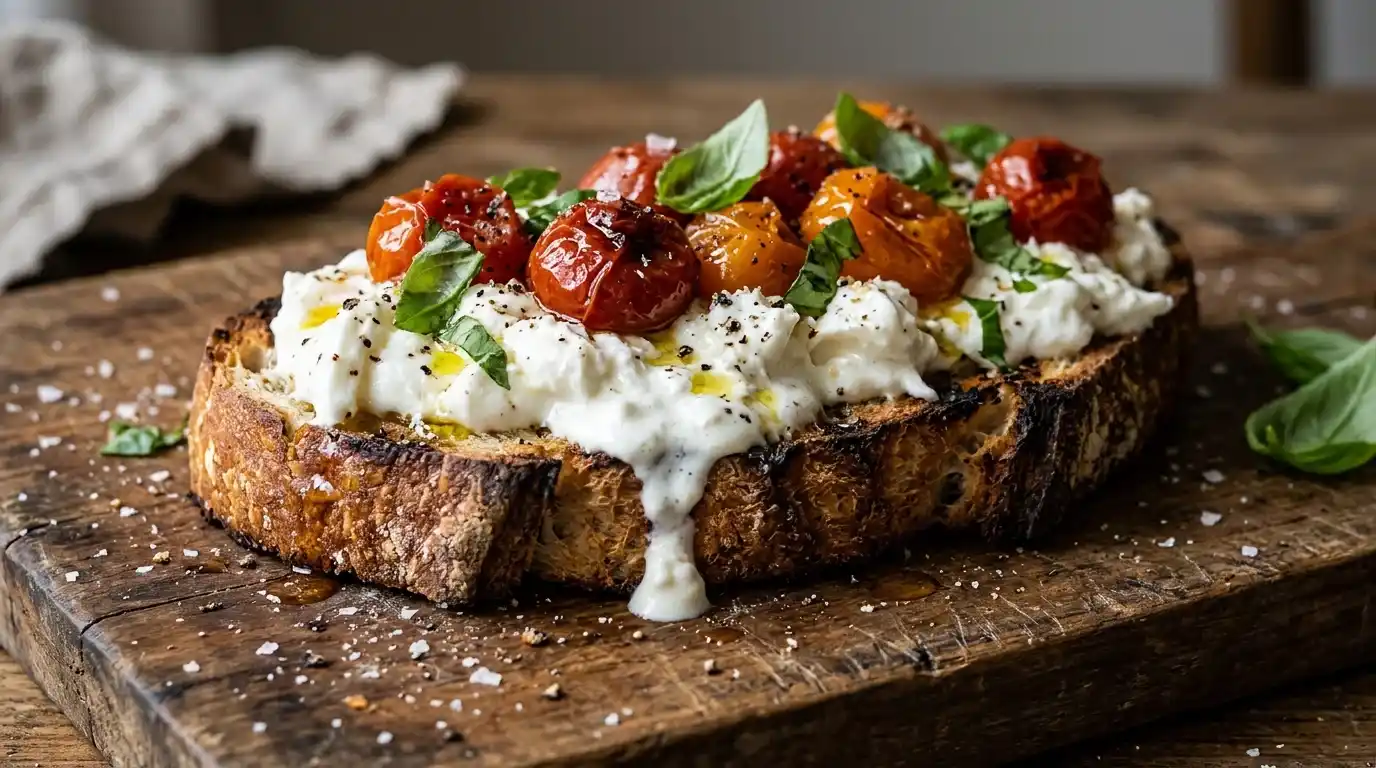
The simplest serving is the standard one. Scatti di Gusto recommends cutting it open and eating it plain with olive oil and salt, or with vegetables, fruit, bread or pasta.
On a sandwich, the liquid center is both the appeal and the problem, since the cream runs as soon as the shell is cut. Grill Cheesy’s guide to why cheese melts and turns greasy covers what heat does to cheese fat, and fontina is the Italian melting cheese covered here for the griddle.
A sandwich book from Campanile
- Nancy Silverton’s Sandwich Book: The Best Sandwiches Ever–from Thursday Nights at Campanile: the sandwich cookbook from the Los Angeles restaurant where burrata found its first American audience. See it on Amazon (affiliate link)
As an Amazon Associate I earn from qualifying purchases. A commission may be earned if you buy through this link, at no extra cost to you.
Questions people ask
What is burrata? A pouch of spun-paste cheese filled with stracciatella, a mix of torn curd and cream.
Where does burrata come from? Puglia, in southern Italy; Burrata di Andria is a PGI covering the whole region.
When was burrata invented? It is disputed: oral tradition says the early 1900s or 1920s, a printed mention dates to 1931, and a popular story says 1956.
How long does burrata last? Only a few days, refrigerated at 4 to 6°C.
Who brought burrata to America? Puglia-born cheesemaker Mimmo Bruno, whose burrata Nancy Silverton served at Campanile in Los Angeles around 1990.
Sources
- Qualigeo (Fondazione Qualivita), “Burrata di Andria PGI”: https://www.qualigeo.eu/en/product/burrata-di-andria-pgi/
- Scatti di Gusto, Nico Cristiani (September 25, 2023, updated July 29, 2024): https://www.scattidigusto.it/cibo/burrata-formaggio-andria-storia-ricette-calorie/
- The Cheese Professor, Alec Scott, “How Burrata Conquered America” (April 22, 2025): https://www.cheeseprofessor.com/blog/burrata
- Cheese Underground, “BelGioioso Burrata” (November 20, 2007): https://cheeseunderground.com/2007/11/20/belgioioso-burrata/?amp=1