In this story
In New York City the bacon, egg and cheese is ordered as a single word, usually spoken in one breath, and handed across a counter in foil or paper a few minutes later. The sandwich has no named inventor and no founding date. Food writers who have gone looking for its beginnings find a trail that runs through London street vendors, a Western egg sandwich of disputed parentage, and the postwar demand for breakfast that could be eaten on the move.
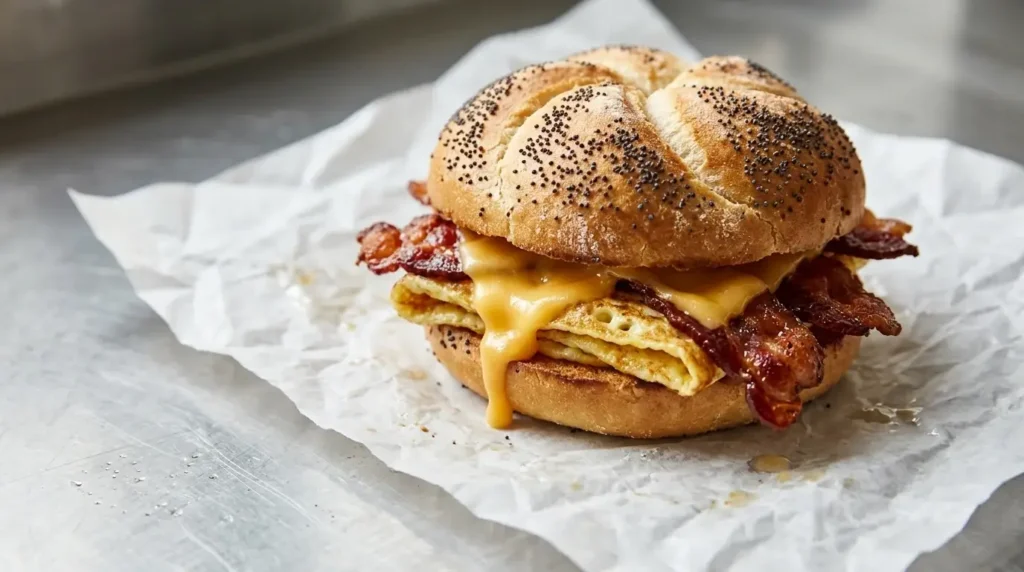
The build is short: bacon, a griddled egg, melted American cheese, and a hard roll or kaiser roll, with salt, pepper and often ketchup. How that combination became a fixture of the five boroughs, and how it relates to the British bacon sandwich, is a story told in pieces, and some of the pieces contradict each other.
Video: Food History: Bacon Egg & Cheese, Mental Floss
The New York order
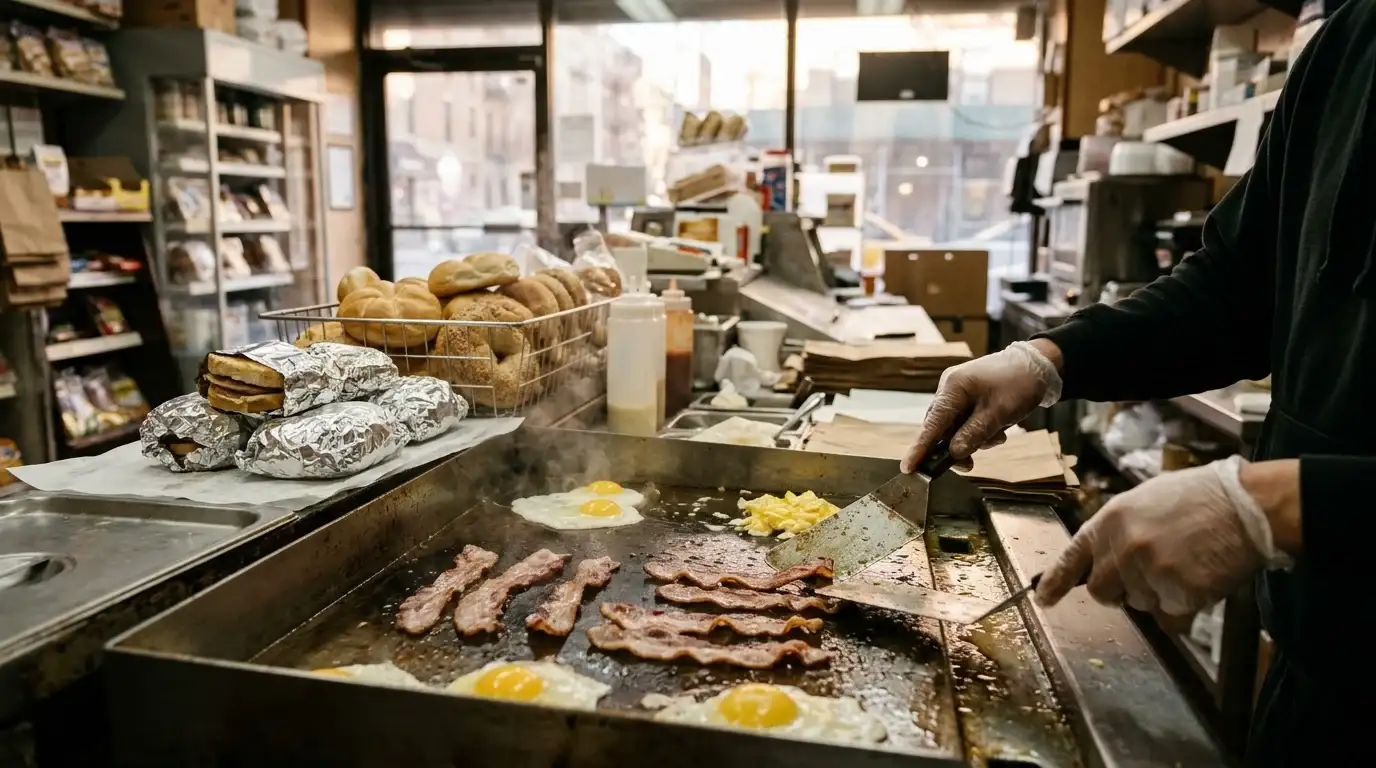
The sandwich is tied most closely to the bodega and the corner deli. A Tasting Table history describes the New York version as a no-frills bodega sandwich cooked on a flattop in minutes, sold on nearly every corner in every borough and often wrapped in tin foil. The same article attributes its popularity to low cost and fast cooking, and traces the one-word name, “baconeggandcheese,” to the way it is ordered.
Chowhound’s account adds the rituals of the counter. According to that piece, the order is typically cut in half and wrapped in foil or deli paper so it does not drip, then passed over when the customer’s name is called. It reports that on Saturday mornings at least half of a deli’s customers often order one.
A student study of one deli
A CUNY Macaulay Honors College project, the New York Food Atlas, looked at the sandwich through a deli near Hunter College on Lexington Avenue. The write-up, titled What Came First: The Bacon, the Egg, or the Cheese?, says the shop has operated since 2001 and took its current name in 2010. Its manager told the project that the sandwich has always been popular and that serving it is a “no-brainer” (source). The same write-up links the sandwich to immigrant-owned bodegas and corner stores, where cheap ingredients and simple preparation suited customers who included students, office workers and construction crews.
That project also describes a split among customers. Commuters, it says, want four ingredients in under ten minutes, while tourists and admirers of the city tend to order elaborate versions such as the deli’s multi-cheese, multi-protein sandwich, which its owners say outsells the plain one. The write-up is a student publication, so its figures rest on interviews at a single shop.
Roll, egg and cheese
The roll is the part that most often marks the New York version. Chowhound’s history names the New York bagel or poppy roll as what sets the city’s sandwich apart, while Mental Floss says the usual choice is a hard roll or kaiser roll. The two accounts do not conflict so much as describe different corners of the same counter.
Mental Floss also gives the roll a short history. The name “hard roll” reportedly gained favor during World War I, when anything sounding German fell out of fashion. At the 1876 Centennial Exhibition in Philadelphia, the Vienna Model Bakery of Louis Fleischmann served kaiser rolls, and the shape later became popular in New York’s Jewish community and beyond. Several explanations exist for the name, among them the crown-like pattern on top, Franz Joseph I, and Joseph II. Most rolls at delis and coffee carts, the article adds, come from a few large distributors.
The cheese
American cheese is a blend of cheese and emulsifying salts, commonly sodium citrate, which lets it melt without turning greasy, according to Mental Floss. The piece traces the technique to Swiss researchers Walter Gerber and Fritz Stettler in the early 1900s, who used it on scraps of Emmental, and to a later patent held by New Yorker George Herbert Garstin. Chowhound describes the sandwich’s cheese only as processed cheese. The CUNY project, drawing on another account, says sliced American cheese arrived in 1916. Further detail on the cheese itself is in the American cheese entry.
The bacon and the egg
Bacon sales slid as the twentieth century began and big breakfasts lost ground to cereal, Mental Floss reports. In the 1920s a packing company hired the public relations pioneer Edward Bernays, who surveyed physicians and publicized the claim that about 4,500 of 5,000 doctors called a heavy breakfast scientifically desirable. Pre-sliced bacon later helped make the meat a breakfast standard.
Early egg sandwiches and the Denver dispute
The deep ancestry is argued rather than documented. Several sources point to nineteenth-century London, where factory workers bought sandwiches of egg, sausage or bacon on a bap from street vendors. Chowhound and Tasting Table both give that account, and the CUNY write-up calls the bap sandwich the earliest traceable version. Mental Floss, though, says no clear line runs from those London sandwiches to the modern bacon, egg and cheese, and that the British offering was not necessarily the first of its kind.
The American side of the family is the Denver sandwich, a relative of the Denver omelet built on eggs, ham, bell peppers and onion. Who made it first is disputed, and each source repeats a different claim:
- Mental Floss reports that James Beard suggested Chinese rail workers of the nineteenth century invented it as a variation on egg foo young, and that other writers propose Basque immigrants in the Nevada territory, drawing on piperade.
- Chowhound says it was allegedly created by Chinese immigrants and adds that it is hard to tell whether the London or the Denver sandwich had more influence.
- Tasting Table mentions pioneers on the overland trail as one credited source of quick breakfasts, and Chinese chefs in logging camps as another credited with the first American egg sandwich.
- The CUNY write-up gives a third line, in which English immigrants carried the bap sandwich to America and it became the Denver sandwich.
Written recipes arrive late. Mental Floss cites Heather Arndt Anderson’s Breakfast: A History, which identifies an 1897 cookbook recipe as the first for a true breakfast sandwich; it used chopped meat, with no bacon and no cheese. A 1926 University of Minnesota publication on bacon included a bacon and egg club sandwich on buttered toast with mayonnaise and tomato. The related tomato-and-lettuce version has its own entry in the BLT sandwich article.
From the postwar rush to a national breakfast
Two accounts agree that the handheld breakfast faded and returned. The CUNY write-up says the sit-down plate pushed portable versions aside in the 1920s, and that faster lifestyles after World War II brought eggs, bacon and cheese back together in a roll. Chowhound likewise places the New York version’s popularity in the mid-twentieth century, as the first fast breakfast sandwiches took hold.
Mental Floss says the sandwich spread through bodegas and delis and, in the second half of the century, appeared at truck stops, diners and food carts. In the early 1970s a 24-hour burger chain introduced a ham, egg and American cheese sandwich on a bun, and around the same time a California franchisee created a breakfast take on eggs Benedict. Tasting Table dates that second product, the Egg McMuffin, to 1972 and says it may have helped popularize grab-and-go breakfast sandwiches, although New Yorkers were already catching on.
The name itself is recent in print. A Google Books search reported by Mental Floss turned up “bacon, egg, and cheese” only from 1990, and “bacon, egg, and cheese on a roll” only from the end of the 1980s. Printed evidence, in other words, trails the counter practice by an unknown margin. Wikipedia’s entry on the sandwich gives no origin date either, and says only that it is particularly significant in New York City and usually served there on a kaiser roll; it is cited here as a pointer and not as the basis of any other claim.
Britain’s bacon sandwich
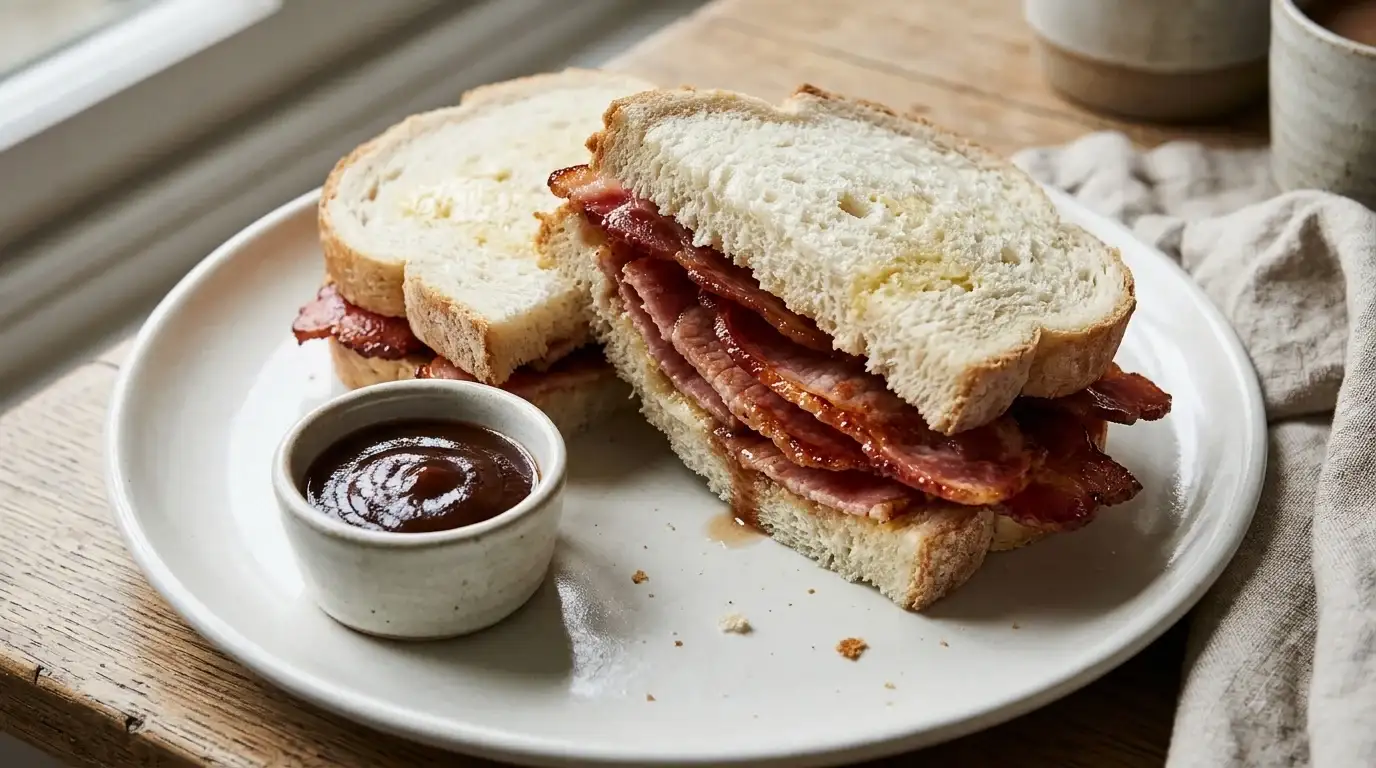
The British bacon sandwich has no firm start date either. Writing in Saveur in 2011, Tim Hayward described it as little more than pork, bread and salt and argued that it is older than the British monarchy, a claim he did not back with a date. He lists the regional names butty, piece, wedge, doorstep, sanger and sarnie, and finds the sandwich everywhere from greasy spoon cafes to grouse moors. The chef Fergus Henderson, whose version at a London restaurant Hayward calls definitive, says the smell of frying bacon speaks to everyone in the same way.
Choices of bread, bacon and sauce are matters of fierce preference. Hayward favors white, crusty bread; Henderson uses thick slices of grilled white bread and smoked back bacon from Gloucestershire Old Spots pigs. Ketchup and brown sauce are the usual condiments, and some add an egg.
Why the bacon differs
Mental Floss notes that Britain’s usual breakfast sandwich is the bacon butty, served with brown sauce or ketchup, and that British bacon is a leaner loin cut closer to Canadian bacon. What Americans call bacon is “streaky bacon” in Britain. The two sandwiches therefore start from different cuts of pork before cheese or egg enters the picture.
Wikipedia’s entry on the bacon sandwich, again used only as a pointer, reports a 2007 University of Leeds study of 700 variants, each ranked by 50 tasters, which favored thick slices of white bread and crisp, not-too-fat bacon. None of the sources fetched ties the British sandwich directly to the New York one, which leaves the two as cousins, not parent and child.
Making it on a griddle
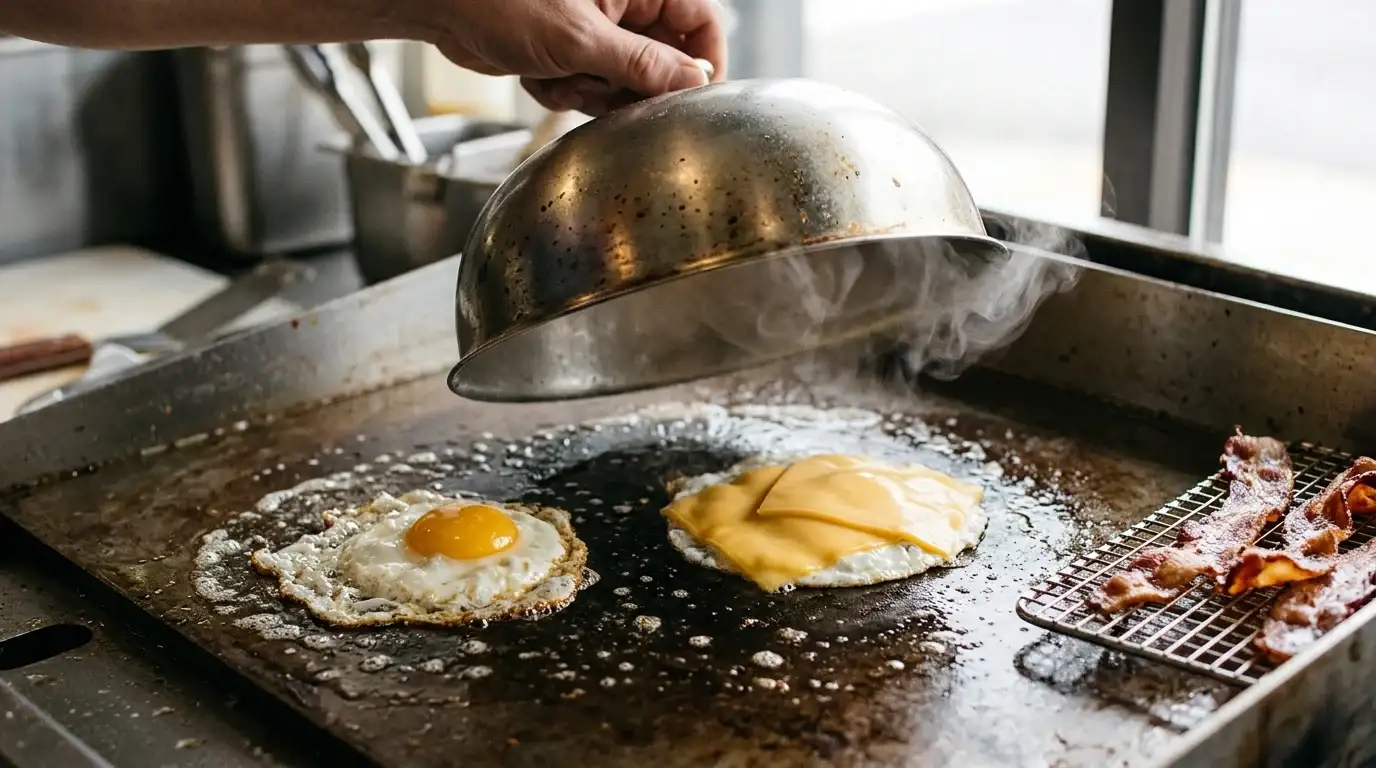
Home recipes for the deli version borrow the flattop. A recipe on Sip and Feast cooks the bacon separately, on racks in a 400°F oven for 20 to 25 minutes, and holds it warm while the eggs go on a griddle or large nonstick pan heated to medium, with a teaspoon of butter for each sandwich.
Egg and cheese
The eggs cook about two minutes, until the whites are firm enough to flip. For over-easy, the yolks stay whole; for a fully cooked yolk, the edge of a spatula breaks them after the flip. Two slices of yellow American cheese go on one egg, and a teaspoon of water thrown into the pan under a tight lid melts them in roughly 15 to 30 seconds. That recipe stacks the cheeseless egg on the bottom half of the roll, the cheesy egg above it, then bacon, salt and pepper, with ketchup spread on both cut sides if wanted.
The wrap
The finishing step is the deli wrap. The recipe folds the sandwich in parchment, with the seam closed and the side edges tucked into triangles, and notes that delis use thicker sandwich paper. It advises eating within 30 minutes, or rewarming in the wrapper in a 300°F oven. On the roll, it recommends large, soft plain or poppy seed deli rolls, with a kaiser roll as the nearest substitute outside New York.
Sources:
- CUNY Macaulay Honors College, New York Food Atlas, “What Came First: The Bacon, the Egg, or the Cheese?”: https://openlab.macaulay.cuny.edu/nyfoodatlas/?p=739
- Chowhound, “The Complete History NYC’s Iconic Bacon, Egg, And Cheese Breakfast Sandwich”: https://www.chowhound.com/1828619/bacon-egg-and-cheese-breakfast-sandwich-history
- Mental Floss, “The Delicious History of the Bacon, Egg, and Cheese Sandwich”: https://www.mentalfloss.com/food/bacon-egg-cheese-breakfast-sandwich-food-history
- Tasting Table, “The History Of New York’s Iconic Bacon, Egg, And Cheese Breakfast Sandwiches”: https://tastingtable.com/1578154/bacon-egg-cheese-breakfast-sandwich-history-new-york
- Saveur, “Britain’s Pride: The Bacon Sandwich”: https://www.saveur.com/article/Travels/Britains-Pride-Bacon-Sandwich/
- Sip and Feast, “Bacon, Egg and Cheese Sandwich”: https://www.sipandfeast.com/bacon-egg-and-cheese-sandwich
- Wikipedia, “Bacon, egg and cheese sandwich” (pointer only): https://en.wikipedia.org/wiki/Bacon,_egg_and_cheese_sandwich
- Wikipedia, “Bacon sandwich” (pointer only): https://en.wikipedia.org/wiki/Bacon_sandwich
- Mental Floss on YouTube, “Food History: Bacon Egg & Cheese”: https://www.youtube.com/watch?v=MHwUOKoXD5Q