In this story
American cheese, in the sense most people mean at a diner counter, is processed cheese: natural cheese ground, heated and blended with an emulsifying salt until it forms a smooth mass that can be cut into uniform slices. Under federal rules the formal name is usually “pasteurized process cheese,” and when cheddar, colby or similar cheeses go into it, the label is allowed to say “American cheese.” The eCFR text of 21 CFR 133.169 sets those terms down in detail.
The product has two histories that overlap without matching: a Swiss laboratory discovery and an American patent. A third strand, the pre-sliced single, arrived decades later. The regulatory vocabulary (process cheese, cheese food, cheese product) then sorted the products by how much real cheese each contains.
Video: WTF is American cheese?, MinuteFood
Two Swiss chemists, a Chicago salesman
Several food publications trace the idea to Switzerland. The Daily Meal names Walter Gerber and Fritz Stettler and dates their work to 1911, when they heated Emmental with sodium citrate. Discover Magazine gives 1912 for the same experiment and describes what happened: melted Emmentaler split into a fatty soup, and the added citrate kept the fat suspended as the mass cooled into a sliceable block. The sources disagree by a year, and neither points to a laboratory notebook or a Swiss archive that could settle it.
The American side has firmer paper. James Lewis Kraft of Chicago filed U.S. Patent 1,186,524 on March 25, 1916, and it was granted on June 6, 1916. Google Patents lists it as “Process of Sterilizing Cheese and an Improved Product Produced by Such Process.” The patent addresses a practical problem: cheddar-type cheese tended to break apart when heated, so the inventor kept the mass stirring while it held near 175 degrees Fahrenheit for about fifteen minutes, then sealed it hot into containers. The goal was a cheese that would keep without further ripening, not a cheese that melted well. Wikipedia’s article on processed cheese, used here only as a pointer to the patent, notes that Kraft’s patented method did not call for emulsifying salts.
Those came into American patent practice a few years later. George Herbert Garstin of Sidney, New York, filed U.S. Patent 1,368,624 in October 1920 and received it on February 15, 1921. It describes sodium phosphate as “an ideal substance for the purpose of maintaining the homogeneity of the cheese,” because heated cheese otherwise sheds butterfat from the casein. Garstin specified about five percent by weight.
Credit for “inventing processed cheese” is therefore split by what is meant. The emulsifying principle appears in the Swiss account, the sealed heat-treated product in Kraft’s patent, and the phosphate refinement in Garstin’s.
What emulsifying salts do
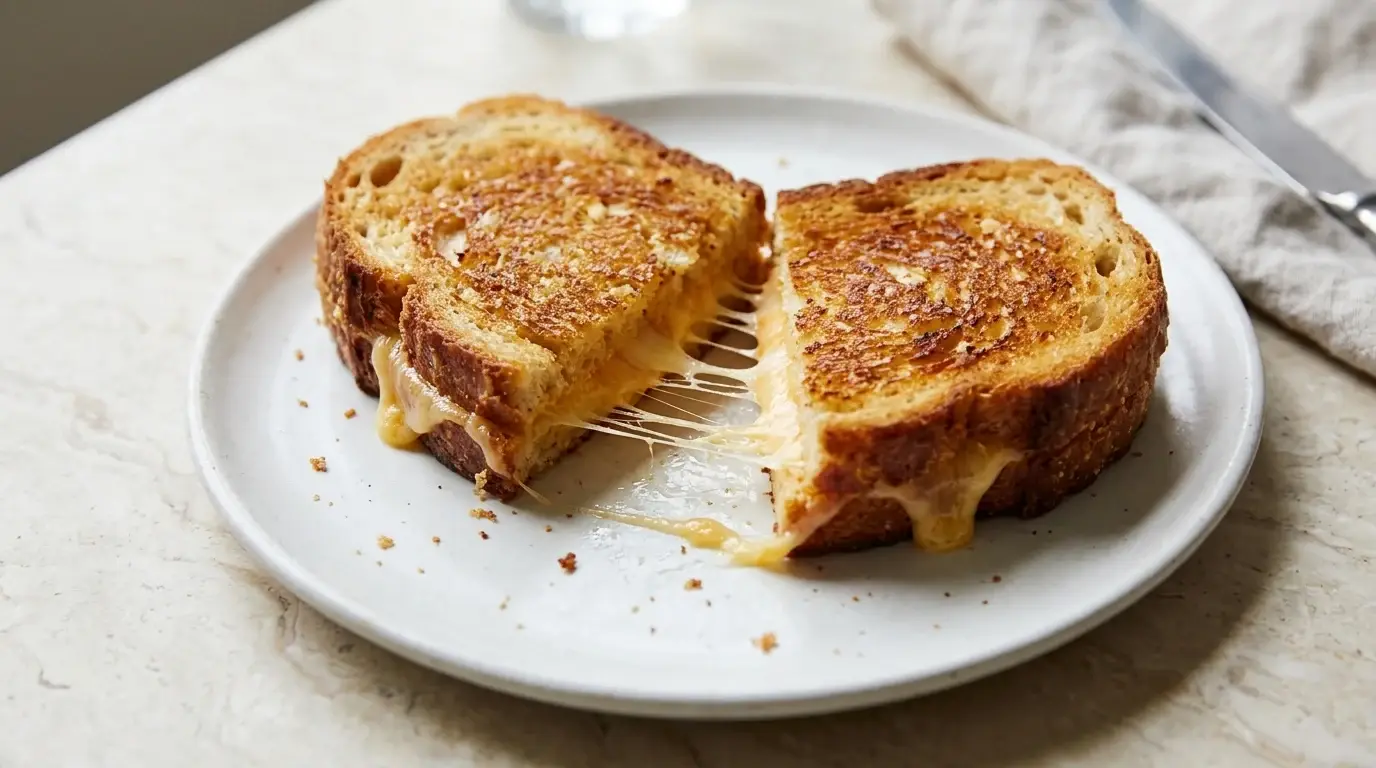
Natural cheese holds together through calcium. Discover Magazine explains that calcium ions bridge casein proteins into a net, and that heat eventually collapses the net and lets fat leak out. In processed cheese, sodium citrate takes calcium’s place in the arrangement. Sodium carries less positive charge, which leaves the caseins more soluble and less tightly bound, so they form a looser network that still traps fat when warmed.
The practical result is a cheese that softens and flows instead of clumping or turning to oil. America’s Test Kitchen puts the contrast in a single line: “American cheese is made with an emulsifying salt—so when it melts, it flows.” The same article explains why a sharp aged cheddar behaves differently. Its proteins are tightly bonded by calcium, so fat escapes before the protein structure relaxes enough to move.
Moisture and acidity also matter. The Cheese Scientist lists a pH between 5.3 and 5.8 as the typical working range for American cheese, and points out that added moisture lowers the melting point. The federal standard reflects the same concern: it forbids the cheese’s pH from falling below 5.3, according to the eCFR text cited above.
Young cheese is part of the equation too. Laughing Squid, summarizing food writer Kate Yoshida of MinuteFood, describes American cheese as a processed cheese food made from young colby and cheddar blended with extra moisture and fat. Aged, hard cheeses tend to clump when heated, while the citrate-treated mass softens and flows. The same article adds that home cooks can stir sodium citrate into an aged cheddar to get a similarly smooth melt, which shows the salt, and not some secret ingredient, does most of the work.
Sodium citrate versus phosphates
Two families of salts appear in the sources. Citrates are the ones named in the Swiss account, and phosphates are the ones named in Garstin’s patent. The federal standard allows either, along with pyrophosphates and tartrates, as long as the emulsifier solids stay at or under 3 percent of the finished weight.
From loaf to single slice
For decades processed cheese was sold in blocks. Slicing it into flat, separable portions took machinery and packaging as much as chemistry.
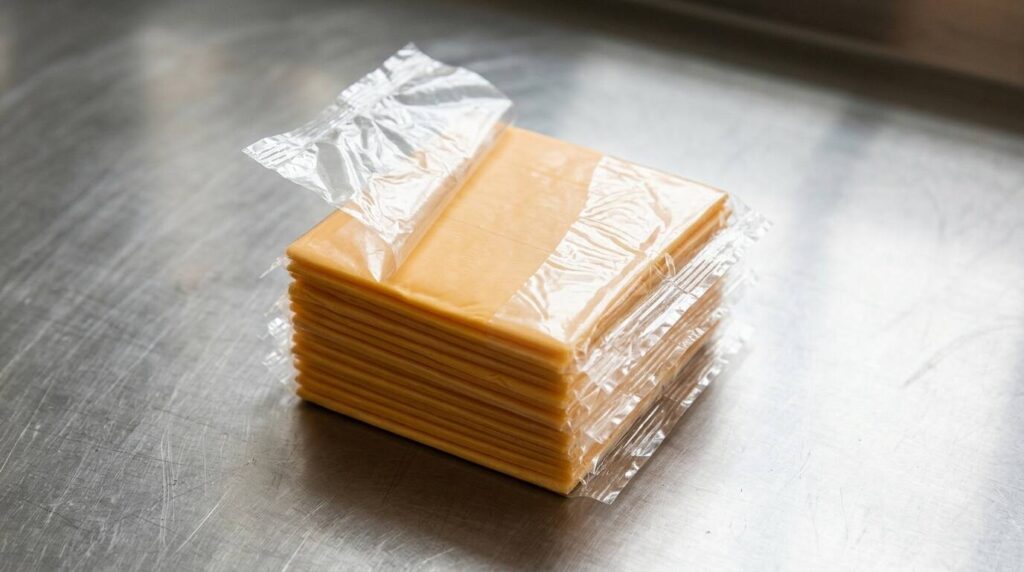
CulinaryLore reports that Kraft introduced unwrapped process slices in 1950, and that customers had trouble pulling them apart. The same page puts the individually wrapped version at around 1965, after plastic film solved the problem of the remaining slices drying out. A Click Americana timeline reproduces a 1965 advertisement describing sixteen slices, each “ready-wrapped.”
A patent record shows the wrapping problem was being worked on earlier. Arnold Norman Nawrocki of Curwensville, Pennsylvania, assigned his application to the Clearfield Cheese Company. Filed October 5, 1953 and granted August 21, 1956, U.S. Patent 2,759,308 covers “Apparatus for producing individually wrapped cheese slabs.” Molten cheese or cheese food is formed into square slabs between belts, cooled, sealed in transparent film and cut apart. The patent text refers to cheese food rather than processed cheese in general, and says nothing about who first sold wrapped slices commercially.
What the FDA’s names mean
The federal standards of identity do the sorting. Each name carries a recipe.
Pasteurized process cheese. Under 21 CFR 133.169, the food is made by combining one or more cheeses with an emulsifying agent, using heat, into a “homogeneous plastic mass.” The cheese must be held at 150 degrees Fahrenheit or higher for at least 30 seconds. Soft fresh cheeses such as cream cheese and cottage cheese are excluded as ingredients. Moisture is capped at 43 percent for most single-variety versions, with a few exceptions, and fat in the solids must be at least 47 percent.
Pasteurized process American cheese. This is not a separate standard but a naming option inside the same section. When the cheeses used are cheddar, washed curd, colby or granular cheese, or mixtures of those, the product may be called “pasteurized process American cheese” or simply “American cheese.”
Pasteurized process cheese food. 21 CFR 133.173 covers the next tier, where optional dairy ingredients such as milk, whey, cream and buttermilk can be mixed in. The cheese ingredient must still make up at least 51 percent of the finished weight, moisture may reach 44 percent, and fat must be at least 23 percent. The label has to read “pasteurized process cheese food.”
Cheese product. This one has no federal standard behind it. Wikipedia’s processed cheese article, again used as a pointer, reports that the FDA has no standard of identity for “pasteurized process cheese product” or “pasteurized prepared cheese product,” and that some manufacturers use “cheese product” for goods that meet no formal standard. The FDA warning letter that the article cites could not be fetched for this post, so the point stands as reported there.
The practical distinction is that “process cheese” and “cheese food” are defined by composition, while “cheese product” is a looser label. A slice’s actual makeup can only be read from its ingredient list.
Why it is used on burgers and griddled sandwiches
Chefs give two reasons repeatedly, and both come from the same chemistry. One is how the cheese melts. The other is what the melted cheese does next to hot beef.
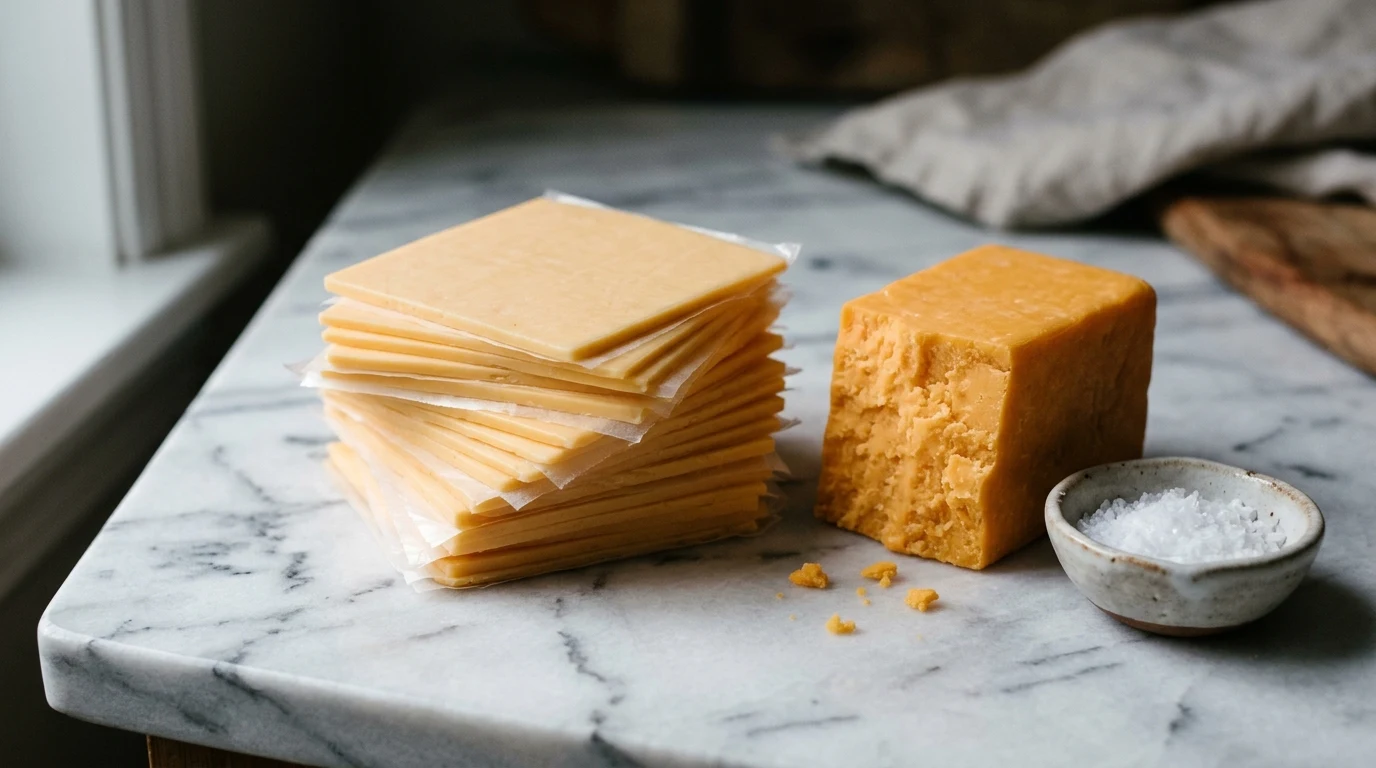
Mic collected remarks from professional cooks. Houston chef Chris Shepherd found that cheddar and Swiss did not melt properly on a burger, whereas processed American hugs the patty. New York chef Dale Talde calls it “the only cheese for a cheeseburger.” The same piece reports J. Kenji Lopez-Alt’s view that no other cheese matches its meltability, and observes that the square slice conveniently matches the footprint of a standard patty and bun.
Nostalgia comes up as often as technique. Chowhound quotes Bobby Flay saying American cheese “melts well and it reminds me of my childhood,” and adds that the cheese softens at a lower temperature than many others, which allows it to go gooey without extra heat on a patty that is already cooked. Flay domes the burgers with a little water on the surface, trapping steam so the slice melts evenly.
Direct heat is where the emulsifier shows most. CulinaryLore examines why processed slices char instead of dripping when held to a flame: the fat stays bound to the solids, so the milk solids brown while still holding the fat. The same page says a lower heat and slower melting help a slice melt properly, and that a block of natural cheddar on a very hot skillet browns and crisps instead of melting.
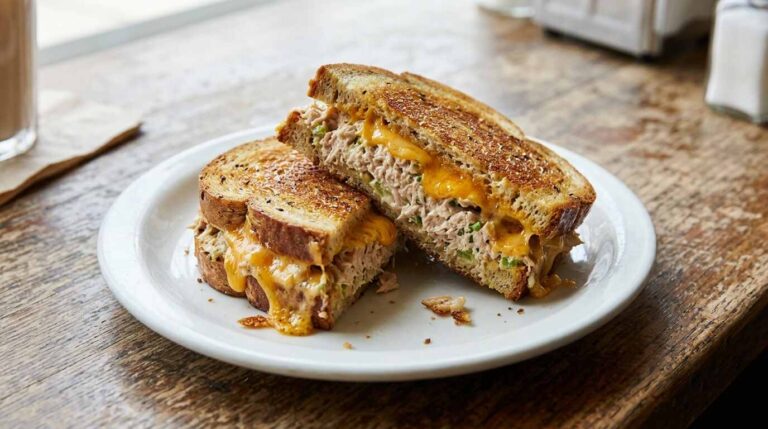
The same bound-fat behavior applies to a slice laid between two pieces of buttered bread on a flat-top. The sources consulted do not measure how it compares with natural cheese in that setting, so the reasoning rests on the flame and burger observations above.
Sources:
- eCFR, 21 CFR 133.169, Pasteurized process cheese: https://www.ecfr.gov/current/title-21/chapter-I/subchapter-B/part-133/subpart-B/section-133.169
- Cornell Legal Information Institute, 21 CFR 133.173, Pasteurized process cheese food: https://www.law.cornell.edu/cfr/text/21/133.173
- Google Patents, US 1,186,524, Kraft, Process of Sterilizing Cheese and an Improved Product Produced by Such Process: https://patents.google.com/patent/US1186524A/en
- Google Patents, US 1,368,624, Garstin, Cheese and process for sterilizing same: https://patents.google.com/patent/US1368624A/en
- Google Patents, US 2,759,308, Nawrocki, Apparatus for producing individually wrapped cheese slabs: https://patents.google.com/patent/US2759308A/en
- Discover Magazine, “The Secret of Velveeta: How Cheese Food Is Made”: https://www.discovermagazine.com/the-secret-of-velveeta-how-cheese-food-is-made-12045
- The Daily Meal, “The Unexpected Connection Between American Cheese And Switzerland”: https://www.thedailymeal.com/1240896/american-cheese-switzerland
- America’s Test Kitchen, “Creamiest Mac ‘n’ Cheese”: https://www.americastestkitchen.com/articles/5206-creamiest-mac-n-cheese
- Laughing Squid, “Why American Cheese Melts Better Than Real Cheese”: https://laughingsquid.com/american-cheese-melts-better/
- The Cheese Scientist, “6 Reasons Why American Cheese Melts So Well When Heated”: https://cheesescientist.com/science/why-american-cheese-melts-so-well/
- CulinaryLore, “When Were Kraft Singles First Introduced?”: https://culinarylore.com/food-history:when-were-kraft-singles-introduced/
- Click Americana, American cheese singles history: https://clickamericana.com/topics/food-drink/history-of-american-cheese
- Mic, “Why American cheese will always reign supreme”: https://www.mic.com/articles/184431/why-american-cheese-will-always-reign-supreme-in-fine-dining-kitchens-and-in-our-hearts
- Chowhound, Bobby Flay and American cheese on burgers: https://www.chowhound.com/2264133/bobby-flay-cheeseburger-cheap-american-singles/
- CulinaryLore, “Kraft American Cheese Burns Instead of Melts When Exposed to Direct Flame?”: https://culinarylore.com/food-myths:kraft-american-cheese-burns-instead-of-melts-when-exposed-to-direct-flame/
- Wikipedia, “Processed cheese” (pointer only): https://en.wikipedia.org/wiki/Processed_cheese
- MinuteFood, “WTF is American cheese?” (YouTube): https://www.youtube.com/watch?v=2ck8pXRrI7c