In this story
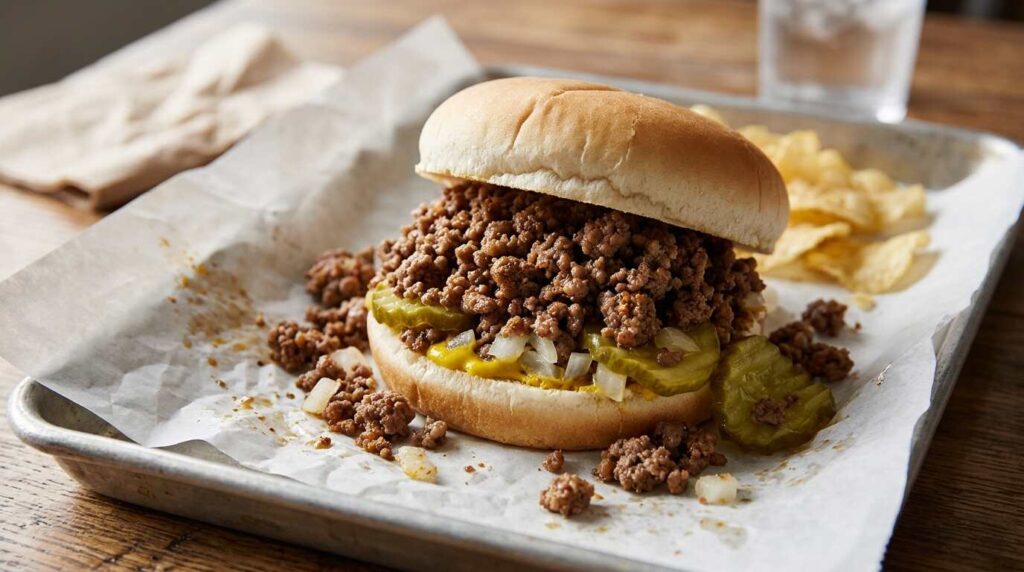
The Maid-Rite is a loose meat sandwich: ground beef cooked without being shaped into a patty, spooned onto a steamed bun. According to the company’s own history page, it began in 1926 with a butcher named Fred Angell, who worked on the cut and grind of the meat and a blend of spices until a deliveryman who tasted the result said, “This sandwich is made right.” Muscatine, Iowa, a river town across from Illinois, is where Angell opened the first shop. A century later, the sandwich is shared by two overlapping stories, a corporate chain with a tangled ownership record and a regional food known in Iowa under several names.
Video: Maid Rite Sandwich (1926) on Sandwiches of History — from the Sandwiches of History YouTube channel
The Muscatine Stand
A butcher, a walk-up window and a deliveryman’s verdict
Notes on Iowa, a state-history site, dates the opening to May 1, 1926, at a walk-up stand on Cedar Street in Muscatine. A local radio station’s anniversary piece gives the address as 110 Cedar Street. Strong sales led Angell to build an eat-in restaurant, and he and his son Francis then opened a second location with car-hop service, which the same account describes as the first in the United States and says many competitors copied.
The first-in-the-nation claim comes from the company’s side of the story, and one competing claim sits in the record. Wikipedia, used here only as a pointer, notes that a Springfield, Illinois shop claims a 1924 opening and the first drive-through, while the company does not list it as a franchise, so the entry leaves the matter unresolved. Funding Universe’s company history likewise says a Springfield location started in 1921 under separate ownership and adopted the Maid-Rite name after the chain was founded. The two sources give different years for the Springfield shop, and neither could be checked against a primary record.
The name has its own legend. Per the story repeated in a business-reference history, a passing delivery driver tasted the crumbly beef and said it was “made just right,” and Angell then chose a name meant to suggest a wholesome, pure product. A local radio piece offers a lighter footnote, that Angell was not much of a speller, which would explain the spelling. A trademark record cited by researcher Barry Popik lists a first-use date of August 1, 1925, a year before the founding date, and his page offers no explanation for the gap.
What Goes on the Bun
Steamed beef, mustard, pickles, onion and a spoon
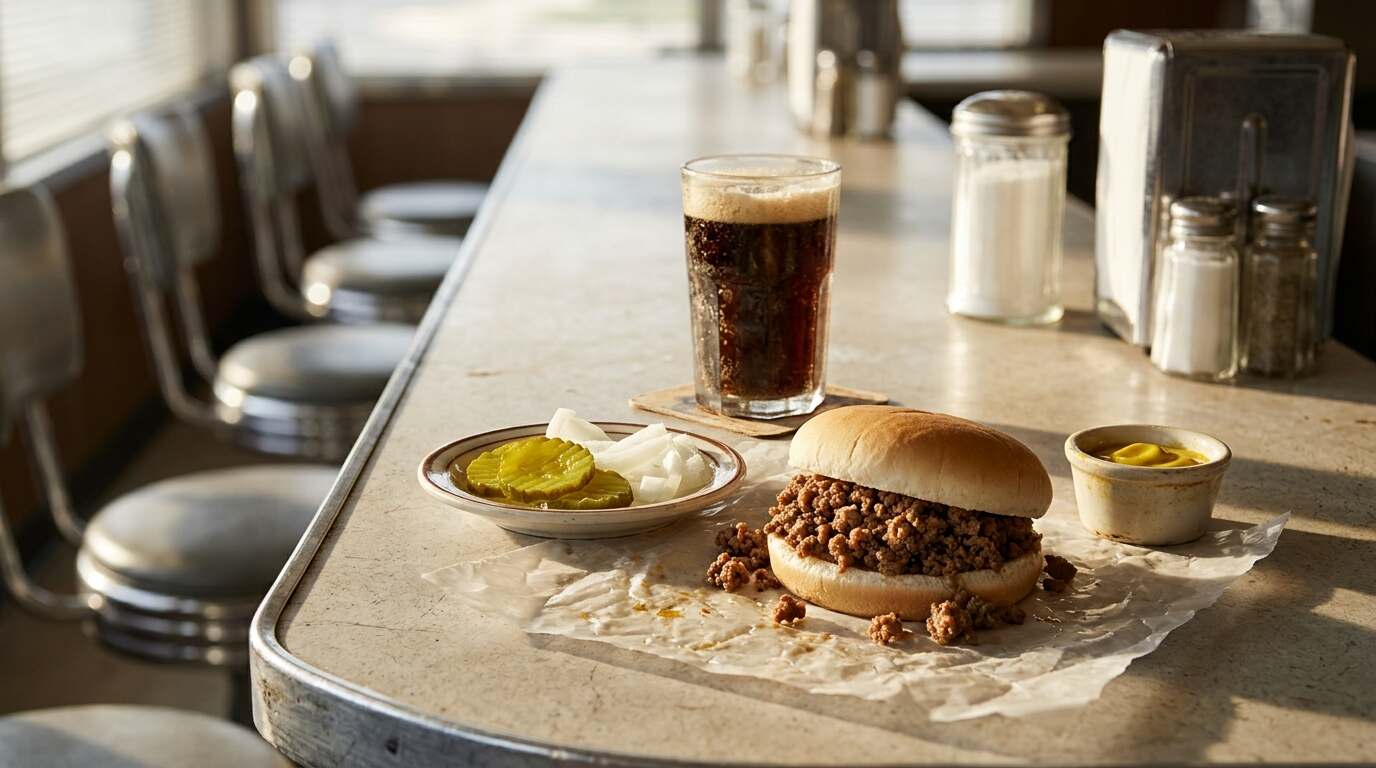
The company’s page describes the product as seasoned loose meat made from 100% USDA Midwestern fresh ground beef, served on a steamed white or wheat bun with ketchup, mustard, onion and pickles. The original condiments, according to the business-reference history, were mustard, pickles and onions.
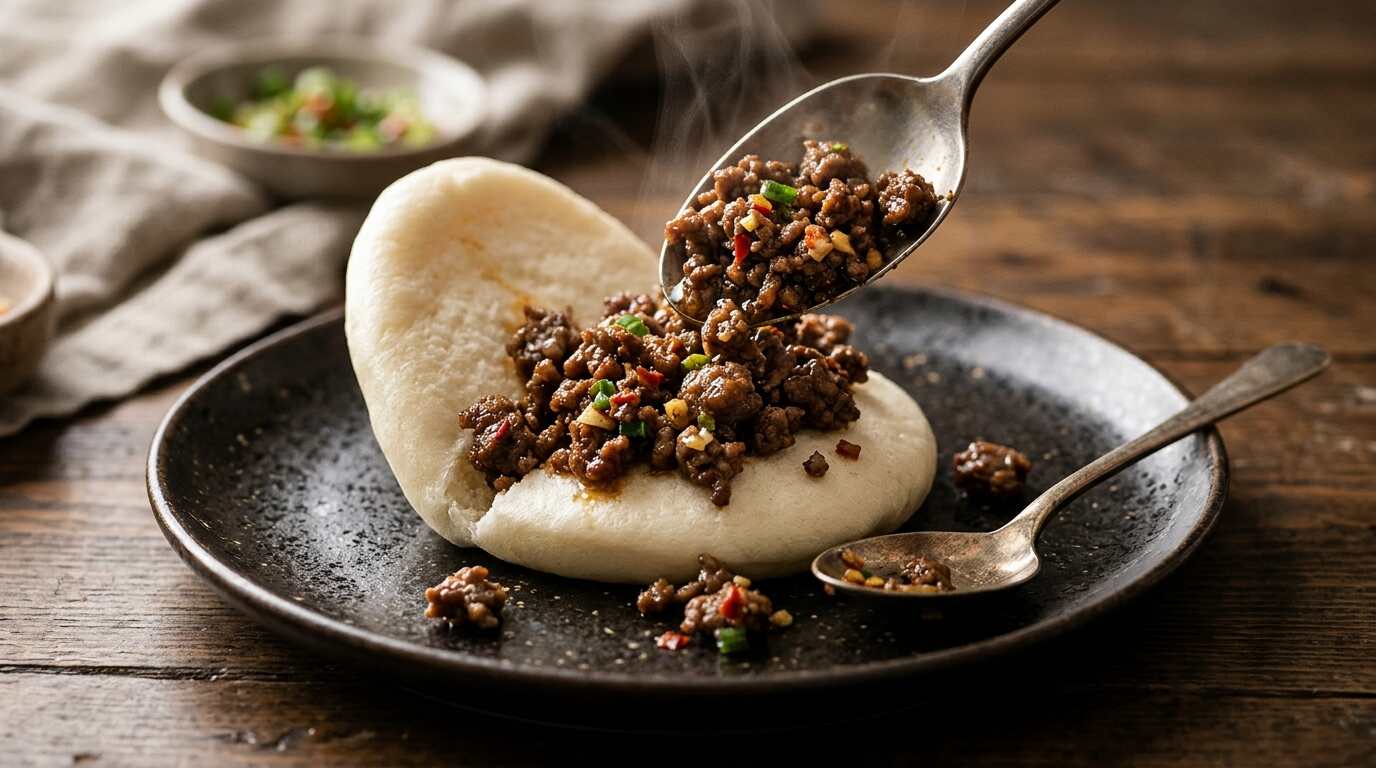
The original filling was cooked in a special steamer and served on a hot bun. Because the loose beef fell out as the sandwich was eaten, the sandwich was served with a spoon to scoop up the filling that fell out. That detail still explains the sandwich’s reputation for messiness.
The spice blend was a point of control. Angell required franchisees to use his custom seasoning, though Clifford Taylor’s Marshalltown shop never adopted it, because its contract was written before the seasoning existed and Angell honored those terms. Some stores dropped the seasoning during World War II rationing and never resumed it. The same source does not disclose what the blend contains, and no fetched page does.
Tavern, Loosemeat and Maid-Rite
One idea, three names and a Sioux City claim
Maid-Rite is the best-known brand of a sandwich type that carries other names. Wikipedia’s tavern sandwich entry, used as a pointer, lists loose meat sandwich and loosemeat, loose hamburger sandwich in Illinois, Maid-Rite in Iowa, and brand-specific names such as Nu Way at a Wichita, Kansas, chain and Pocketburger at a Kansas City, Missouri, shop. The same entry records the story that Dave Heglin sold such sandwiches in Sioux City, Iowa, in 1924 and is credited with the word “tavern,” and that Abe Kaled bought the business in 1934 and renamed it Ye Olde Tavern.
The origin of that Sioux City version is itself contested. A 2016 post on the WordPress food-history blog erinnudi.com reports that the sandwich is widely believed to have started at Ye Old Tavern in 1924, that it may have started in Missoula, Montana, in 1920 with no documented proof, and that its author could not find a verified original recipe. A separate local-history blog states that there is no document proof for the Missoula claim, while itself citing only a Wikipedia article.
The radio program A Way with Words also treats the story as unsettled. It calls the origin story contested, reports that the most repeated account points to Ye Olde Tavern, and says the sandwich is familiar in parts of the Dakotas and Iowa. The program’s caller, who grew up in Kansas City, had never heard of it.
Popik’s file adds printed evidence. A 1951 student-preference quote from Le Mars, Iowa, mentions “loose meat sandwiches, such as taverns”, and a 1952 newspaper advertisement in Harlingen, Texas, offers Scotty’s Loose Meat Sandwich. Whether Angell or a Sioux City cook came first is not settled by those dates, because the file’s earliest citations are from the 1950s.
Loose Meat Versus Sloppy Joe
The sauce is the dividing line, and local usage blurs it
The usual distinction is the sauce. Wikipedia’s Maid-Rite entry describes the sandwich as similar to a sloppy joe but without the tomato-based sauce, and the tavern entry says the same. A definition quoted from a Sioux City-focused blog says a true tavern has no sauce or gravy and no rice mixed into the meat.
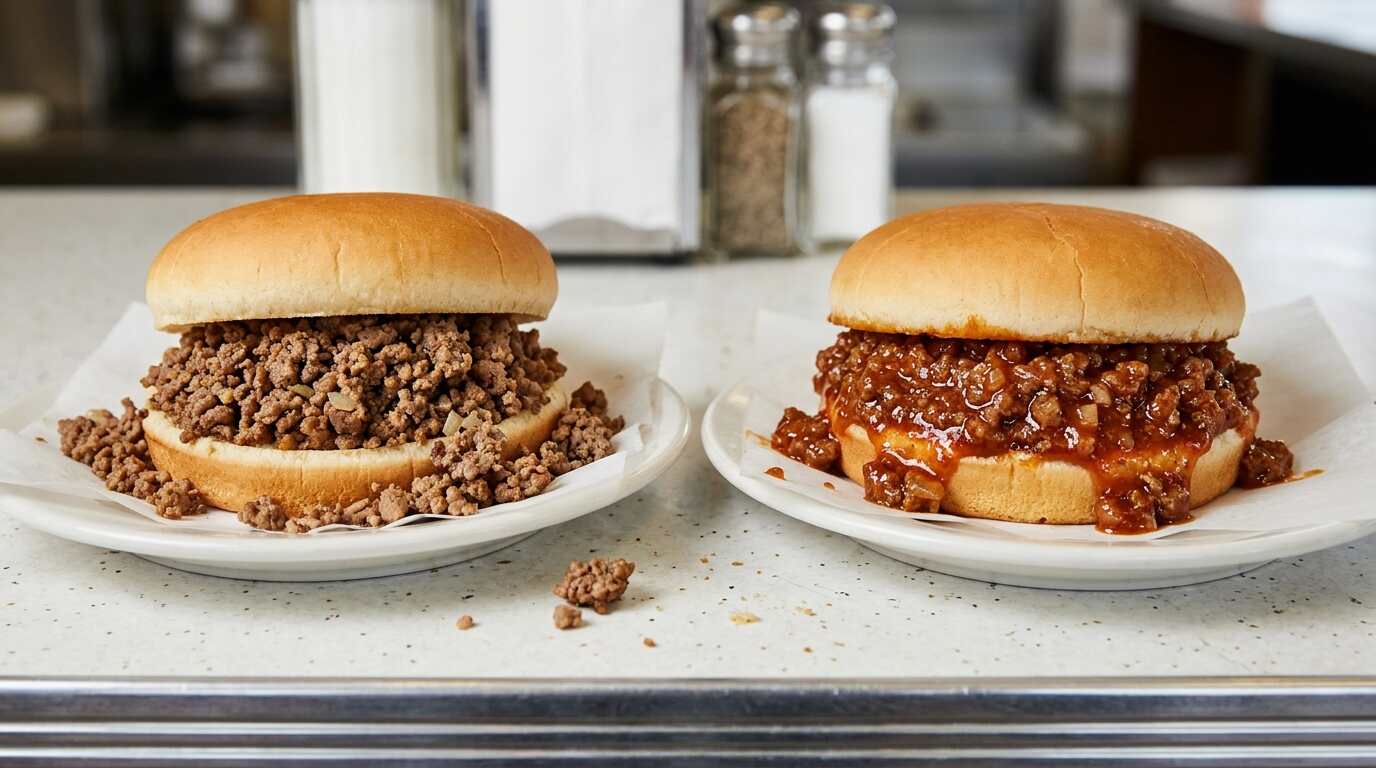
A sloppy joe carries a sauce and has its own competing origin stories. The Daily Meal’s history of the sandwich lists a bar in Havana, Cuba, founded in 1918 by José Abeal y Otero, and two bars in Key West, Florida, that both claim the invention. The same article observes that loose meat sandwiches of the 1920s and 1930s were quite reminiscent of the modern sloppy joe, without drawing a firm line between them.
Usage on the ground is looser than any definition. The Dictionary of American Regional English, as cited by Popik, recorded in 1986 that a sloppy joe is called a loose-meat sandwich in Yankton, South Dakota. Regional names that split a map are not confined to the Midwest; the pork roll and Taylor ham naming question is covered in a separate post.
The loose meat idea also sits close to the griddle-cooked beef of the patty melt, though the patty melt keeps its meat in a formed patty and the Maid-Rite does not.
Franchising Across Iowa Towns
Newton in 1927, Marshalltown in 1928 and a $300 fee
The chain grew through individual owners. Funding Universe reports that Angell sold franchise rights in Newton, Iowa, in 1927, and that Clifford Taylor bought the Marshalltown rights in 1928 for $300 with no royalties. Taylor’s opened on January 1, 1928, according to Notes on Iowa, which says the shop bought pickles from the Marshall Vinegar Works and buns from Strand’s Bakery, and ground its hamburger fresh every day. Wikipedia names Durant, Iowa, as the first franchise, and says the Durant shop is still open.
Decentralization defined the mid-century decades. The company history says the chain peaked at roughly 300 to 400 stores in nearly 20 states, concentrated in eastern Iowa and western Illinois, with franchisees varying menus, hours and decor. Many added French fries and milkshakes, and the chain did not join the franchising boom of the 1960s and 1970s. No national marketing was conducted.
Television supplied unplanned publicity in the early 1990s. Around 1993, the television comedy Roseanne referenced a “crumbly burger from Iowa,” and a Marshalltown store began shipping mail-order frozen sandwiches. By the late 1990s, it was reaching about 1,000 shipments a year. Popik’s file cautions that the chain is not the unnamed restaurant that inspired the show’s fictional Lanford Lunch Box.
Lawsuits, Decline and the Chain Today
Sources agree on the outline and differ on the dates
Ownership remained with the Angell family until the early 1980s. The company history puts the sale to Clayton Blue at 1982, while Wikipedia gives 1984, and both say John Gillotti ended up with the chain after Blue defaulted. The sources then diverge: Wikipedia places the Gillotti buyout at 1988, while Funding Universe describes a later court fight in which a judge ruled for the Gillotti estate. Both agree that litigation lasted well into the 1990s. Notes on Iowa says the dispute ended in 1995, when the Polk County District Court gave Gillotti ownership of a 138-store chain.
The count fell sharply afterward. By 2002, 83 stores remained. That year, a group of 14 investors led by former Des Moines banker Bradley Burt bought the chain. The new management introduced operating manuals, a seven-day training program and a 1950s-style store design, and existing franchisees, especially those who ground their own beef, resisted. They formed the Maid-Rite Franchise Association, after which headquarters relaxed its approach.
Growth targets followed. According to Wikipedia, the company set a ten-year goal of more than 1,000 restaurants in 2006 and announced a Hy-Vee grocery partnership in 2007 that never materialized.
As of August 2025, the same entry counts 25 locations in Iowa, Illinois, Minnesota and Missouri, 14 of them in Iowa. The company’s website describes Maid-Rite as a loose meat sandwich franchise making them since 1926, with “You have the rite to life, liberty, and freshly steamed buns” as a banner line.
Sources
- Maid-Rite, “How We Maid History” — https://maid-rite.com/history.php
- Maid-Rite, home page — https://maid-rite.com/
- Notes on Iowa, “Iowa Time Machine: Maid-Rite, May 1, 1926” — https://www.notesoniowa.com/post/iowa-time-machine-maid-rite-may-1-1926
- Notes on Iowa, “Taylor’s Maid-Rite, Iowa Time Machine, January 1, 1928” — https://notesoniowa.com/post/taylor-s-maid-rite-iowa-time-machine-january-1-1928
- Funding Universe, “Maid-Rite Corporation History” — https://www.fundinguniverse.com/company-histories/maid-rite-corporation-history
- Reference for Business, “Maid-Rite Corporation” — https://www.referenceforbusiness.com/history2/93/Maid-Rite-Corporation.html
- 97X, “98 Years Ago, The Maid-Rite Sandwich Was Born In Iowa” — https://97x.com/ixp/711/p/98-years-ago-the-maid-rite-sandwich-was-born-in-iowa/
- Barry Popik, “Loose-Meat Sandwich” — https://barrypopik.com/blog/loose_meat_sandwich
- Wikipedia, “Maid-Rite” (pointer) — https://en.wikipedia.org/wiki/Maid-Rite
- Wikipedia, “Tavern sandwich” (pointer) — https://en.wikipedia.org/wiki/Tavern_sandwich
- A Way with Words, “Tavern Sandwich” — https://www.waywordradio.org/tavern-sandwich/
- Erin Nudi, “Food history: loose meat sandwiches” — https://www.erinnudi.com/?p=4227
- History Culture by Bicycle, “History of loose meat or tavern” — https://historyculturebybicycle.blogspot.com/2012/04/history-of-loose-meat-or-tavern.html
- The Daily Meal, “The Mysterious History Of Sloppy Joes” — https://www.thedailymeal.com/1402623/fascinating-history-sloppy-joes
Keep reading
- Hot Brown Sandwich: History, Origin and How It Is Made
- Filet-O-Fish History: Lou Groen, Lent and the Hula Burger
- Dagwood Sandwich: How a Comic Strip Snack Became a Dictionary Word
More in this section: Sandwich History guide.