In this story
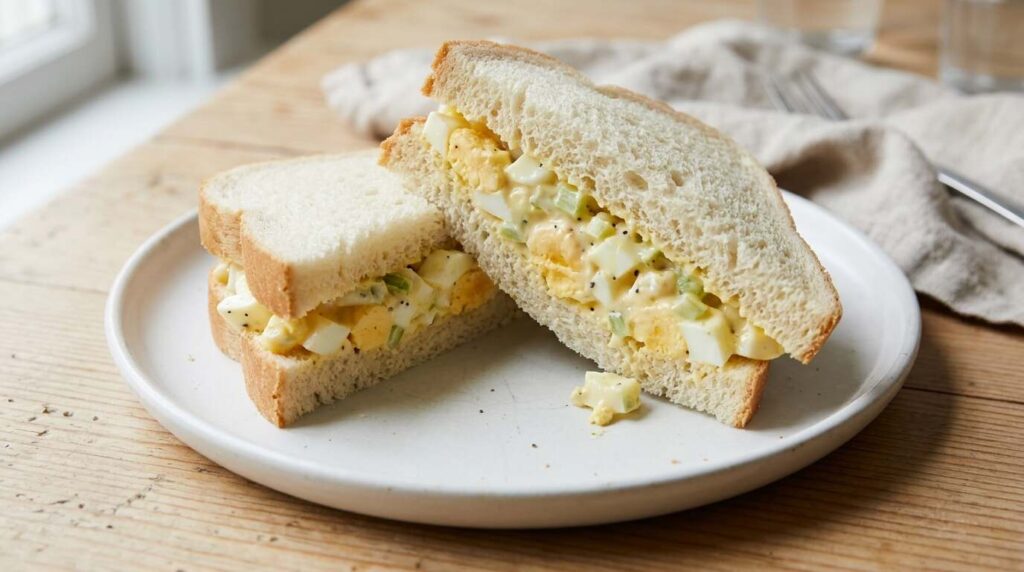
No source names the person who first folded chopped hard-cooked eggs into mayonnaise. The Nibble says the cook who did it is lost to history and guesses, with no citation, that the cook was probably French. What can be dated is the pieces: boiled eggs as a sandwich filling in the 1860s, a mayonnaise that Americans could buy by the jar in the early 1900s, and a sandwich that by the 1980s was common enough to be the setup for a joke.
Video: Egg Salad Sandwich (1941) on Sandwiches of History | Sandwiches of History
Eggs on bread before egg salad
The earliest sandwich citation in Food Timeline’s collection comes from Mrs. Crowen’s American Lady’s Cookery Book (1866), which lists “cold boiled eggs sliced, for luncheon” among sandwich fillings, according to Food Timeline’s sandwich page. Sliced egg on bread is not egg salad, since nothing binds the pieces together. Tasting Table’s survey of the subject, The Hazy History of Egg Salad, reaches the same point from a different direction: the record of the dish is thin, and the first mentions look more like recipes for mixtures than for the sandwich.
That article cites a 1905 second edition of “The ‘Queen’ Cookery Books No. 9,” which mixed boiled eggs with chutney, cream or herring. It also reports an 1899 recipe from a Hamilton, Ohio newspaper, found by the blog Rooted in Foods, for something called egg salad that used butter instead of mayonnaise and added chopped chicken breast. Tasting Table relays this secondhand, and the newspaper page itself was not fetched for this post. If the description is accurate, the first American “egg salad” was a different dish from the one now sold in deli cases.
Chopped egg also turns up in tea-time food. Food Timeline lists a cookbook by Oscar Tschirky of the Waldorf, dated 1896, that calls canapes “a tasty dish for tea or supper parties” and names egg canapes among them. A canape is an open slice of bread or toast, not a sandwich, but the pairing of egg and the afternoon table was established by then.
Mayonnaise and the dispute over its name
Egg salad depends on mayonnaise in the modern sense, and mayonnaise has its own contested history. NPR’s account gives the most repeated version. The duc de Richelieu took the island of Minorca from the British in June 1756, and his chef, according to Richard Gutman of the Culinary Archives and Museum, invented a sauce to celebrate and named it for Port Mahon. Gutman calls that account “compact and nice” and says it makes sense to him.
The same piece lays out the rivals. One holds that the sauce began in the Basque town of Bayonne as “bayonnaise,” and Gutman says of that theory that he is “not sure about that one.” Another traces the word to moyeu, an old French term for egg yolk. A fourth derives it from an obsolete French verb meaning to stir. The Daily Meal, summarizing Slate, calls the origin contested and adds that the sauce started to appear in French-influenced cookbooks around the nineteenth century. The Nibble credits the chef Marie-Antoine Carême with having “re-conceived” the sauce in the early 1800s, though that page cites no references.
None of this places egg and mayonnaise together on bread. The Daily Meal reports that Delmonico’s in New York used it in 1838 for dishes such as chicken mayonnaise and mayonnaise of lobster, and that only households with a taste for haute cuisine kept it at home.
The jar that changed the sandwich
What put mayonnaise within reach of an ordinary kitchen was a delicatessen. NPR reports that Richard Hellman, a German immigrant, opened a deli in New York City in 1905, and that his wife’s mayonnaise recipe, used in the deli’s salads, became popular on its own. He sold it in small wooden boats of the sort used to weigh butter, offered two grades, marked one with a blue ribbon, and by 1912 was bottling the blue-ribbon version.
The dates do not line up everywhere. The Daily Meal, citing Food Republic, puts the first Hellmann’s jars in 1920 and the blue-ribbon label in 1925. Tasting Table, drawing on NPR, says only that Hellman sold mayonnaise from his deli in 1905 and that the sauce was mostly limited to wealthy Americans until then. The Nibble gives 1907 for the start of commercial distribution in the United States. A reasonable reading is that a deli product, a bottled product and a national brand were three different stages, and the sources are dating different ones.
Deviled eggs and the same binder
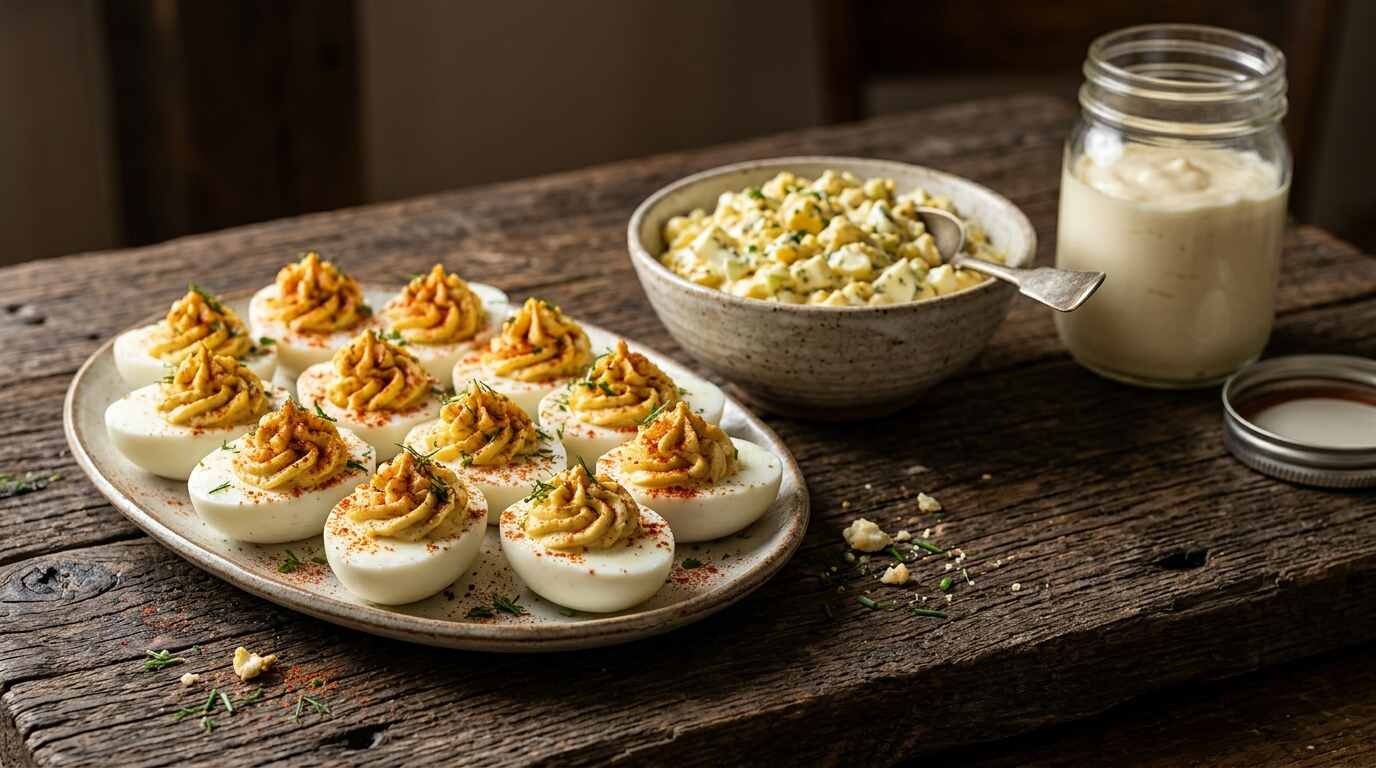
Eggs bound with mayonnaise have a close cousin in the deviled egg, whose history is much better documented. A History-network article traces stuffed eggs to a Roman first course called gustatio, to a thirteenth-century cookbook from Andalusia that describes mashing yolks with herbs, spices and a fermented sauce and packing them back into the whites, and to medieval recipes across Europe that added raisins, cheese and herbs. The word “devil” as a cooking term, meaning hot or heavily seasoned, appears in print in Great Britain in 1786, per both that article and The Nibble’s deviled egg history.
The link to egg salad is the filling. Both accounts credit Fannie Farmer’s Boston Cooking-School Cookbook of 1896 as one of the first to suggest mayonnaise as the binder for the yolks, and both say mayonnaise became standard in deviled egg recipes in the 1940s. The Nibble dates the start of commercial mayonnaise in the United States to 1907. The two dishes use the same ingredients and the same sauce. In one, the whites are kept whole and the yolks are piped back in. In the other, everything is chopped and stirred together.
No fetched source says which dish came first in the United States, or whether cooks adapted one from the other. That would be a claim about intent, and the record has none.
Dating the sandwich and its place at tea
Writers on egg salad often reach for 1762, the year usually given for the Earl of Sandwich’s name attaching to the meal. The Nibble says the sandwich was “formally invented in 1762,” and a Quora answer quoted on a Barry Popik page claims the egg salad sandwich dates to France that year. Popik’s page notes that the answer cites no source, so the date belongs to the sandwich in general and not to the egg version.
Popik’s own dated citations are later. The earliest he lists for the phrase “egg salad sandwich” are a May 1975 Ladies’ Home Journal cartoon asking which came first, the chicken salad or the egg salad sandwich, an October 1981 Boys’ Life joke about a philosopher ordering both, and an October 29, 1985 item in the Morning News of Wilmington, Delaware. He adds that newspaper databases show citations “in the 1900s,” without naming a paper. That falls short of an origin date. It means only that the printed trail for the exact phrase is weaker than the habit it describes.
Variants from the first half of the twentieth century show how freely cooks treated the filling. Mashed describes an egg and sardine sandwich from Lulu Thompson Silvernail’s 1923 Nine Hundred Successful Recipes, made from four boiled eggs, a can of sardines and horseradish chopped together and spread on buttered bread. Tasting Table notes a 1936 “Shrimpegg” sandwich of shrimp, walnuts, egg and mayonnaise.
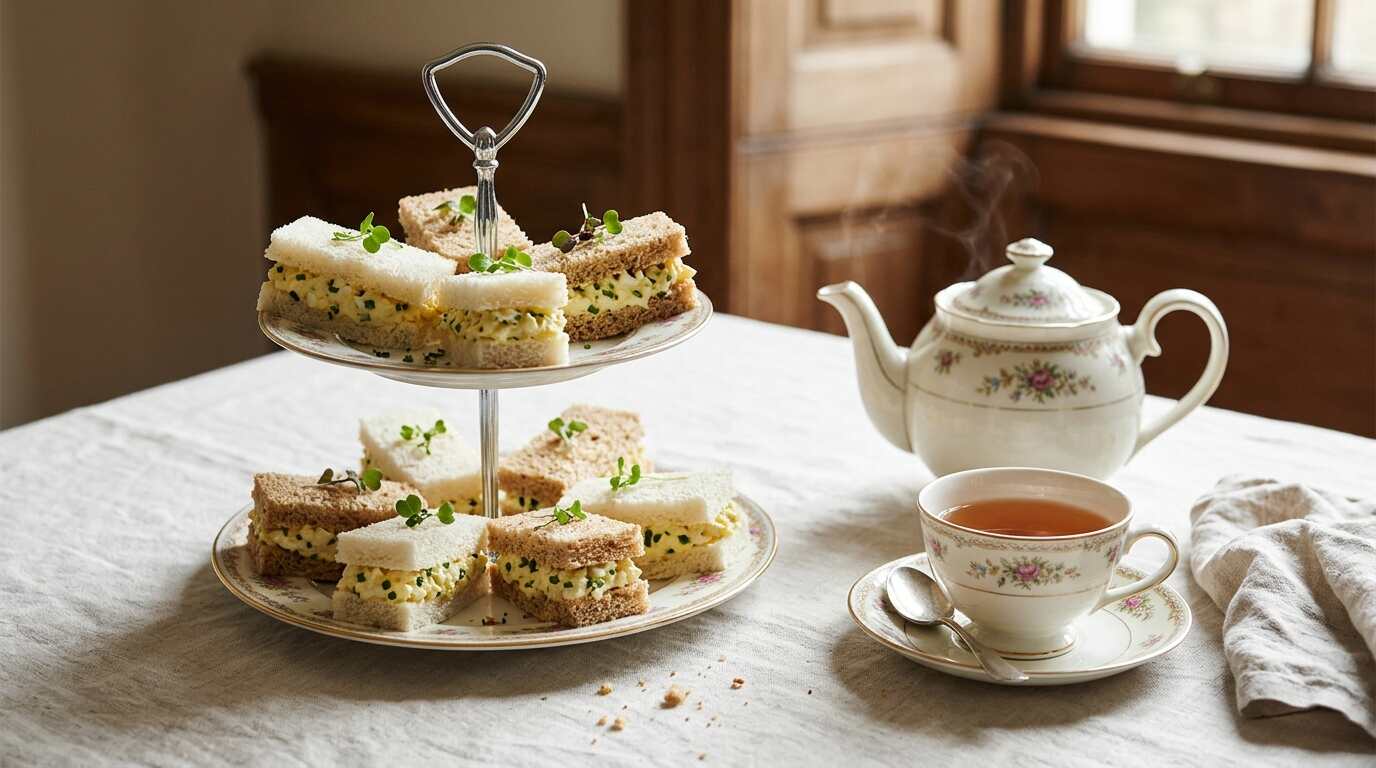
In Britain and in American tearooms, egg filling settled into the tea sandwich, a small crustless sandwich that is covered in detail in the post on tea sandwiches. The Nibble places egg salad in a family of protein salads, among them chicken, turkey, ham, tuna and salmon, all bound with a dressing, and says it is the cheapest of the group. The same page remarks that ham salad now survives mainly as a tea sandwich, while egg, tuna and chicken salad remain popular as everyday sandwiches.
The Nibble also separates egg salad from the older English composed salad called salmagundi, which it describes as “a world apart” from egg salad. It guesses that egg salad appeared after mayonnaise was standardized in the early 1800s, possibly in Britain, where sandwiches were more popular than on the Continent. The page labels this a guess.
How it is made
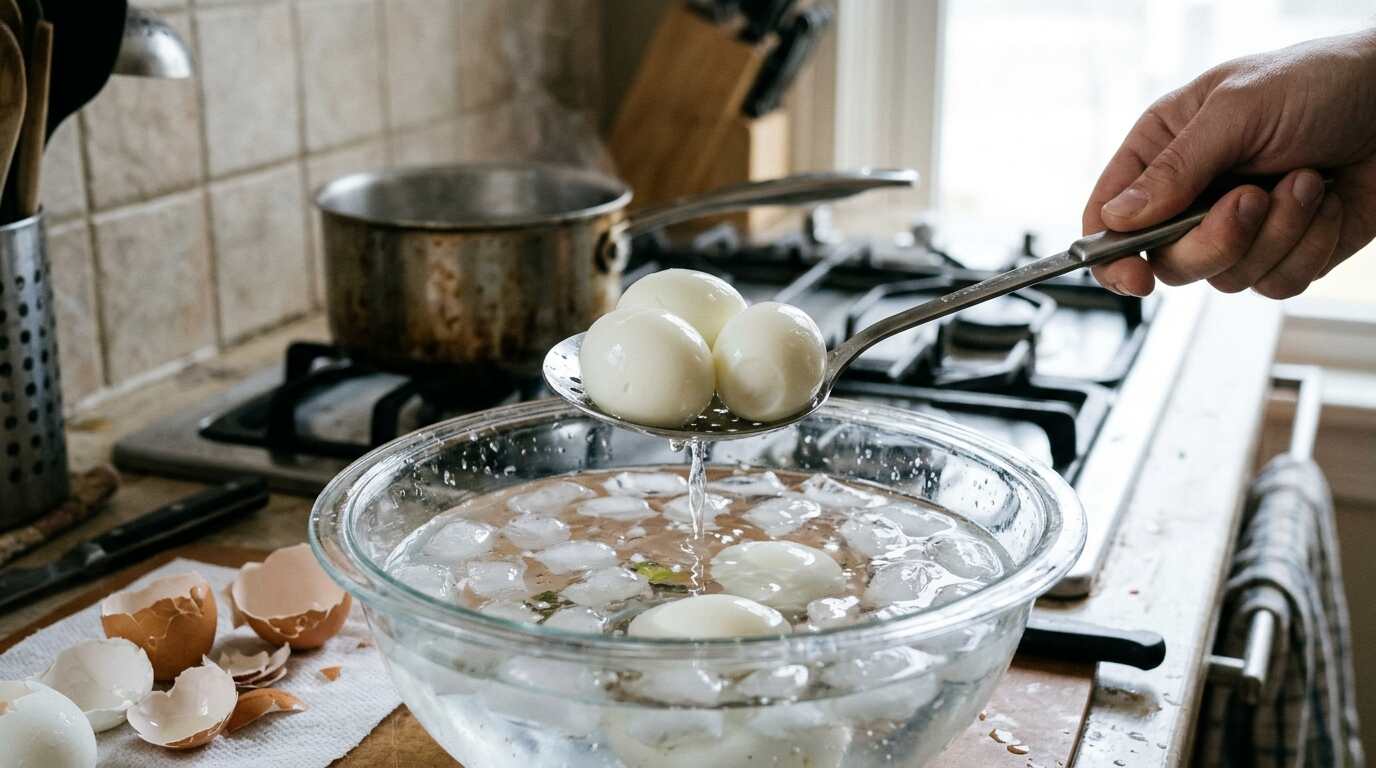
The American Egg Board’s published method for hard-cooking eggs uses residual heat. The eggs go in a single layer in a saucepan, covered with cold water by an inch. The water comes to a boil over high heat, and the pan is then taken off the burner and covered. Large eggs sit about 12 minutes, medium eggs 9 and extra-large 15. They are drained and moved to ice water at once. The board says hard-boiled eggs are easiest to peel right after cooling.
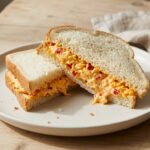
Its egg salad recipe for six large eggs is plain. Four center slices are saved for garnish, and the rest are chopped. A quarter cup of mayonnaise, two teaspoons of lemon juice, a tablespoon of minced onion, salt and pepper go into a bowl with the eggs and half a cup of finely chopped celery. The mixture is covered and refrigerated so that the flavors blend, then served on lettuce topped with the reserved slices. Between slices of bread, the same salad becomes the sandwich.
The quantities are one source’s choice, not a standard. Recipes vary on celery, mustard, pickle relish and paprika, and the sources fetched for this post do not settle which version is traditional.
Food safety for egg salad
Federal guidance puts the risk in the eggs and in the time spent at room temperature. The USDA’s Food Safety and Inspection Service says in Shell Eggs from Farm to Table that hard-cooked eggs should be refrigerated within 2 hours of cooking and used within a week, and that cooking removes the shell’s protective coating and leaves pores open to bacteria. The same document says cooked egg dishes should be cooled in shallow containers, refrigerated at once and eaten within 3 to 4 days, and that the refrigerator should be at 40 degrees F or below. It does not address egg salad by name, so the 3 to 4 day figure for egg salad is an application of the general rule for cooked egg dishes, not a statement about the sandwich.
A USDA page titled Cool for the Summer: Keep Your Favorite Salads Chilled, dated May 24, 2023, places the hazard in the main ingredient and not in the dressing. The eggs or chicken must be cooked and chilled properly before mixing. Perishable food should be refrigerated within two hours, or within one hour when the temperature is above 90 degrees F, and cold foods should stay at 40 degrees F or below. NPR’s mayonnaise story arrived at a similar conclusion about potato salad, reporting that mayonnaise is not to blame when a picnic salad sits out too long.
An archived FoodSafety.gov page on Salmonella and eggs adds that eggs should be cooked until both the yolk and white are firm and that eggs should not stay at room temperature, between 40 and 140 degrees F, for more than 2 hours. FSIS also advises against raw eggs in homemade mayonnaise. Commercial jars are a separate matter, and none of the fetched documents addresses their ingredients.
Sources:
- The Nibble, “Egg Salad History”: https://thenibble.com/REVIEWS/MAIN/cheese/eggs/egg-salad-recipes.asp
- The Nibble, “Food Holiday: The History of Deviled Eggs”: https://blog.thenibble.com/2015/11/02/food-holiday-the-history-of-deviled-eggs/
- Tasting Table, “The Hazy History of Egg Salad”: https://www.tastingtable.com/1110452/the-hazy-history-of-egg-salad/
- Food Timeline, sandwich history: https://www.foodtimeline.org/foodsandwiches.html
- NPR transcript, mayonnaise: https://www.npr.org/transcripts/5639903
- The Daily Meal, “The Time Mayo Was Considered A Luxury Food”: https://www.thedailymeal.com/1085471/the-time-mayo-was-considered-a-luxury-food
- History-network article, “The Ancient History of Deviled Eggs” (host: loki.editorial.aetnd.com): https://loki.editorial.aetnd.com/news/the-ancient-history-of-deviled-eggs
- Barry Popik, “Which came first, the chicken salad or the egg salad sandwich?”: https://barrypopik.com/blog/which_came_first_the_chicken_salad
- Mashed, egg and sardine sandwich: https://www.mashed.com/2207877/popular-1900s-egg-and-sardine-sandwich/
- American Egg Board, Incredible Egg, hard-cooked eggs and egg salad: https://incredibleegg.org/?p=1509
- USDA FSIS, Shell Eggs from Farm to Table (archived): https://webarchive.library.unt.edu/web/20120915090009/http:/www.fsis.usda.gov/PDF/Shell_Eggs_from_Farm_to_Table.pdf
- USDA, Cool for the Summer: Keep Your Favorite Salads Chilled: https://www.usda.gov/node/53664
- FoodSafety.gov, Eggs: Reducing the Risk of Illness from Salmonella (archived): https://webarchive.library.unt.edu/web/20120915123408/http://www.foodsafety.gov/blog/blog_17.html
- Sandwiches of History (YouTube), “Egg Salad Sandwich (1941)”: https://www.youtube.com/watch?v=1dVi4UiPVLk
- Internal: https://grillcheesy.com/tea-sandwiches/