In this story
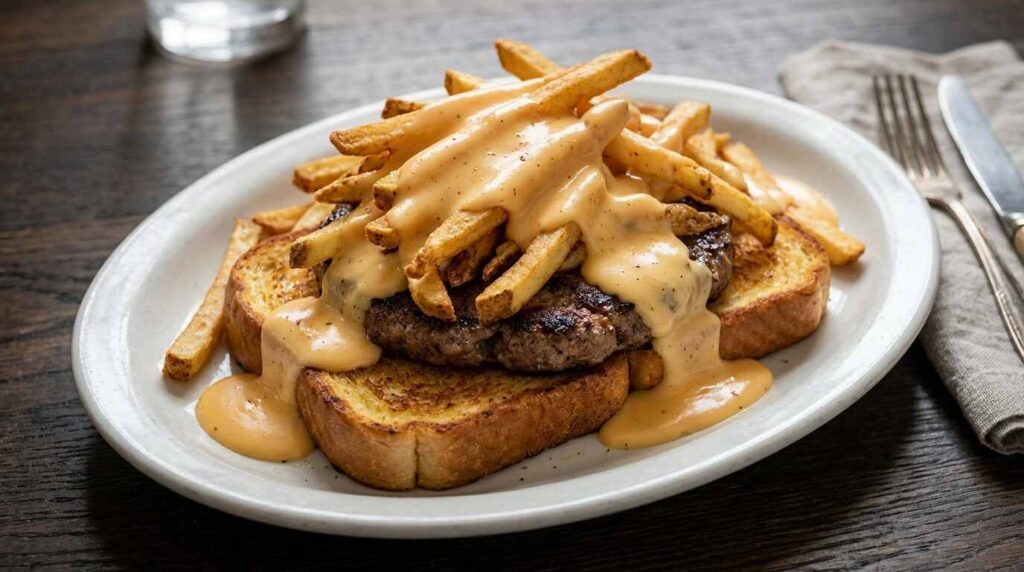
The horseshoe is an open-faced sandwich from Springfield, Illinois: toasted bread, a layer of meat, a pile of French fries, and a cheese sauce poured over the whole plate. The Springfield tourism bureau describes it as two thick slices of Texas toast with a choice of meat, a heap of crisp fries and homemade cheese sauce. Local historians trace it to a hotel kitchen in the late 1920s, and the details of who did what in that kitchen are still argued over nearly a century later.
Video: Springfield Horseshoe Sandwich Trail offers rewarding way to eat local — from the WCIA News YouTube channel
How a Horseshoe Is Built
Toast first, sauce last, and no top slice anywhere
Bread forms the base. Current Springfield menus lean on thick-cut Texas toast, according to Springfield’s visitor bureau, while the sandwich’s county historical write-up notes that modern versions are usually served that way, with hamburger, chicken or ham as the meat and proprietary house cheese sauces. The meat sits on the toast, fries go on top, and the sauce covers everything.
The order of those layers has been a point of disagreement. One recipe history published by the state’s tourism office says the sequence of fries and cheese is debated, and that most modern restaurants pile the fries first and then soak them in sauce. A food-history site describes the traditional method as pouring sauce over the bread and meat and then piling the fries on top.
Hamburger is now the most common meat, according to the Wikipedia entry on the sandwich, though the original meat was ham. (Wikipedia is used here as a pointer to the sources it cites, among them the Illinois Times and a 2019 book.) Locals, Peoria Magazine reports, call it simply a “shoe,” and the sandwich spread across central Illinois as portions grew.
The Leland Hotel and Chef Joe Schweska
A new lunch item for a downtown hotel dining room
Most accounts place the sandwich’s birth at the Leland Hotel, at the corner of Sixth Street and Capitol Avenue in downtown Springfield. A 2024 NPR Illinois report by Sean Crawford says local historians usually credit chef Joe Schweska and his wife, Elizabeth, with creating it in 1928. The Sangamon County Historical Society frames the credit with caution: “Although accounts differ, most people credit Joseph Schweska with creating the horseshoe sandwich.”
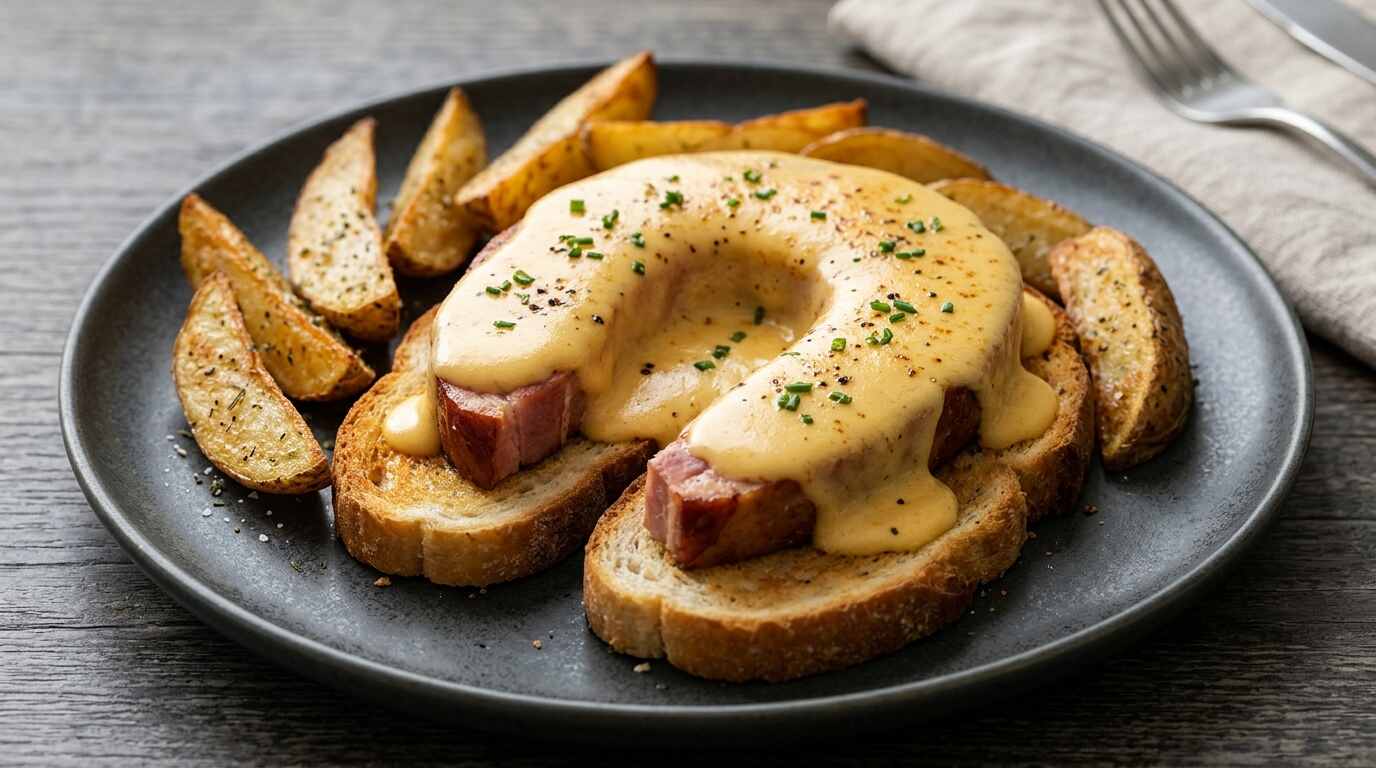
Springfield’s visitor bureau tells the story in a June 2024 press release: in 1928 Schweska needed a new lunch item for the Leland Hotel Restaurant, and Elizabeth helped him work out the idea. The historical society adds that she suggested an open-faced sandwich with Welsh rarebit sauce, and that Schweska’s family accounts say the cheese sauce was his own recipe.
Schweska’s life dates and job title come from a Barry Popik research entry, which lists him as Joe (or Joseph) Schweska, 1901 to 1971, chef of the Red Lion Room at the Leland. The same entry says the idea of using a rarebit sauce came from Elizabeth, per the recollection of the chef’s son, Joseph E. Schweska Jr.
The hotel itself is gone as a hotel. Peoria Magazine reports that the Leland closed in 1970, and the building at Sixth and Capitol now houses the Illinois Commerce Commission, the agency that cooperated with Visit Springfield on a commemorative plaque in 2024.
The Dispute Over Steve Tomko
A dishwasher, a cook, or the man who made it famous
A second name enters the story through Steve Tomko. The historical society says Tomko worked with Schweska at the Leland, later cooked at Norb Andy’s Tabarin and at Wayne’s Red Coach Inn, and “popularized” the horseshoe at those restaurants, both of which served well-regarded variations.
Other accounts go further. The Popik entry cites a 1972 State Journal-Register article, “Springfield’s sandwich of distinction” by Joanne Long, reporting that Tomko claimed to have invented the horseshoe in 1928 at the old Leland and was then serving it at the Red Coach Inn. The same entry notes that Tomko attributed the name to the shape of the bone-in ham cut.
Counter-accounts exist. The state tourism recipe page says Schweska, the head chef, is the more likely creator, rather than a 17-year-old dishwasher whom some credit and whom Schweska mentored. A separate food-history site goes harder, calling the Tomko credit fiction and saying he began claiming it around 1986, after Schweska had died. That date conflicts with the 1972 article the Popik entry cites, so the timing of Tomko’s claim stays unsettled in the published record.
The date of the invention is not locked down either. The Popik entry says the sandwich was created between 1928 and 1932 and calls the widely repeated 1928 date disputed. A 1938 newspaper article quoted Schweska on the sauce, and the historical society reads that article as placing the start of his rarebit sauce at around 1932.
Why It Is Called a Horseshoe
Ham, nails and an anvil
The name has a tidy explanation that most Springfield sources repeat. The plaque installed at the Leland building in 2024 says, according to NPR Illinois, that the name comes from the cut of ham used in the sandwich, the French fries stand in for the nails, and the platter represents the hot anvil.
The original build looked different from the current one. The historical society says family accounts describe ham cut off the bone in a horseshoe shape, served with potato wedges rather than fries. A 1980 article quoted by the Popik entry has Tony Wables Sr. recalling that the first fries were wedges, eight to a sandwich, cut from a potato three times. Atlas Obscura describes the first version as served on a steel oval plate with a trivet-style border, two slices of bread side by side, a ham slice cut from the bone, cheese sauce, and baked potato wedges around the edge as the nails.
Several sources agree the sandwich was born in the Prohibition era. Atlas Obscura says the first sauce was made with nonalcoholic beer, and Food Republic says the original recipe probably used near beer. The Popik entry attributes the near-beer detail to Wables.
The Cheese Sauce and the 1938 Recipe
Welsh rarebit, adjusted for a hotel kitchen
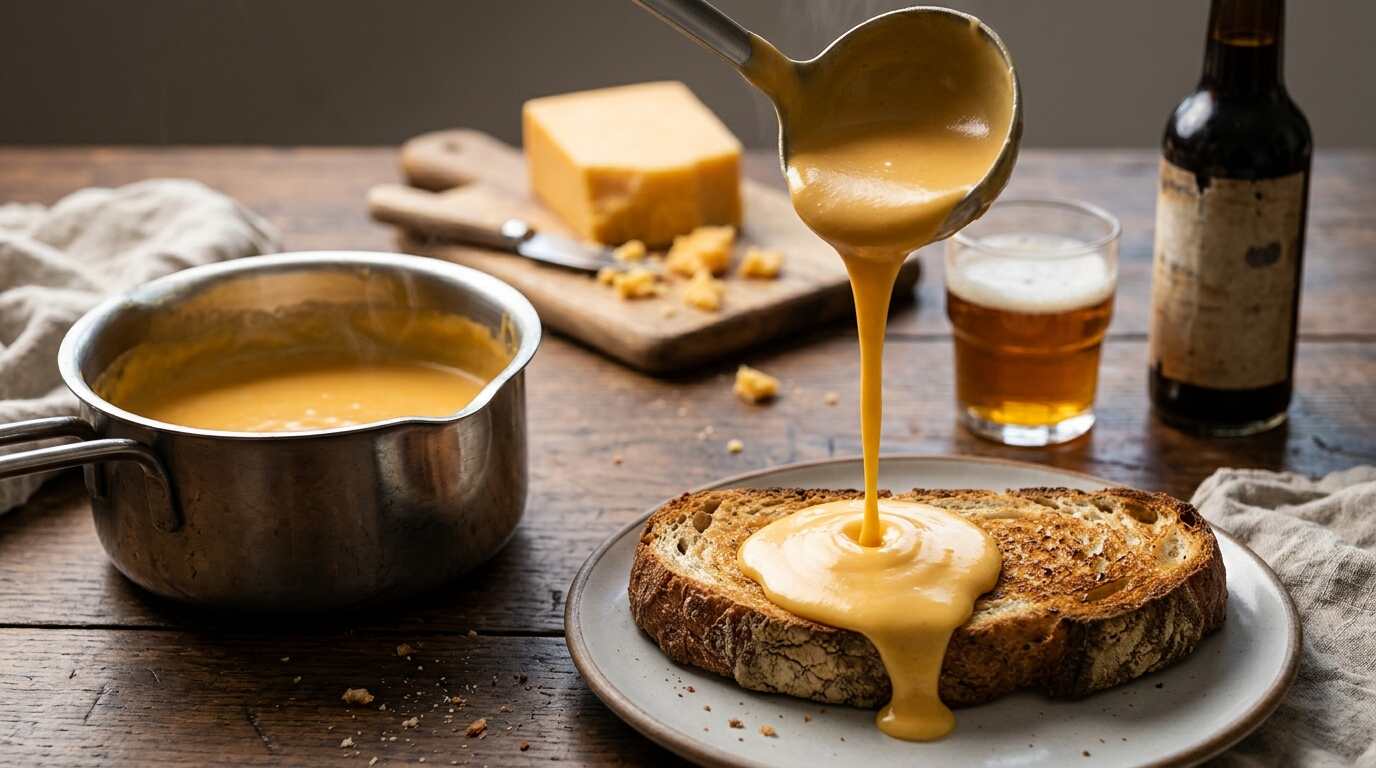
The sauce is the part of the horseshoe that Springfield cooks argue about most. Its ancestor is Welsh rarebit sauce, and the Wikipedia entry says horseshoe sauces generally derive from it, with ingredients such as beer, butter, sharp cheddar, Worcestershire sauce, flour, dry mustard, paprika, salt, pepper and cayenne.
The earliest published recipe tied to Schweska appeared in the Illinois State Journal on Christmas Day 1938, in a feature by Robert Wood on recipes from three Springfield hotel chefs. The historical society summarizes it: Schweska’s rarebit sauce was built from butter, flour, milk, beer, old English or American cheese, salt, cayenne, dry mustard and Lea & Perrins sauce, cooked in a double boiler with the beer added just before serving. He estimated that he made six gallons of the sauce daily for Leland diners and had already shared the recipe with hundreds of people.
The 1938 article does not use the word “horseshoe.” The historical society points out that the earliest newspaper reference it found that links a horseshoe-type dish to the sauce is an October 8, 1946 ad for The Mill, where Schweska was then chef, describing “ham and eggs on toast with Welsh rarebit sauce and French fries.” The first explicit “horseshoe sandwich” mention it found is a Mill ad dated October 21, 1948.
The 1938 recipe called for old English or American cheese, and the cheese itself has its own history in entries on American cheese and cheddar. Modern restaurants make their own choices. Peoria Magazine reports that Charlie Parker’s uses processed cheddar with Worcestershire and hot sauce and no beer, that Norb Andy’s builds its sauce on a butter-and-flour roux with white and yellow cheddar, beer and cayenne, and that Boone’s Saloon simmers a blend of white and yellow cheese for at least three hours. The state tourism page, for its part, insists Velveeta is no substitute.
From Hotel Plate to Springfield Menu Staple
Duncan Hines, bar ads and a Wall Street Journal mention
Documentation of the sandwich as a menu item thickens in the 1950s and 1960s. The Popik entry lists a 1959 mention in Duncan Hines’s Adventures in Good Eating of a “Leland Horseshoe sandwich” with chicken and shoestring potatoes, and two 1962 Illinois State Journal ads for John’s Lounge, one advertising its famous horseshoe sandwiches and another listing a horseshoe sandwich at a dollar and up.
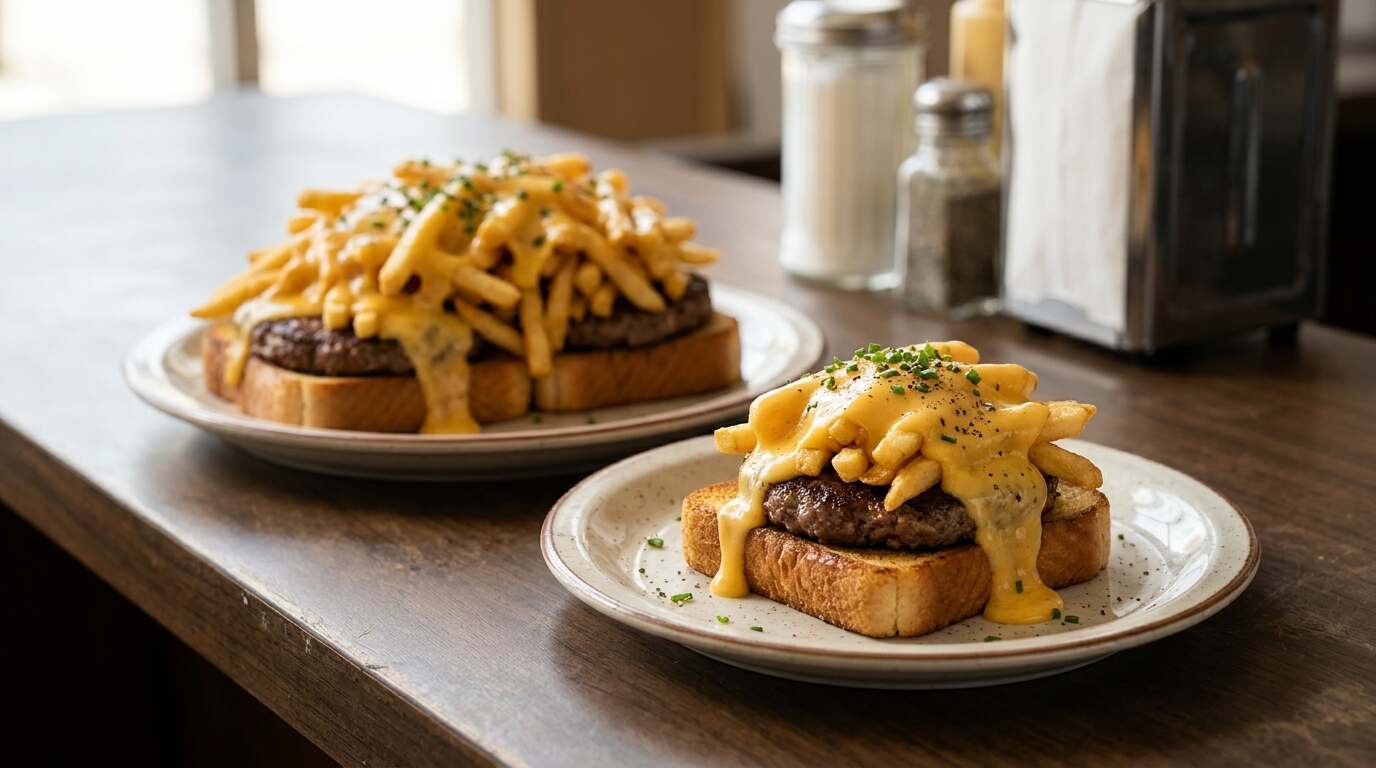
By the end of the 1970s the sandwich had acquired a long list of versions. A December 26, 1979 State Journal-Register column by Bob Gonko, as summarized by the Popik entry, lists ham and egg, all egg, hamburger, shrimp, turkey and corned beef among them. In 2012 Julianne Glatz, food writer for the Illinois Times, gave a talk to the Culinary Historians of Chicago on the sandwich, recorded by WBEZ, in which the horseshoes served at Springfield’s casual restaurants are described as “a far cry from the original.”
National attention followed. The historical society notes that television crews regularly feature the horseshoe and that the Wall Street Journal reported on it in 2010. Springfield’s visitor bureau notes that D’Arcy’s Pint appeared on the Travel Channel’s Man vs. Food and that Charlie Parker’s was featured on Food Network’s Diners, Drive-Ins and Dives.
Ponyshoes and Other Variations
Half portions, breakfast plates and a Midwestern cousin
A smaller serving is called a ponyshoe, or pony shoe. The Wikipedia entry defines it as a version with one slice of bread and one serving of meat, citing a 2006 reference work, and the food-history site describes it as a half portion, usually on one slice of toast. Peoria Magazine says Norb Andy’s Tabarin serves walleye and original-style ham “ponies,” smaller versions of the sandwich.
Breakfast has its own version. Peoria Magazine lists a breakfast shoe at Ritz’s Little Fryer with scrambled eggs, bacon and hash browns under gravy, cheese sauce or both, and another at Charlie Parker’s built on an omelet-style egg and thick-cut ham. Springfield’s visitor bureau says Charlie Parker’s won $25,000 at the 2015 Thomas Breakfast Battle with a breakfast horseshoe on an English muffin with eggs, bacon, cheese sauce, sausage gravy and hash browns.
Other kitchens change the meat or the potato. Peoria Magazine describes an Irish cheesesteak horseshoe at D’Arcy’s Pint with sirloin, mushrooms, onions and peppers over Texas toast, and a hamburger shoe at Boone’s Saloon with crinkle-cut fries. Atlas Obscura lists buffalo chicken, fried pork tenderloin and Kobe beef among the proteins and tater tots or hash browns among the substitutes for the wedges, and Wikipedia cites a Des Moines Register report of a similar dish, the Magic Mountain, served with steamed loose meat at Ross’ Restaurant in Bettendorf, Iowa, before the restaurant closed in February 2023.
The plaque went up at the Leland building in June 2024, after tourists kept asking where the sandwich began, according to Visit Springfield’s Amy Beadle. A horseshoe trail with a tracking app launched the same year. The Hot Brown and the Primanti Bros. sandwich are covered in their own entries.
Sources
- Sangamon County Historical Society, “The horseshoe sandwich (with recipe)”: https://sangamoncountyhistory.org/?p=2067
- NPR Illinois / WNIJ, Sean Crawford, “A plaque marks the birth of the horseshoe” (June 21, 2024): https://www.northernpublicradio.org/illinois/2024-06-21/a-plaque-marks-the-birth-of-the-horseshoe
- Visit Springfield, “Signature Horseshoe”: https://www.visitspringfieldillinois.com/Landing/SignatureHorseshoe.aspx
- Visit Springfield press release, June 17, 2024: https://www.visitspringfieldillinois.com/Media/PressReleaseDetails/?id=100
- Enjoy Illinois, “Springfield’s horseshoe sandwich”: https://www.enjoyillinois.com/illinois-200/springfields-horseshoe-sandwich/
- Barry Popik, “Horseshoe Sandwich”: https://barrypopik.com/blog/horseshoe_sandwich
- What’s Cooking America, “Horseshoe Sandwich Recipe and History”: https://whatscookingamerica.net/history/sandwiches/horseshoesandwich.htm
- Peoria Magazine, “Blazing a horseshoe trail in the city of its birth”: https://www.peoriamagazine.com/?p=29885
- Atlas Obscura, “Horseshoe Sandwich”: https://assets.atlasobscura.com/foods/horseshoe-sandwich
- Food Republic, “The Horseshoe Sandwich Is A Midwest Feast That Piles On The Flavor (And Fries)”: https://www.foodrepublic.com/1761058/illinois-horseshoe-sandwich-fries/
- WBEZ / Culinary Historians of Chicago, “What happened to horseshoes?”: https://www.wbez.org/shows/wbez-news/what-happened-to-horseshoes/4f1cedd6-40e1-4021-9692-e4daaa952b36
- Wikipedia, “Horseshoe sandwich” (used as a pointer to its cited sources): https://en.wikipedia.org/wiki/Horseshoe_sandwich
- YouTube, WCIA News, “Springfield Horseshoe Sandwich Trail offers rewarding way to eat local”: https://www.youtube.com/watch?v=9gQBDcbOd5Y