
In this story
Pastrami on rye is the signature sandwich of the New York Jewish delicatessen, and its history is contested at almost every step. Romanian Jews are the most commonly named ancestors of the meat, a Lithuanian-born butcher and a Delancey Street deli both claim the first beef version, and a Texas barbecue writer has argued for a different route altogether. In a historical survey for The Forward, Andrew Silverstein reported finding no “smoking gun” for any of them.
Video: The History of Pastrami | The Nosher
Goose pastrama in Romania
The name points east. Silverstein writes that Romanian pastrama was a tough, dried meat, closer to jerky than to anything sliced behind a deli counter today, and that Romanian Jews most commonly made it from goose. Saveur’s guide to deli meats gives the method an older pedigree, dating the technique to the Byzantines and noting that Romania had long dry-cured mutton and beef with salt and spices. In its account, Romanian Jews adopted the preparation mainly for goose breast, served cold and thinly sliced as an appetizer.
Silverstein also traces related cured meats under the names pastram, pastromá, pastirma, basdirma and basturma across Eastern Europe and the Caucasus, and he credits the preservation method to Ottoman armies. Ted Merwin, author of Pastrami on Rye, is quoted there describing Central Asian horsemen who kept meat under their saddles. The spice rub of coriander, paprika and mustard, the article adds, still reflects those spice-route origins.
A second account of the Romanian link comes from Tasting Table, which cites My Jewish Learning for the claim that pastrami came from a Romanian dish called pastirma, traditionally made from goose. Goose became harder to find after Jewish immigrants reached the United States, so beef took its place. The same article says the shift from “pastirma” to “pastrami” is said to come from the meat being served beside salami. A separate Tasting Table piece repeats that Yiddish blend of “pastirma” and “salami” as the source of the word. Silverstein’s newspaper research complicates the tidy version: he found that “pastrama” dominated in the 1890s, “pastrame” in the early 1900s, and “pastrami” only after World War II.
From the Lower East Side to the beef plate
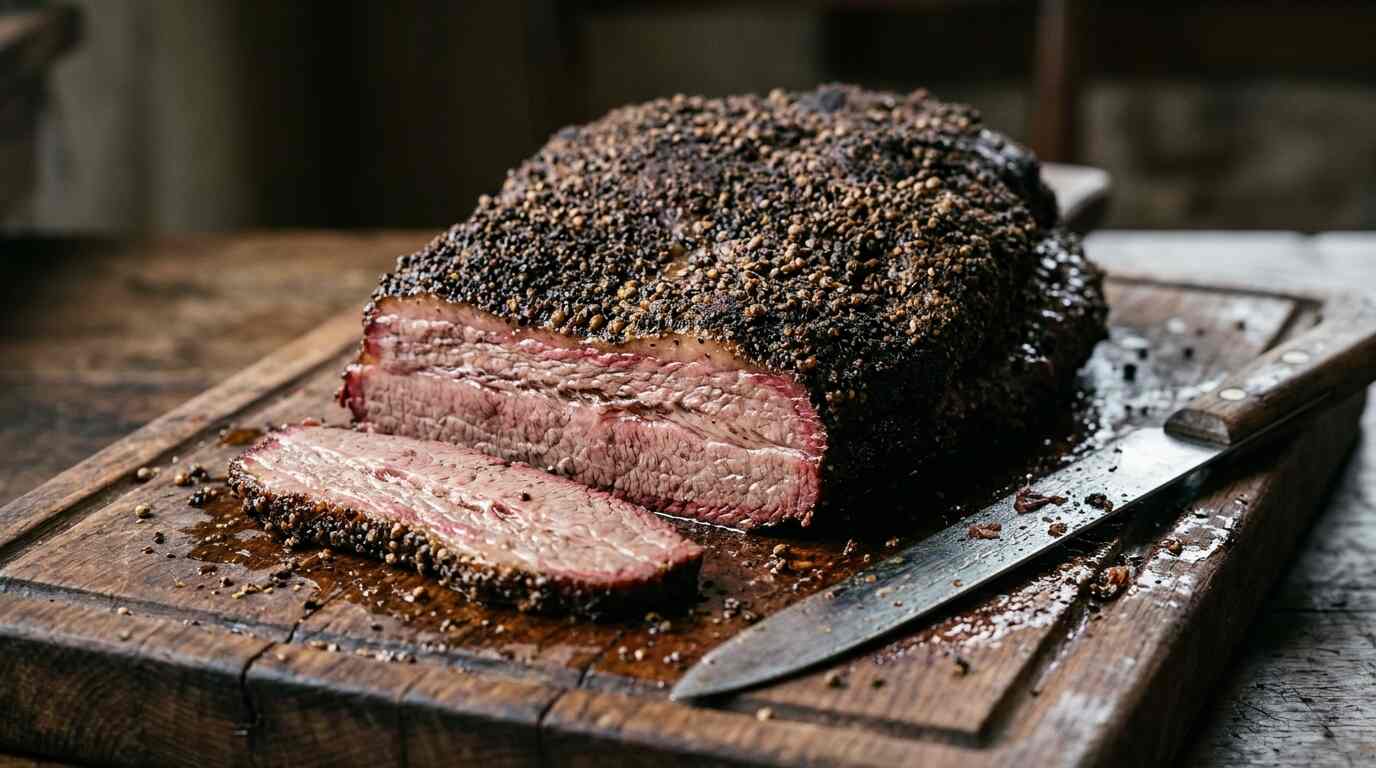
Silverstein cites several early records of the meat on the Lower East Side. Marcus Ravage’s 1917 memoir describes Romanian delicatessens on Rivington and Allen Streets selling “goose-pastrama and kegs of ripe olives.” A sausage factory on Avenue C, B. Meier, advertised in a Yiddish anarchist paper in September 1891 as the only maker of “the world famous pastrama.” In March 1894, the firm Meier & Gerzog ran an English-language ad in The Hebrew American for “Roumania Pastroma,” which Silverstein gives as the earliest English pastrami advertising he located.
The step from goose to beef, in Merwin’s account as summarized by Silverstein, came with American conditions. Beef was cheap and plentiful, refrigeration slowed the old curing, and the meat was smoked and then rehydrated by steaming or braising. Saveur offers a compatible picture: on the Lower East Side beef replaced goose, and pastrami began to be served hot on a sandwich, which let garment workers eat on the job.
Silverstein’s own conclusion is cautious. He considers it likely that German Jewish meatpackers, already established in New York, turned Romanian goose pastrama into beef pastrami at some point after Romanian Jews began arriving in 1881, but he states that the proof is missing.
Sussman Volk and Katz’s, two competing claims
Two New York businesses claim a place in the story. According to Silverstein, Sussman Volk, a Lithuanian Jewish immigrant, claimed in 1887 to be the first to make pastrami at his Delancey Street butcher shop, later a deli. Volk’s granddaughter Patricia Volk wrote in Stuffed that he got the recipe from a Romanian Jewish friend. Tasting Table describes him as a Lithuanian immigrant often credited with popularizing the pastrami sandwich, sold on rye from his Delancey Street deli, and adds that whether he was the first to serve it in the familiar way will never be known.
Katz’s Delicatessen makes a rival claim. Silverstein reports that Katz’s says it invented pastrami in 1888, and that the barbecue historian Robert Moss argued neither business could have existed before 1898. He also notes that the “Since 1898” sign at Katz’s has been altered to read 1888. The CityLore entry on the deli gives the deli’s founding as 1888 by the Kostagin brothers, with the Katz family taking over in 1912. The same entry says corned beef at Katz’s is pickled for about a month and pastrami is pickled and smoked off-site.
Neither claim is proven. The ownership dates of the building and the dates of the first sandwiches are different questions, and the sources do not settle either.
The Texas theory
Silverstein’s article also reports an alternative route. In his 2015 book New York in a Dozen Dishes, Robert Sietsema suggested that Jewish butchers in Texas may have started smoking corned beef, an idea built on research by Daniel Vaughn, barbecue editor of Texas Monthly. Vaughn found 1916 advertisements for a Corpus Christi Jewish butcher selling “Pastromie,” and later turned up older references. Nick Solares of Eater summarized the theory in 2016: Czech and German butchers brought their meat-preserving processes to Texas.
The theory has been answered twice. Moss concluded in 2018 that pastrami first took hold in large northern immigrant centers, including New York, Montreal and Chicago. Sietsema himself raised a counterpoint to the Romanian story: Romanian steakhouses such as Sammy’s Roumanian and Harry Greenberg’s Roumanian Casino, the latter opened in 1894, did not serve pastrami, and he asked why, if Romanian Jews brought it over, it was missing from their restaurants. Tasting Table dismisses the Texas claim outright, calling the Texas version a different product from deli-style pastrami, while InsideHook presents the Romanian account as the most popular theory and Vaughn’s as its rival, with the origin not entirely clear.
The deli and the sandwich
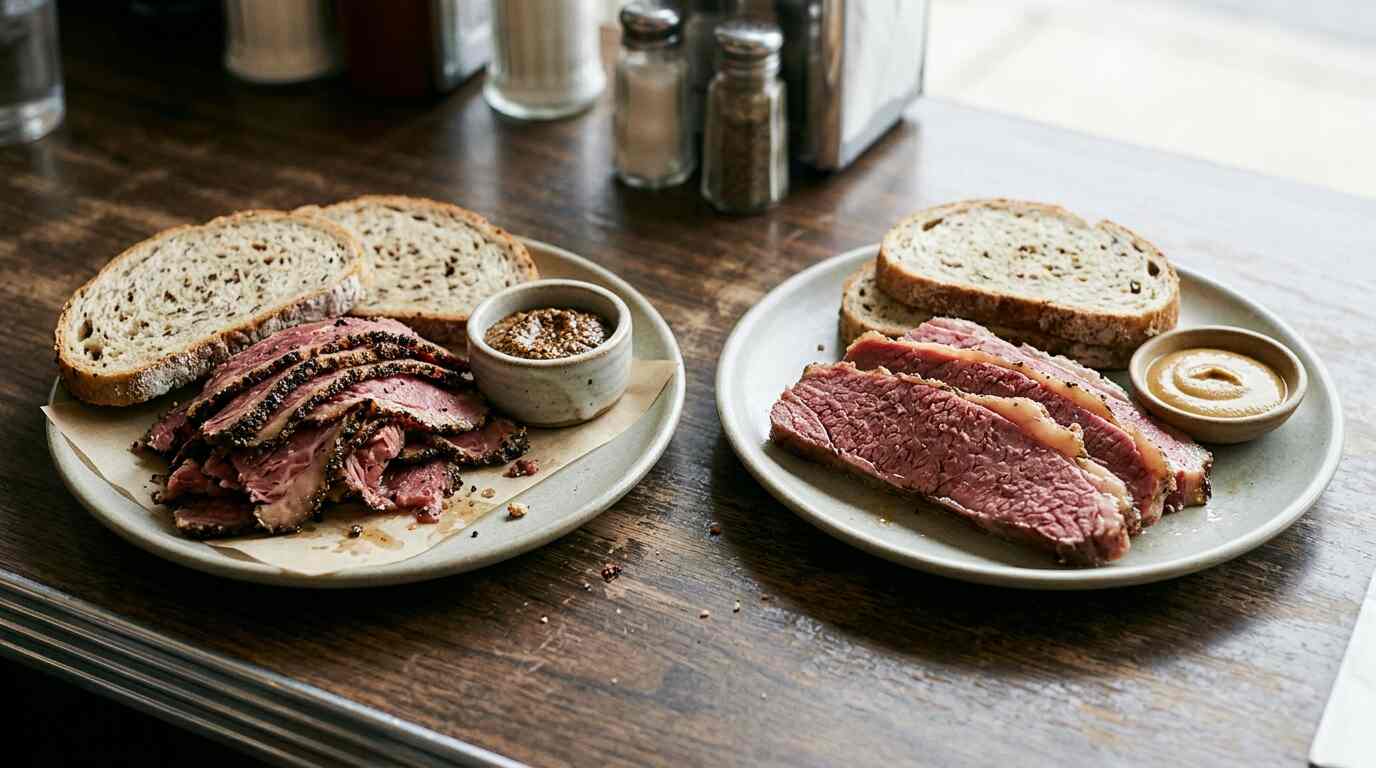
The Jewish deli as an institution came later than the meat. The World, drawing on Merwin’s book, reports that the first Jewish American deli opened in New York in 1888, with a photograph captioned as Katz’s, and that the deli and its signature sandwiches became standard in the 1920s. For the first immigrants who founded these places, Merwin says, pastrami and similar meats were expensive luxuries: “the caviar of Eastern European Jewish life.”
Between the wars, access to rich meat came to stand for a climb out of poverty. The same article says delis became a refuge from widespread antisemitism, a place near the theater district to mingle with stage and screen stars, and, in Merwin’s words, a Sunday-night replacement for “Friday night in the synagogue.” As American Jews moved up economically, the deli’s central place in community life faded, though the sandwich kept its standing.
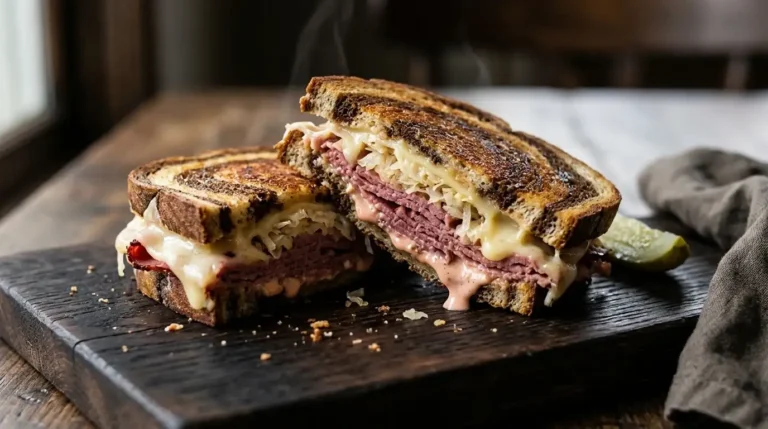
Most new-world Jewish delis began as kosher butcher shops, according to Saveur, and salting meat is part of kosher certification, which helped drive the curing traditions. Tasting Table’s description of the finished sandwich is simple: meat piled high between two slices of rye bread. Tasting Table also describes the Reuben, with Swiss cheese, sauerkraut and Thousand Island or Russian dressing, as a pastrami-on-rye sandwich for non-kosher diners. The contested origin of that sandwich, Omaha against New York, is covered in the post on the Reuben sandwich.
How pastrami differs from corned beef
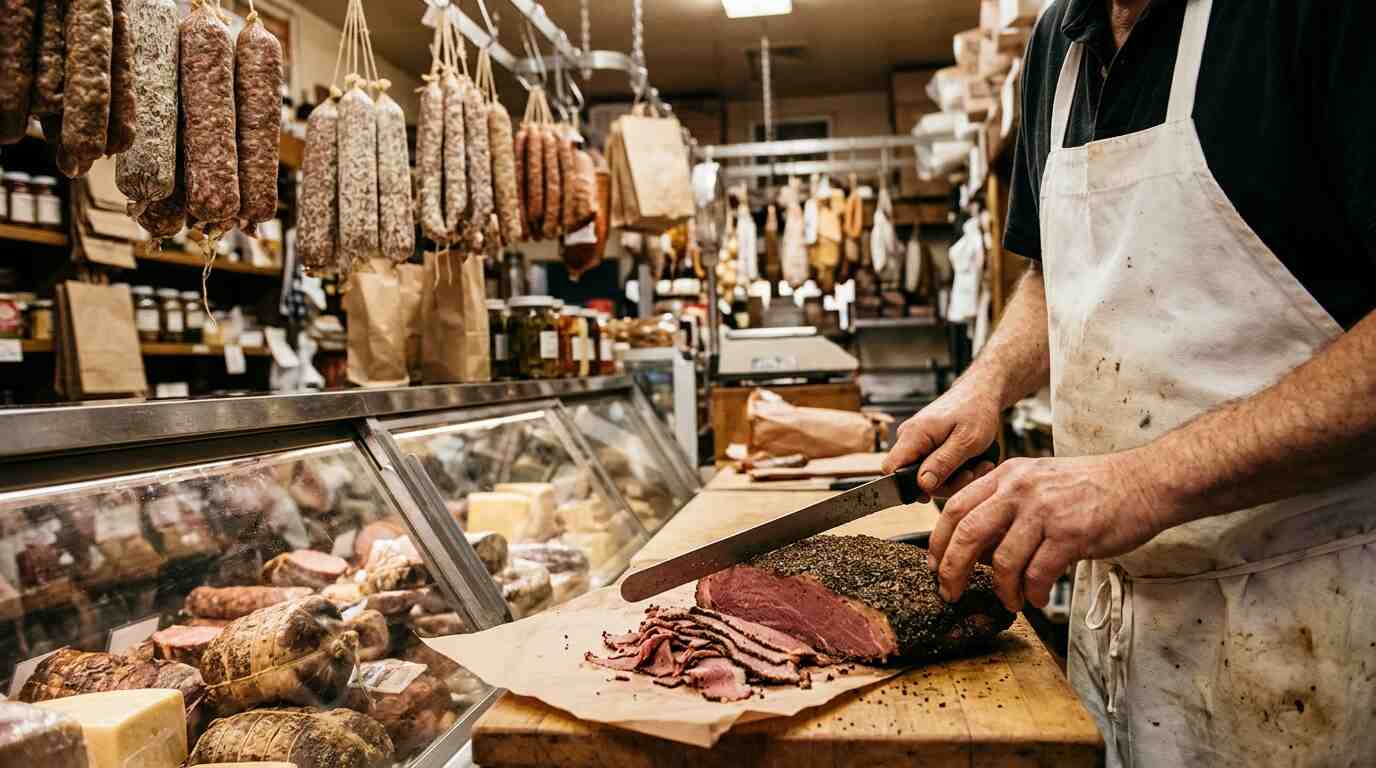
Both meats begin as cured beef, and the confusion is old. The differences lie in cut, seasoning and finishing, and the sources do not agree on every detail.
Food Network lists the cuts first. Corned beef comes from flat-cut brisket, leaner and easier to slice, while pastrami comes from point-cut brisket with more marbling, with deckle or navel also used. The Kitchn says pastrami can come from brisket, navel or deckle, and that corned beef comes only from brisket. Mental Floss gives pastrami’s cut as the shoulder, or deckle, sometimes brisket. Saveur names brisket or navel, both tough and sinewy.
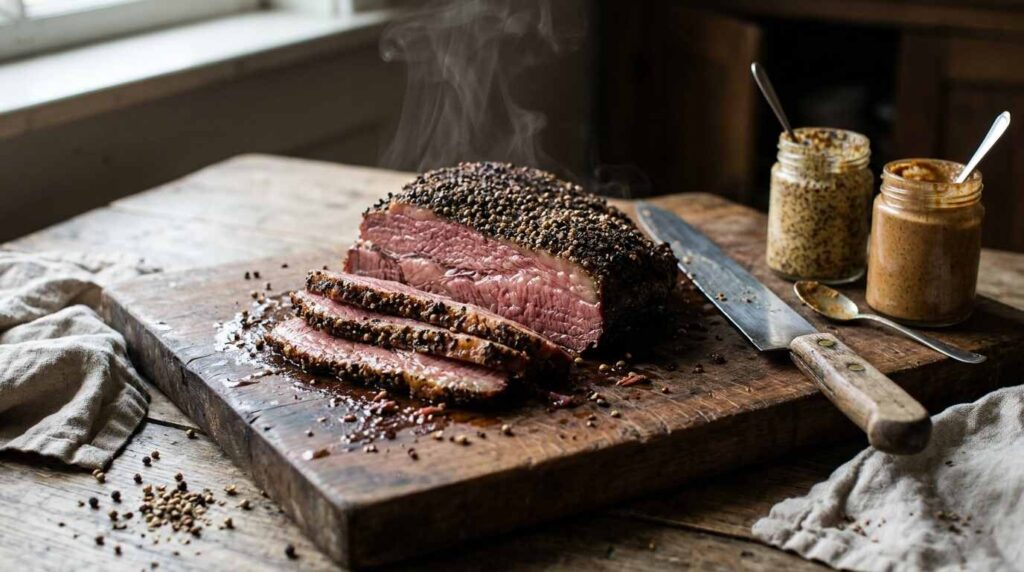
The brines are close. Food Network says both are cured in a salt-and-spice brine with garlic, peppercorns, bay and mustard seed, and that both take their reddish-pink color from pink curing salts. The break comes after curing. Pastrami gets a thick coat of crushed black pepper, coriander, mustard seed and garlic, then is cold smoked and steamed. Corned beef skips the coating and the smoke, and is boiled or slow-cooked, often in a boiled dinner with cabbage, potatoes and carrots.
The Kitchn compares the results as salty with a subtle sour note and a salami-like taste for corned beef, against rich, smoky and heavily spiced for pastrami. Mental Floss notes that corned beef “doesn’t actually contain any corn”; the term refers to corn as a way of preserving meat with salt. Mental Floss also says Irish immigrants first made corned beef from pork and switched to beef once it was more widely available in America. Saveur places the corned beef tradition in medieval England or Ireland, later adapted by Ashkenazi Jews in Germany.
Texture follows method. Food Network describes pastrami as fall-apart tender and fattier, cut thin for deli sandwiches, often on rye, and corned beef as firmer and leaner, cut thick for boiled dinners or Reubens.
Sources:
- Andrew Silverstein, “Where does pastrami really come from?” (The Forward, republished by the St. Louis Jewish Light): https://stljewishlight.org/top-story/where-does-pastrami-really-come-from
- Tasting Table, “The Origins Of NYC’s Famous Pastrami Sandwich”: https://www.tastingtable.com/1089840/the-origins-of-nycs-famous-pastrami-sandwich
- Tasting Table, “How Pastrami Took Over New York City”: https://www.tastingtable.com/1634988/why-pastrami-is-associated-with-new-york
- Saveur, “Meats of the Deli”: https://www.saveur.com/article/Travels/Meats-of-the-Deli/
- InsideHook, “Where Did Pastrami Come From?”: https://www.insidehook.com/food/where-did-pastrami-come-from/amp
- The World (PRX), “Pastrami on rye: A full-length history of the Jewish deli”: https://theworld.org/stories/2016-03-31/pastrami-rye-full-length-history-new-york-jewish-deli
- CityLore, “Katz’s Delicatessen”: https://citylore.org/?p=21707
- Food Network, “Corned Beef vs Pastrami: What’s the Difference?”: https://www.foodnetwork.com/how-to/packages/food-network-essentials/corned-beef-vs-pastrami
- The Kitchn, “What’s the Difference Between Pastrami and Corned Beef?”: https://www.thekitchn.com/pastrami-vs-corned-beef-23515959
- Mental Floss, “Pastrami vs. Corned Beef: What’s the Difference?”: https://www.mentalfloss.com/food/pastrami-vs-corned-beef-what-is-difference
- Grill Cheesy, “Who Invented the Reuben Sandwich? Omaha vs. New York”: https://grillcheesy.com/reuben-sandwich/
- The Nosher (YouTube), “The History of Pastrami”: https://www.youtube.com/watch?v=yJ_MTVg1jYQ