In this story
The jar is sold under two names. East of the Rocky Mountains it says Hellmann’s; west of them it says Best Foods. The mayonnaise inside started in a delicatessen on Manhattan’s Columbus Avenue, run by a German immigrant named Richard Hellmann, and the brand’s own timeline and outside histories disagree on when that deli opened and whose recipe went into the first batch.
Video: Hellmann's Real Mayonnaise Heritage Story, from the UFS ANZ YouTube channel
Columbus Avenue, 1905 or later
The deli date is the first split. CooksInfo, in a sourced biography first published in 2013, says Hellmann arrived in New York in October 1903 after working in London for Crosse & Blackwell, took a $9-a-week job at the grocer Francis H. Leggett Co., and in mid-1905 rented a former tailor shop at 490 Columbus Avenue for a delicatessen. NPR’s 2013 Weekend Edition segment, Mayonnaise Turns 100, by food commentator Bonny Wolf, also puts the deli in 1905.
Hellmann’s own Our Story timeline tells it later and in a different order. It says Richard married Margaret, the daughter of deli owners, in 1913, that the couple opened Hellmann’s Delicatessen that year, and that in 1920 the deli opened on Columbus Avenue, where Richard began making his mayonnaise.
Whose recipe
The second split is the recipe itself. NPR says Hellmann sold mayonnaise made from his wife’s recipe, with eggs, oil and vinegar. The U.S. brand timeline credits Richard. CooksInfo says Hellmann developed a new recipe in 1912 and began selling it in the store.
The blue ribbon came from a two-tier lineup. NPR says Hellmann first made two grades and put a blue ribbon on the better one; the brand timeline tells the same story and dates it to 1925.

Jars, ribbons and trademarks
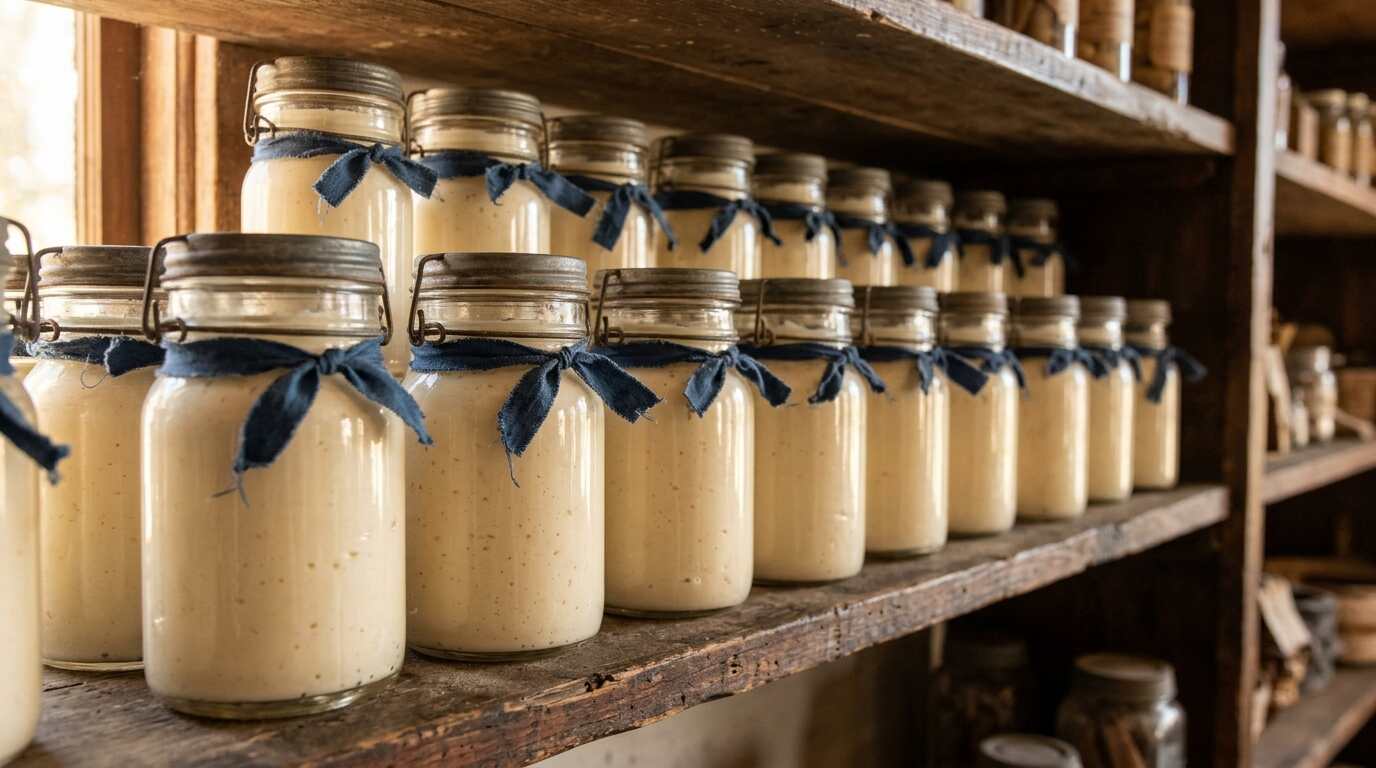
CooksInfo gives the most granular dates. It says that on September 1, 1912, Hellmann began selling mayonnaise in clear-glass jars in two sizes, which customers could reuse for home canning, with replacement rubber rings for a penny each. It says he applied in November 1913 to trademark the ribbon graphic, and in May 1914 simplified it to a single ribbon trademarked with the name “Blue Ribbon Mayonnaise.” NPR dates the Blue Ribbon trademark to 1913.
Before the jars, CooksInfo says, bulk mayonnaise went to hotels in one-gallon stone jars. NPR adds that early demand was high enough that Hellmann sold it in the wooden bowls used for weighing butter.
Queens factories
The business outgrew the deli quickly. CooksInfo says Hellmann sold the store at the end of 1914, opened a temporary factory at 120 Lawrence Street in Manhattan in 1915, moved to a larger plant on Steinway Street in Long Island City by the end of that year, and built a five-story factory at 34-08 Northern Boulevard in Long Island City in 1922. NPR says that by the late 1920s the company was making three tons of mayonnaise an hour.
Postum, Best Foods and the Rockies
The sale is dated two ways. Hellmann’s timeline and CooksInfo say Postum Foods acquired the brand in 1927; CooksInfo specifies August 1927, says Hellmann sold to Marjorie Merriweather Post’s company, and puts annual sales then at about $15 million with roughly $1 million in profit. NPR says Hellmann’s merged with Best Foods, a West Coast mayonnaise maker, in 1932.
The result was a map. Both NPR and the brand say the product is sold as Hellmann’s east of the Rockies and Best Foods west of them. Hellmann’s timeline adds that Unilever acquired both brands in 2000, the squeeze bottle arrived in 2014, and the “Bring out the Hellmann’s” and “Bring out the best” taglines date to 1987.
NPR’s segment also passes along a family story, told as such: that Richard Hellmann nearly sailed on the Titanic and changed his mind at the last minute.
Hellmann died on February 2, 1971, at 94, according to CooksInfo.

On a sandwich
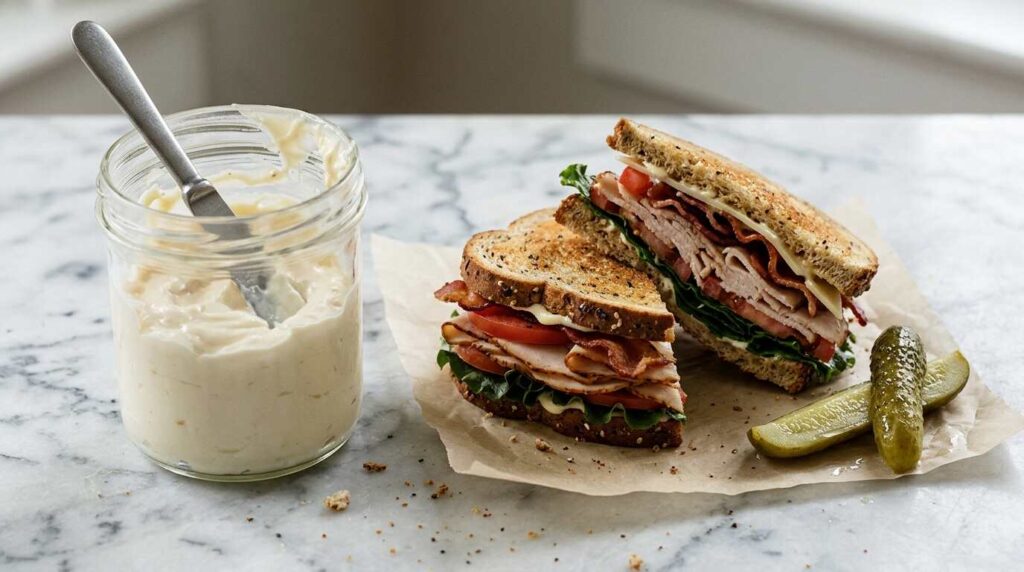
Mayonnaise is a regular on Grill Cheesy. Duke’s mayonnaise covers the Southern rival, mayonnaise vs. Miracle Whip covers the other jar on the shelf, and aioli vs. mayonnaise covers the garlic side.
- Hellmann’s Real Mayonnaise Classic 30 oz: the Blue Ribbon jar sold east of the Rockies. See it on Amazon (affiliate link)
- Best Foods Real Mayonnaise Classic 48 oz: the same product under its western name. See it on Amazon (affiliate link)
- Hellmann’s Real Mayonnaise 20 oz, Mayo Squeeze, Sandwich Spread, 3PK: the squeeze bottle the brand dates to 2014. See it on Amazon (affiliate link)
- Hellmann’s Plant Based Mayonnaise Squeeze Bottle Spread & Dressing 11.5 oz: the egg-free version. See it on Amazon (affiliate link)
As an Amazon Associate I earn from qualifying purchases. A commission may be earned if you buy through this link, at no extra cost to you.
Questions people ask
Who invented Hellmann’s mayonnaise? Richard Hellmann, a German immigrant deli owner in New York; NPR credits his wife Margaret’s recipe.
When was Hellmann’s mayonnaise created? CooksInfo dates jarred sales to 1912; NPR dates the trademark to 1913.
Why is Hellmann’s called Best Foods in the West? After the merger, the product kept both names: Hellmann’s east of the Rockies, Best Foods west.
Where was the first Hellmann’s deli? 490 Columbus Avenue in Manhattan, per CooksInfo.
Who owns Hellmann’s? Unilever, since 2000.
Sources
- CooksInfo, “Richard C. Hellmann, creator of Hellmann’s Mayonnaise” (October 5, 2013; updated October 26, 2020): https://www.cooksinfo.com/richard-c-hellmann
- NPR, Weekend Edition, Bonny Wolf, “Mayonnaise Turns 100” (2013): https://www.npr.org/transcripts/197229890
- Hellmann’s, “Our Story”: https://hellmanns.com/us/en/our-story.html