In this story
Thomas’ English Muffins are griddle-baked, yeast-raised rounds sold split rather than sliced, so the inside stays rough and pitted. The brand traces itself to a bakery that an English immigrant, Samuel Bath Thomas, opened in Manhattan’s Chelsea in 1880. The company says he created the product that year. Other accounts put the date later, and the phrase “English muffin” was in American print before his bakery opened.
Video: Food Factory USA: Texturizing an English Muffin, from the Home.Made.Nation YouTube channel
Plymouth to Ninth Avenue
The outline is consistent across sources. Barry Popik, the New York word historian, summarizes on his site a New York Times account that Thomas was born in Plymouth, England, in 1855, came to New York, and opened a bakery in 1880 at 163 Ninth Avenue in Chelsea.
Raanan Geberer of Our Town / NY Press wrote in May 2016 that Thomas had emigrated in 1874 and used a recipe he brought with him. A plaque now marks the Ninth Avenue site. Geberer adds that Thomas first sold to hotels and restaurants rather than the public, and delivered first by pushcart and later by horse-drawn wagon.
Demand pushed him into a second building. Nicholas Loud of Untapped New York reported in June 2020 that early in the 20th century the company bought 337 West 20th Street, a former foundry built in 1850 with an oven already in its basement.
1880 or 1894
The company’s own about page is direct: in 1880, it says, Samuel Bath Thomas created the original “Nooks & Crannies” English muffin.
Karen Hochman of The Nibble, in a September 2010 history, gives a different year. She writes that Thomas invented the English muffin in 1894, and that it was first called a “toaster crumpet.”
The two dates are not necessarily in conflict about the bakery, which all sources place in 1880. They disagree about when the product itself took the form the brand sells. None of the sources fetched for this post explains the 1894 date or what document it rests on.
The name came first
There is a second problem with calling Thomas the inventor. The term was already in use. Popik lists an 1871 citation in Appletons’ Journal describing a tea table with “the tripod throne of English muffins,” and an 1874 one about a character who breakfasted on English muffins and souchong tea. Both predate the Ninth Avenue bakery.
In England, Popik notes, the thing was simply called a muffin. Hochman draws the line between it and the crumpet: a crumpet is not split and shows its holes on top, while the English muffin is a variation of the crumpet with the holes inside.
What Thomas can be credited with, on the evidence fetched here, is a particular product and the brand that grew from it, not the English muffin as a category.

Nooks and crannies
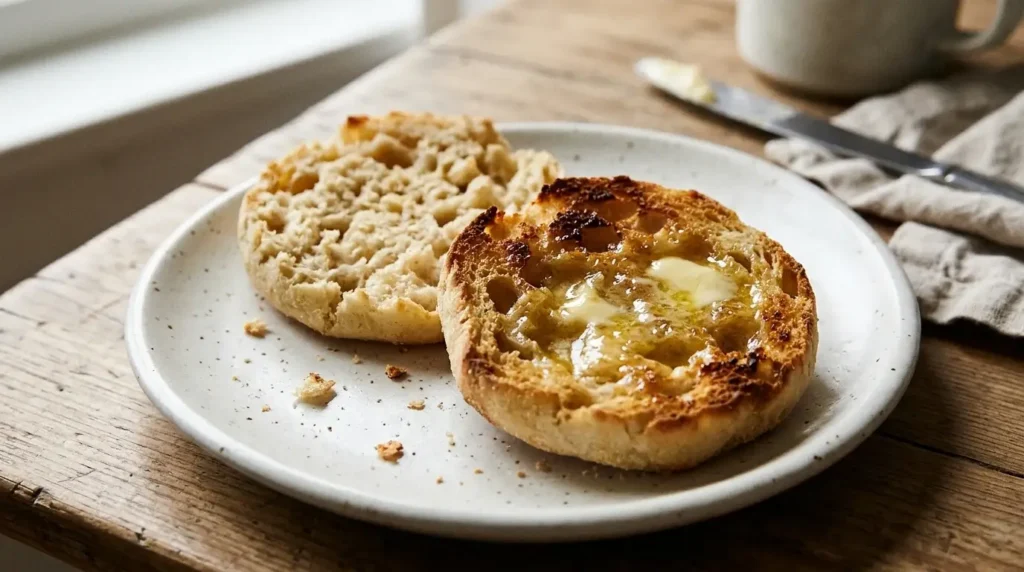
The texture is the selling point, and the company has built its advertising on it for decades. Hochman wrote in 2010 that Thomas’ had been advertising nooks and crannies for about 30 years. Popik records an older ad line about nooks and crannies that hold the melted butter.
The company attributes the texture to griddle baking, a process it calls unchanged since the start, and to a coarse-grained, yeast-raised dough. Its muffins are split, not sliced. Geberer defines the nooks as the ridges and small depressions in the muffin’s texture.
What happens to that rough surface in a toaster is a question of browning chemistry, covered in the Maillard reaction and bread browning.
The oven under the courtyard
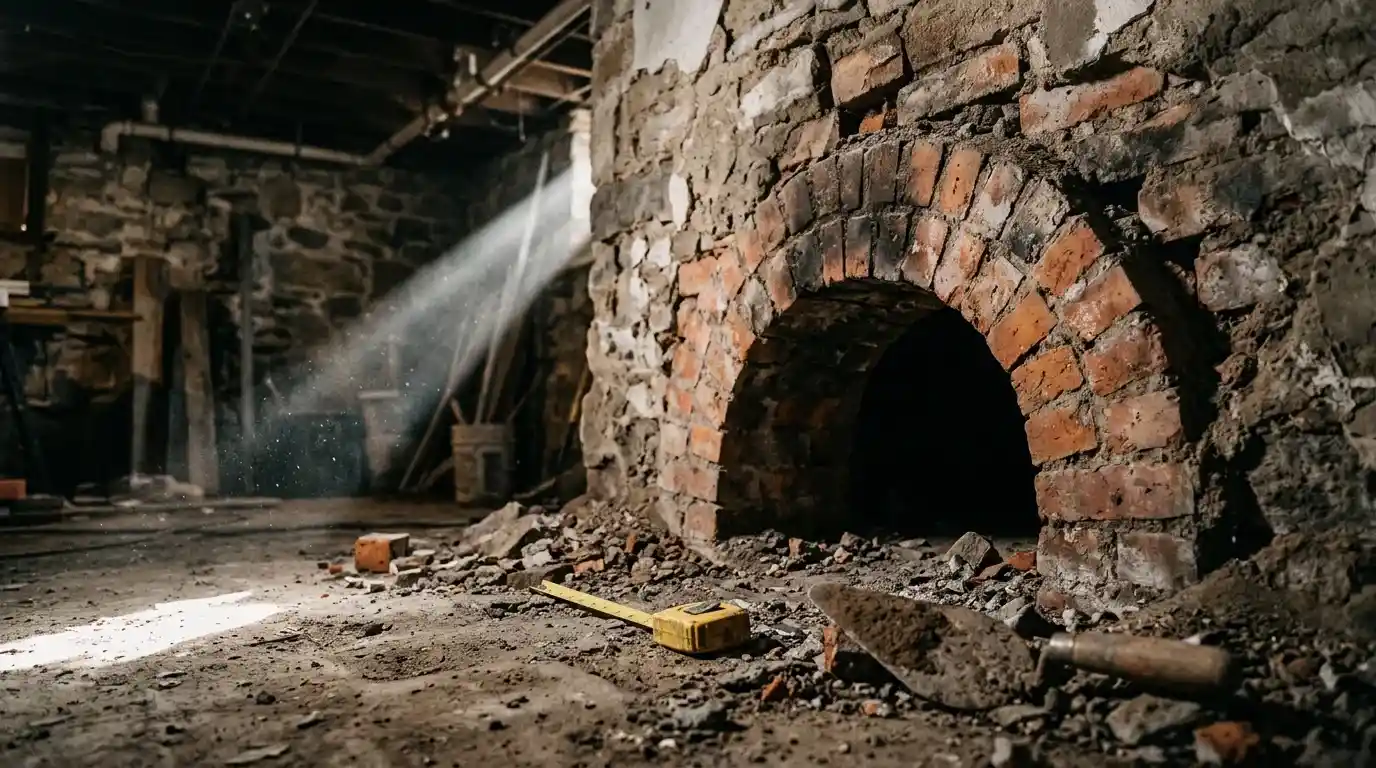
The second bakery outlived the business there. Loud reports that the basement oven at 337 West 20th Street was forgotten until 2006, when residents Mike Kinnane and Kerry McInerney found its bricks during a renovation. An urban archaeologist and an engineer from George Weston, then the brand’s parent, assessed it and confirmed it had been the center of Thomas’ second bakery.
Geberer adds that George Weston Bakeries looked into moving the oven, but it could not be removed. The building is now an 11-unit co-op, according to Loud, with the residents’ courtyard above the oven and a plaque naming it the Muffin House.

Owners and dates
The corporate history is better documented than the invention. Popik’s summary says Thomas died in 1919, his daughters and nephew inherited the business and opened a bakery in Long Island City, Queens, in 1922, and that the company was acquired in 1970 by what is now Bestfoods. Geberer also gives 1919 as the year of death.
Hochman’s account says the family incorporated S.B. Thomas, Inc. in 1922 after his death, and registered the “Thomas” trademark on August 3, 1926. The accounts fit together: death in 1919, a new bakery and incorporation in 1922.
The brand is now part of Bimbo Bakeries USA. Geberer reported in 2016 that Thomas’ Breads was a division of Bimbo, which also owns Entenmann’s and Sara Lee. The company’s timeline lists expansion to Philadelphia and New England in 1940, bagels in 1991 and a protein muffin in 2025.
As sandwich bread
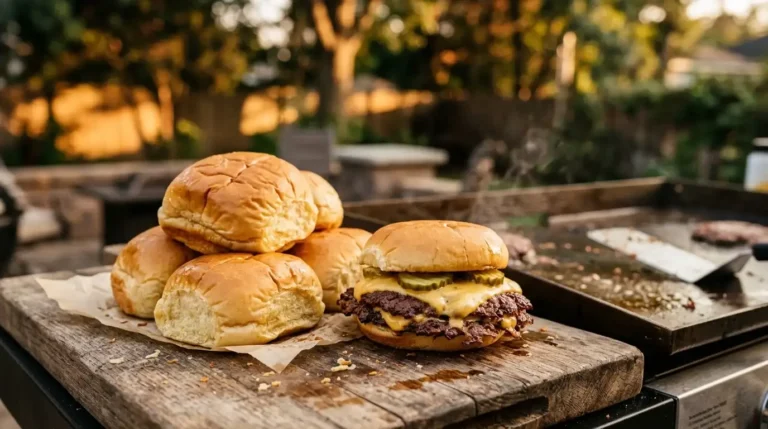
Split, the muffin gives two flat halves, and that shape has made it a breakfast sandwich bread. Its best-known use is the Egg McMuffin, built on one. The company’s about page says restaurants, chefs and fast food chains have put its muffins on their menus, without naming them.
Questions people ask
Who invented the English muffin? Thomas’ credits Samuel Bath Thomas in 1880. The phrase “English muffin” appears in American print by 1871, per Barry Popik, so Thomas is better described as the creator of the Thomas’ product than of the category.
When did Thomas’ start? The bakery opened at 163 Ninth Avenue in 1880. The Nibble dates the product to 1894.
Why does Thomas’ say to split the muffin? The company says its muffins are split, not sliced, which keeps the inside rough.
Where is the Muffin House? At 337 West 20th Street in Chelsea, where Thomas’ second bakery stood and its oven remains under the courtyard.
Who owns Thomas’ now? Bimbo Bakeries USA.
Sources
- Barry Popik, The Big Apple, English Muffin (Dec. 11, 2004): https://barrypopik.com/blog/english_muffin
- Raanan Geberer, Our Town / NY Press, Nooks and crannies’ Chelsea pedigree (May 13, 2016): https://www.nypress.com/news/local-news/nooks-and-crannies-chelsea-pedigree-CVNP1020160516160519961
- Nicholas Loud, Untapped New York, Chelsea “Muffin House” Tells the Hidden History of the English Muffin (June 5, 2020): https://untappedcities.com/2020/06/05/chelsea-muffin-house-tells-the-hidden-history-of-the-english-muffin/
- Thomas’ Breads, About: https://thomasbreads.com/about
- Karen Hochman, The Nibble, English Muffin History (Sept. 2010): https://thenibble.com/REVIEWS/main/breadstuffs/english-muffin-history.asp