In this story
Portugal runs on two hot meat sandwiches. The bifana is thin pork simmered in a garlicky sauce and stuffed into a crusty roll; the prego is a garlic-pounded beef steak in bread. Both are cheap, both are eaten standing at café counters with a beer, and both come with a town that claims to have invented them and no document that settles it.
Video: Vendas Novas Bifanas – The secret is in the sauce!, from the Paulo Oliveira YouTube channel
The bifana and Vendas Novas
A café on the EN4
The bifana’s claimed birthplace is Vendas Novas, an Alentejo town on the old road between Lisbon and Évora. A January 2017 report by Rute Sousa Vasco for SAPO 24, drawing on the Lusa news agency, said the sandwich began in a café beside the EN4 national road, serving motorists who stopped on the drive through town.
The town treats it as an industry. Mayor Luís Dias told Lusa that about 12 to 15 establishments in Vendas Novas focus almost entirely on bifanas, and estimated sales at about 3,000 a day, roughly 90,000 a month and close to a million a year. He also said the sector employs hundreds of people in the cafés and in the local bakery that supplies the bread.
Café Boavista was described in the same report as the oldest and most traditional of the town’s bifana cafés, and probably the busiest. Its owner, Maria Clara Isabel, said it sells about 300 bifanas a day and 400 to 500 on busy weekends, using pork loin cut and pounded in-house and toasted rolls. The rest of the family recipe, she said, is secret.
Who invented it
Vendas Novas against Casa Branca
Nobody has proved the claim. The same SAPO 24 report quoted the mayor saying the origin story had not yet been documented, and said the municipality planned to research it. The council had already registered “Bifanas de Vendas Novas” as a trademark with Portugal’s national industrial property institute, INPI, about five years before the article.
A rival exists. Dan Špaňhel, writing on the travel food site Jídlo na cestách in July 2022, reported that the railway settlement of Casa Branca, also in the Alentejo, says bifanas were handed to travellers at its station in the days of steam. Špaňhel noted that neither town has documentary proof, and dated the Vendas Novas trademark to 2011.
Wikipedia’s bifana entry, used here only as a pointer, says the name translates as “small steak.”

North and south
Pale sauce, dark sauce, lard
The sauce changes with the map. Špaňhel describes three styles: a pale, simple southern sauce of white wine, garlic and bay leaf; a darker, thicker and sharper Porto version, often made with beer or a splash of port; and an Alentejo method that cooks the meat slowly in lard without wine. The roll is a crisp-crusted papo-seco, dipped in the sauce again just before serving. Mustard goes on in the south; in the north, he writes, the sauce is enough. He paid 2.40 euros for a bifana at Conga in Porto.
Portugal.com’s bifana recipe by Becky Gillespie, published November 14, 2025, follows the southern line. For two sandwiches it calls for four thin slices of pork loin or shoulder, three minced garlic cloves, half a cup of dry white wine, two tablespoons of olive oil or lard, a teaspoon of paprika, salt, pepper and two papo-seco rolls. The pork marinates in the garlic, paprika and wine for at least an hour, browns in the fat for a few minutes per side, then simmers in the leftover marinade until the sauce thickens. The split rolls can be dipped in that sauce before the pork goes in, with mustard or piri-piri on the side.
The prego
A nail, or a man named Prego
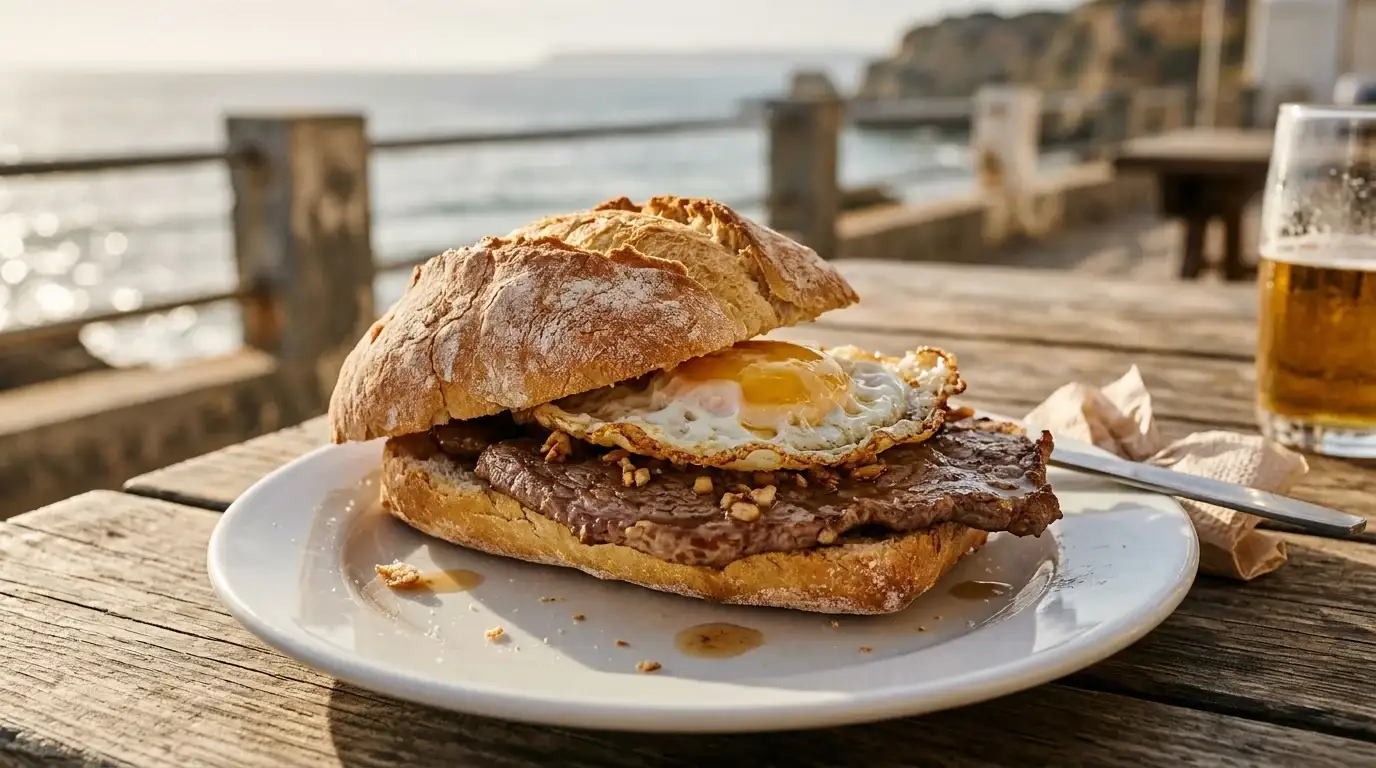
The prego is the beef half of the pair. Andrew Amelinckx, writing for Chowhound on December 31, 2024, described it as a garlicky steak sandwich on a split roll. Prego means “nail” in Portuguese, and one explanation for the name is the method: thin slices of garlic are pounded into the steak with a mallet, as if nailed in, before the meat is sautéed in butter. “No pão” means “in bread.”
The second explanation is a person. Amelinckx reported the story of Manuel Dias Prego, a 19th-century seaside tavern owner in Praia das Maçãs, about an hour west of Lisbon, who specialized in steak sandwiches that took his name. Jeffrey Merrihue of Xtreme Foodies, in a May 2025 post, backed the tavern version and reproduced a photo captioned as Prego’s tavern in Praia das Maçãs in 1889. Merrihue described the first pregos as beef tenderized with a hammer and dressed with its own juices, with garlic pounded in later. His post cites written and photographic evidence without naming any documents beyond that photo, and gives a second date of 1894 for it elsewhere.
Wikipedia’s prego entry), as a pointer, lists Sintra as the place of origin and Manuel Dias Prego as creator, citing a 1988 Sintra municipal history, Velharias de Sintra.
How Portugal eats them
At the counter, and after the fish
Both sandwiches are bar food. Amelinckx noted that recipes for the prego vary: some marinate the meat or cook it in wine or beer, and toppings run to mustard, piri-piri hot sauce or a fried egg. He also described the habit of eating a prego at the end of a meal, citing Anthony Bourdain eating one after a seafood dinner in Lisbon while filming No Reservations in 2012. Merrihue lists cheese, fried egg, mustard and hot sauce as additions that accumulated over the decades.
Other cuisines solved the same problem with different meat. Uruguay’s national steak sandwich is the chivito, and Philadelphia’s is the cheesesteak of Pat’s and Geno’s. The crusty roll matters as much as in a kaiser roll sandwich, and a serrated bread knife splits a papo-seco without crushing it.
Questions people ask
What is a bifana? A Portuguese sandwich of thin pork simmered in a garlic sauce, usually with wine, served in a crusty papo-seco roll.
Where does the bifana come from? Vendas Novas in the Alentejo claims it and holds the “Bifanas de Vendas Novas” trademark; Casa Branca also claims it. Neither claim is documented.
What is the difference between a bifana and a prego? The bifana is pork in sauce; the prego is a beef steak, typically pounded with garlic and cooked in butter.
What does prego mean? Nail. The name is explained either by garlic being pounded into the steak or by tavern owner Manuel Dias Prego of Praia das Maçãs.
What goes on a bifana? Mustard in the south and piri-piri for heat; in Porto, the darker sauce is often eaten on its own.
For the table
- Maçarico Hot Sauce (Piri-Piri): a Portuguese piri-piri hot sauce for bifanas and pregos. See it on Amazon (affiliate link)
As an Amazon Associate I earn from qualifying purchases. A commission may be earned if you buy through this link, at no extra cost to you.
Sources
- Rute Sousa Vasco with Lusa, SAPO 24, Sai uma bifana, aliás três mil ao dia e um milhão ao ano (Jan. 17, 2017): https://24noticias.sapo.pt/vida/artigos/sai-uma-bifana-alias-tres-mil-ao-dia-e-um-milhao-ao-ano
- Dan Špaňhel, Jídlo na cestách, Bifana (July 21, 2022): https://www.jidlonacestach.cz/en/bifana/
- Becky Gillespie, Portugal.com, The Bifana: Portugal’s Beloved Pork Sandwich (Nov. 14, 2025): https://www.portugal.com/recipes/the-bifana-portugals-beloved-pork-sandwich/
- Andrew Amelinckx, Chowhound, How Portugal’s Iconic Steak Sandwich, The Prego, Got Its Name (Dec. 31, 2024): https://chowhound.com/1747095/portugese-sandwich-steak-prego
- Jeffrey Merrihue, Xtreme Foodies, Birth of Portugal’s greatest sandwich (May 15, 2025): https://xtremefoodies.substack.com/p/birth-of-portugals-greatest-sandwich
- Wikipedia, Bifana (pointer only): https://en.wikipedia.org/wiki/Bifana
- Wikipedia, Prego (pointer only): https://en.wikipedia.org/wiki/Prego_(Portuguese_sandwich)