In this story
The story is told the same way almost everywhere: John Montagu, 4th Earl of Sandwich, would not leave the gaming table, asked for meat between slices of bread, and gave his title to the result. The sandwich is named after him, and that part is rarely disputed. Almost everything else in the tale rests on a single paragraph in a French travel book, one diary line, and a good deal of repetition.
Video: Why Is It Called a ‘Sandwich’?, History of Simple Things
What the early writers actually recorded is thinner than the legend, and in places it points somewhere else. The word turns up in writing before the gambling story does. The gambling story names no one. A modern biographer of the Earl has argued for a different setting altogether. And bread wrapped around a filling was being eaten long before anyone in London needed a word for it.
Why is it called a sandwich?
The short answer, given by most reference works, is that the food carries the title of the Earl of Sandwich. The Oxford English Dictionary, as quoted by Grammarphobia, says the word comes from the Earl “who once spent twenty-four hours at the gaming-table without other refreshment.” That sentence is a summary of Grosley’s story, not an independent record of what happened.
A page on Foods of England notes that the origin of the word is not entirely clear, and floats two other possibilities: the Kent town, and a type of cord or rope that was called “sandwich” as far back as the 1400s. The same page treats the Earl as the generally assumed source while stating that his habit of eating while playing cards is an often repeated story, not a verified one.
The writers who study the word closely land in roughly the same place. The Word Histories entry by Pascal Tréguer calls the connection to the Earl the traditional account and sets out what the earliest documents really say. The Word Origins database calls the naming itself very likely, since no other plausible explanation has turned up, while questioning the gambling detail.

The 1762 date
The year 1762 is the one usually attached to the legend, and a report on the town of Sandwich’s anniversary celebration calls that year the first written record of the sandwich. The record in question is a journal entry by the historian Edward Gibbon, a member of the Cocoa Tree club in London.
Gibbon described the club’s evening scene: twenty or thirty of the first men in the kingdom for fashion and fortune, supping at little tables, upon “a bit of cold meat, or a sandwich”, and drinking a glass of punch. That passage is reproduced from John Timbs’s Club Life of London (1866). Secondary sources disagree about the day of the entry. Word Histories and Grammarphobia give 14 November 1762, while the Timbs reproduction and the Food Timeline, citing the OED, give 24 November. All agree on the year and month.
Two things stand out about the entry. Gibbon does not mention the Earl. And he uses the word without explanation, the way a writer does when the reader already knows the food. The Foods of England page reads that as a hint that the dish was already familiar, and possibly not yet tied to Montagu at all. The entry also predates Grosley’s visit to London by about three years, which matters for the next piece of evidence.
Grosley’s account of the minister at the gaming table
The only contemporary text that connects a sandwich to a long gambling session is Pierre-Jean Grosley’s Londres. Grosley (1718 to 1785) was a French man of letters from Troyes who spent a year in London in 1765. His book appeared in 1770, and Thomas Nugent’s English translation, A Tour to London, was published by Lockyer Davis in 1772.
The passage describes a minister of state who sat at a public gaming table for four and twenty hours and lived on a piece of beef, between two slices of toasted bread. In Grosley’s telling, the dish took its name from the minister and was adopted because it saved time. Word Histories gives the French original and notes that Grosley says the dish gained favor while he was living in London.
Three details limit what the passage can prove.
No name is given. Grosley writes about “a minister.” The link to Montagu is an inference from timing: Wikipedia’s list of his offices shows him as Secretary of State for the Northern Department from 1763 to July 1765, which would make him a minister during Grosley’s stay. The same page notes that the earliest version of the legend is Grosley’s.
The word was older than the story. Word Origins points out that Grosley wrongly implies the word was freshly coined when Gibbon had already used it in 1762, and suggests the tale may be older gossip, possibly revived when Montagu returned to government.
It is a toasted sandwich. The meat sits between two slices of toast, which, as the Foods of England page puts it, means the account may not tell the whole story of the food Gibbon was eating.
Nugent’s translation of the passage appears on page 149 of the 1772 edition, according to the Wikipedia article on the Earl. Sources differ on where the original 1770 edition was printed, with Lausanne named in Word Origins and Neuchâtel in Wikipedia.
Did the Earl of Sandwich invent the sandwich?
By the reading of every source above, no. Montagu is the namesake, and the claim to invention is another matter. The Takeout article states that he gave the sandwich its name without inventing the concept, and the lexicographer John Ayto, as paraphrased on Grammarphobia, says the idea was nothing new but that the Earl’s patronage gave it a vogue.
The most thorough challenge to the gambling story comes from his biographer, N. A. M. Rodger, in The Insatiable Earl (1993). As summarized on Word Histories, Rodger says of the gambling account: “There is no supporting evidence for this piece of gossip.” He still regards Montagu as the real source of the sandwich, and proposes that the Earl was eating at his desk during long working hours, given his duties in the navy, in politics, and in the arts, a view also noted on Wikipedia and in the Public Domain Review.
The desk theory has a problem of its own. Word Origins observes that Montagu held no government office in 1762, so the working-through-lunch scenario cannot explain the word in Gibbon’s entry. It also notes that Rodger describes Montagu’s gambling as restrained and social, and his scandals as more often romantic than financial.
The legend as most people know it adds a final flourish: friends at the table asking for “the same as Sandwich.” Wikipedia reports that version and adds that the gambling story may have been invented after the fact, since the Earl had many other habits, including membership in the Hellfire Club. The sources do not settle which setting, if any, is true.

Bread and filling before the Earl
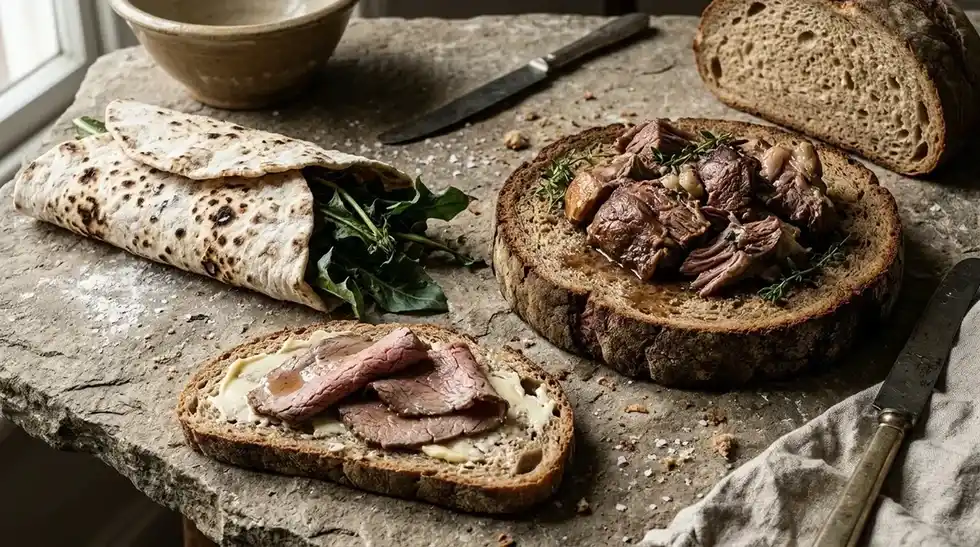
The idea of bread around food has a long and loosely documented past, and the sources vary in how much weight they put on it.
The Passover tradition. Rabbinic tradition credits the sage Hillel the Elder, placed by the Takeout in the first century BC, with eating the Passover lamb, matzah, and bitter herbs together. According to a YUTorah lecture, the source is the Gemara in tractate Pesachim 115a, and the commentators differ: Rashi has Hillel combining all three, while Rambam has him combining only the matzah and the bitter herbs. The Takeout calls the result closer to a wrap than a modern sandwich.
Trenchers. Medieval diners often ate from a flat round of stale bread that served as a plate; after the meal, a sauce-soaked trencher could be eaten or given to the poor, and the Wikipedia entry cites Singman for the form of the bread. That counts as bread under food rather than around it. The Food Timeline cites Renner (1944) tracing the sandwich to the buttered bread and thick slice used in Tudor England as a foundation for meat dishes.
Plain bread and meat. The phrases “bread and meat” and “bread and cheese” turn up in English plays of the sixteenth and seventeenth centuries, according to the Takeout. The same article says filled flatbreads were a popular snack in the Persian and Ottoman empires, thousands of years before the Earl was born in 1718. That is a general statement without specific dated examples.
Dutch bread and butter. Wikipedia’s sandwich article summarizes the naturalist John Ray’s 1673 Observations, in which Ray is said to describe Dutch taverns serving thin slices of hung beef laid on bread and butter, presented as something unfamiliar to English readers. The article cites the book on the Internet Archive.
Mediterranean roots. The Food Timeline cites the food historian Solomon Katz’s encyclopedia (2003) calling the sandwich “a culinary practice of ancient origins” among the Greeks and other Mediterranean peoples, and adds that literary references to sandwiches in English begin to appear in the 1760s. Grammarphobia relays a claim from the Larousse Gastronomique that farm laborers in rural France ate meat between slices of bread before the English word existed.
The pattern across the sources is consistent. The dish is old, the English word is from the early 1760s, and the Earl’s contribution, if the naming story holds, was fashion.
What the sources leave open
Four points remain unresolved by anything fetched for this article.
- Whether the Earl is the minister in Grosley’s account. Grosley never says so.
- Whether the gaming table or the writing desk produced the order for meat between bread. Rodger’s desk theory and the older gambling tale both lack a contemporary witness.
- The exact day of Gibbon’s journal entry, which secondary sources place on either the 14th or the 24th of November 1762.
- Why the word was in Gibbon’s pen before Grosley’s book appeared, if the dish only became fashionable during Grosley’s 1765 stay.
The Public Domain Review notes that the first American cookbook sandwich recipe appeared in 1815, and that a 1909 volume by Eva Green Fuller, The Up-To-Date Sandwich Book, was already offering 400 variations.
Sources:
- Wikipedia, Sandwich: https://en.wikipedia.org/wiki/Sandwich
- Wikipedia, John Montagu, 4th Earl of Sandwich: https://en.wikipedia.org/wiki/John_Montagu,_4th_Earl_of_Sandwich
- Wikipedia, Pierre-Jean Grosley: https://en.wikipedia.org/wiki/Pierre-Jean_Grosley
- Wikipedia, Trencher (tableware): https://en.wikipedia.org/wiki/Trencher_(tableware)
- Word Histories, “history of the word ‘sandwich'”: https://wordhistories.net/2017/03/23/sandwich/
- Word Origins, sandwich: https://www.wordorigins.org/big-list-entries/sandwich
- Grammarphobia, sandwich: https://grammarphobia.com/blog/2013/11/sandwich.html
- Foods of England, sandwich: https://foodsofengland.info/sandwich.html
- Food Timeline, sandwiches: https://foodtimeline.org/foodsandwiches.html
- Timbs, Club Life of London, via The Cocoa Club: https://pascalbonenfant.com/18c/clubs/jt_thecocoaclub.html
- The Takeout, “The Sandwich Was Not, In Fact, Invented By The Earl Of Sandwich”: https://thetakeout.com/1748638/who-invented-sandwich-earl
- The World, “Sandwich celebrates 250th birthday”: https://theworld.org/stories/2016/07/31/sandwich-celebrates-250th-birthday
- YUTorah, Korech: The Matzah and Maror Sandwich: https://yutorah.org/lectures/733678
- Public Domain Review, The Up-To-Date Sandwich Book (1909): https://publicdomainreview.org/collection/the-up-to-date-sandwich-book-400-ways-to-make-a-sandwich-1909
- Ray, Observations (1673), Internet Archive: https://archive.org/details/observationstopo00rayj