In this story
A tortilla press is two flat plates on a hinge with a lever on top. A ball of masa goes between them, the lever comes down, and a thin round of dough comes out. The tool is plain enough that its history is mostly unwritten, and the machines that came after it, the tortilladoras of Mexican tortillerías, have dates that sources still argue over.
Video: How To Use A Tortilla Press, from the Cook123 YouTube channel
Before the press
Hands came first. In a TASTE article by Abe Beame, published in April 2026, Los Angeles Times columnist Gustavo Arellano says tortillas were shaped by hand before presses, with the palms, a pin roller or a bottle, and puts the press itself at more than a century old based on records from early Mexican restaurants. His line on the subject: “the first tortilla presses were hands.”
Arellano ties the press to restaurants that needed uniform tortillas in volume. TASTE describes the design that won out: two heavy, flat-bottomed plates, round or square, usually wood or metal, joined by a hinge.
Banana leaves and a lever
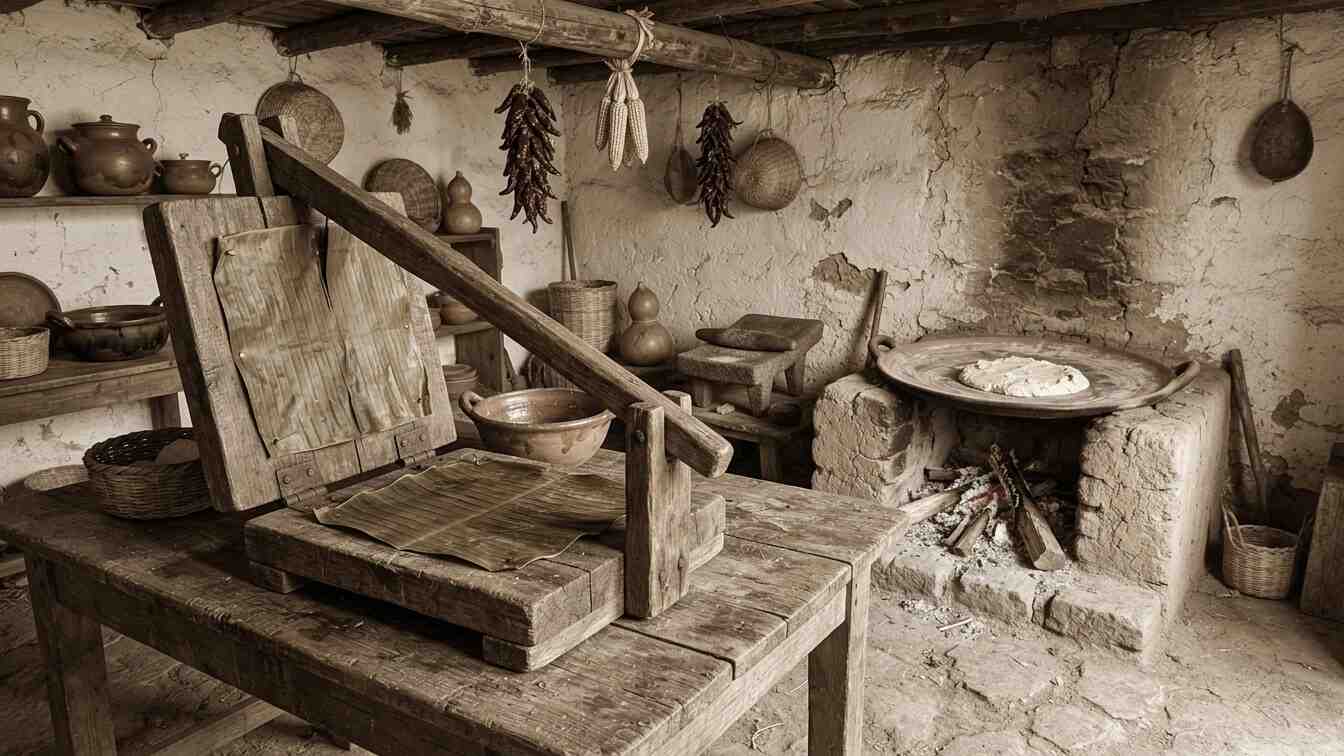
Early mechanical shaping shows up in Mexican sources from the first decade of the 20th century. Xataka México, in a 2018 history by Steve Saldaña, credits Ramón Benítez in 1905 with the first device to shape tortillas, pressing dough between two square plates with a lever, the plates lined with banana leaves so the masa would not stick. The same piece credits Everardo Rodríguez and Luis Romero with a 1904 machine that carried tortillas to the griddle, and says it could turn out 16,000 tortillas in a day.
Fausto Celorio and the tortilladora
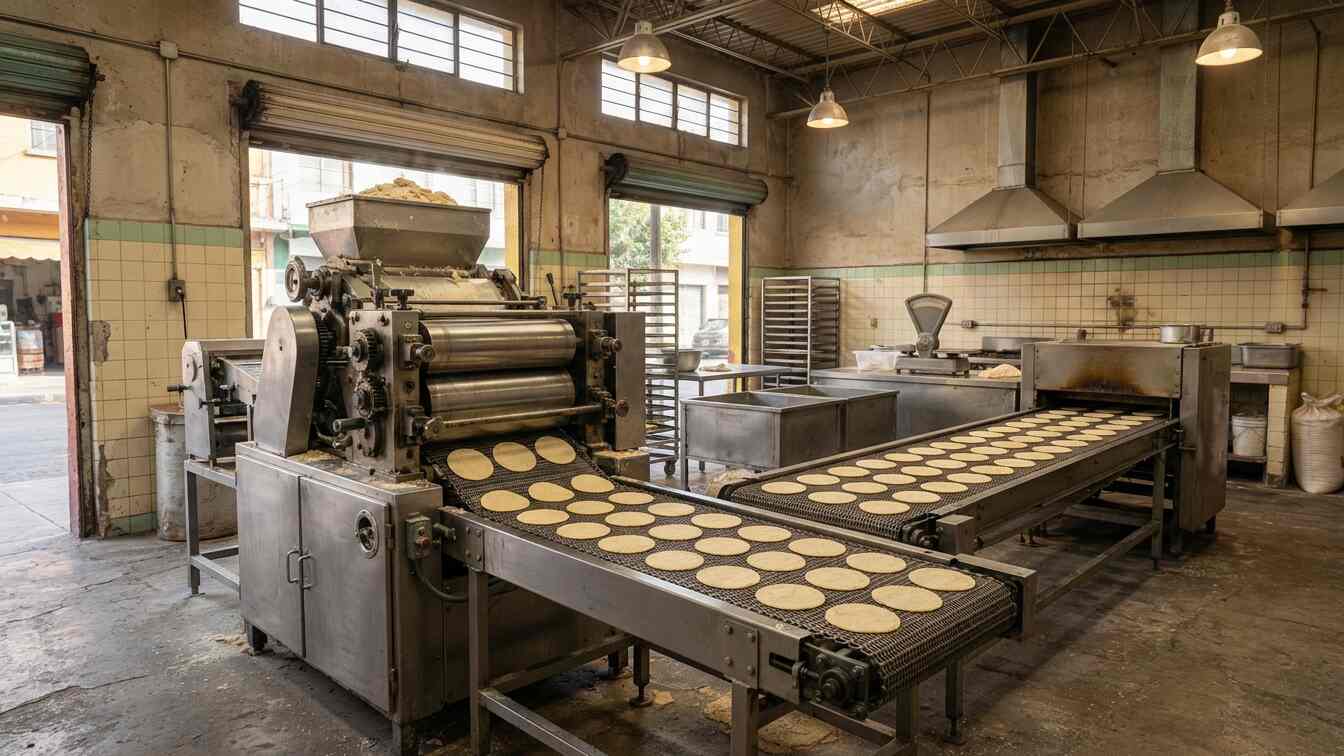
The machine that fills Mexican tortillerías is credited to Fausto Celorio Mendoza. The date depends on the source. Xataka says Celorio introduced roller-based pressing and transport in 1947, which is why he is remembered as the inventor of the tortilladora, then improved gas flow in 1959. Excélsior, in a July 2025 piece, says it was not until 1963 that Celorio created and patented a roller-system tortilladora; Excélsior cites no patent number.
The fuel story splits too. Xataka lists a first gas-fired model in 1920 and a petroleum-fired Romero model in 1921, while Excélsior credits Celorio’s machine with replacing petroleum with gas.
The sales figures come from one source. Xataka says Celorio sold 42,000 machines between 1960 and 1980, more than twice his main competitor, Oscar Verástegui, and credits him with more than 150 inventions.
Cast iron, aluminum, steel
The home press never went away. TASTE says most small presses are round and made of cast iron or aluminum, and that the company Masienda, founded by Jorge Gaviria, sells an 8-inch square rolled-steel model whose shape Gaviria first saw at Oaxaca’s Mercado de Abastos in 2014. According to the article, Enrique Olvera’s Cosme in New York was Masienda’s first press customer, and its chef de cuisine, Gustavo Garnica, says the larger square plate spreads the weight better and fits two tortillas at once.
Cosme, per TASTE, makes roughly 200 tortillas an hour during service.
Not only tortillas
The press flattens other things. TASTE reports that Cosme uses its presses for plantains and other flattened vegetables, that Luis Eduardo Swain re-fries pressed plantains for tostones, a method he learned from his mother in California, and that Jesse Jenkins presses tuna between plastic sheets for carpaccio. One experiment, Jenkins’s smashed cucumber salad, did not survive the press.
Retail listings reflect that range: Victoria’s presses are sold for roti and flour tortillas and also labeled “pataconera.”
On the sandwich side, a pressed tortilla is the base of the quesadilla and the burrito, and Grill Cheesy has taken up the question of whether a burrito is a sandwich.

Press, masa and griddle
- Victoria Cast Iron Tortilla Press, Roti Maker and Tortilladora, Pataconera Seasoned with Flaxseed Oil, Made in Colombia, Traditional Style, Black, 8-Inch: an 8-inch round cast-iron press, listed as made in Colombia. See it on Amazon (affiliate link)
- Victoria Cast Iron Tortilla Press. Tortilla Maker, Flour Tortilla press, Rotis Press, Dough Press, Pataconera Seasoned with Flaxeed Oil, Black, 10-Inch: the 10-inch version for larger tortillas. See it on Amazon (affiliate link)
- IMUSA USA Tortilla Press, 8 Inch, Silver: a lighter aluminum press, the other common material TASTE names. See it on Amazon (affiliate link)
- Maseca Instant Yellow Corn Masa Flour 2.2lb | Masa Instantanea de Maiz Amarillo 1kg: instant corn masa flour for the dough. See it on Amazon (affiliate link)
- Lodge Round Seasoned Cast Iron Griddle, PFAS-Free, 10.5 Inches: a round cast-iron griddle for cooking pressed tortillas. See it on Amazon (affiliate link)
As an Amazon Associate I earn from qualifying purchases. A commission may be earned if you buy through this link, at no extra cost to you.
Questions people ask
Who invented the tortilla press? No single inventor is documented for the hand press; Xataka credits Ramón Benítez with a lever press in 1905.
Who invented the tortilla machine? Fausto Celorio is credited with the modern tortilladora, dated 1947 by Xataka and 1963 by Excélsior.
What is a tortilla press made of? Most small presses are cast iron or aluminum; some are wood or rolled steel.
Why line a tortilla press? To keep masa from sticking; Xataka says Benítez’s 1905 press used banana leaves for that.
What else can a tortilla press flatten? Plantains for tostones, and some chefs press fish for carpaccio, per TASTE.
Sources
- TASTE, Abe Beame, “The Smushing Machine” (April 22, 2026): https://tastecooking.com/the-smushing-machine/
- Xataka México, Steve Saldaña, “Fausto Celorio, el mexicano genio detrás de la máquina que ha alimentado a México por más de 70 años” (April 2, 2018): https://www.xataka.com.mx/investigacion/fausto-celorio-el-mexicano-genio-detras-de-la-maquina-que-ha-alimentado-a-mexico-por-mas-de-70-anos
- Excélsior, “¿Quién inventó la máquina para hacer tortillas? Un orgullo mexicano” (July 10, 2025): https://www.excelsior.com.mx/expresiones/quien-invento-la-maquina-para-hacer-tortillas-un-orgullo-mexicano/1726428