In this story
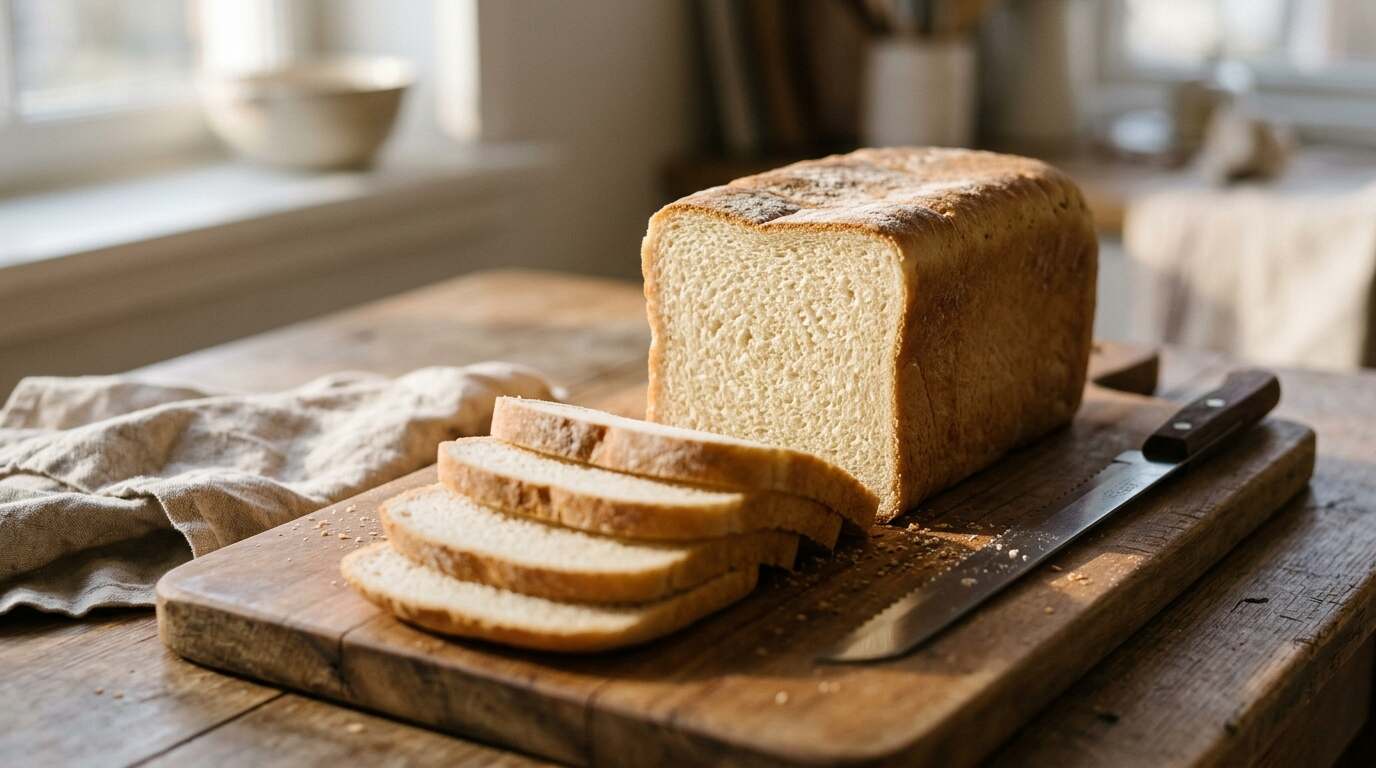
A loaf of sandwich bread is mostly flour and water, and the ratio between them decides almost everything about it: how firm the dough feels, how tight the crumb is, how well a slice holds mustard without tearing. Bakers track that ratio with a system called baker’s percentages, and the system only works with a scale. The cup measure, the tool most American home cooks reach for, came out of a cookbook that pushed the country away from scales in the first place.
Video: What is Baker's Percentage? – Bread School, from the King Arthur Baking Company YouTube channel
Flour is always 100
The idea is simple once the flour is fixed. King Arthur Baking, in an April 2022 article by baker Martin Philip, explains that every ingredient is written as a percentage of the total flour weight, which is always 100 percent. His example formula is 500 grams of flour, 66 percent water (330 grams), 2 percent salt (10 grams) and 1.2 percent yeast (6 grams).
The numbers add up to more than 100, and that is correct. The percentages describe each ingredient against the flour, not against the whole batch.
Several flours still count as one. Philip’s example blends 700 grams of all-purpose, 200 grams of whole wheat and 100 grams of rye, which makes 1,000 grams of flour, written as 70, 20 and 10 percent.
Why the system exists
Scaling is the first reason. Philip writes that the ratios stay the same whatever the batch size, so a baker can double a recipe or work backward from the amount of one ingredient on hand. Using his formula, a 1,000-gram batch of flour takes 660 grams of water, 20 grams of salt and 12 grams of yeast, with no conversion tables involved.
Comparison is the second. Two recipes written in percentages can be read side by side, even when one makes a single loaf and the other makes a bakery’s worth.
The third is a shared language. A baker who says a dough is 66 percent hydration has told another baker most of what matters about it.
Hydration and the sandwich loaf
Hydration is the water figure. In a January 2023 King Arthur article on hydration, Philip defines it as the weight of water, plus water-heavy liquids such as milk, divided by the weight of flour. He describes about 60 percent or lower as a firm, stiff dough, puts 75 to 85 percent with all-purpose flour in slack and sticky territory, and gives his own baguette formula at 77 percent and pain de campagne at 80.
The crumb follows the water. Philip writes that wetter doughs tend toward a moister, more open crumb and lower hydration toward a tighter, closed one, while wet doughs are harder to shape and may need longer bakes. Grill Cheesy’s post on the pain de mie Pullman loaf covers the classic square sandwich loaf those numbers get applied to.
Not every liquid counts. The 2022 article says milk and beer can count toward hydration, while oil, honey and melted butter do not, because they contain little water.
What a cup of flour weighs
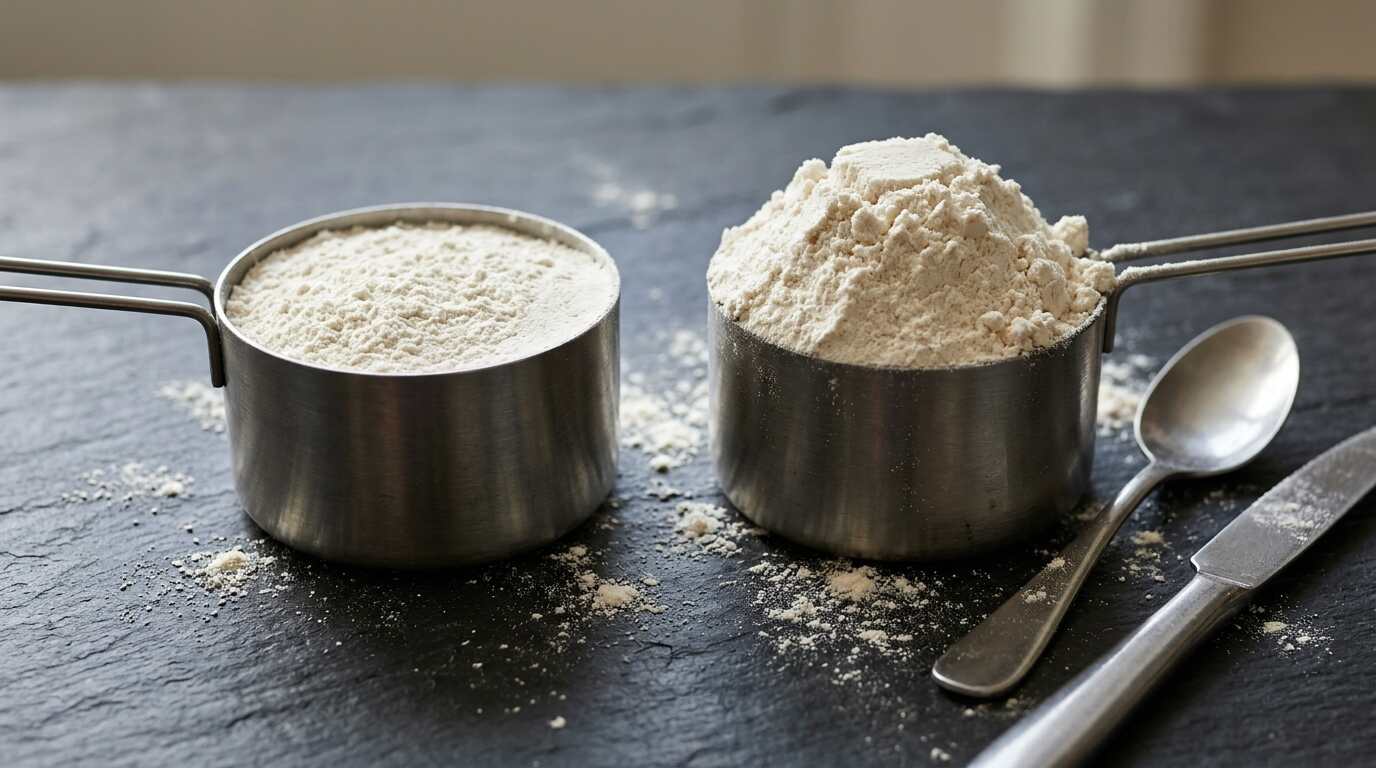
The cup cannot give a baker that kind of control. Alice Medrich, in an excerpt from her book Flavor Flours published by Sunset in 2017, says a cup of the same flour can vary by as much as 50 percent in weight depending on whether the cook dips into a packed bag, dips into loose flour, or spoons and levels. She adds that mills have no standard fineness, so the same type of flour can weigh differently per cup from brand to brand. Her conclusion: “The only way to deal with this chaos is to measure by weight.”
Medrich’s point is about sharing recipes as much as accuracy. In her words, with a scale one cook’s 100 grams of flour is the same as another’s, which is the whole premise of a formula written in percentages.
How the cup took over
The American cup measure has a famous champion. Helen Zoe Veit, a Michigan State historian, wrote in the Saturday Evening Post in 2018 that Fannie Farmer’s Boston Cooking-School Cook Book of 1896 ran 567 pages, sold about 360,000 copies by her death in 1915, and called for standardized teaspoons, tablespoons and cups. Farmer required every ingredient to be measured level with the top of the cup or spoon, not heaped.
Her role is easy to exaggerate. CooksInfo, in an entry last updated in January 2022, says her influence on measurement is “often admittedly over-stated.” It notes that she did not define the units themselves; she specified how to use them, by leveling. It also says she reinforced a North American shift that was already underway, away from weighing scales and toward measuring cups.
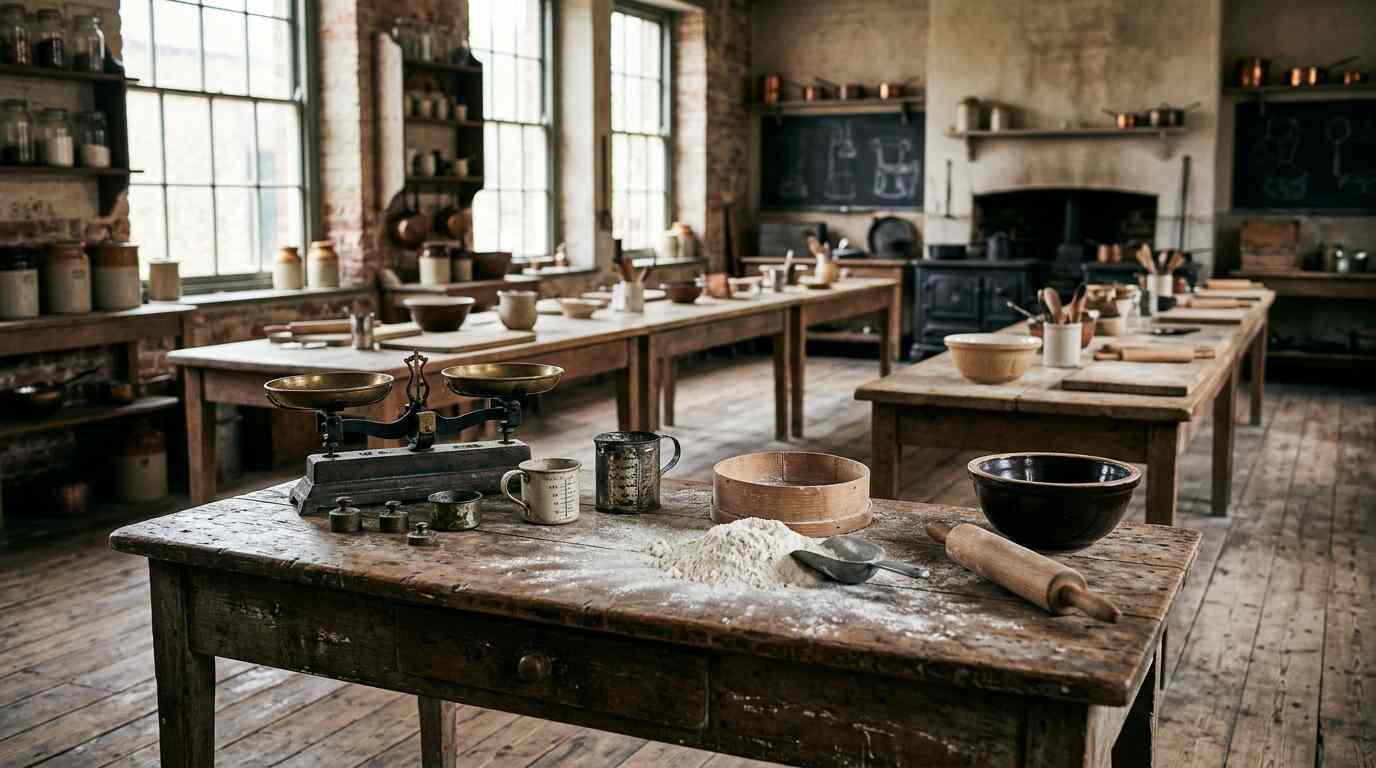
The irony runs through every American recipe card. The book that made the cup dependable also helped push the scale out of the home kitchen, and baker’s percentages need the scale back.
Setting up to weigh
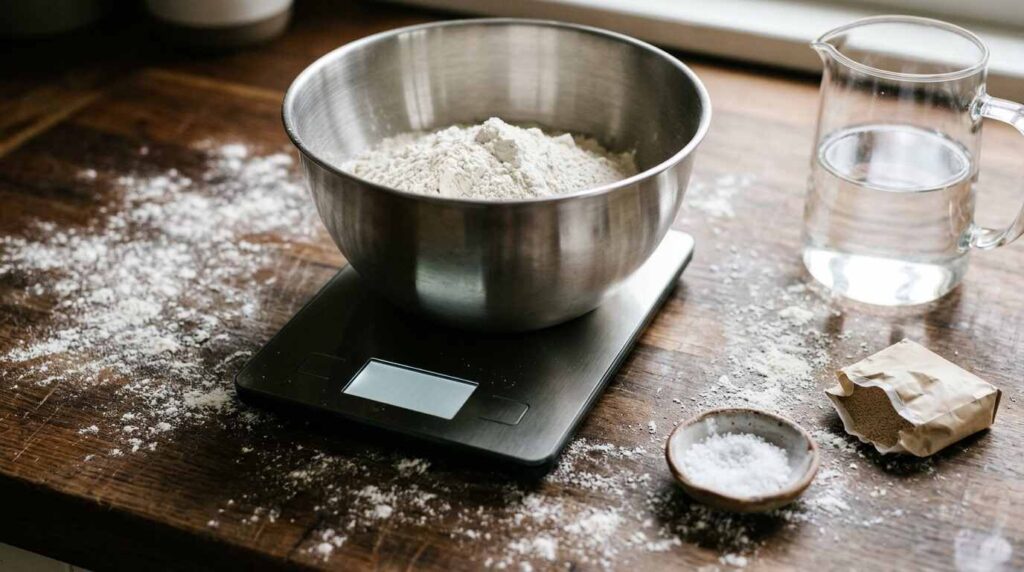
The kit is short. A digital scale that reads in grams and has a tare button, which resets the display to zero with a bowl on it, lets each ingredient go into the same bowl in turn. Flour choice changes the water math too: King Arthur’s hydration article notes that thirsty high-protein and whole-grain flours can push some doughs past 100 percent hydration.
For more on what happens after the dough is mixed, Grill Cheesy covers the browning chemistry in the Maillard reaction and bread and the loaf’s afterlife in why bread goes stale. For the bread itself at the counter, see best bread for grilled cheese.
The scale, the flour and a second option
- OXO Good Grips 11-Pound Digital Kitchen Food Scale: an 11-pound digital kitchen scale, enough capacity to weigh a full batch of dough in its mixing bowl. See it on Amazon (affiliate link)
- Escali Primo Digital Food Scale Multi-Functional Kitchen Scale and Baking Scale for Precise Weight Measuring and Portion Control, 8.5 x 6 x 1.5 inches, Chrome: a compact digital food and baking scale, a smaller-footprint alternative. See it on Amazon (affiliate link)
- King Arthur, Organic 100% Bread Flour, Unbleached, 5 lb (Pack of 1) – Non-GMO Project Verified, No Preservatives: unbleached high-protein bread flour, the kind King Arthur describes as thirstier for water. See it on Amazon (affiliate link)
As an Amazon Associate I earn from qualifying purchases. A commission may be earned if you buy through this link, at no extra cost to you.
Questions people ask
What is baker’s percentage? A way of writing a recipe where every ingredient is a percentage of the total flour weight, which is always 100 percent.
Why does it add up to more than 100? Each ingredient is measured against the flour, not against the total dough.
What is dough hydration? The weight of water and water-based liquids divided by the weight of flour, as a percentage.
How much does a cup of flour weigh? It varies with how it is measured; Alice Medrich says by as much as 50 percent, and publishers use different standards.
Did Fannie Farmer invent measuring cups? No. She standardized level measurement in her 1896 cookbook; CooksInfo says her role is often overstated.
Sources
- King Arthur Baking, Martin Philip, “What is baker’s math?” (April 28, 2022): https://www.kingarthurbaking.com/blog/2022/04/28/what-is-bakers-math-and-how-can-i-use-it-in-my-everyday-bread-baking
- King Arthur Baking, Martin Philip, “Hydration in bread dough, explained” (January 11, 2023): https://www.kingarthurbaking.com/blog/2023/01/11/bread-hydration
- Sunset, Alice Medrich, excerpt from Flavor Flours (September 26, 2017): https://sunset.com/food-wine/become-a-better-baker-with-just-one-tool
- Saturday Evening Post, Helen Zoe Veit, “The Rise of Cookbooks in America” (November 27, 2018): https://www.saturdayeveningpost.com/2018/11/the-rise-of-cookbooks-in-america/
- CooksInfo, “Fannie Merritt Farmer” (updated January 16, 2022): https://cooksinfo.com/fannie-merritt-farmer