In this story
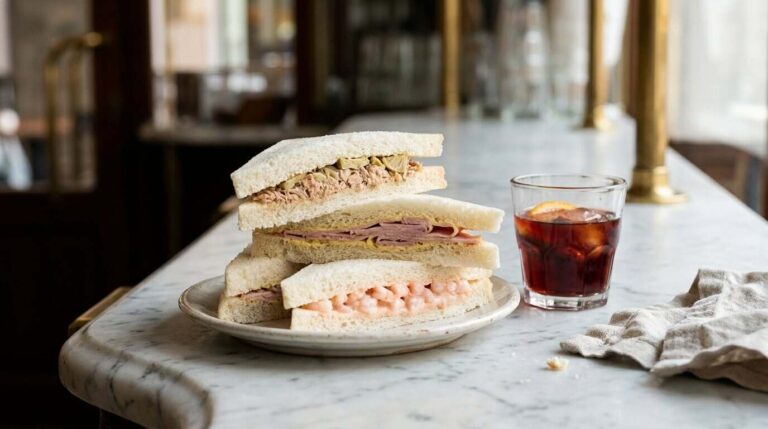
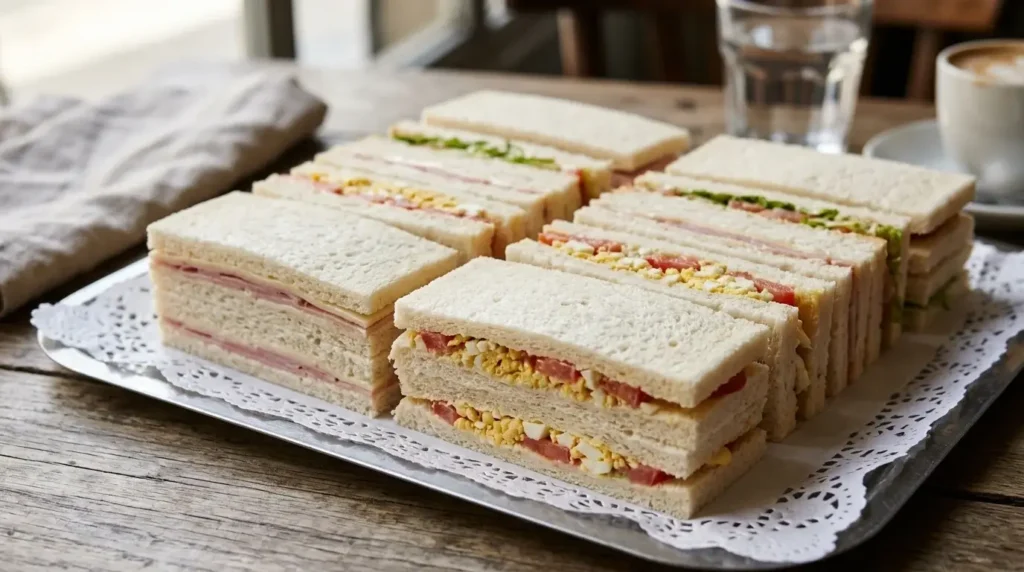
The sándwich de miga is made from thin slices of crustless white bread, usually spread with butter or mayonnaise and filled with ham and cheese, and cut into neat rectangles. In Argentina and Uruguay it is sold by bakeries and confiterías, the old cafés and pastry shops of Buenos Aires, and it is a fixture at parties. The name refers to the bread. Miga means crumb.
Video: ¿COMO SE HACEN LOS MEJORES SANDWICH DE MIGA DE BUENOS AIRES?, from the Marcos Di Cesare YouTube channel
Crumb bread
The bread defines the sandwich. Tasting Table, in a January 2023 article by Kyle Grace Trinidad, explains that pan de miga, “crumb bread,” refers to the soft white center left once the crust is gone. It is usually baked in a narrow lidded Pullman pan, then trimmed into square slices. Grill Cheesy covers the French cousin of that loaf in pain de mie.
Confiterías that make their own slice it by machine, thin. A Google Arts & Culture story by Allie Lazar on Confitería Caren, a shop in Recoleta opened by the brothers Carlos and Enrique in 1969, describes five 10-kilogram loaves arriving every day. The baker pats each loaf with water, trims the outer crust, and cuts it into thin, even layers that stay moist without tearing. Each loaf makes about 120 sandwiches.
Simples and triples
There are two basic builds. Billiken, in a May 2024 article by Lucía Jauzat, divides them into simples, with two layers of bread, and triples, with three.
A triple has an order. Billiken lists it: bread spread with butter or mayonnaise, a slice of cheese or ham, a second spread slice, another layer of filling, then the third slice. The sturdier fillings go at the bottom and the wetter ones at the top.
At Caren, according to the Arts & Culture story, a typical triple starts with mayonnaise and ham on the bottom, with an upper layer such as tomato, boiled egg, blue cheese and celery, or hearts of palm with salsa golf.

What goes inside
Ham and cheese leads. Billiken names ham and cheese, egg and tomato as the classic Argentine fillings. Tasting Table adds hard-boiled egg with tomatoes and peppers as a traditional choice, with tuna, chicken, olives and pineapple among the others.
Mayonnaise is the usual binder. Grill Cheesy has compared the spread in mayonnaise versus Miracle Whip.
Homesick engineers at La Ideal
The best-known origin story is British. Tasting Table, citing the Argentine newspaper Clarín, says the sandwich may date to 1900s Buenos Aires and Confitería Ideal, a café popular with British businessmen, which made a version of the crustless cucumber sandwich for homesick customers. The Arts & Culture story on Caren gives the same idea in another form: an early-20th-century Buenos Aires bakery making them, possibly for British engineers who missed English tea sandwiches.
The building is real and old. The Buenos Aires Times reports that La Ideal, on Calle Suipacha near Avenida Corrientes, was founded in 1912 by the Spanish merchant Manuel Rosendo Fernández, closed in 2016, and was set to reopen in November 2022 after six years and a restoration. That article does not mention sandwiches or British customers. None of the sources fetched for this post gives documentary evidence for the engineers.
Or Turin
The rival story is Italian. Billiken states flatly that the sándwich de miga is not Argentine, and that it was first made in 1925 at Caffè Mulassano in Turin, as an answer to English high-tea sandwiches. It links the miga to the Italian tramezzino, originally served as a triangle, and says the recipe arrived with Italian immigrants before spreading through Buenos Aires bars and cafés. Tasting Table notes the Italian theory too, from the food retailer Amigo Foods. The Caren story credits northern Italian immigrants as one possibility.
The two stories collide on timing. If La Ideal served crustless English-style sandwiches in its early years after opening in 1912, the Argentine version would predate a 1925 Turin invention. If the Turin date is right and the sandwich arrived with Italians, the Ideal story is either later than told or describes something else. The sources here do not resolve it, and both share one detail: an English tea sandwich somewhere in the background.

Where to buy them
Billiken says that at first the sandwiches could be found only in traditional confiterías, naming Las Violetas, Las Delicias, Los Dos Boulevares, El Águila, La Exposición, La Porteña, La París and Dos Escudos, before they became a fixture of bars and cafés across the city.
The handwork is under pressure. Augusto Vázquez, who took over Caren from his father, told Arts & Culture that “Making the miga sandwich is a craft that is being lost,” and the shop keeps its traditional methods.

The party sandwich
The sándwich de miga has its own idiom. Tasting Table reports that a person who never misses a party may hear “Vos tenés más fiesta que un sándwich de miga,” roughly “You go to more parties than a crumb sandwich.” It is also eaten as an everyday snack, the same article notes.
For one of the hams that can go between the slices, Grill Cheesy has Black Forest ham.
A pan for crustless bread
- USA Pan Bakeware Pullman Loaf Pan with Cover, 13 x 4 inch, Nonstick & Quick Release Coating, Made in the USA from Aluminized Steel: a lidded Pullman pan of the kind Tasting Table says pan de miga is baked in. See it on Amazon (affiliate link)
As an Amazon Associate I earn from qualifying purchases. A commission may be earned if you buy through this link, at no extra cost to you.
Questions people ask
What does “de miga” mean? Miga means crumb; the sandwich is named for its crustless bread.
What is a sándwich de miga triple? A sandwich made with three thin slices of bread and two layers of filling.
Where did the sándwich de miga come from? It is disputed: one story credits Buenos Aires’s Confitería Ideal and British customers; another credits a 1925 Turin café and Italian immigrants.
What is the classic filling? Ham and cheese.
How is pan de miga baked? Usually in a lidded Pullman pan, then trimmed of its crust and sliced thin.
Sources
- Tasting Table, Kyle Grace Trinidad, “What Makes Argentina’s Pan De Miga Different From Other Types Of Bread?” (January 16, 2023): https://tastingtable.com/1163901/what-makes-argentinas-pan-de-miga-different-from-other-types-of-bread
- Google Arts & Culture, Allie Lazar, “The Mighty Miga Sandwich at Confitería Caren”: https://artsandculture.google.com/story/LgUx4gacuf3Plw
- Billiken, Lucía Jauzat, “¿Cuál es la historia del sándwich de miga?” (May 8, 2024): https://billiken.lat/interesante/cual-es-la-historia-del-sandwich-de-miga/
- Buenos Aires Times, Claudio Corsalini, “Buenos Aires’ century-old confitería La Ideal reopens after six-year closure” (November 15, 2022): https://batimes.com.ar/news/culture/after-six-years-the-century-old-confectionery-shop-la-ideal-reopens-a-symbol-of-the-city-of-buenos-aires.phtml