In this story
Bresaola is beef that has been salted, seasoned and air-dried until it turns a deep, even red, then sliced paper-thin and eaten raw. Its home is Valtellina, an Alpine valley in the province of Sondrio in northern Lombardy. The specification caps its fat at 7 percent.
Video: Valtellina: Bresaola, from the Italia Slow Tour YouTube channel
A valley and a cure
The protected version is Bresaola della Valtellina, a Protected Geographical Indication. Its production specification, filed with the European Commission and available in the EU’s eAmbrosia register, limits production to the entire province of Sondrio. Slicing, portioning and packaging must happen there too, under the control body’s supervision.
The producers’ consortium credits the valley’s climate. Its history page says the area’s generally low temperatures, very dry air and the shape of the province let the meat keep its quality with only light salting.
Registration came in 1996. A March 2022 decree from Italy’s agriculture ministry, reproduced by the trade group Unionalimentari, cites Commission Regulation (EC) No 1263/96 of July 1, 1996, as the act that registered the name. A consortium-curated exhibit on Google Arts & Culture, published by the Italian agriculture ministry, gives 1996 for the PGI and 1998 for the founding of the consortium.
Five cuts of the leg
Not every piece of beef qualifies. The specification lists five cuts from the hind leg: fesa (topside), punta d’anca (rump tip), sottofesa (silverside), magatello (eye of round) and sottosso. The Arts & Culture exhibit calls the punta d’anca, the haunch tip, the finest and most common.
Each cut has a minimum finished weight in the specification: 3.5 kilograms for fesa, 2.5 for punta d’anca, 1.8 for sottofesa, 1 for magatello and 0.8 for sottosso. Each piece is trimmed by hand of outside fat and tendons, according to the exhibit.

Salt, spices and time
The cure is dry. Under the specification, the meat is salted with salt and natural flavorings for an average of 10 to 15 days depending on weight. Wine, sugar or its derivatives, ascorbic acid, and sodium or potassium nitrates and nitrites up to 195 parts per million are all permitted. The exhibit lists the seasonings commonly used: pepper, juniper berries, dried bay leaves, nutmeg, cinnamon and garlic. It describes the pieces being massaged periodically during salting, and says wine and sugar may go into closely guarded house recipes.
After salting, the meat goes into a casing, natural or artificial. Drying takes about a week, and the full curing period, which includes the drying, runs four to eight weeks at 12 to 15°C in climate-controlled rooms. The specification prohibits accelerated dehydration.
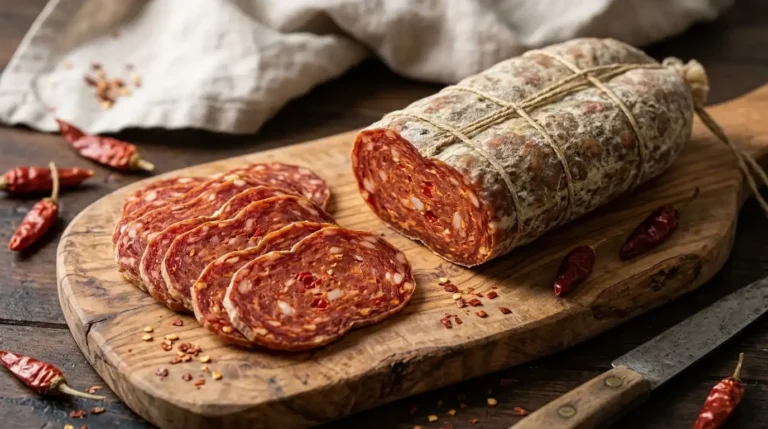
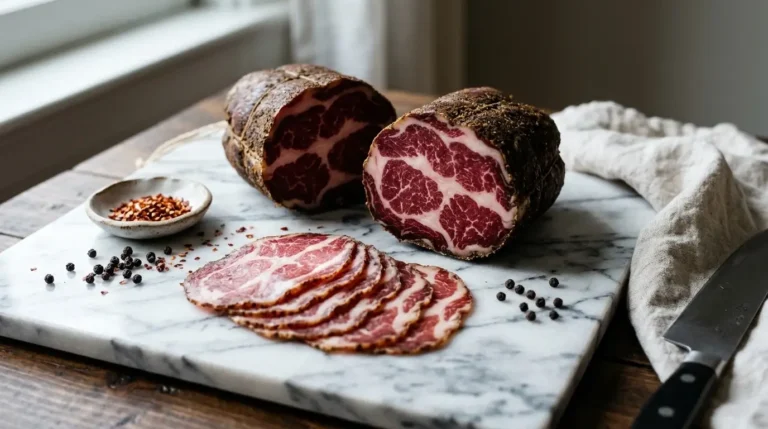
The finished product is held to numbers. The specification caps moisture at 65 percent and salt at 5 percent, alongside the fat limit. It describes a firm, elastic texture, a compact cut without cracks, a uniform red with a slightly darker rim on the lean, a delicate and lightly aromatic smell, and a taste that is moderately savory and never sour. The shape can be roughly cylindrical or pressed into a brick.
How old the cattle must be
The age rule has moved. The specification in the EU register gives cattle between two and four years old. The Arts & Culture exhibit gives 18 months to four years, and the 2022 ministry decree also records the rule as 18 months to four years before temporarily changing it.
That decree lowered the minimum to animals over 12 months old for one year. It cites a beef shortage tied to the COVID-19 emergency, which cut slaughter and slowed meat logistics, and a study by a Parma food-preservation research station finding that younger animals did not change the product’s characteristics. The differences across these documents reflect a specification that has been amended over time.
Where the beef comes from
The protected name refers to where the meat is cured, not where the cattle were raised. A Valtellina PGI is about the place and method of processing.
The industry’s own figures show how much beef that takes. Il Sole 24 Ore, reporting consortium data in April 2025, says production exceeded 12,600 tonnes in 2024 and that more than 34,000 tonnes of rump beef are needed to supply the district. Fourteen companies were certified by the control body. Beef of EU origin fell from 30 percent of supply in 2023 to 22 percent in 2024, with a further decline expected.
Cost is the pressure point. The same article explains that GATT licenses allow some meat imports at a preferential 20 percent duty but in fixed volumes, and that without them the cost of raw material can rise by up to 50 percent. Exports in 2024 were 632 tonnes, about 5 percent of production.

Brisa, brasa or “bre”
The name has three proposed origins, all listed in the Arts & Culture exhibit. One links it to “brisa,” described as a heavily salted cattle gland. Another derives it from “brasa,” embers, after the custom of drying the meat in rooms warmed by braziers. A third combines “bre,” a word for a deer or wild ruminant, with “sal,” salted. The exhibit does not choose among them.
The history is clearer than the word. The consortium’s page says the first literary evidence of bresaola dates to the 15th century, though it was probably made earlier, and that production served only family needs until the early 19th century. In that century craft production grew and bresaola was exported to Switzerland. The exhibit also cites an 1893 letter by the poet Giosuè Carducci.

On a plate and in a sandwich
The serving is simple. One of the Amazon listings below describes it the usual way: sliced thin, with olive oil, lemon juice and black pepper. In a sandwich, the leanness matters. With so little fat, bresaola works with something rich beside it, such as a soft cheese or a shaving of Parmigiano-Reggiano.
Grill Cheesy’s other Italian cured meats include prosciutto, a cured pork leg, and capicola.
Buying bresaola
- Volpi Bresaola “Dry Cured Beef” – approximately 2 lbs.: a whole piece of dry-cured beef for slicing at home. See it on Amazon (affiliate link)
- Bresaola Punta D’anca Unsliced Air Dried Beef – Approx. 2-3 LB – OVERNIGHT GUARANTEED: an unsliced piece made from the rump tip, the cut most associated with bresaola. See it on Amazon (affiliate link)
As an Amazon Associate I earn from qualifying purchases. A commission may be earned if you buy through this link, at no extra cost to you.
Neither listing is labeled Bresaola della Valtellina PGI; the protected name appears only on product made in Sondrio under the specification.
Questions people ask
What is bresaola made of? Beef, from one of five cuts of the hind leg, salted and air-dried.
Where is bresaola from? Valtellina, in the province of Sondrio, Lombardy.
Is bresaola raw? It is cured and air-dried, not cooked, and is eaten in thin slices.
How long is bresaola cured? Four to eight weeks after 10 to 15 days of salting, under the PGI specification.
Is Bresaola della Valtellina made from Italian beef? Not necessarily. The PGI covers where it is processed; EU-origin beef was 22 percent of supply in 2024, according to consortium figures.
Sources
- Bresaola della Valtellina PGI production specification, EU eAmbrosia register: https://webgate.ec.europa.eu/eambrosia-api/api/v1/attachments/63622
- Consorzio Bresaola della Valtellina, History: https://bresaolavaltellina.it/?p=9376
- Google Arts & Culture, “Historical Background,” curated by the Consorzio per la tutela del nome Bresaola della Valtellina: https://artsandculture.google.com/story/9wXhAZ-MbhsA8A?hl=en
- Italian Ministry of Agricultural, Food and Forestry Policies, decree of March 28, 2022, via Unionalimentari: https://unionalimentari.com/wp-content/uploads/2024/09/MIPAAF-prov-28.3.2022-Bresola-della-Valtellina.pdf
- Il Sole 24 Ore, Emiliano Sgambato (April 29, 2025): https://en.ilsole24ore.com/art/bresaola-valtellina-igp-consumption-recovery-but-complicated-2025-ahead-AH4tX9V