
In this story
Wilhelmus Adrianus van Berkel ran a pork shop in Rotterdam and, according to a history kept by a Berkel service company, spent years ruining expensive cuts of meat on prototype machines. What came out of it was the rotary slicer, the reason a deli counter can stack pastrami, ham and provolone in sheets of equal thickness. Grace’s Guide records that he was born in 1869, died in Switzerland in 1952, and set up a factory in Rotterdam in 1898, and describes him as a butcher with an interest in mechanical engineering. Sources call him Wilhelm or Wilhelmus; the patent office went with Wilhelmus.
Video: Trancheuse Berkel Indianina La Porte – Model B – 1928 — from The House of Grauer YouTube channel
Rotterdam, 1898
A butcher who ruined good meat to get a straight slice
The company that carries his name dates its first factory to 12 October 1898 in Rotterdam, and says that by 1899 Van Berkel’s Patent Company Ltd had delivered 84 slicers in a single year. The same company describes the aim of the invention in one phrase: to reproduce mechanically “the movement of the hand that cuts with a knife”.
The same service-company account fills in the workshop. Van Berkel looked over the tools butchers and cheesemakers already used, judged elliptical and spiral knives impractical, and settled on a concave knife with a table that slid toward it. The account ties the invention to a prosperous port city where demand for meat and cheese was climbing.
The patent record is firmer than the anecdotes. US patent 635,225, “Machine for Slicing German Sausages, &c.,” lists Wilhelmus Adrianus van Berkel of Rotterdam as inventor, was filed on January 27, 1899, and was granted on October 17, 1899. It describes a revolving circular knife on a swinging arm. The meat sits clamped on a fixed table, and a feed plate advances it after each cut, with a lever arrangement setting slice thickness.
The 1904 patent and the hand-cranked machine
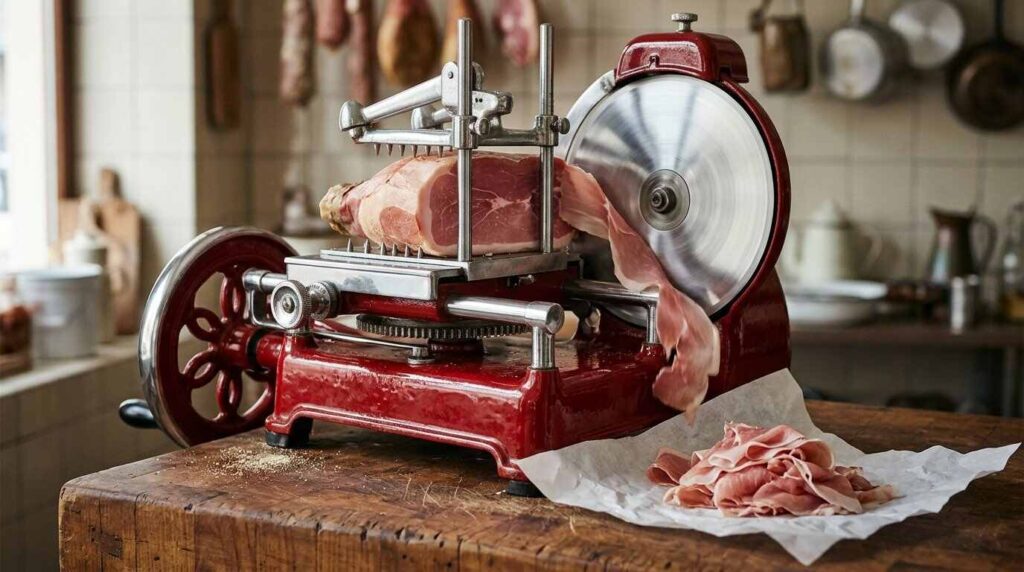
Screw feed, flywheel and a red enamel finish
A second van Berkel patent, US 895,213, was filed on April 1, 1904 and granted on August 4, 1908. Its subject is a slicer with a rotary circular knife, and here the meat plate slides on a table between guide bars while a screw spindle advances it by a set amount for each slice. Slice thickness comes from the screw advance; the patent names no separate gauge plate.
Early production machines were turned by hand. A KaTom Restaurant Supply history of flywheel slicers says most were coated in bright red enamel, with black or ivory versions trimmed in red and gold, and it describes rounded corners, tapering slopes and claw feet. The Carne Genuina guide to slicers says the original design centered on a flywheel driving gears that moved the blade, and that the first model gave butchers regular, symmetrical slices for the first time. The patents do not back up that last claim, and Carne Genuina is a single commercial source.
Berkel itself says that after patenting, factories opened in Europe, the United States, South America and Canada. The product line widened to scales, meat mincers, coffee grinders and bread slicers. Grace’s Guide adds that the First World War brought production of trade scales, lathes and other mechanical instruments, and even aircraft.
La Porte, Indiana
An American factory and a household machine
In the United States, Berkel slicers were built by the U.S. Slicing Machine Company of La Porte, Indiana. The Henry Ford museum holds a slicing machine from around 1950 whose record reads “Made by the U.S. Slicing Machine Company in La Porte, Indiana for Berkel.” An emblem on its side says “U.S. BERKEL.” The machine stood behind the meat-and-cheese counter at A. Rensch & Co., a family-owned specialty import food store in Toledo, Ohio, that opened in 1882.
A patent assigned to the same company shows the design moving toward the home kitchen. US 1,897,541, by Cornelis Franciscus Maria van Berkel of Wassenaar, Netherlands, was filed in the United States on January 20, 1926 (with a German priority date of September 18, 1925) and patented on February 14, 1933. It covers a hand-operated slicer in which a swinging table carries the meat past a circular knife; a steel tape and a one-way clutch turn the knife on one stroke of the table and not on the return. The inventor calls the design simple and cheap to make and “primarily suitable for household purposes.”
Hobart and the electric slicer
Streamlined aluminum replaces the exposed motor
Berkel was not the only maker. Hobart, which was founded as the Hobart Electric Manufacturing Company on July 20, 1897 and is based in Troy, Ohio, introduced its first electric slicer in 1930. Cooper Hewitt curator Cynthia Trope writes that this Model 11-A had an exposed motor and parts that were hard to keep clean. The company brought in the industrial designer Egmont Arens, who worked with Theodore C. Brookhart to produce the Model 410, nicknamed the Streamliner.
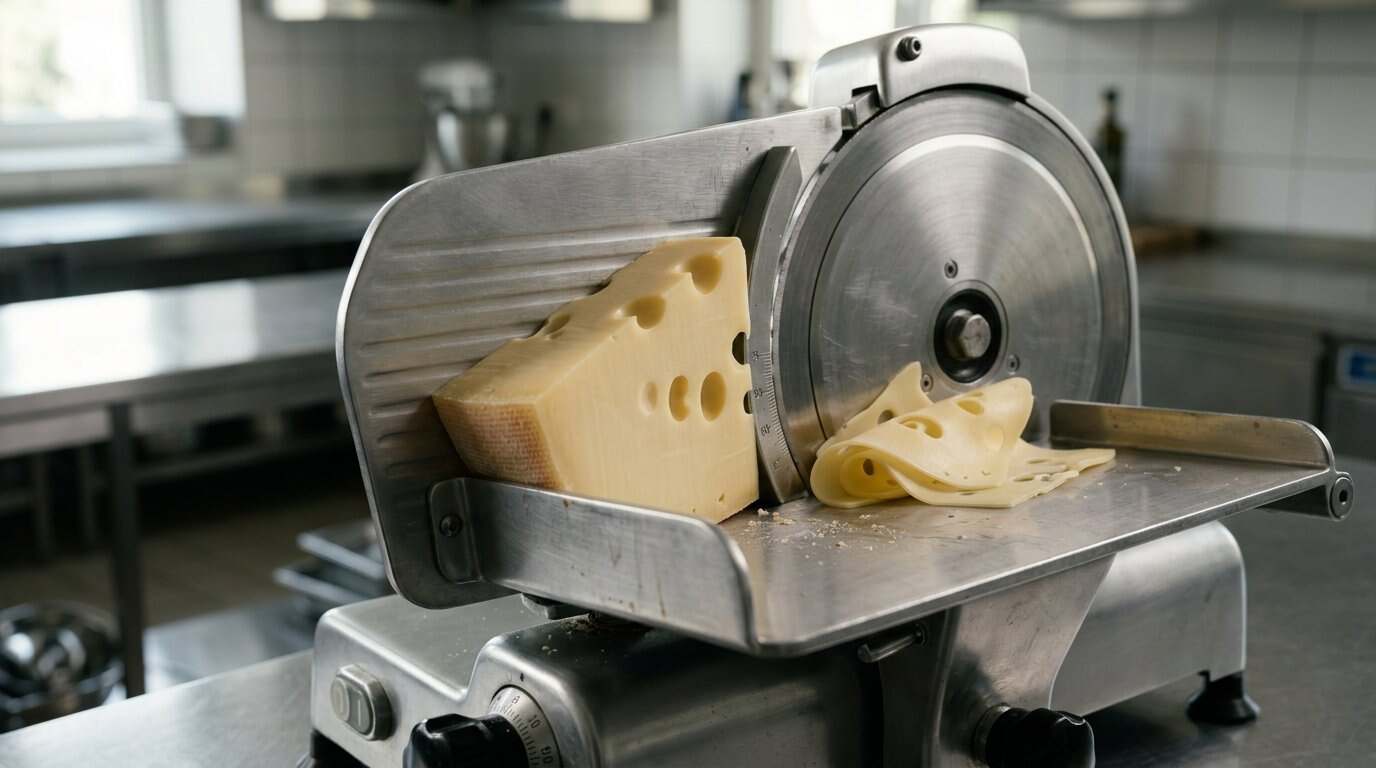
On the 410, only the circular blade, the sled-like bed and the pivoting meat holder stay exposed; the motor and gears sit inside a smooth aluminum housing. The article credits the aluminum body with being easier to clean and more sanitary, which it calls “indispensable features for commercial food service.” Museums date the machine slightly differently: Cooper Hewitt gives about 1940 for its object, the Wolfsonian lists 1941, and Hobart’s own timeline says the 410 was first produced in 1944. Cooper Hewitt puts production at the early 1940s to the mid-1980s.
Later Hobart milestones, per its own timeline: the 1512 Angle-Feed Slicer in 1947, the 1612 and 1712 Automatic Slicers in 1959, the 2000 Series on May 16, 1998, built-in Microban antimicrobial protection in 2001, and the CleanCut blade in 2003. A KaTom company history, which places the founding in Troy and credits C.C. Hobart and Herbert L. Johnston, puts the hands-free automatic slicers in 1964 instead of 1959.
What the slicer changed at the counter
Uniform slices, adjustable thickness, less effort
The documented gains are practical ones. A slicer cuts with less effort than a knife, and slice thickness is adjustable, according to the general reference entry on meat slicers, a Wikipedia article cited here only because no better summary was found. Berkel’s own history frames the invention as a mechanical copy of the hand that cuts with a knife, and the service-company history above places the machine in butcher shops and cheese markets before it reached home kitchens.
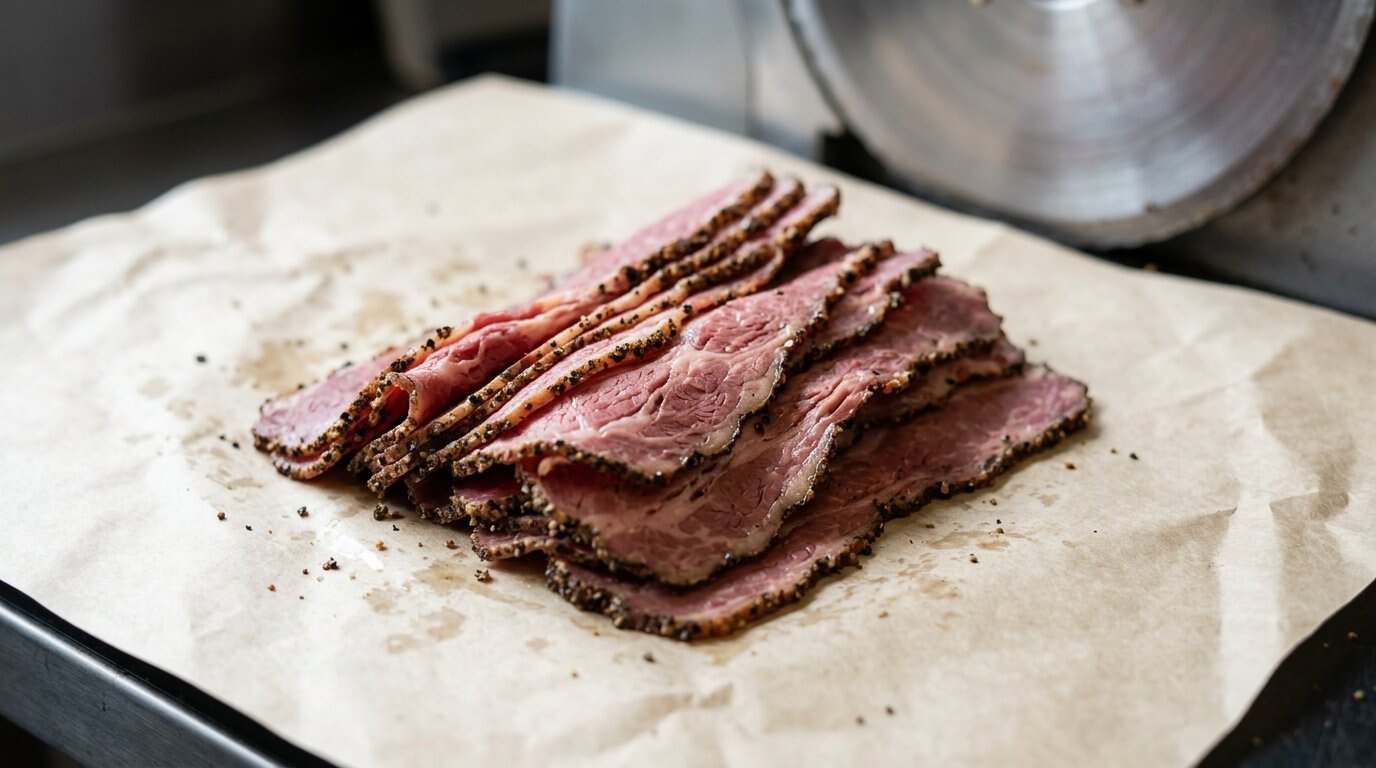
Hand slicing never disappeared at the best-known counters. Langer’s Delicatessen, whose owner Norm Langer is quoted on the restaurant’s site, cuts pastrami by hand to cut out connective tissue, and warns that on a machine, “that is going to be in your sandwich” in the form of a tough yellow membrane. Norm Langer compares chewing it to chewing a racquetball.
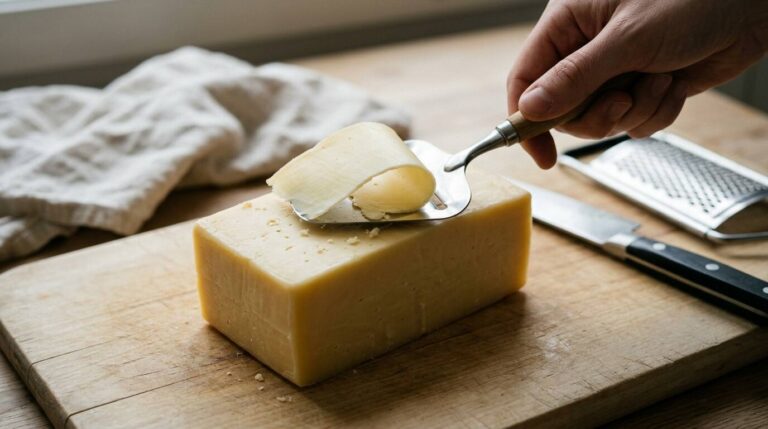
Bread has a slicing-machine story of its own, covered in the post on the invention of sliced bread. Cheese counters have a lower-tech counterpart in the cheese slicer, knife and grater used at home.
How a modern slicer is built
Blade, carriage, gauge plate, sharpener
A commercial slicer today follows the layout van Berkel settled on: a round knife, a carriage that holds the product and moves it past the knife, and an adjustable stop that sets thickness. A trade-magazine guide to specifying slicers supplies the current numbers.

Blades mostly run 10 to 14 inches, with 12 and 13 inches common. Some blades are low-friction, with recesses that reduce contact with the product, and cheese blades may be scalloped to break the vacuum seal that forms during slicing. In a gravity-feed design the blade and carriage sit at an angle, so the weight of the product helps move it through the cut. The gauge plate sets slice thickness, up to about an inch on some manual models. Many machines include a built-in sharpener; others use a removable ceramic stone. Current bases are often one piece to cut down on crevices where debris collects. Safety hardware includes blade-removal tools for cleaning, locks that hold the blade in two places, and indicator lights that show whether the blade is running, exposed or stopped. Units are rated light, medium or heavy duty depending on the product and daily volume.
Manual flywheel machines survive alongside the electric ones. Because the blade moves only while the operator turns the flywheel, KaTom reports that operators say it avoids motor heat that can melt fat and tear the cut. That is operator lore, not a measurement. A 2010 entry in Cooks Info notes the vintage hand-cranked Berkels have a fire-engine red body and a concave blade, as in the original.
The brand after its first century
Italian headquarters, a fire and a change of owner
According to Berkel, the Italian chapter began in Milan in 1924, and the company today is Van Berkel International S.r.l., based in Oggiona S. Stefano, Italy, selling in 100 countries under the Berkel and OMAS names. The Carne Genuina guide gives a thumbnail of the later corporate history: a 1991 fire that nearly destroyed the factory then under English ownership, a rebuild in Rotterdam, a decline after the parent company Avery stopped adapting the machines to stricter European safety rules in 1996, and a takeover of the brand and factory by Italy’s Rovagnati in 2014. Only that one commercial blog gives these dates.
The red flywheel survives as the brand’s signature. Berkel’s site calls the color “that Berkel red” and describes the machine as “a true status symbol” by the 1950s. A machine built to copy the hand of a butcher became a showpiece, and at Langer’s the hand is still doing the pastrami.
Common questions
Who invented the deli meat slicer?
The rotary meat slicer traces to a Dutch butcher named Wilhelmus Adrianus van Berkel. The company that carries his name dates its first factory to 12 October 1898 in Rotterdam and says that by 1899 it had delivered 84 slicers in a single year.
When did electric slicers arrive?
Hobart introduced its first electric slicer in 1930. Cooper Hewitt curator Cynthia Trope writes that this Model 11-A had an exposed motor and parts that were hard to clean, and the company later brought in the industrial designer Egmont Arens.
Who built Berkel slicers in the United States?
The U.S. Slicing Machine Company of La Porte, Indiana. The Henry Ford museum holds a slicer from around 1950 whose record reads “Made by the U.S. Slicing Machine Company in La Porte, Indiana for Berkel.”
Sources
- Grace’s Guide, Van Berkel: https://www.gracesguide.co.uk/Van_Berkel
- Berkel, company profile: https://www.theberkelworld.com/en/company-profile
- Berkel, The Berkel World history of slicers: https://www.theberkelworld.com/en/the-berkel-world-history-slicers
- Berkel Sales and Service, Top 3 Historical Facts About Meat Slicers: https://berkelsalesservice.com/top-3-historical-facts-about-meat-slicers-and-berkel-meat-slicer/
- Carne Genuina, The secrets of the slicer: https://www.carnegenuina.it/en/blogs/guida-di-cucina/i-segreti-dellaffettatrice
- US patent 635,225, Machine for Slicing German Sausages: https://patents.google.com/patent/US635225
- US patent 895,213, Slicing-machine: https://patents.google.com/patent/US895213
- US patent 1,897,541, Slicing machine: https://patents.google.com/patent/US1897541
- The Henry Ford, Slicing Machine, circa 1950: https://www.thehenryford.org/collections-and-research/digital-collections/artifact/374659
- Cooper Hewitt, Model 410 meat slicer article: https://www.cooperhewitt.org/?p=12366
- Wolfsonian, Hobart meat slicer: https://w3.fiu.edu/websites/Wolfsonian/wolfsonian.fiu.edu/collections/c4/c4_design9.html
- Hobart, Our History: https://hobartcorp.com/about-us/history
- KaTom, Hobart Company History: https://www.katom.com/learning-center/hobart-company-history.html
- KaTom, Slicing by Hand with Flywheel Slicers: https://www.katom.com/learning-center/flywheel-slicers-going-retro.html
- A Cut Above: Tips for Specifying Slicers (fermag.com): https://fermag.com/articles/a-cut-above-tips-for-specifying-slicers
- Langer’s Delicatessen, Hand Slicing (SavetheDeli.com excerpt): https://www.langersdeli.com/tag/hand-cut
- Cooks Info, Meat slicer: https://www.cooksinfo.com/meat-slicer
- Wikipedia, Meat slicer (pointer only): https://en.wikipedia.org/wiki/Meat_slicer
Keep reading
- Jaffle Iron and Sandwich Toaster: Pie Irons, Toas-Tite and the Breville
- Serrated Bread Knife for Sandwiches: Why the Teeth Matter and What to Look For
- Panini Press vs Skillet: How Each Cooks a Pressed Sandwich
More in this section: Gear and Equipment guide.