In this story
A bagel split and spread with cream cheese, layered with thin slices of cured salmon and finished with red onion and capers is among the best-known sandwiches in New York, and its history is tied to the Jewish immigrants who settled on the Lower East Side in the late 19th and early 20th centuries. Food writers agree on the setting but not on a date, a creator or even the exact kind of salmon on the first versions, and the sources below disagree on several points that are reported here as disagreements.
Video: Al Roker Uncovers The Origins of Bagels and Lox in New York City — from the TODAY YouTube channel
Where the bagel came from
A boiled ring of dough with a contested Polish past
The bagel reached New York with Jewish immigrants from Poland. The Nosher says it “arrived in the United States with Jewish immigrants from Poland in the late 19th century” and was sold on the streets of the Lower East Side, stacked on poles or hung from strings. Beyond that point the early history splits. National Geographic reports that author Maria Balinska traces the bread to 13th-century Jewish bakers in what is now Poland, as a single-serving cousin of the boiled ring bread called obwarzanek. A separate 6sqft account gives the first known mention as 1610, in Jewish community ordinances from Kraków.
The reason for boiling is also argued. Writing in the Forward, the author presents Balinska’s hypothesis that boiling arose in Poland under restrictions on Jewish bread-selling, and that without it the bagel would have resembled the obwarzanek. The Forward piece treats these ideas as hypotheses rather than settled history.
Once in New York, the bagel stayed inside the immigrant community for a long time. The historian Matthew Goodman, quoted by National Geographic, says bagels “existed in America for decades as a purely ethnic phenomenon, virtually unknown to society at large.”
The labor history is better documented than the recipe’s origins. National Geographic dates the International Beigel Bakers Union to 1907, and the Times of Israel reports about 70 bagel shops in the city by 1900 and a baker strike in 1909 that improved pay and conditions. The Nosher gives a different date for Local 338, saying the trade union was created in 1915, so the union’s founding year varies by source.
Why cured salmon and cream cheese
Salt, ice, the Sabbath and a dairy spread
Cured salmon was not a staple of the Eastern European Jewish kitchen. The cookbook author Claudia Roden, quoted by Aish, writes: “There is no evidence that the Jews of Eastern Europe ate it in the shtetls.” The Forward goes further and says immigrant Jews first met lox and similar smoked salmon in America, including “Eastern smoked salmon and Scottish smoked salmon.” By the early twentieth century, the same article says, appetizing stores carried lox and other smoked salmon that was “equally salty, easily obtainable and, above all, inexpensive.”
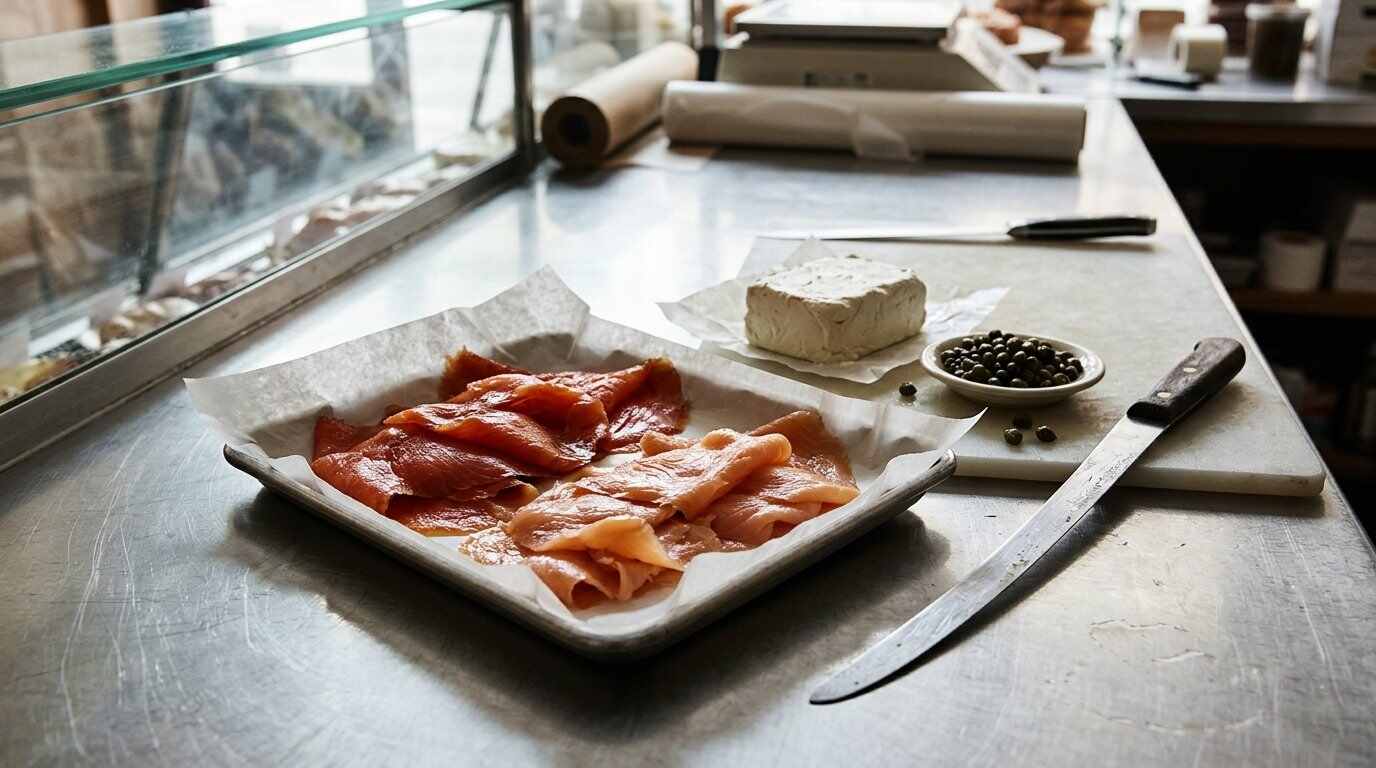
Practical reasons for the pairing recur across accounts. Aish notes that most New York homes of the period lacked refrigerators and that brine-cured salmon needed little cooling. A TODAY feature quotes the NYU historian Jacob Remes on tenement life: “When you don’t have running water and when you don’t have electric or gas stoves, it’s really hard to do very much cooking.” Cured fish and a bagel required no stove at all, and the same TODAY article adds that this let observant Jews eat them on the Sabbath, when most cooking is restricted. The Daily Meal adds a dietary-law point: fish is pareve, so it can be eaten with dairy such as cream cheese, and it describes the pairing as “more a product of a community’s struggle than a chef’s ingenuity.”
Cream cheese is an American product. The Daily Meal credits the dairy farmer William Lawrence with inventing it in the late 1800s, probably in upstate New York, and says the brothers Isaac and Joseph Bregstein later manufactured it in Brooklyn. Salt is the other half of the logic. Niki Russ Federman, fourth-generation owner of Russ & Daughters, is quoted by Aish on the pairing: “It’s so salty it needed the cream cheese to cut the salinity.”
Dating the sandwich
Late 1920s, the 1930s or the 1950s, depending on the account
No source fetched names a first seller or a first day. The Times of Israel cites the author Jeffrey A. Marx, who dates the lox and cream cheese bagel to the late 1920s and says it became popular between the World Wars. The Daily Meal puts the combination around the turn of the 20th century in New York’s Jewish community without a date, a restaurant or a creator.
The Nosher pushes the mass-market version later. It credits 1950s housewives and a cocktail-party suggestion from Family Circle magazine for spreading the idea beyond Jewish neighborhoods, quoting the magazine’s advice to “spread with sweet butter and place a small slice of smoked salmon on each.” That recipe called for smoked salmon, not lox, and for butter rather than cream cheese.
Broader acceptance came with industrial production. The Times of Israel notes that bagels gained a wide non-Jewish audience in the 1960s, when the Lender brothers mass-marketed frozen bagels. Balinska, as summarized by National Geographic, credits the Canadian baker Meyer Thompson with the bagel machine in 1918, which reached the United States in the 1960s. The 6sqft article gives a slightly different story for the machine, saying Daniel Thompson began work on the first commercially viable one in 1958, so the inventor’s name and date differ between sources.
A deli tradition surrounds the sandwich. The Times of Israel ties it to the era when New York Jewish delicatessens specialized in smoked and pickled meats, the same setting that produced the Reuben sandwich. Related deli profiles cover pastrami on rye and Katz’s Delicatessen.
Belly lox, Nova and smoked salmon
Three products often sold under one name
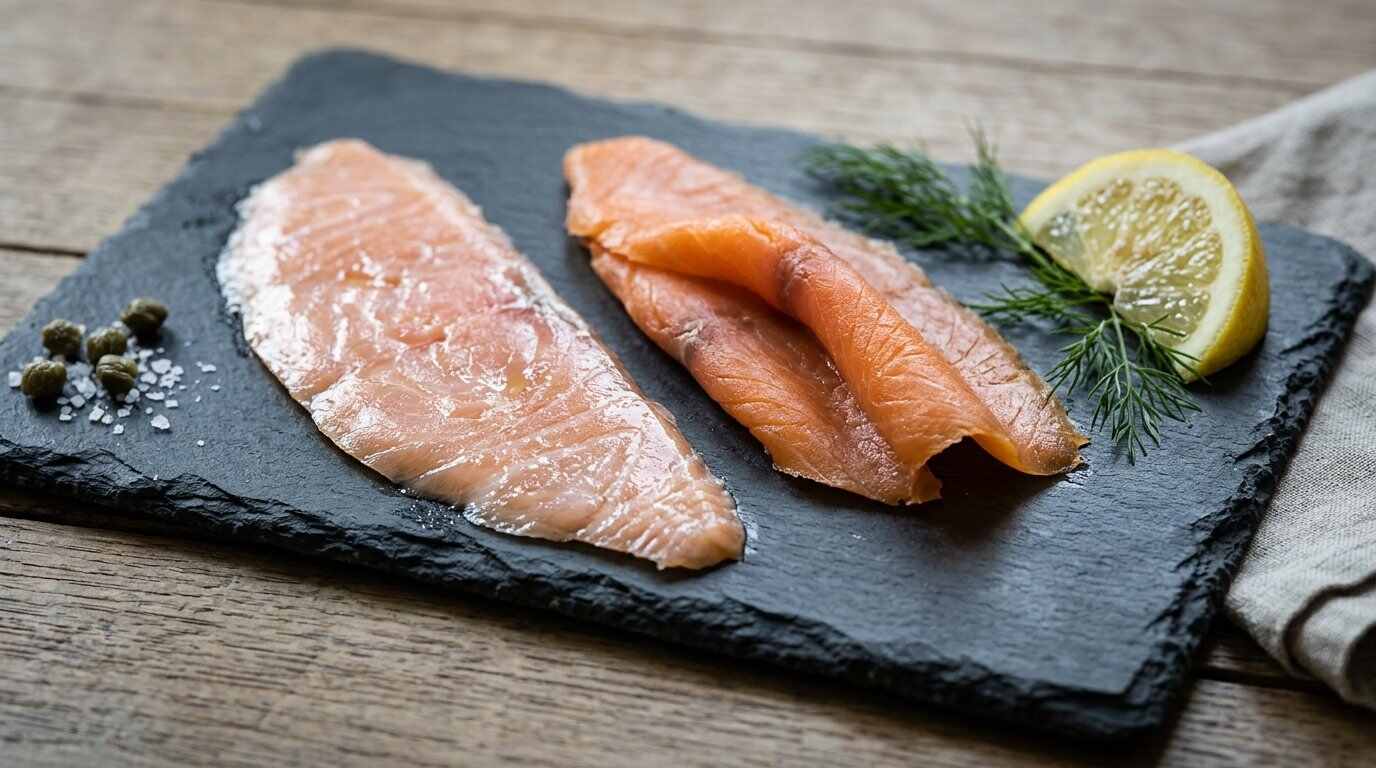
The word “lox” is used loosely in the United States, and the sources draw the lines differently. The Goldbelly blog describes lox, also called belly lox, as salmon cured in salt and not smoked, very salty and originally a way of preserving fish before refrigeration. Smoked salmon, in the same article, is salt-cured and then cold-smoked, less salty than lox, with a delicate smoky flavor and a texture that is not cooked. Nova, also called Gaspe Nova, is a type of smoked salmon, milder and smoother than traditional lox and sourced from Nova Scotia, Canada.

Aish gives a similar working rule: “Lox generally refers to salmon that has been cured in salt,” while smoked salmon is exposed to smoke for an extended period, changing its texture and flavor. Gravlax, which Goldbelly describes as a Scandinavian cure of salt, sugar, herbs and spices with dill usually prominent, is a separate preparation again.
Federman, quoted by Aish, says “that the term ‘bagel and lox’ actually started with belly lox.” The TODAY article agrees that the original lox sandwich used belly lox, salt-cured without smoking.
The Times of Israel describes the sandwich as a bagel with cream cheese and lox, “a cured salmon that may or may not be smoked.” Sourcing is recorded differently too. A TODAY report says cured salmon reached New Yorkers from Nova Scotia, while Aish, citing Aryeh Genger, says the lox was made from Pacific Ocean salmon shipped across the country in large salt baths.
Appetizing stores and Russ & Daughters
The shops built around fish and dairy
The retail home of the sandwich was the appetizing store, a New York institution that sold fish and dairy but not meat. Federman describes it in the TODAY piece: “The appetizing store is where you go for fish and dairy, things like herring, smoked fish.” The Forward quotes Adam Gostony, who wrote for a 1930s Works Progress Administration project, calling the appetizing store an “outgrowth of New York City’s special trading inventions and creations.” The same Forward article says that an estimated 20 to 30 appetizing stores once operated on the Lower East Side, and that Russ & Daughters on East Houston Street was then the only one left.
The Tenement Museum records that Joel Russ arrived in America in 1907 and started with a herring barrel and a pushcart, selling to Jewish immigrants on the Lower East Side. He first ran a storefront on Orchard Street, then in 1920 opened a shop at 179 East Houston Street, which has been the business’s home since. He named it for his three daughters, Hattie, Ida and Anne. The Museum gives 1914 as the founding year of the business, and TODAY dates the first brick-and-mortar shop, J. Russ National Appetizing, to the same year and the renaming to Russ & Daughters to 1935, noting that it was reportedly the first American business to carry “& Daughters” in its name.
Four generations of the family have run the business, according to both sources. Cousins Niki Russ Federman and Josh Russ Tupper now lead it. Smoked salmon is sliced so thinly, TODAY reports, that new employees can take up to six months to master the technique. The same article says some of the shop’s products come from Acme Smoked Fish, a Brooklyn company that has operated for 115 years.
How a New York bagel is boiled and baked
Water, malt and a hot oven
Boiling sets the New York bagel apart from softer, steamed imitations. Per 6sqft, most New York shops boil bagels in water with baking soda, which gives the outside a shiny layer and a chewy interior, while others use lye, barley malt syrup or honey in the water. The dough is proofed for at least twelve hours at 40 to 50 degrees Fahrenheit, then baked at roughly 350 to 600 degrees. Steam bagels skip the boil and are baked in a steam-injection oven, which produces a softer, less chewy result.
New York’s water is the subject of a theory on the same page: its calcium-to-magnesium ratio is said to make it especially soft and to bond well with dough gluten. Elsewhere in the same article Philip Romanzi of Bagel Hole in Park Slope says: “They should always be boiled, never steamed.” Goodman, via National Geographic, describes the old bagel as “small, flavorful, dense, and crusty” and the machine-made one as “huge, insipid, and pillowy soft,” and he attributes the change to oven steaming along with dough conditioners and preservatives.
The Forward adds one grievance from Balinska’s book, a critic complaining of “a public too lazy to chew,” and notes that machine production ended the union’s hold on the trade. Even the 6sqft piece records a December 1951 strike in which 32 of 34 bagel bakeries closed, which the New York Times called a “bagel famine.”
Serving it today
Red onion, capers and a stack of variations
The Daily Meal and Aish both note that the sandwich is often served with red onion and capers, and that National Bagel and Lox Day falls on February 9. The Times of Israel counts about 500 specialty bagel shops across the five boroughs, citing Sam Silverman of the trade group Bagelup, and says the everything bagel ranks third nationally behind blueberry and cinnamon raisin. The origin of the everything bagel is called disputed in the same article, with Joseph Bastianich and David Gussin each claiming credit.
A different New York bagel sandwich, the bacon, egg and cheese, has its own history. The lox version traces to the appetizing counter, and no fetched source names who sold the first one.
Common questions
What is the difference between lox and smoked salmon?
The Goldbelly blog describes lox, also called belly lox, as salmon cured in salt and not smoked, and very salty. Smoked salmon is salt-cured and then cold-smoked, less salty than lox. The sources draw the lines differently, and the word “lox” is used loosely in the United States.
When did bagel and lox begin?
No source fetched names a first seller or a first day. The Times of Israel cites the author Jeffrey A. Marx, who dates the lox and cream cheese bagel to the late 1920s, while The Daily Meal puts the combination around the turn of the 20th century without a date, a restaurant or a creator.
When is National Bagel and Lox Day?
The Daily Meal and Aish both say National Bagel and Lox Day falls on February 9.
Sources
- The History of Bagels in America (The Nosher) — https://www.myjewishlearning.com/the-nosher/the-history-of-bagels-in-america/
- The unusual history of the beloved bagel (National Geographic) — https://www.nationalgeographic.com/history/article/bagel-history-jewish-american-culture-symbol
- How bagels have schmeared across NYC history (The Times of Israel) — https://www.timesofisrael.com/how-bagels-have-schmeared-across-nyc-history/
- The New York bagel: The ‘hole’ story (6sqft) — https://www.6sqft.com/?p=68546
- Did antisemitism forge the bagel we know and love? (Forward) — https://forward.com/culture/462242/did-antisemitism-forge-the-bagel-we-know-and-love
- Turning the Key to the Great Houses of Lox (Forward) — https://forward.com/articles/171480/default.htm
- The History of Lox: An American Dream (Aish) — https://aish.com/the-history-of-lox-an-american-dream/
- Lox, Smoked Salmon, Nova: What’s the Difference? (Goldbelly) — https://blog.goldbelly.com/lox-smoked-salmon-nova-whats-the-difference/
- Russ & Daughters (Tenement Museum) — https://yourstory.tenement.org/groups/russ-and-daughters
- Al Roker explores origins of bagels and lox in New York City (TODAY) — https://www.today.com/food/al-roker-explores-origins-bagels-lox-new-york-city-t241468
- The Origins Of Salmon And Cream Cheese (The Daily Meal) — https://www.thedailymeal.com/1666397/salmon-cream-cheese-origins
Keep reading
- Egg McMuffin Origin: Herb Peterson, Santa Barbara and the Dates Sources Dispute
- Bacon Butty: The British Bacon Sandwich, Its Names, Its Sauce Wars and Its Science
- Denver Sandwich: Origin of the Western Sandwich, From a 1903 Print Mention to Today
More in this section: Breakfast Sandwiches guide.