In this story
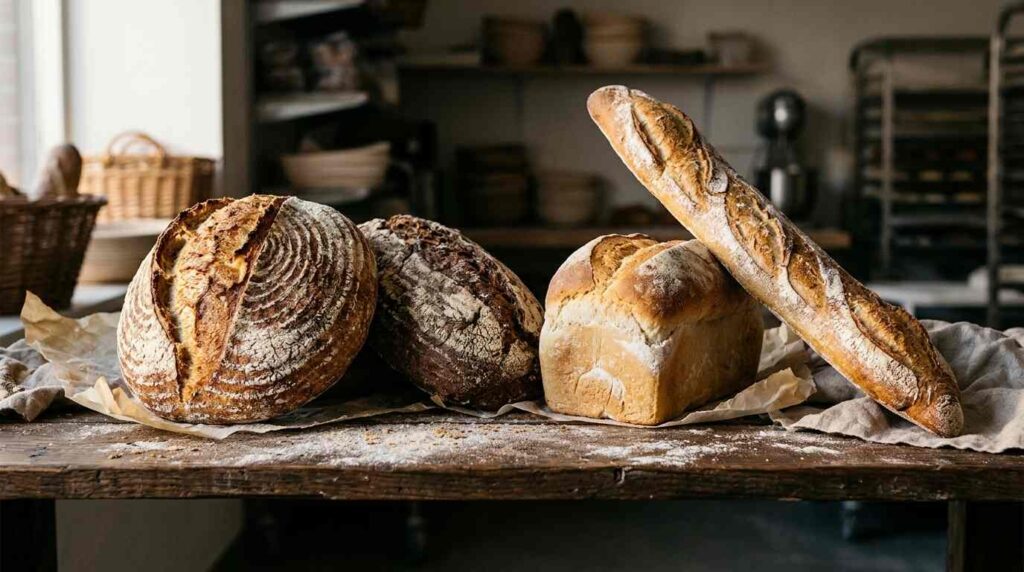
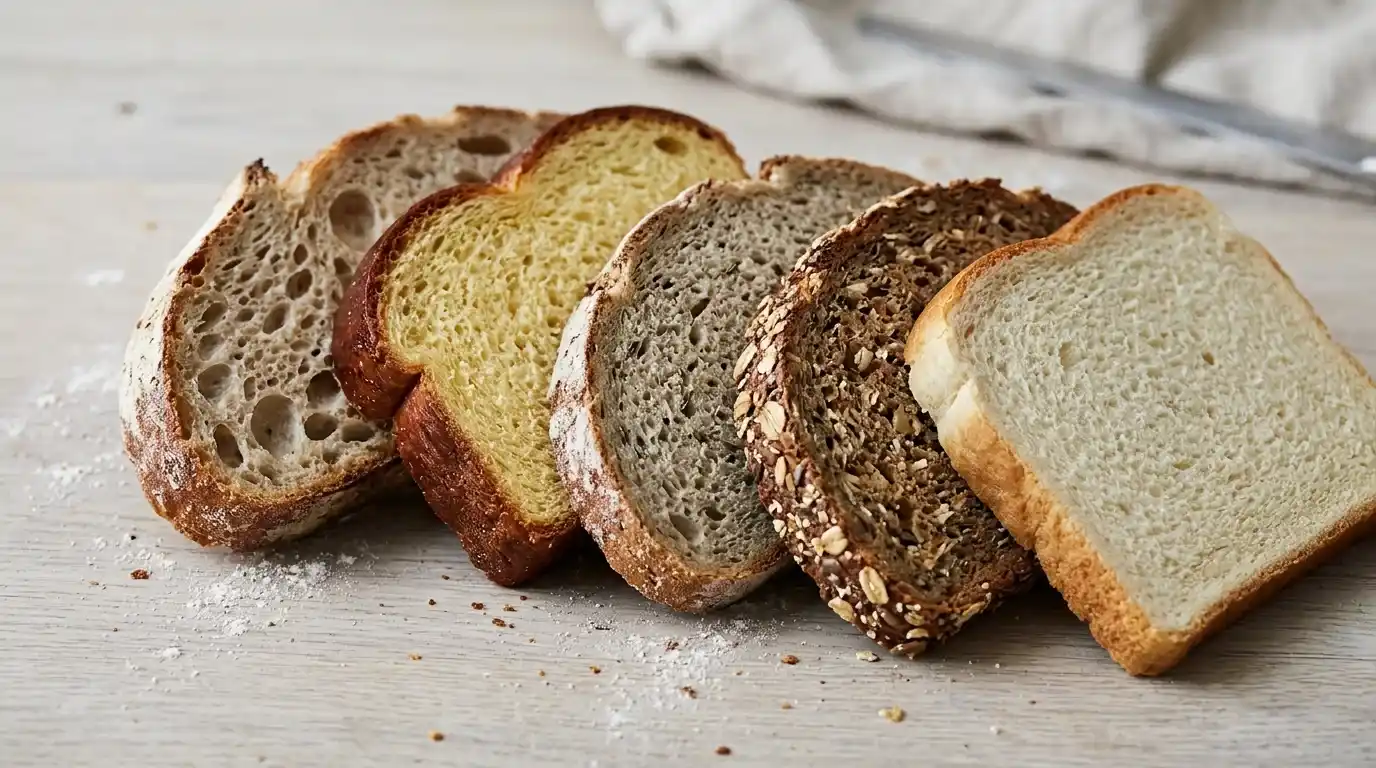
Sourdough is the loaf that several test kitchens and food writers name first, but the reasoning behind the pick says more than the pick itself. Across the sources, the same three properties recur: a sturdy structure, a tight and even crumb, and slices of moderate, consistent thickness. Sourdough, brioche, rye and a plain Pullman loaf can all meet them. Plenty of other breads cannot.
The question splits in two. One half is flavor, where tang, sweetness and nuttiness change how a sandwich tastes against melted cheese. The other half is mechanics: how quickly a slice browns, whether it survives a long sear, and whether the cheese stays inside. The sections below cover the common choices one at a time, then the variables that apply to every loaf.
Sandwich white and Pullman loaves
Plain sliced white bread is the default, and the sources treat it with some reserve. A Food & Wine roundup, republished by Yahoo, describes Pullman bread as a crustier step up from basic white bread that stays soft inside, and suggests pressing extra cheese onto the slices for a crisp, cheesy crust. A separate guide at Foodie calls sliced white the childhood standard, then adds that it may lack the structure to carry rich cheeses.
Soft white bread has a defender in Max Halley, a London sandwich-shop owner and cookbook author. According to The Daily Meal, he prefers it precisely because it can be cut into very thick slices and pressed under a weight while frying, which keeps the result from turning dense and chewy.
The square, even slices of a Pullman loaf solve a practical problem. King Arthur Baking notes that a lidded pain de mie pan produces square slices, so the top of the sandwich needs no patchwork of cheese pieces. Bread sold already sliced has its own history, covered in the account of how sliced bread was invented.
Sourdough
Food Republic gives sourdough its strongest endorsement, saying the loaf ticks every box. The article credits its chew and slight tang, and observes that the sturdy structure stays firm while cooking. Allrecipes reaches the same verdict, naming sourdough its winner because the sturdy slices tolerate a long sear in the pan and the toasted crust adds crunch.
Laura Werlin, speaking to HuffPost UK, prefers store-bought sourdough. Her reasoning is partly about texture, because the bread keeps its shape while softening in the pan, and partly about acidity, since the sourness cuts through the richness of the cheese.
Sourdough comes with two cautions. Food Republic warns that it can turn too crunchy if heated for too long and offers challah as a softer alternative. Foodie adds a note about crust: the sandwich works best when the slices are thin enough that the crust does not scratch the roof of the mouth. A third issue, the open crumb typical of artisan loaves, gets its own section below.
Halley pairs sourdough with mayonnaise rather than egg. Without an egg coating, he says in the same Daily Meal piece, the loaf contributes extra structure to a sandwich that is only heavily coated with mayo.
Brioche, challah and other enriched loaves
Enriched breads brown differently. The Kitchn notes that brioche browns faster because of its eggs and sugar, so the burner should be lowered, and it recommends loaves that slice evenly rather than rolls. Foodie describes brioche as made with butter, eggs and a little sugar, with enough gluten to hold soft cheeses such as brie or camembert, and observes that its sweetness suits caramelized onions or fruit preserves.
Allrecipes points to crumb density as the benefit. Brioche and challah both have a dense crumb that keeps melted cheese in, and both spread easily with butter or mayonnaise. Chowhound lists brioche alongside sourdough in its advice to opt for firm breads.
A test at Tasting Table used Japanese milk bread. Two sandwiches made with the same cheese on a nonstick skillet over medium-low heat were compared, one spread with butter and one with mayonnaise. The details of that comparison appear in the final section, as reported by Tasting Table.
Rye, whole grain and the denser loaves
Rye brings the most pronounced flavor of the common options. Chowhound describes a nutty, earthy note with some maltiness and a tang that balances fatty cheese, and recommends light rye over dark, since dark rye holds more moisture and grills less well. The same article advises medium heat or lower so the bread does not burn before the cheese melts. The Kitchn pairs rye, with its caraway seeds, with mild cheeses such as Swiss, Gruyère or Gouda.
Whole-grain loaves earn a different argument. King Arthur Baking says the oil-rich germ in whole-grain bread turns golden in the pan and helps with even browning, though butter or mayonnaise is still needed for a crisp crust. Lisa Dahl, quoted by HuffPost UK, likes good-quality grainy bread for the extra layer of texture. The Week goes a step further and names whole-wheat sourdough as its preferred loaf.
Darker, denser breads have limits. Foodie says pumpernickel is an option but can overwhelm the gooey cheese filling.
Smaller formats and crusty breads draw the most disagreement. Food & Wine suggests English muffins for very melty cheeses like triple-crème or brie, since the nooks and crannies catch them, and ciabatta cut into thick slices for a filling sandwich. Chowhound advises skipping burger buns, ciabatta and focaccia, which it says lack a sandwich-ready crumb. Both positions are in print, and the sources do not reconcile them.
Slice thickness
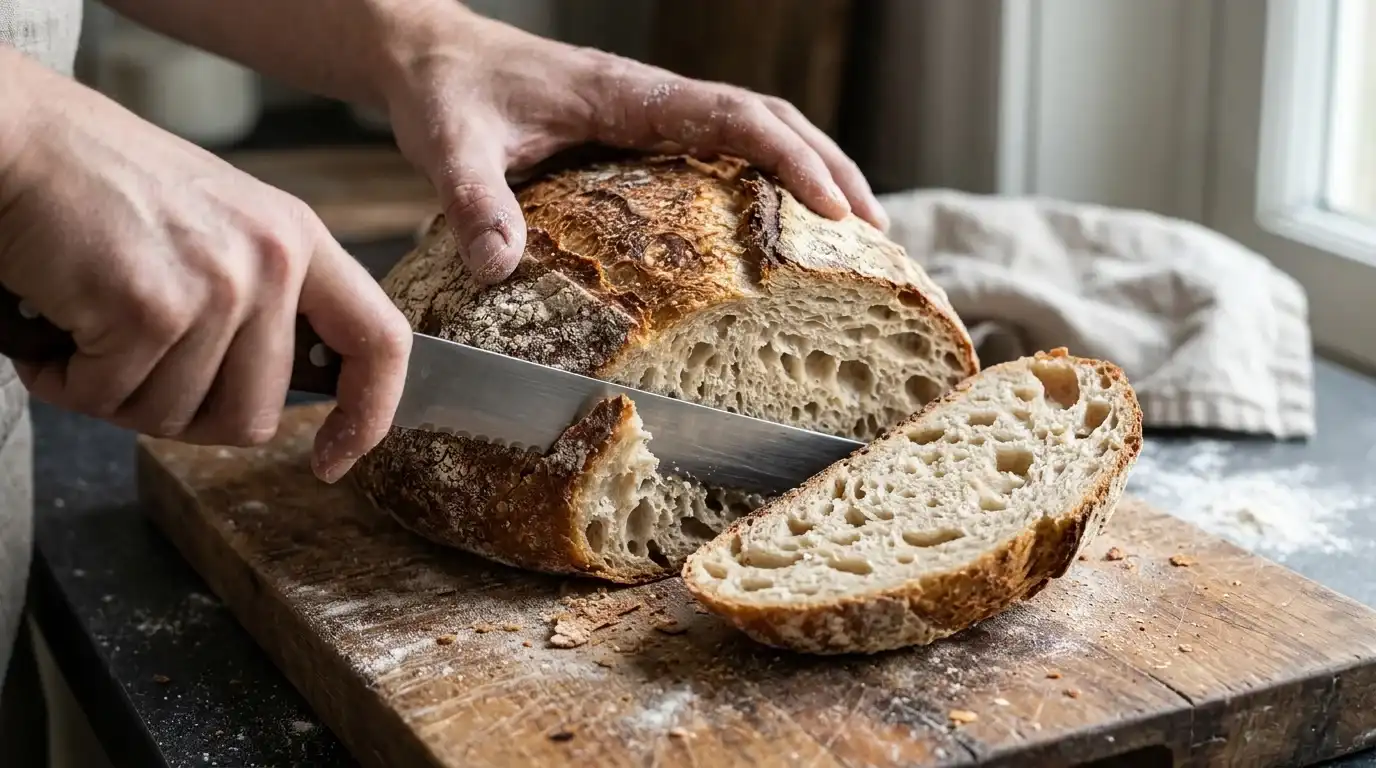
Recommendations for standard sandwich bread land in a narrow band. The Kitchn calls for even slices of medium thickness, about a quarter inch, and explains that an even slice lets the bread contact the pan consistently so the interior can crisp. The Week advises cutting a whole loaf into one-third-inch slices, reporting that thicker slices risk burnt bread over unmelted cheese, while thinner ones let cheese ooze out and leave the bread soaked in grease.
Food Republic puts the same idea in general terms, saying the slices should not be so thick that the cheese fails to melt fully. Foodie pushes in the opposite direction for crusty bread, where thin cuts keep the crust manageable.
Halley’s approach sits outside this band. His thick slices of soft white bread are paired with a weight pressed onto the sandwich as it fries.
The Kitchn recommends pre-sliced bread for its uniformity, and advises anyone cutting a loaf by hand to avoid slices that run too thick.
Crumb structure
Crumb, the pattern of holes inside a loaf, drives two outcomes: whether cheese leaks and how much fat the bread absorbs.
King Arthur Baking calls for a close-grained loaf and, in a separate article, one that doesn’t have too many holes and isn’t too fragile. The reason given is that a close texture keeps cheese from leaking while still taking up some of the melted flavor. The Kitchn is blunter: open crumbs or large holes let cheese run out, and rolls are a poor choice because their dense crust and non-porous interior cannot soak up fat.
Sourdough sits awkwardly in this picture. Allrecipes acknowledges that its open crumb with irregular holes can let cheese drip through, and recommends a country-style loaf with a tighter crumb to limit that. Food Republic reaches a matching conclusion, advising a tightly packed crumb, since bread with many holes may let cheese slide into the pan.
Brioche and challah answer the same problem from the other direction, with a dense crumb that holds the cheese in, according to Allrecipes.
The pull toward a uniform, sliceable, moderately dense loaf shows up in every one of these sources, whatever bread they end up naming.
Butter, mayonnaise and the bread underneath
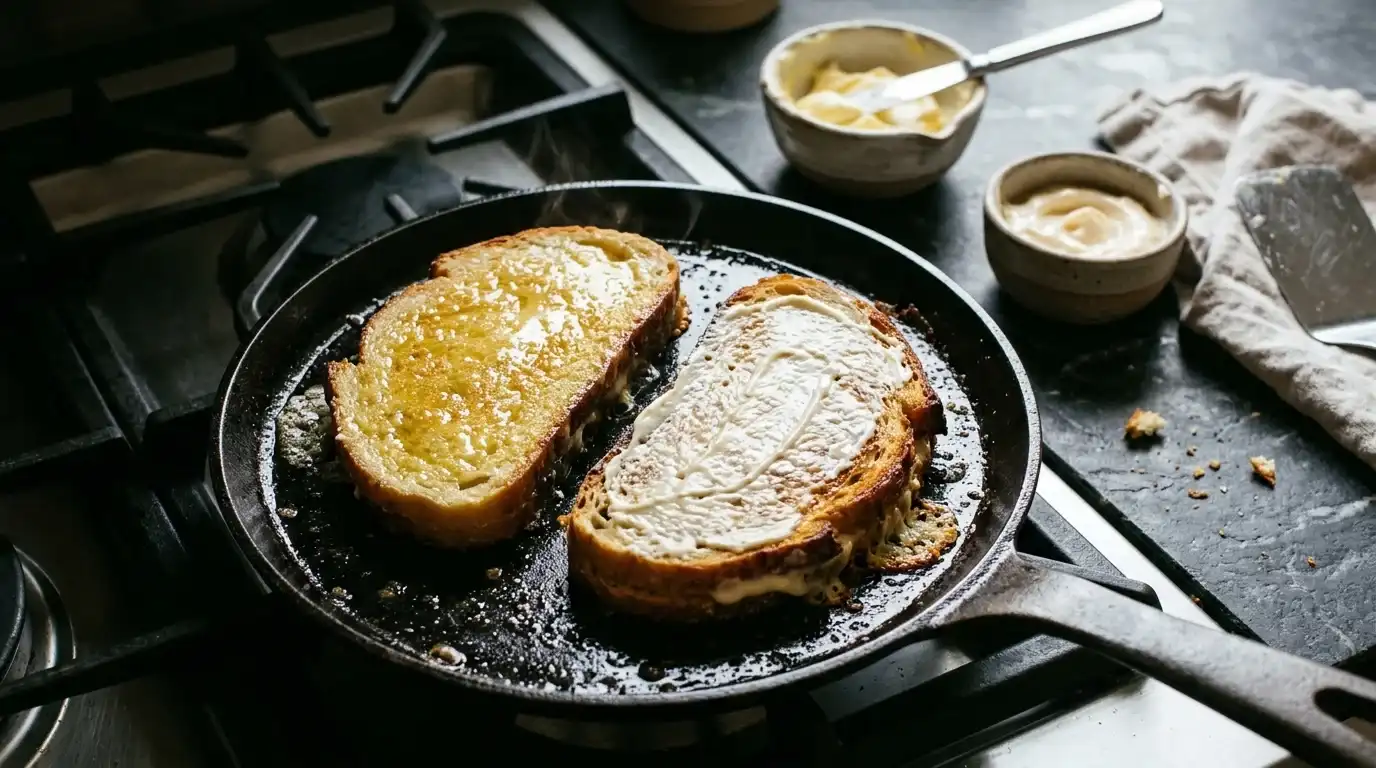
The spread on the outside interacts with whichever loaf is chosen. America’s Test Kitchen found that buttering the exterior of the bread, rather than adding butter to the hot pan, gave the most even browning, and that either butter or mayonnaise works well. Mayonnaise spreads straight from the refrigerator, whereas butter needs to soften first, and its tang is slight but discernible. The same test kitchen warns against light mayonnaise, which leads to spotty browning because of its water content. In a Cook’s Country comparison, extra-virgin olive oil also browned well but tasted too strongly of oil.
Other voices lean toward mayonnaise. The Week says it does not burn, so the crust browns evenly without hot spots. Chowhound credits the oil and egg in mayonnaise for helping bread brown and crisp without scorching, and its rye article points to mayonnaise’s higher smoke point compared with butter. King Arthur Baking suggests a combination of butter and mayonnaise on the outside for a deeper brown.
Not every cook agrees. Werlin favors salted butter at room temperature, spread on the bread rather than melted in the pan. Dahl chooses olive oil for its crispness and buttery flavor without burning. Josh Archibald, also quoted by HuffPost UK, recommends mayonnaise spread generously to the edges for a crouton-like crunch.
The interaction with bread shows most clearly in enriched loaves. Brioche, which The Kitchn says browns faster because of its eggs and sugar, comes with a recommendation for lower heat.
Tasting Table tested the two spreads on milk bread. The team found mayonnaise gave more even browning and needed no advance prep, while tasters preferred the flavor of the butter version, which they described as brown-butter caramelization. The butter reached its smoke point at about the two-minute mark. The mayonnaise never smoked.
Sources:
- The Best Bread For A Crispy Grilled Cheese Sandwich, Food Republic: https://www.foodrepublic.com/1542748/best-bread-crispy-grilled-cheese-sandwich
- Grilled cheese winners, King Arthur Baking: https://www.kingarthurbaking.com/blog/2016/03/28/grilled-cheese-winners
- Grilled cheese, King Arthur Baking: https://www.kingarthurbaking.com/blog/2015/03/19/grilled-cheese?page=3
- The Best-Ever Bread to Use for a Grilled Cheese, The Kitchn: https://www.thekitchn.com/best-bread-for-grilled-cheese-23652537
- How to make the ultimate grilled cheese, The Week: https://theweek.com/articles/442673/how-make-ultimate-grilled-cheese
- The Best Breads To Use For The Perfect Grilled Cheese, The Daily Meal: https://www.thedailymeal.com/1629898/best-breads-grilled-cheese-expert
- The Best Breads To Use When Making Grilled Cheese, Foodie: https://www.foodie.com/1548173/best-breads-grilled-cheese
- The Best Bread for Grilled Cheese, Food & Wine via Yahoo: https://www.yahoo.com/lifestyle/best-bread-grilled-cheese-160401682.html
- Tips for the crispiest grilled cheese sandwiches ever, Chowhound: https://chowhound.com/stories/tips-for-the-crispiest-grilled-cheese-sandwiches-ever
- Grilled cheese bread, rye, Chowhound: https://www.chowhound.com/2281402/grilled-cheese-bread-10x-more-flavorful-when-use-rye/
- This Is the Best Bread for Grilled Cheese, Allrecipes via AOL: https://www.aol.com/best-bread-grilled-cheese-111500484.html
- How To Make The Best Grilled Cheese, According To Actual Chefs, HuffPost UK: https://huffingtonpost.co.uk/entry/how-to-make-the-best-grilled-cheese-according-to-actual-chefs_uk_6582c8abe4b085747d67cab5
- 5 ideas to improve your grilled cheese game, America’s Test Kitchen: https://www.americastestkitchen.com/articles/3068-5-ideas-to-improve-your-grilled-cheese-game
- Is mayonnaise better than butter on grilled cheese, America’s Test Kitchen: https://www.americastestkitchen.com/how_tos/13705-is-mayonnaise-better-than-butter-on-grilled-cheese
- The Mayo Advantage for Grilled Cheese, America’s Test Kitchen: https://www.americastestkitchen.com/how_tos/9570-the-mayo-advantage-for-grilled-cheese
- Should I use butter or mayo on the outside of my grilled cheese, America’s Test Kitchen: https://www.americastestkitchen.com/articles/7184-should-i-use-butter-or-mayo-on-the-outside-of-my-grilled-cheese
- Butter Vs. Mayo, Tasting Table: https://tastingtable.com/1161681/butter-vs-mayo-we-resolve-the-debate-over-which-makes-a-better-grilled-cheese