In this story
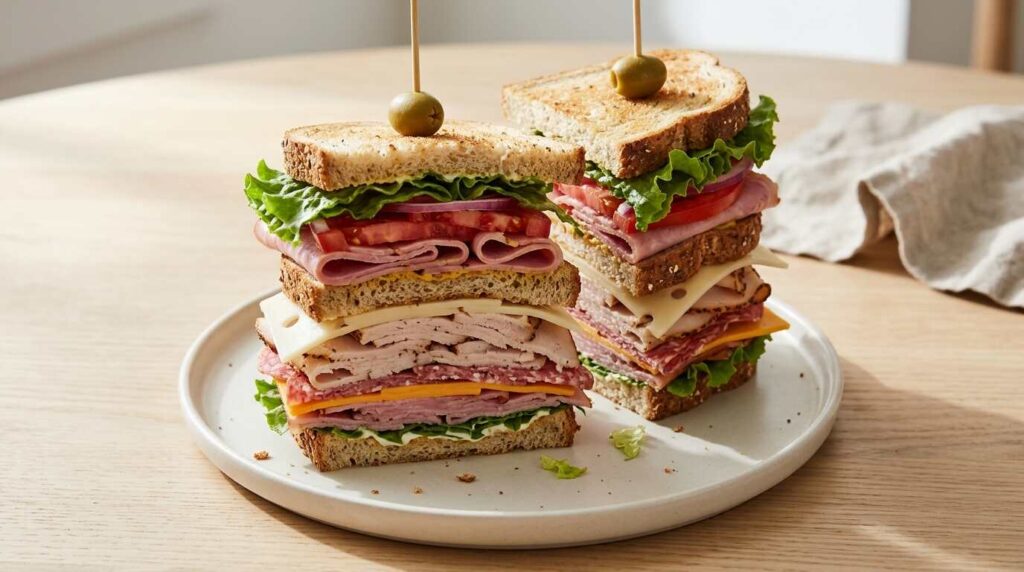
A Dagwood is a tall, many-layered sandwich of meats, cheeses, dressings and condiments, named for Dagwood Bumstead, the husband in Chic Young’s comic strip Blondie. Merriam-Webster traces the word to the character who made such sandwiches in the strip, and Dictionary.com defines it as a thick sandwich filled with a variety of meats, cheeses, dressings and condiments. The word is unusual among sandwich names because it does not describe a recipe. No set ingredients define it, and its history is a trail of newspaper clippings.
Video: Dagwood’s Favorite Sandwich (1947) on Sandwiches of History — from the Sandwiches of History YouTube channel
Dagwood Bumstead and the start of Blondie
A flapper, a wealthy suitor and a strip that began in September 1930
Blondie started on September 8, 1930, per Toonopedia, and Dagwood debuted alongside the title character on that day, according to Wikipedia’s article on the character (cited here as a pointer to the references it lists). Murat Bernard Young, who signed his work Chic Young, was born in Chicago on January 9, 1901, and died in St. Petersburg, Florida, on March 14, 1973, according to Britannica. He had drawn Beautiful Babs and then spent six years on Dumb Dora after moving to New York City in the mid-1920s.
The strip did not begin as a domestic comedy. Toonopedia describes it as a “pretty girl” strip in the style of Young’s earlier work, with Blondie, whose maiden name was Boopadoop, as a flapper and Dagwood as a wealthy suitor. His father, the railroad tycoon J. Bolling Bumstead, disowned him for marrying her, and Dagwood took a job at the Dithers Construction Company to support the family. The marriage took place on February 17, 1933, per the same source.
By the 1960s, Britannica reports, Blondie ran in more than 1,500 newspapers worldwide. Wikipedia’s article on the strip) puts the current figure at more than 2,000 newspapers in 47 countries. After Chic Young’s death in 1973, his son Dean Young took over the strip, and the current Comics Kingdom page lists Dean Young and John Marshall among its creators.
The sandwiches came well after the wedding. An earlier appetite gag came first: Dagwood’s hunger strike ran from January 3 to January 30 of that year, according to R.C. Harvey in The Comics Journal.
The first sandwich in the strip
A 1936 strip, a late-1930s description and two sources that say 1930
The sources give different answers for when the sandwich gag began. The Deseret News reported in 2006 that the sandwich debuted in a 1936 Blondie strip in which Dagwood built a towering sandwich. Wikipedia’s Dagwood sandwich entry attributes the same 1936 date to Dean Young, who says his father began drawing the huge sandwiches that year. On Barry Popik’s etymology page, the earliest dated item is a strip from the New Castle (PA) News of April 16, 1936, shown preparing a sandwich; the caption does not use the phrase “Dagwood sandwich.”
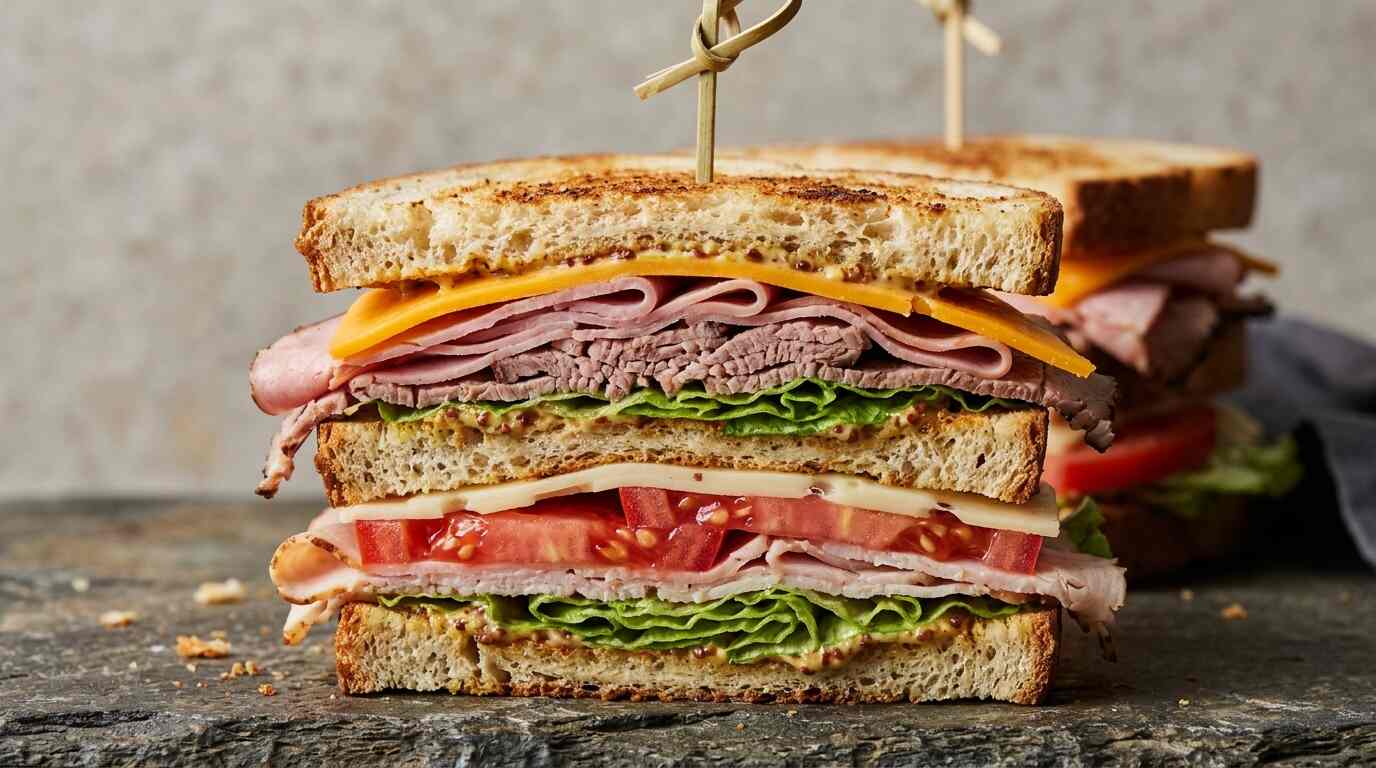
The Oxford Encyclopedia of Food and Drink in America, by Andrew F. Smith (2004), puts it later. In the summary available through Cookbook Digital Library, readers first saw Dagwood in his pajamas raiding the refrigerator and building a sandwich from whatever he found in the late 1930s. Both accounts could describe the same gag at different points in its life.
Two other sources lean earlier. What’s Cooking America lists 1930 as the date the term originated in comic strips of the 1930s, and CulinaryLore dates the origin of the Dagwood style of sandwich to 1930, describing a style, not a specific sandwich. Neither cites a dated strip, and the dated evidence found for this article starts in 1936.
The character appeared on day one in 1930. The sandwich gag has a documented strip in April 1936 and a “late 1930s” description in a reference work, and nothing earlier was found.
How the sandwich became a word
Print citations from 1938 to 1941, and then the dictionaries
Popik’s page collects a chain of dated newspaper uses. On April 27, 1938, the Appleton (WI) Post-Crescent mentioned balancing a “Dagwood sandwich (a little of everything)” with a glass of beer at a party. On April 26, 1939, a Dallas Morning News film review referred to Dagwood’s “ever-present three-decker sandwich.” Within three months, a Hollywood column in the Uniontown (PA) Weekly News Standard of July 11, 1939, reported that a popular eatery had added a “Dagwood” sandwich to its menu. A bar column in Tavern Weekly News on April 8, 1940, used the spelling “Dagwood Bumpstead type of sandwich” for a large sandwich made from whatever is in the icebox. On September 26, 1941, the Trenton (NJ) Evening Times printed an Army slang list that gave “Dagwood” as a sandwich term from the Blondie strip.
Those citations sit alongside the film series that began with Blondie in 1939, starring Penny Singleton and Arthur Lake and running to around 1950, per Toonopedia. The movies gave the character a second audience, though none of the sources consulted ties the wording of the 1938 and 1939 citations to the films.
The dictionaries came after. Wikipedia reports that “Dagwood sandwich” appears in Webster’s New World Dictionary and “Dagwood” in the American Heritage Dictionary. Merriam-Webster’s entry gives the sense “a many-layered sandwich” and the etymology from the strip, without a first-known-use date on the page retrieved. Dictionary.com, similarly, gives no earliest recorded date. The earliest dated use of the term itself in the sources assembled here is therefore 1938, which makes it a floor for the word and not a proven first use.
What goes into a Dagwood
Leftovers, an olive on a toothpick and a 1947 cookbook
In the strip, the contents change from panel to panel. CulinaryLore lists sardines, tongue, baked beans, onions, mustard and horseradish among the original strip’s sandwiches. Food Republic adds a lobster in its shell, a whole fish with its head on and unpeeled carrots with their leaves attached. Mashed describes cold cuts, cheese, vegetables and condiments, with fried eggs, spaghetti and sausages in some strips, and an olive on a toothpick on top. Chic Young reportedly said that towering sandwiches were the one food Dagwood knew how to make, according to Food Republic, and What’s Cooking America records the same remark as Young saying Dagwood could make only a tall stack of mismatched leftovers between two slices of bread.
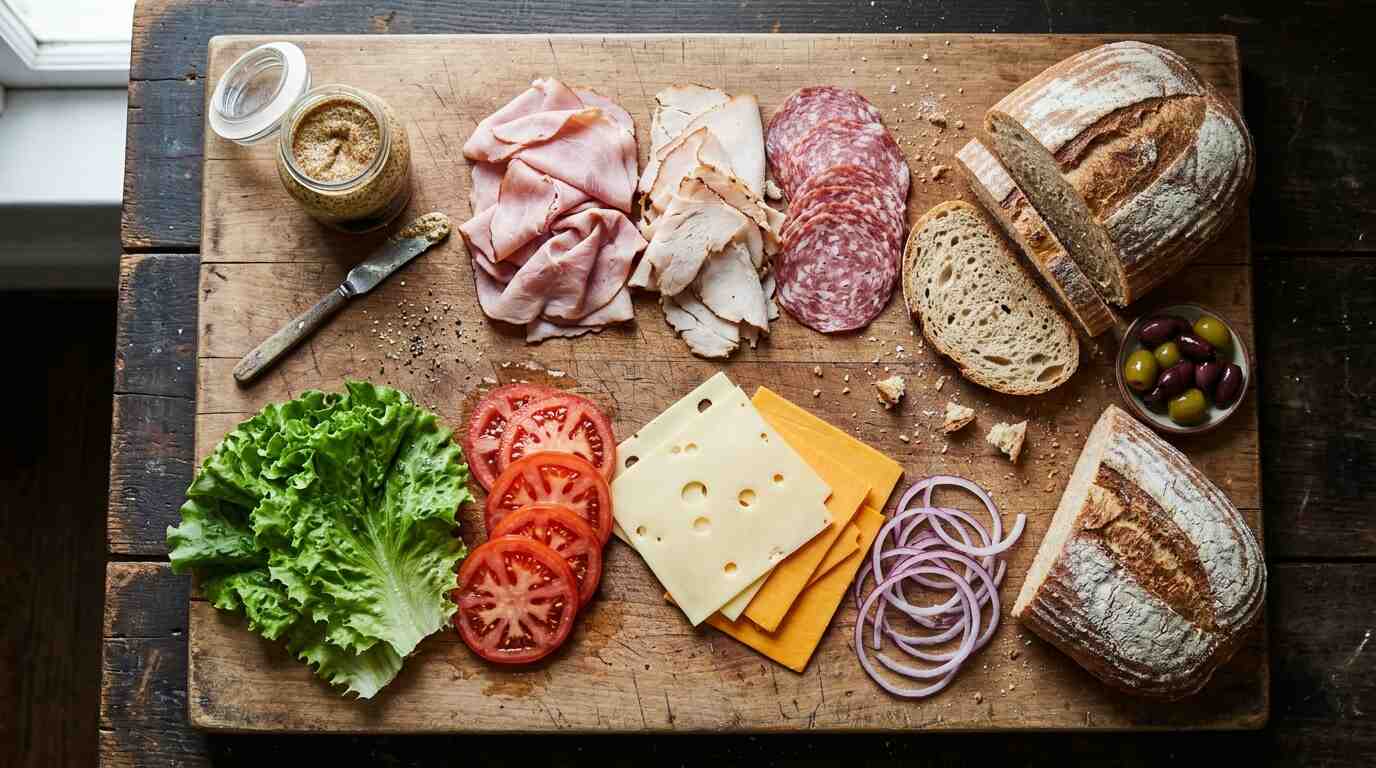
CulinaryLore adds a strip from 1944 in which the sandwich grew so tall that it would not hold together, and Dagwood used an electric drill and a frankfurter as a dowel. That article cites no source for the detail, so it stands as that site’s claim.
In 1947 Young published Blondie’s Cook Book, which, per Food Republic, included a Dagwood recipe calling for cold leftover meats, several cheeses, sardines, anchovies or salmon, cold baked beans, lettuce, tomatoes and onions on buttered bread. The Oxford Encyclopedia summary names the recipe the “Skyscraper Special,” built from combinations such as sardines and baked beans. The YouTube channel Sandwiches of History has two videos with 1947 in their titles on the subject, including the one embedded above.
R.C. Harvey, writing in The Comics Journal, treats the sandwich as the emblem of the strip’s turn from ordinary situations to absurd ones, showing that a humble food can reach “heroic, if lunatic, proportions.” For the strip’s 75th anniversary, the party cake in the September 4, 2005 Sunday strip was a Dagwood sandwich with candles on it, per the same article.
Dagwood, the club sandwich and the deli stack
Where a fictional stack sits among real sandwiches
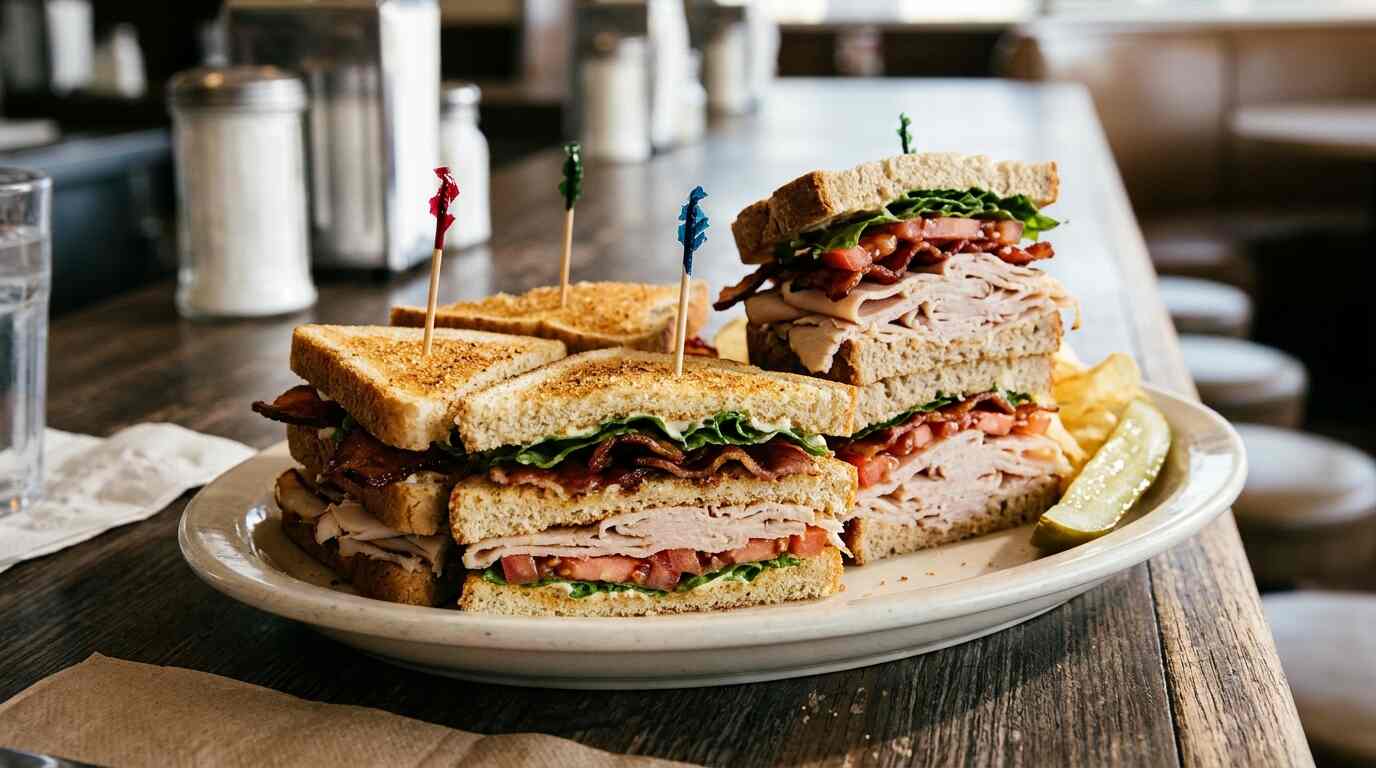
A Dagwood has no recipe, and Food Republic makes the point by contrast: unlike a BLT, a Reuben or a Cubano, it has no set ingredients. Mashed draws the line against the club sandwich, saying a club usually has two layers of filling, typically turkey or chicken, bacon, lettuce and tomato, separated by bread, while a Dagwood is looser and less structured. The BLT, in Food Republic’s contrast, is one of the sandwiches with a fixed list.
The Oxford Encyclopedia summary places the Dagwood in a different company: any large, layered sandwich with several cold cuts, fillings and condiments, similar to a hoagie or sub. The hoagie, sub, hero and grinder is the long-roll family that comparison points toward.
The strip itself has a deli in it. Per the Comics Kingdom page, Blondie is the owner and CEO of Blondie’s Deli and Catering, and Dagwood’s sandwich-making is described there as one of the strip’s central running gags. Whether the deli trade took the word from the strip or arrived at tall stacks on its own is not addressed in any of the sources consulted.
A name on restaurants
From a 1951 licensing dispute to a theme-park counter
Commercial use of the name started early. Wikipedia’s entry reports that in 1951 Bob Weiler and Art Lang opened a Dagwood-themed restaurant in Toledo, Ohio, and that King Features ordered them to stop using the name because it had not been licensed. A Dagwood Diner operated in Ann Arbor, Michigan, until 1971, and Dagwood’s Deli and Sub Shop in Indiana dates from 1985, according to the same entry. Blondie’s restaurant at Universal’s Islands of Adventure opened in May 1999, per Wikipedia’s Blondie article, and Food Republic notes that it sits in Toon Lagoon under a large Dagwood sculpture, with a Dagwood of ham, roast beef, turkey, pimento cheese spread, aged Swiss, special sauce, lettuce, tomato and shaved red onion on an onion poppy seed roll.
The Deseret News reported in May 2006 that Dean Young was co-founding Dagwood’s Sandwich Shoppes, with the first to open in Clearwater, Florida, in August 2006. Young was quoted as saying he had held the idea for 30 or 40 years. The plan called for a real-sized Dagwood weighing about 1.5 pounds on display in stores. By 2011, per Wikipedia and Food Republic, the shops had closed.
Sources
- Merriam-Webster, “Dagwood” — https://www.merriam-webster.com/dictionary/dagwood
- Dictionary.com, “Dagwood sandwich” — https://www.dictionary.com/browse/dagwood-sandwich
- Britannica, “Chic Young” — https://www.britannica.com/biography/Chic-Young
- Toonopedia, “Blondie” — http://www.toonopedia.com/blondie.htm
- R.C. Harvey, “Hare Tonic: Chic’s Blondie,” The Comics Journal — http://www.tcj.com/chics-blondie/
- Comics Kingdom, “Blondie” (about) — https://www.comicskingdom.com/blondie/about
- Deseret News, “Food-loving Dagwood to lend name to real-life sandwich,” May 15, 2006 — https://www.deseret.com/2006/5/15/19953414/food-loving-dagwood-to-lend-name-to-real-life-sandwich/
- Barry Popik, “Dagwood Sandwich” — https://barrypopik.com/blog/dagwood_sandwich
- Andrew F. Smith, Oxford Encyclopedia of Food and Drink in America (2004), “Dagwood Sandwich” entry summary — https://app.ckbk.com/reference/food34962c04s001e001/dagwood-sandwich
- What’s Cooking America, “Dagwood Sandwich History” — https://whatscookingamerica.net/history/sandwiches/dagwoodsandwich.htm
- CulinaryLore, “What Is A Dagwood Sandwich?” — https://culinarylore.com/food-history:what-is-a-dagwood-sandwich/
- Food Republic, “We Can Thank A Comic Strip For The Dagwood Sandwich” — https://www.foodrepublic.com/2079654/dagwood-sandwich-comic-strip-origins/
- Mashed, “The Cartoonish Origins Of The Dagwood Sandwich” — https://www.mashed.com/1364968/origins-cartoon-dagwood-sandwich
- Wikipedia, “Dagwood sandwich” (pointer) — https://en.wikipedia.org/wiki/Dagwood_sandwich
- Wikipedia, “Dagwood Bumstead” (pointer) — https://en.wikipedia.org/wiki/Dagwood_Bumstead
- Wikipedia, “Blondie (comic strip)” (pointer) — https://en.wikipedia.org/wiki/Blondie_(comic_strip)
- Sandwiches of History on YouTube, “Dagwood’s Favorite Sandwich (1947)” — https://www.youtube.com/watch?v=Tcx_716heMw